|
VOOZH | about |
|
VOOZH | about |
These promotions will be applied to this item:
Some promotions may be combined; others are not eligible to be combined with other offers. For details, please see the Terms & Conditions associated with these promotions.
Download the free Kindle app and start reading Kindle books instantly on your smartphone, tablet, or computer - no Kindle device required.
Read instantly on your browser with Kindle for Web.
Using your mobile phone camera - scan the code below and download the Kindle app.
OK
For years, companies have rewarded their most effective engineers with management positions. But treating management as the default path for an engineer with leadership ability doesn't serve the industry well--or the engineer. The staff engineer's path allows engineers to contribute at a high level as role models, driving big projects, determining technical strategy, and raising everyone's skills.
This in-depth book shows you how to understand your role, manage your time, master strategic thinking, and set the standard for technical work. You'll read about how to be a leader without direct authority, how to plan ahead to make the right technical decisions, and how to make everyone around you better, while still growing as an expert in your domain.
By exploring the three pillars of a staff engineer's job, Tanya Reilly, a veteran of the staff engineer track, shows you how to:
Sharing the knowledge of experts
O'Reilly's mission is to change the world by sharing the knowledge of innovators. For over 40 years, we've inspired companies and individuals to do new things (and do them better) by providing the skills and understanding that are necessary for success.
Our customers are hungry to build the innovations that propel the world forward. And we help them do just that.
From the Introduction
Where do you see yourself in five years? The classic interview question is the adult equivalent of “What do you want to be when you grow up?”: it has some socially acceptable answers and a long enough time horizon that you don’t need to commit. But if you’re a senior software engineer looking to keep growing in your career, the question becomes very real. Where do you see yourself going?
You may find yourself at a fork in the road, two distinct paths stretching ahead. On one, you take on direct reports and become a manager. On the other, you become a technical leader without reports, a role often called staff engineer. If you really could see five years ahead on both of these paths, you’d find that they have a lot in common: they lead to many of the same places, and the further you travel, the more you’ll need many of the same skills. But, at the start, they look quite different.
The manager’s path is clear and well traveled. Becoming a manager is a common, and perhaps default, career step for anyone who can communicate clearly, stay calm during a crisis, and help their colleagues do better work. Most likely, you know people who have chosen this path. You’ve probably had managers before, and perhaps you have opinions about what they did right or wrong. Management is a well-studied discipline, too. The words promotion and leadership are often assumed to mean “becoming someone’s boss,” and airport bookshops are full of advice on how to do the job well. So, if you set off down the management path, it won’t be an easy road, but you’ll at least have some idea of what your journey will be like.
The staff engineer’s path is a little less defined. While many companies now allow engineers to keep growing in seniority without taking on reports, this “technical track” is still muddy and poorly signposted. Engineers considering this path may have never worked with a staff engineer before, or might have seen such a narrow set of personalities in the role that it seems like unattainable wizardry. (It’s not. It’s all learnable.) The expectations of the job vary across companies, and, even within a company, the criteria for hiring or promoting staff engineers can be vague and not always actionable.
Often the job doesn’t become clearer once you’re in it. Over the last few years, I’ve spoken with staff engineers across many companies who weren’t quite sure what was expected of them, as well as engineering managers who didn’t know how to work with their staff engineer reports and peers. All of this ambiguity can be a source of stress. If your job’s not defined, how can you know whether you’re doing it well? Or doing it at all?
Even when expectations are clear, the road to achieving them might not be. As a new staff engineer, you might have heard that you’re expected to be a technical leader, make good business decisions, and influence without authority—but how? Where do you start?
This in-depth book shows you how to understand your role, manage your time, master strategic thinking, and set the standard for technical work. You'll read about how to be a leader without direct authority, how to plan ahead to make the right technical decisions, and how to make everyone around you better, while still growing as an expert in your domain.
Exploring the three pillars of a staff engineer's job, Tanya Reilly, a veteran of the staff engineer track, shows you how to:
|
The Engineering Leader
|
Leading Effective Engineering Teams
|
Crafting Engineering Strategy
|
The Engineering Executive's Primer
|
The Manager's Path
|
The Staff Engineer's Path
|
|
|---|---|---|---|---|---|---|
| Customer Reviews |
4.4 out of 5 stars 19
|
3.8 out of 5 stars 52
|
4.5 out of 5 stars 20
|
4.7 out of 5 stars 171
|
4.6 out of 5 stars 3,348
|
4.7 out of 5 stars 890
|
| Price | $24.15$24.15 | $30.98$30.98 | $24.03$24.03 | $24.60$24.60 | $22.13$22.13 | $26.39$26.39 |
| What is it? | A practical guide to becoming a well-rounded, career-minded, and resilient engineering leader. | A research-backed guide to the essential principles, tips, and frameworks for building highly effective engineering teams. | A practical guide to crafting engineering strategy from first principles. | A primer on how to obtain your first executive job and quickly ramp up to meet the challenges you may not have encountered in non-executive roles. | A guide to successfully navigating the different steps involved in transitioning from engineer to manager. | A guide for growing as a technical expert and leader beyond the management track. |
| What you'll learn | How to rethink career goals; tips on self-management; how to create healthy, diverse, and autonomous teams. | What traits relate to engineering effectiveness; how to build trust and accountability within your team; how the most effective engineering teams work. | How to create, test, and refine effective engineering strategies, including with modeling and mapping, with insight from company examples. | How to get an executive job and what to do you in your first 90 days. How to run a planning process, conduct core meetings, create a tech strategy, and manage yourself effectively. | How to manage individuals, teams, multiple teams, and managers. How to be thoughtful about the culture of your engineering team. | How to understand your role, master strategic thinking, drive big projects, and make everyone around you better. |
| Who is this book for? | Managers looking for a model for how to balance personal and team needs. | Technical leaders and managers who want to build effective software engineering teams. | Senior eng. leaders and Staff+ engineers responsible for creating and leading strategy. | Anyone in an engineering executive role, or anyone attempting to reach their first executive role. | New or aspiring managers who need to get situated in their new role and learn, for the first time, how to lead teams. | Staff and principal engineers looking to better understand and grow in their roles. |
| Who else is it for? | Aspiring managers and individual contributors who want a better understanding of how things work. | Individual contributors who want evidence-based guidance to improve their effectiveness. | Engineers at any level wanting to understand and think more deeply about strategy. | Anyone trying to better understand the engineering executive they work with. | Experienced managers looking for guidance on how to deal with common problems in engineering management. | Junior engineers interested in career growth on the individual contributor track. |
Tanya Reilly has over twenty years of experience in software engineering, most recently working on architecture and technical strategy as a Senior Principal Engineer at Squarespace. Previously she was a Staff Engineer at Google, responsible for some of the largest distributed systems on the planet. Tanya writes about technical leadership and software reliability at http://noidea.dog. She's an organizer and host of the LeadDev StaffPlus conference and a frequent conference speaker and keynote. Originally from Ireland, she now lives in Brooklyn with her spouse, kid, and espresso machine.
Customer Reviews, including Product Star Ratings help customers to learn more about the product and decide whether it is the right product for them.
To calculate the overall star rating and percentage breakdown by star, we don’t use a simple average. Instead, our system considers things like how recent a review is and if the reviewer bought the item on Amazon. It also analyzed reviews to verify trustworthiness.
Learn more how customers reviews work on AmazonAlot of people enter software development because they don’t want their primary job task to consist of interacting with people. However, career progressions often define management as the next step after being a senior developer. To those who don’t want to be with people full-time, this hierarchy can make a dead end. In recent years, the pathway of a staff engineer has opened up. Staff engineers are in charge of the technical direction of their team and pushing hard projects foward, but they do not have direct reports. In such a system, managers deal with people issues and do not have to be technical masters themselves. In this book, Tanya Reilly explains in clear words what this position is about to encourage companies to adopt the pathway and individuals to contribute uniquely as individual contributors.
Many times, technical books, even on non-technical topics, aren’t written in conversational tone. Thus, readers can be turned off by a writer’s style instead of ingesting their content. Fortunately, this book is not one of those and is pleasant to read cover to cover. Among other topics, Tanya describes what a staff engineer does, talks about possible political pitfalls, and imagines what career development looks like. The reader leaves the book with a 360-degree picture of what a role as a staff engineer might look like.
Personally, I’m not interested in the staff engineering path. I’m most interested in leading others down that pipeline. This book helped me see how to guide my colleagues towards a fulfilling career that doesn’t involve having direct reports. It certainly met that aim quite well.
Those involved in the later stages of careers developing software should read this book, regardless of their role. It’s the best snapshot of this career trajectory that I’ve read so far. It applies to both future staff developers, who might take the path, as well as managers, who might guide others down it. It can apply to other engineering and technical pathways although it has an admittedly strong bias towards software development. Reilly simply shines a bright beacon on this emerging career direction that can benefit individuals along with businesses significantly in years to come.
According to Sandro Mancuso, there are 4 kinds of books we have read to advance our careers:
1- Technology-specific books are very valuable but they expire.
2- Conceptual books are the books that give us the foundation to advance in our careers.
3- Behavioral books are the books that make us more efficient when working in teams and organizing ourselves.
4- Revolutionary books (some call them classics) are the ones that changed the way we work.
We should favor conceptual and behavioral books for long-term career progression, starting with the revolutionary ones and read technology-specific books for short and medium-term plans.
Tanya's book is a technology-agnostic, conceptual & behavioral book at the same time and to me already revolutionary. It has all the elements to change the way we work as an industry.
I read the early release of this book on O’Reilly back in April and I have been catching up on every new chapter as Tanya wrote them. I have accumulated hundreds of notes and highlights useful not only to Staff Engineers, but to Directors of Engineering like myself and to be honest to any Engineering Leadership role.
Can’t recommend this book strongly enough!
According to Sandro Mancuso, there are 4 kinds of books we have read to advance our careers:
1- Technology-specific books are very valuable but they expire.
2- Conceptual books are the books that give us the foundation to advance in our careers.
3- Behavioral books are the books that make us more efficient when working in teams and organizing ourselves.
4- Revolutionary books (some call them classics) are the ones that changed the way we work.
We should favor conceptual and behavioral books for long-term career progression, starting with the revolutionary ones and read technology-specific books for short and medium-term plans.
Tanya's book is a technology-agnostic, conceptual & behavioral book at the same time and to me already revolutionary. It has all the elements to change the way we work as an industry.
I read the early release of this book on O’Reilly back in April and I have been catching up on every new chapter as Tanya wrote them. I have accumulated hundreds of notes and highlights useful not only to Staff Engineers, but to Directors of Engineering like myself and to be honest to any Engineering Leadership role.
Can’t recommend this book strongly enough!
I ran a book discussion at work with a number of like minded co-workers. Everyone found it extremely valuable. Initially I didn't think lower level engineers would get anything out of it, but now I think developers of all levels should read it. It helped me by providing a framework against which I could evaluate my own position and career goals. We're taking a brief break for the summer, but will return to do a deeper dive on some of the chapters that resonated with us.
The ideologies for building a great career in software were always beneath my tongue. This book help me see my ideas and put them into practice in a more efficient way. It helped me put my career in my own hands against and carries a lot of wisdom for all levels id software engineers.
I was recommended this book from a colleague, and it's very good. I have been in tech professionally for over 10 years, and learned many things from this book - and how to formulate what I already knew even better. 10/10, and i dont even like reading tech books usually!
Very interesting book with a lot of good practical examples. The book covers all aspects of Staff+ (IC) engineering. In addition, it has a lot of excellent references to other articles, blogs, and books. The book doesn't have to be read from beginning to end. You can read chapters in any order.
I recommend reading this book if you are new to the Staff+ path. Even though this book targets Staff+ engineers, there is a lot of wisdom for any level of developers.
I am an SEII and I read this book every morning before my daily standups. I always find relating stories. I am learning a lot for my future self from this book. A must read for anyone who intends to grow.
The content is great if you're starting as a Staff engineer, but does not actually shows the path to go there (as it's on the book The Manager's Path).
The author uses a lot of metaphors that may help or distract the reader trying to land it to the real world.
Some of the advices are the same ones that you find on The Manager's Path, mainly on the softs kills/ people skills.
It's an ok book to read but was expecting a similar structure or consistency with The Manager's Path.
I recommend the Kindle version, the book not use code, and diagrams and images fits on the Kindle screen without a problem.
The book physical state arrives a bit damage (in the corners) but not too much to get it back. The seller should get more attention on the envelope mechanism.
The content is great if you're starting as a Staff engineer, but does not actually shows the path to go there (as it's on the book The Manager's Path).
The author uses a lot of metaphors that may help or distract the reader trying to land it to the real world.
Some of the advices are the same ones that you find on The Manager's Path, mainly on the softs kills/ people skills.
It's an ok book to read but was expecting a similar structure or consistency with The Manager's Path.
I recommend the Kindle version, the book not use code, and diagrams and images fits on the Kindle screen without a problem.
The book physical state arrives a bit damage (in the corners) but not too much to get it back. The seller should get more attention on the envelope mechanism.
Content is valuable but pace is painfully slow. I got the feeling that the volume of the book was artificially inflated. I had to return it.
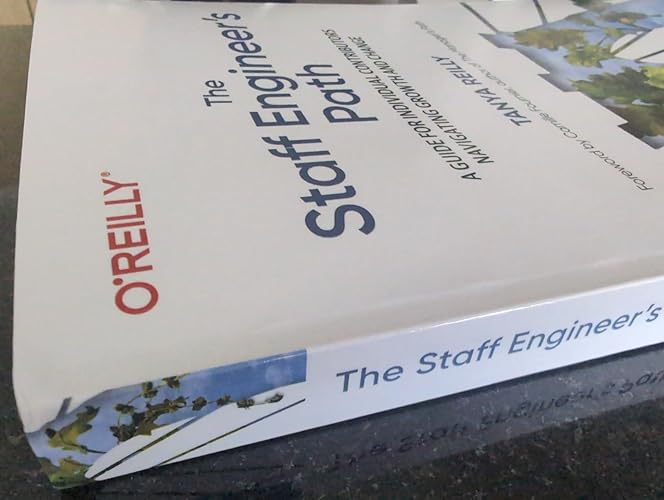
This appears to be a fake item. The printed text is a bit blurry, the pages a little translucent, the cover art is not square, and the (paperback) cover sticks out further than the edges of the pages. Other reviews here have similar complaints.
The book seems interesting, but the experience of reading it won't be as enjoyable as it should be.
Interesante. Quizá está más orientado al mercado laboral americano
Great book
The book goes in-depth about the responsibilities and challenges staff engineers face. It is a good read.