👁 announcement - icon
If you're working on a Spring Security (and especially an OAuth) implementation, definitely have a look at the Learn Spring Security course:
>> LEARN SPRING SECURITY |
VOOZH | about |
Mocking is an essential part of unit testing, and the Mockito library makes it easy to write clean and intuitive unit tests for your Java code.
Get started with mocking and improve your application tests using our Mockito guide:
Handling concurrency in an application can be a tricky process with many potential pitfalls. A solid grasp of the fundamentals will go a long way to help minimize these issues.
Get started with understanding multi-threaded applications with our Java Concurrency guide:
Spring 5 added support for reactive programming with the Spring WebFlux module, which has been improved upon ever since. Get started with the Reactor project basics and reactive programming in Spring Boot:
Since its introduction in Java 8, the Stream API has become a staple of Java development. The basic operations like iterating, filtering, mapping sequences of elements are deceptively simple to use.
But these can also be overused and fall into some common pitfalls.
To get a better understanding on how Streams work and how to combine them with other language features, check out our guide to Java Streams:
Get started with Spring and Spring Boot, through the Learn Spring course:
>> LEARN SPRINGExplore Spring Boot 3 and Spring 6 in-depth through building a full REST API with the framework:
Yes, Spring Security can be complex, from the more advanced functionality within the Core to the deep OAuth support in the framework.
I built the security material as two full courses - Core and OAuth, to get practical with these more complex scenarios. We explore when and how to use each feature and code through it on the backing project.
You can explore the course here:
Spring Data JPA is a great way to handle the complexity of JPA with the powerful simplicity of Spring Boot.
Get started with Spring Data JPA through the guided reference course:
Refactor Java code safely — and automatically — with OpenRewrite.
Refactoring big codebases by hand is slow, risky, and easy to put off. That’s where OpenRewrite comes in. The open-source framework for large-scale, automated code transformations helps teams modernize safely and consistently.
Each month, the creators and maintainers of OpenRewrite at Moderne run live, hands-on training sessions — one for newcomers and one for experienced users. You’ll see how recipes work, how to apply them across projects, and how to modernize code with confidence.
Join the next session, bring your questions, and learn how to automate the kind of work that usually eats your sprint time.
React is a component-based JavaScript library built by Facebook. With React, we can build complex web applications with ease. In this article, we’re going to make Spring Security work together with a React Login page.
We’ll take advantage of the existing Spring Security configurations of previous examples. So, we’ll build on top of a previous article about creating a Form Login with Spring Security.
First, let’s use the command-line tool create-react-app to create an application by executing the command “create-react-app react”.
We’ll have a configuration like the following in react/package.json:
{
 "name": "react",
 "version": "0.1.0",
 "private": true,
 "dependencies": {
 "react": "^16.4.1",
 "react-dom": "^16.4.1",
 "react-scripts": "1.1.4"
 },
 "scripts": {
 "start": "react-scripts start",
 "build": "react-scripts build",
 "test": "react-scripts test --env=jsdom",
 "eject": "react-scripts eject"
 }
}
Then, we’ll use the frontend-maven-plugin to help build our React project with Maven:
<plugin>
 <groupId>com.github.eirslett</groupId>
 <artifactId>frontend-maven-plugin</artifactId>
 <version>1.6</version>
 <configuration>
 <nodeVersion>v8.11.3</nodeVersion>
 <npmVersion>6.1.0</npmVersion>
 <workingDirectory>src/main/webapp/WEB-INF/view/react</workingDirectory>
 </configuration>
 <executions>
 <execution>
 <id>install node and npm</id>
 <goals>
 <goal>install-node-and-npm</goal>
 </goals>
 </execution>
 <execution>
 <id>npm install</id>
 <goals>
 <goal>npm</goal>
 </goals>
 </execution>
 <execution>
 <id>npm run build</id>
 <goals>
 <goal>npm</goal>
 </goals>
 <configuration>
 <arguments>run build</arguments>
 </configuration>
 </execution>
 </executions>
</plugin>
The latest version of the plugin can be found here.
When we run mvn compile, this plugin will download node and npm, install all node module dependencies and build the react project for us.
There are several configuration properties we need to explain here. We specified the versions of node and npm, so that the plugin will know which version to download.
Our React login page will serve as a static page in Spring, so we use “src/main/webapp/WEB-INF/view/react” as npm‘s working directory.
Before we dive into the React components, we update the Spring configuration to serve the static resources of our React app:
@EnableWebMvc
@Configuration
public class MvcConfig extends WebMvcConfigurer {

 @Override
 public void addResourceHandlers(
 ResourceHandlerRegistry registry) {

 registry.addResourceHandler("/static/**")
 .addResourceLocations("/WEB-INF/view/react/build/static/");
 registry.addResourceHandler("/*.js")
 .addResourceLocations("/WEB-INF/view/react/build/");
 registry.addResourceHandler("/*.json")
 .addResourceLocations("/WEB-INF/view/react/build/");
 registry.addResourceHandler("/*.ico")
 .addResourceLocations("/WEB-INF/view/react/build/");
 registry.addResourceHandler("/index.html")
 .addResourceLocations("/WEB-INF/view/react/build/index.html");
 }
}
Note that we add the login page “index.html” as a static resource instead of a dynamically served JSP.
Next, we update the Spring Security configuration to allow access to these static resources.
Instead of using “login.jsp” as we did in the previous form login article, here we use “index.html” as our Login page:
@Configuration
@EnableWebSecurity
@Profile("!https")
public class SecSecurityConfig {

 //...

 @Bean
 public SecurityFilterChain filterChain(HttpSecurity http) throws Exception {
 return http.csrf(csrf -> csrf.csrfTokenRepository(CookieCsrfTokenRepository.withHttpOnlyFalse()))
 .authorizeHttpRequests(request -> request.requestMatchers("/admin/**")
 .hasRole("ADMIN")
 .requestMatchers("/anonymous*")
 .anonymous()
 .requestMatchers(HttpMethod.GET, "/index*", "/static/**", "/*.js", "/*.json", "/*.ico", "/rest")
 .permitAll()
 .anyRequest()
 .authenticated())
 .formLogin(form -> form.loginPage("/index.html")
 .loginProcessingUrl("/perform_login")
 .defaultSuccessUrl("/homepage.html", true)
 .failureUrl("/index.html?error=true"))
 .logout(logout -> logout.logoutUrl("/perform_logout")
 .deleteCookies("JSESSIONID"))
 .build();
 }
}
As we can see from the snippet above, when we post form data to “/perform_login“, Spring will redirect us to “/homepage.html” if the credentials match successfully and to “/index.html?error=true” otherwise.
Now, let’s get our hands dirty on React. We’ll build and manage a form login using components.
Note that we’ll use ES6 (ECMAScript 2015) syntax to build our application.
Let’s start with an Input component that backs the <input /> elements of the login form in react/src/Input.js:
import React, { Component } from 'react'
import PropTypes from 'prop-types'

class Input extends Component {
 constructor(props){
 super(props)
 this.state = {
 value: props.value? props.value : '',
 className: props.className? props.className : '',
 error: false
 }
 }

 //...

 render () {
 const {handleError, ...opts} = this.props
 this.handleError = handleError
 return (
 <input {...opts} value={this.state.value}
 onChange={this.inputChange} className={this.state.className} />
 )
 }
}

Input.propTypes = {
 name: PropTypes.string,
 placeholder: PropTypes.string,
 type: PropTypes.string,
 className: PropTypes.string,
 value: PropTypes.string,
 handleError: PropTypes.func
}

export default Input
As seen above, we wrap the <input /> element into a React controlled component to be able to manage its state and perform field validation.
React provides a way to validate the types using PropTypes. Specifically, we use Input.propTypes = {…} to validate the type of properties passed in by the user.
Note that PropType validation works for development only. PropType validation is to check that all the assumptions that we’re making about our components are being met.
It’s better to have it rather than getting surprised by random hiccups in production.
Next, we’ll build a generic Form component in the file Form.js that combines multiple instances of our Input component on which we can base our login form.
In the Form component, we take attributes of HTML <input/> elements and create Input components from them.
Then the Input components and validation error messages are inserted into the Form:
import React, { Component } from 'react'
import PropTypes from 'prop-types'
import Input from './Input'

class Form extends Component {

 //...

 render() {
 const inputs = this.props.inputs.map(
 ({name, placeholder, type, value, className}, index) => (
 <Input key={index} name={name} placeholder={placeholder} type={type} value={value}
 className={type==='submit'? className : ''} handleError={this.handleError} />
 )
 )
 const errors = this.renderError()
 return (
 <form {...this.props} onSubmit={this.handleSubmit} ref={fm => {this.form=fm}} >
 {inputs}
 {errors}
 </form>
 )
 }
}

Form.propTypes = {
 name: PropTypes.string,
 action: PropTypes.string,
 method: PropTypes.string,
 inputs: PropTypes.array,
 error: PropTypes.string
}

export default Form
Now let’s take a look at how we manage field validation errors and login error:
class Form extends Component {

 constructor(props) {
 super(props)
 if(props.error) {
 this.state = {
 failure: 'wrong username or password!',
 errcount: 0
 }
 } else {
 this.state = { errcount: 0 }
 }
 }

 handleError = (field, errmsg) => {
 if(!field) return

 if(errmsg) {
 this.setState((prevState) => ({
 failure: '',
 errcount: prevState.errcount + 1,
 errmsgs: {...prevState.errmsgs, [field]: errmsg}
 }))
 } else {
 this.setState((prevState) => ({
 failure: '',
 errcount: prevState.errcount===1? 0 : prevState.errcount-1,
 errmsgs: {...prevState.errmsgs, [field]: ''}
 }))
 }
 }

 renderError = () => {
 if(this.state.errcount || this.state.failure) {
 const errmsg = this.state.failure
 || Object.values(this.state.errmsgs).find(v=>v)
 return <div className="error">{errmsg}</div>
 }
 }

 //...

}
In this snippet, we define the handleError function to manage the error state of the form. Recall that we also used it for Input field validation. Actually, handleError() is passed to the Input Components as a callback in the render() function.
We use renderError() to construct the error message element. Note that Form’s constructor consumes an error property. This property indicates if the login action fails.
Then comes the form submission handler:
class Form extends Component {

 //...

 handleSubmit = (event) => {
 event.preventDefault()
 if(!this.state.errcount) {
 const data = new FormData(this.form)
 fetch(this.form.action, {
 method: this.form.method,
 body: new URLSearchParams(data)
 })
 .then(v => {
 if(v.redirected) window.location = v.url
 })
 .catch(e => console.warn(e))
 }
 }
}
We wrap all form fields into FormData and send it to the server using the fetch API.
Let’s not forget our login form comes with a successUrl and failureUrl, meaning that no matter if the request is successful or not, the response would require a redirection.
That’s why we need to handle redirection in the response callback.
Now that we’ve set up all the components we need, we can continue to put them in the DOM. The basic HTML structure is as follows (find it under react/public/index.html):
<!DOCTYPE html>
<html lang="en">
 <head>
 <!-- ... -->
 </head>
 <body>

 <div id="root">
 <div id="container"></div>
 </div>

 </body>
</html>
Finally, we’ll render the Form into the <div/> with id “container” in react/src/index.js:
import React from 'react'
import ReactDOM from 'react-dom'
import './index.css'
import Form from './Form'

const inputs = [{
 name: "username",
 placeholder: "username",
 type: "text"
},{
 name: "password",
 placeholder: "password",
 type: "password"
},{
 type: "submit",
 value: "Submit",
 className: "btn"
}]

const props = {
 name: 'loginForm',
 method: 'POST',
 action: '/perform_login',
 inputs: inputs
}

const params = new URLSearchParams(window.location.search)

ReactDOM.render(
 <Form {...props} error={params.get('error')} />,
 document.getElementById('container'))
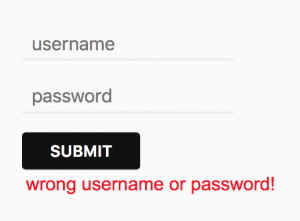
So our form now contains two input fields: username and password, and a submit button.
Here we pass an additional error attribute to the Form component because we want to handle login error after redirection to the failure URL: /index.html?error=true.
👁 form login errorNow we’ve finished building a Spring Security login application using React. The last thing we need to do is to run mvn compile.
During the process, the Maven plugin will help build our React application and gather the build result in src/main/webapp/WEB-INF/view/react/build.
In this article, we’ve covered how to build a React login app and let it interact with a Spring Security backend. A more complex application would involve state transition and routing using React Router or Redux, but that’d be beyond the scope of this article.
Baeldung Pro comes with both absolutely No-Ads as well as finally with Dark Mode, for a clean learning experience:
Once the early-adopter seats are all used, the price will go up and stay at $33/year.
The Apache HTTP Client is a very robust library, suitable for both simple and advanced use cases when testing HTTP endpoints. Check out our guide covering basic request and response handling, as well as security, cookies, timeouts, and more:
Handling concurrency in an application can be a tricky process with many potential pitfalls. A solid grasp of the fundamentals will go a long way to help minimize these issues.
Get started with understanding multi-threaded applications with our Java Concurrency guide:
Since its introduction in Java 8, the Stream API has become a staple of Java development. The basic operations like iterating, filtering, mapping sequences of elements are deceptively simple to use.
But these can also be overused and fall into some common pitfalls.
To get a better understanding on how Streams work and how to combine them with other language features, check out our guide to Java Streams:
Get started with Spring Boot and with core Spring, through the Learn Spring course:
Modern Java teams move fast — but codebases don’t always keep up. Frameworks change, dependencies drift, and tech debt builds until it starts to drag on delivery. OpenRewrite was built to fix that: an open-source refactoring engine that automates repetitive code changes while keeping developer intent intact.
The monthly training series, led by the creators and maintainers of OpenRewrite at Moderne, walks through real-world migrations and modernization patterns. Whether you’re new to recipes or ready to write your own, you’ll learn practical ways to refactor safely and at scale.
If you’ve ever wished refactoring felt as natural — and as fast — as writing code, this is a good place to start.