

Data Visualization with Advanced Excel
Keep adding new skills with 10,000+ programs for $239 (usually $399). Save now.

Data Visualization with Advanced Excel
This course is part of Data Analysis and Presentation Skills: the PwC Approach Specialization

Instructor: Alex Mannella
110,956 already enrolled
Ask Coursera
3,006 reviews
3,006 reviews
Skills you'll gain
Tools you'll learn
Details to know

See how employees at top companies are mastering in-demand skills

Build your subject-matter expertise
- Learn new concepts from industry experts
- Gain a foundational understanding of a subject or tool
- Develop job-relevant skills with hands-on projects
- Earn a shareable career certificate

There are 4 modules in this course
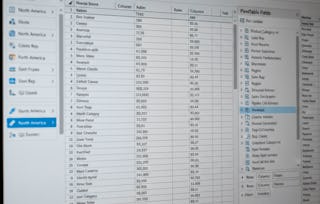
In this course, you will get hands-on instruction of advanced Excel 2013 functions. You’ll learn to use PowerPivot to build databases and data models. We’ll show you how to perform different types of scenario and simulation analysis and you’ll have an opportunity to practice these skills by leveraging some of Excel's built in tools including, solver, data tables, scenario manager and goal seek. In the second half of the course, will cover how to visualize data, tell a story and explore data by reviewing core principles of data visualization and dashboarding. You’ll use Excel to build complex graphs and Power View reports and then start to combine them into dynamic dashboards.
Note: Learners will need PowerPivot to complete some of the exercises. Please use MS Excel 2013 version. If you have other MS Excel versions or a MAC you might not be able to complete all assignments. This course was created by PricewaterhouseCoopers LLP with an address at 300 Madison Avenue, New York, New York, 10017.
During this first week, you are going to learn about the development of data models and databases. We will cover the components of data sets and the relational database models, database keys, relationships, and joins. We will also look at a tool called PowerPivot that is used to import and prepare data to build relational models, as well as visualize data. By the end of the week, you will have a working knowledge of how to develop a data model. Be sure to complete lessons in the order in which they are sequenced in the course.
What's included
16 videos4 readings1 assignment1 discussion prompt
16 videos•Total 87 minutes
- Welcome to Course 3•3 minutes
- Introduction to the Scenarios Used in this Course•4 minutes
- Tao of Excel Recap and Guiding Principles•6 minutes
- The Power of Visualization•4 minutes
- Introduction to Working with Data Sets•3 minutes
- Introduction to the Components of Data Sets and the Relational Database Model•4 minutes
- Introduction to Keys and Forming Data Tables•9 minutes
- Introduction to Joins•6 minutes
- Overview of SQL and Other Database Tools•2 minutes
- A Message from our Chief People Officer at PwC•1 minute
- PowerPivot: Importing and Preparing Data•3 minutes
- Linking Data Tables and Building the Relational Model•10 minutes
- Using PowerPivot to Visualize Data•9 minutes
- Calculated Fields•12 minutes
- Multiple Data Tables and Filters•11 minutes
- Week 1 closing•2 minutes
4 readings•Total 105 minutes
- Course Overview and Syllabus•10 minutes
- Meet the PwC Instructors and Content Developers•10 minutes
- Guiding Principles Handout•10 minutes
- Week 1 Excel Student Exercise Workbook•75 minutes
1 assignment•Total 20 minutes
- Week 1 Quiz•20 minutes
1 discussion prompt•Total 10 minutes
- Meet Your Classmates•10 minutes
This week, we are going to explore three different analytical methods used to help model different scenarios and deal with variable uncertainty. These methods are scenario analysis, sensitivity analysis and simulation. We’ll look at what each method is and then go deeper into why and how you use each. Following some guided demonstration, you’ll be given a chance to practice in an Excel workbook and demonstrate what you’ve learned.
What's included
9 videos1 reading1 assignment
9 videos•Total 65 minutes
- Introduction to Week 2•4 minutes
- Advanced Scenario Analysis•9 minutes
- Goal Seek•7 minutes
- Scenario Manager•9 minutes
- One-way Data Tables•4 minutes
- Two-way Data Tables•4 minutes
- Simulations•14 minutes
- Solver•12 minutes
- Week 2 Closing•2 minutes
1 reading•Total 120 minutes
- Week 2 Excel Student Exercise Workbook•120 minutes
1 assignment•Total 30 minutes
- Week 2 Quiz•30 minutes
This week we are going to focus on data visualization. We will start off by discussing data visualization basics, outlining the theory and concepts behind data visualization. We will also discuss how to enable effective story telling through the correct selection, creation, and presentation of tables and charts. You’ll get a chance to learn how to create detailed graphs and charts to effectively tell a story about your data.
What's included
12 videos1 reading1 assignment
12 videos•Total 93 minutes
- Week 3 Opening•3 minutes
- Introduction to Data Visualization•7 minutes
- Effective and Ineffective Charting•8 minutes
- Selecting the Right Type of Chart•2 minutes
- Introduction to Chart Navigation•9 minutes
- Column Chart•7 minutes
- Combo Chart•10 minutes
- Stacked Column Chart•10 minutes
- Heatmap•14 minutes
- Gantt Project Plan•12 minutes
- Power View•8 minutes
- Week 3 closing•2 minutes
1 reading•Total 120 minutes
- Week 3 Excel Student Exercise Workbook•120 minutes
1 assignment•Total 30 minutes
- Week 3 Quiz•30 minutes
In the final week of this course, you are going to learn how to create a dynamic dashboard. We are going to discuss how to establish a good understanding of your audience and how to collect key requirements in order to determine what type of dashboard to build. We will talk about some guiding design principles and things to consider when building a dashboard. You’ll have a chance to practice everything you learn this week by creating your own functional dashboard in Excel.
What's included
8 videos2 readings1 assignment
8 videos•Total 72 minutes
- Introduction to Week 4•2 minutes
- Introduction to Dashboarding•3 minutes
- Dashboarding: Beyond the basics•9 minutes
- Form Controls and Grouping•15 minutes
- Slicers and PowerPivot•11 minutes
- Conditional Formatting and KPIs•18 minutes
- Dashboard Finalization and Securing the Workbook•11 minutes
- Week 4 Closing and Course Recap•3 minutes
2 readings•Total 130 minutes
- Week 4 Excel Student Exercise Workbooks•120 minutes
- Learn More About Career Opportunities at PwC•10 minutes
1 assignment•Total 30 minutes
- Week 4 Quiz•30 minutes
Earn a career certificate
Add this credential to your LinkedIn profile, resume, or CV. Share it on social media and in your performance review.
Instructor

Explore more from Data Analysis
- Status: Free Trial
Course
- Status: Free Trial
Course
- Status: Free TrialM
Macquarie University
Course
- Status: Free TrialM
Macquarie University
Specialization



Why people choose Coursera for their career


Learner reviews
- 5 stars
80.40%
- 4 stars
16.63%
- 3 stars
1.96%
- 2 stars
0.53%
- 1 star
0.46%
Showing 3 of 3006
Reviewed on Jun 30, 2020
Great course with the detailed samples. There is one quiz question (the one asks about the highest monthly sales revenue) from week 4 quiz need to be updated. It doesn't belong to week 4 content.
Reviewed on May 28, 2020
Coursera gives me a platform to explore my new skills. I was able to experience education from world-renowned universities without losing out on career opportunities. Thanks to Coursera!
Reviewed on Mar 22, 2019
This course took me from Basic level knowledge of Excel to a really advanced level. Course practice exercises are developed in a very appropriate way to teach the advanced level.




Frequently asked questions
To access the course materials, assignments and to earn a Certificate, you will need to purchase the Certificate experience when you enroll in a course. You can try a Free Trial instead, or apply for Financial Aid. The course may offer 'Full Course, No Certificate' instead. This option lets you see all course materials, submit required assessments, and get a final grade. This also means that you will not be able to purchase a Certificate experience.
When you enroll in the course, you get access to all of the courses in the Specialization, and you earn a certificate when you complete the work. Your electronic Certificate will be added to your Accomplishments page - from there, you can print your Certificate or add it to your LinkedIn profile.
Yes. In select learning programs, you can apply for financial aid or a scholarship if you can’t afford the enrollment fee. If fin aid or scholarship is available for your learning program selection, you’ll find a link to apply on the description page.
More questions
Financial aid available,