

Capstone Project: Advanced AI for Drug Discovery
Keep adding new skills with 10,000+ programs for $239 (usually $399). Save now.
Capstone Project: Advanced AI for Drug Discovery
This course is part of AI for Scientific Research Specialization

Instructor: LearnQuest Network
6,615 already enrolled
Included with
Ask Coursera
Recommended experience
Recommended experience
What you'll learn
Analyzing genome sequences to find similarities and identify target subsequences using predctive models.
Skills you'll gain
- Machine Learning Methods
- Model Training
- Predictive Modeling
- Unsupervised Learning
- Dimensionality Reduction
- Model Evaluation
- Feature Engineering
- Data Manipulation
- Bioinformatics
- Molecular Biology
- Data Preprocessing
- Medical Science and Research
- Molecular, Cellular, and Microbiology
- Artificial Neural Networks
- Predictive Analytics
- Machine Learning
- Applied Machine Learning
- Scientific Visualization
- Drug Development
Tools you'll learn
Details to know

See how employees at top companies are mastering in-demand skills

Build your subject-matter expertise
- Learn new concepts from industry experts
- Gain a foundational understanding of a subject or tool
- Develop job-relevant skills with hands-on projects
- Earn a shareable career certificate

There are 4 modules in this course
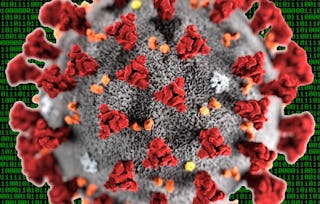
In this capstone project course, we'll compare genome sequences of COVID-19 mutations to identify potential areas a drug therapy can look to target. The first step in drug discovery involves identifying target subsequences of theirs genome to target. We'll start by comparing the genomes of virus mutations to look for similarities. Then, we'll perform PCA to cut down our number of dimensions and identify the most common features. Next, we'll use K-means clustering in Python to find the optimal number of groups and trace the lineage of the virus. Finally, we'll predict similarity between the sequences and use this to pick a target subsequence. Throughout the course, each section will consist of a programming assignment coupled with a guide video and helpful hints. By the end, you'll be well on your way to discovering ways to combat disease with genome sequencing.
In this module, we'll start to get familiar with our dataset by performing some basic EDA and comparing genome sequences. By analyzing the mutations of the COVID-19 virus, we'll be able to identify some common properties of the genome that our drug should look to target.
What's included
4 videos1 programming assignment1 discussion prompt1 ungraded lab
4 videos•Total 7 minutes
- Welcome to the Course!•1 minute
- Setting Up the Environment•2 minutes
- Module Intro•1 minute
- Introduction to Part I•3 minutes
1 programming assignment•Total 150 minutes
- Part I: Comparing Genome Sequences•150 minutes
1 discussion prompt•Total 10 minutes
- Welcome to the Course!•10 minutes
1 ungraded lab•Total 10 minutes
- Programming Assignment Solutions: Part I: Comparing Genome Sequences•10 minutes
In this module, we'll continue to work with out genome sequence data - using PCA to identify groups and delicate the most important features. After reducing the number of dimensions in the dataset, we'll be able to use K-means to form clusters and visualize the different areas in 2-D space.
What's included
2 videos1 reading1 programming assignment1 ungraded lab
2 videos•Total 3 minutes
- Module Intro•1 minute
- Introduction to Part II•2 minutes
1 reading•Total 10 minutes
- Other Functions of PCA•10 minutes
1 programming assignment•Total 150 minutes
- Part II: PCA•150 minutes
1 ungraded lab•Total 10 minutes
- Programming Assigment Solutions: Part II: PCA•10 minutes
In this module, we'll cluster the genome sequences using the K-means algorithm. We'll optimize the number of clusters by comparing silhouette scores across a wide variety of inputs to identify the greatest drop-off. Finally, we'll set ourselves up to using prediction pipelines to predict bit scores and drug therapies in the last module.
What's included
2 videos1 programming assignment1 discussion prompt1 ungraded lab
2 videos•Total 2 minutes
- Module Intro•1 minute
- Introduction to Part III•2 minutes
1 programming assignment•Total 180 minutes
- Part III: K-Means Clustering•180 minutes
1 discussion prompt•Total 10 minutes
- Clustering•10 minutes
1 ungraded lab•Total 10 minutes
- Programming Assigment Solutions: Part III: K-Means Clustering•10 minutes
In this module, we'll test a variety of regressors to see which one performs best in predicting bit scores for each genome sequence. Then, we'll use our chosen model to find the genome equines that are most closely related and trace out a possible subsequence to target with a combative drug.
What's included
2 videos1 programming assignment1 ungraded lab
2 videos•Total 3 minutes
- Module Intro•1 minute
- Introduction to Part IV•2 minutes
1 programming assignment•Total 180 minutes
- Part IV: Neural Network Predictors•180 minutes
1 ungraded lab•Total 10 minutes
- Programming Assigment Solutions: Part IV: Neural Network Predictors•10 minutes
Earn a career certificate
Add this credential to your LinkedIn profile, resume, or CV. Share it on social media and in your performance review.
Instructor
Offered by

Explore more from Machine Learning
- Status: Free TrialU
University of Glasgow
Course
- Status: Free TrialN
Novartis
Course
- Status: Free TrialU
University of California San Diego
Course
- Status: PreviewA
AI CERTs
Course

Why people choose Coursera for their career






Frequently asked questions
To access the course materials, assignments and to earn a Certificate, you will need to purchase the Certificate experience when you enroll in a course. You can try a Free Trial instead, or apply for Financial Aid. The course may offer 'Full Course, No Certificate' instead. This option lets you see all course materials, submit required assessments, and get a final grade. This also means that you will not be able to purchase a Certificate experience.
When you enroll in the course, you get access to all of the courses in the Specialization, and you earn a certificate when you complete the work. Your electronic Certificate will be added to your Accomplishments page - from there, you can print your Certificate or add it to your LinkedIn profile.
Yes. In select learning programs, you can apply for financial aid or a scholarship if you can’t afford the enrollment fee. If fin aid or scholarship is available for your learning program selection, you’ll find a link to apply on the description page.
More questions
Financial aid available,