

Analyze & Evaluate Bank Branch Audit Practices
Ends soon! Keep adding new skills with 10,000+ programs for $239 (usually $399). Save now.

Analyze & Evaluate Bank Branch Audit Practices
This course is part of Complete Bank Branch Audit & Risk Management Specialization

Included with
What you'll learn
Analyze bank branch audit procedures, NPAs, and credit appraisal processes.
Evaluate compliance, KYC norms, and internal control systems.
Apply audit techniques to assess operational and financial risks.
Skills you'll gain
- Credit Risk
- Cash Handling
- Internal Controls
- Internal Auditing
- Commercial Lending
- Cash Control
- Financial Auditing
- Auditing
- Banking
- Finance
- Commercial Banking
- Bank Regulations
- Cash Management
- Business
- Compliance Auditing
- Financial Controls
- Generally Accepted Auditing Standards
- Regulation and Legal Compliance
- Audit Planning
Tools you'll learn
Details to know

April 2026
16 assignments
See how employees at top companies are mastering in-demand skills

Build your subject-matter expertise
- Learn new concepts from industry experts
- Gain a foundational understanding of a subject or tool
- Develop job-relevant skills with hands-on projects
- Earn a shareable career certificate

There are 4 modules in this course
Learners will analyze bank branch audit procedures, evaluate asset classification and provisioning norms, assess credit appraisal and post-sanction compliance, and apply regulatory and operational controls in real-world banking scenarios. This course provides a structured and practical understanding of bank branch auditing, covering advances management, prudential norms, concurrent audit systems, KYC compliance, and operational housekeeping controls.
By completing this course, learners will strengthen their ability to identify non-performing assets (NPAs), interpret restructuring guidelines, examine risk-based audit planning, and evaluate internal control systems within bank branches. The course bridges regulatory theory with applied audit practice, enabling professionals to confidently review loan documentation, deposits, cash operations, and sensitive custody procedures. What makes this course unique is its comprehensive coverage of both financial and operational audit areas within a bank branch environment. It integrates regulatory compliance, fraud prevention mechanisms, and concurrent audit techniques into a cohesive learning pathway, equipping learners with job-ready auditing competencies aligned with modern banking standards.
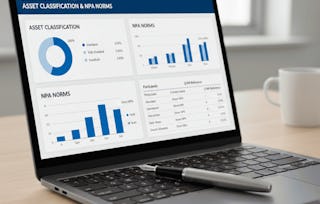
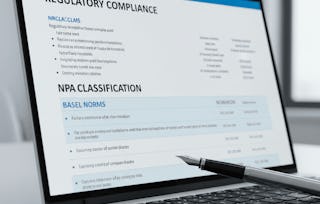
This module introduces the core concepts of bank branch audit, covering the evolving regulatory landscape, prudential norms, and asset classification framework. It explains how non-performing assets (NPAs), provisioning requirements, and restructuring guidelines influence audit procedures. Learners develop foundational knowledge required to understand advances, compliance expectations, and risk-based audit approaches in modern banking environments.
What's included
9 videos4 assignments
9 videos•Total 70 minutes
- Introduction to Branch Banking Audit•2 minutes
- Role of Banks•12 minutes
- Future of Bank Branch Audits•13 minutes
- Asset Classification•7 minutes
- Guidelines for Classification of Assets•6 minutes
- Upgrading Loan Accounts classified as NPAs•6 minutes
- Understanding Advances•6 minutes
- Prudential Norms•7 minutes
- General principles & prudential norms for restructured advances•11 minutes
4 assignments•Total 60 minutes
- Introduction to Branch Banking & Audit Evolution•10 minutes
- Asset Classification Framework•10 minutes
- Advances & Prudential Norms•10 minutes
- Graded - Foundations of Bank Branch Auditing•30 minutes
This module focuses on audit objectives, regulatory treatment of restructured accounts, audit scope, and professional standards. It explores statutory audit requirements, concurrent audit mechanisms, dual control systems, and audit planning methodology. Learners gain practical insight into risk assessment, internal controls, and regulatory compliance essential for effective branch audit execution.
What's included
9 videos4 assignments
9 videos•Total 57 minutes
- Special regulatory treatment for asset classification•5 minutes
- Audit Objectives•8 minutes
- Audit Objectives continue•9 minutes
- Audit Objective- Safe deposit•5 minutes
- Scope, Plan, Program and Standards•5 minutes
- Compliance with quality control standards•9 minutes
- Audit Plan and Methodology•3 minutes
- Bank Concurrent Audit Definition and Subheads•2 minutes
- Bank Concurrent Audit Objectives•12 minutes
4 assignments•Total 60 minutes
- Regulatory Treatment & Audit Objectives•10 minutes
- Audit Scope, Standards & Methodology•10 minutes
- Audit Planning & Concurrent Audit Framework•10 minutes
- Graded - Regulatory Treatment & Audit Planning•30 minutes
This module examines credit appraisal, post-sanction compliance, deposit management, and KYC implementation within bank branches. It emphasizes loan documentation, monitoring of advances, deposit classification, and prevention of money laundering risks. Learners build competency in evaluating credit risk, ensuring regulatory compliance, and auditing high-risk operational areas.
What's included
9 videos4 assignments
9 videos•Total 50 minutes
- Scope of Concurrent Audits•4 minutes
- Advances- Key aspects and Appraisal•3 minutes
- Appraisal Documentation•11 minutes
- Post Sanction Compliance•4 minutes
- Understanding Deposits•5 minutes
- Deposits- Key Aspects•10 minutes
- Adherence to KYC Norms•8 minutes
- Auditors responsibility- KYC Norms•4 minutes
- Inoperative Accounts•1 minute
4 assignments•Total 60 minutes
- Concurrent Audit Scope & Advances Appraisal•10 minutes
- Post Sanction & Deposits•10 minutes
- KYC Norms & Inoperative Accounts•10 minutes
- Graded - Advances & Deposits Audit•30 minutes
This module addresses operational controls and housekeeping procedures within bank branches, including cash retention limits, remittance management, voucher verification, periodical returns, sensitive stationery custody, and locker maintenance. It equips learners with practical audit techniques to detect operational lapses, safeguard assets, and ensure regulatory adherence.
What's included
8 videos4 assignments
8 videos•Total 36 minutes
- Introduction to House Keeping•4 minutes
- Inward and Outward Cash Remittance•3 minutes
- House keeping- Cheques•10 minutes
- Hourse keeping- Vouchers•10 minutes
- Periodical Returns•1 minute
- Registers•2 minutes
- Sensitivity Stationary•4 minutes
- Locker Maintenance•2 minutes
4 assignments•Total 60 minutes
- Housekeeping & Cash Remittance•10 minutes
- Documentation & Returns•10 minutes
- Security & Locker Maintenance•10 minutes
- Graded - Branch Operations & Housekeeping Controls•30 minutes
Earn a career certificate
Add this credential to your LinkedIn profile, resume, or CV. Share it on social media and in your performance review.

Explore more from Finance
- Status: Free Trial
Course
- Status: Free Trial
- Status: Free Trial
Specialization
- Status: Free Trial


Why people choose Coursera for their career


Learner reviews
- 5 stars
92.30%
- 4 stars
0%
- 3 stars
7.69%
- 2 stars
0%
- 1 star
0%
Showing 3 of 13
Reviewed on Apr 16, 2026
A top-tier learning experience. The course perfectly balances statutory requirements with the practical challenges faced by branch auditors.
Reviewed on May 1, 2026
The course content is clear and relevant. It strengthened my understanding of auditing standards and improved my decision-making skills.
Reviewed on Apr 27, 2026
This course challenges you to think like a senior evaluator, providing the high-level perspective needed to assess the health of any bank branch effectively.




Frequently asked questions
To access the course materials, assignments and to earn a Certificate, you will need to purchase the Certificate experience when you enroll in a course. You can try a Free Trial instead, or apply for Financial Aid. The course may offer 'Full Course, No Certificate' instead. This option lets you see all course materials, submit required assessments, and get a final grade. This also means that you will not be able to purchase a Certificate experience.
When you enroll in the course, you get access to all of the courses in the Specialization, and you earn a certificate when you complete the work. Your electronic Certificate will be added to your Accomplishments page - from there, you can print your Certificate or add it to your LinkedIn profile.
Yes. In select learning programs, you can apply for financial aid or a scholarship if you can’t afford the enrollment fee. If fin aid or scholarship is available for your learning program selection, you’ll find a link to apply on the description page.
More questions
Financial aid available,