

Bioinformatic Methods I
Keep adding new skills with 10,000+ programs for $239 (usually $399). Save now.

Bioinformatic Methods I
This course is part of Plant Bioinformatic Methods Specialization

Instructor: Nicholas James Provart
119,695 already enrolled
Included with
Ask Coursera
1,786 reviews
1,786 reviews
Skills you'll gain
Details to know

See how employees at top companies are mastering in-demand skills

Build your subject-matter expertise
- Learn new concepts from industry experts
- Gain a foundational understanding of a subject or tool
- Develop job-relevant skills with hands-on projects
- Earn a shareable career certificate

There are 8 modules in this course
Large-scale biology projects such as the sequencing of the human genome and gene expression surveys using RNA-seq, microarrays and other technologies have created a wealth of data for biologists. However, the challenge facing scientists is analyzing and even accessing these data to extract useful information pertaining to the system being studied. This course focuses on employing existing bioinformatic resources – mainly web-based programs and databases – to access the wealth of data to answer questions relevant to the average biologist, and is highly hands-on.
Topics covered include multiple sequence alignments, phylogenetics, gene expression data analysis, and protein interaction networks, in two separate parts. The first part, Bioinformatic Methods I (this one), deals with databases, Blast, multiple sequence alignments, phylogenetics, selection analysis and metagenomics. The second part, Bioinformatic Methods II, covers motif searching, protein-protein interactions, structural bioinformatics, gene expression data analysis, and cis-element predictions. This pair of courses is useful to any student considering graduate school in the biological sciences, as well as students considering molecular medicine. Both provide an overview of the many different bioinformatic tools that are out there. These courses are based on one taught at the University of Toronto to upper-level undergraduates who have some understanding of basic molecular biology. If you're not familiar with this, something like BIO101 from Saylor Academy (https://learn.saylor.org/course/view.php?id=889) might be helpful. No programming is required for this course. Bioinformatic Methods I is regularly updated, and was completely updated for January 2026.
In this module we'll be exploring the amazing resources available at NCBI, the National Centre for Biotechnology Information, run by the National Library of Medicine in the USA. We'll also be doing a Blast search to find similar sequences in the enormous NR sequence database. We can use similar sequences to infer homology, which is the primary predictor of gene or protein function.
What's included
4 videos4 readings1 assignment
4 videos•Total 52 minutes
- Introduction•2 minutes
- Lecture•24 minutes
- Lab Discussion•25 minutes
- Summary•1 minute
4 readings•Total 120 minutes
- Acknowledgements•10 minutes
- Course Logistics•10 minutes
- Lecture Materials•10 minutes
- Lab 1 -- Exploring NCBI•90 minutes
1 assignment•Total 30 minutes
- Lab 1 Quiz•30 minutes
In this module we'll continue exploring the incredible resources available at NCBI, the National Centre for Biotechnology Information. We will be performing several different kinds of Blast searches: BlastP, PSI-Blast, and Translated Blast. We can use similar sequences identified by such methods to infer homology, which is the primary predictor of gene or protein function. We'll also be comparing parts of the genomes of a couple of different species, to see how similar they are.
What's included
4 videos2 readings1 assignment
4 videos•Total 58 minutes
- Introduction•2 minutes
- Lecture•32 minutes
- Lab Discussion•23 minutes
- Summary•1 minute
2 readings•Total 100 minutes
- Lecture Materials•10 minutes
- Lab 2 -- Advanced Blast and Comparative Genomics•90 minutes
1 assignment•Total 30 minutes
- Lab 2 Quiz•30 minutes
In this module we'll be doing multiple sequence alignments with Clustal and MUSCLE (as implemented in MEGA), and MAFFT. Multiple sequences alignments can tell you where in a sequence the conserved and variable regions are, which is important for understanding the biology of the sequences under investigation. It also has practical applications, such as being able to design PCR primers that will amplify sequences from a number of different species, for example.
What's included
4 videos2 readings1 assignment
4 videos•Total 46 minutes
- Introduction•2 minutes
- Lecture•25 minutes
- Lab Discussion•18 minutes
- Summary•1 minute
2 readings•Total 100 minutes
- Lecture Materials•10 minutes
- Lab 3 -- Multiple Sequence Alignment•90 minutes
1 assignment•Total 30 minutes
- Lab 3 Quiz•30 minutes
What's included
1 assignment
1 assignment•Total 30 minutes
- Quiz: Modules 1-3•30 minutes
In this module we'll be using the multiple sequence alignments we generated last lab to do some phylogenetic analyses with both neighbour-joining and maximum likelihood methods. The tree-like structure generated by such analyses tells us how closely sequences are related one to another, and suggests when in evolutionary time a speciation or gene duplication event occurred.
What's included
4 videos2 readings1 assignment
4 videos•Total 43 minutes
- Introduction•1 minute
- Lecture•27 minutes
- Lab Discussion•15 minutes
- Summary•1 minute
2 readings•Total 100 minutes
- Lecture Materials•10 minutes
- Lab 4 -- Phylogenetics•90 minutes
1 assignment•Total 30 minutes
- Lab 4 Quiz•30 minutes
In this module we'll take a set of orthologous sequences from bacteria and use DataMonkey to analyze them for the presence of certain sites under positive, negative or neutral selection. Such an analysis can help understand the biology of a set of protein coding sequences by identifying residues that might be important for biological function (those residues under negative selection) or those that might be involved in response to external influences, such as drugs, pathogens or other factors (residues under positive selection).
What's included
4 videos2 readings1 assignment
4 videos•Total 39 minutes
- Introduction•3 minutes
- Lecture•24 minutes
- Lab Discussion•10 minutes
- Summary•2 minutes
2 readings•Total 100 minutes
- Lecture Materials•10 minutes
- Lab 5 -- Selection Analysis•90 minutes
1 assignment•Total 30 minutes
- Lab 5 Quiz•30 minutes
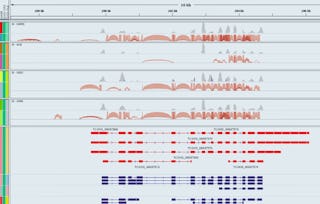
In this module we'll explore some of the data that have been generated as a result of the rapid decrease in the cost of sequencing DNA. We'll be exploring a couple of RNA-Seq data sets that can tell us where any given gene is expressed, and also how that gene might be alternatively spliced. We'll also be looking at a couple of metagenome data sets that can tell us about the kinds of species (especially microbial species that might otherwise be hard to culture) that are in a given environmental niche.
What's included
4 videos2 readings1 assignment
4 videos•Total 49 minutes
- Introduction•3 minutes
- Lecture•24 minutes
- Lab Discussion•18 minutes
- Summary•3 minutes
2 readings•Total 100 minutes
- Lecture Materials•10 minutes
- Lab 6 -- Next Generation Sequencing Applications: RNA-Seq and Metagenomics•90 minutes
1 assignment•Total 30 minutes
- Lab 6 Quiz•30 minutes
What's included
1 reading2 assignments
1 reading•Total 10 minutes
- Final Assignment Instructions•10 minutes
2 assignments•Total 60 minutes
- Review: Modules 5-7 •30 minutes
- Final Assignment•30 minutes
Earn a career certificate
Add this credential to your LinkedIn profile, resume, or CV. Share it on social media and in your performance review.
Instructor
Offered by

Explore more from Health Informatics
- Status: Free TrialU
University of Toronto
Course
- Status: Free TrialU
University of Toronto
Specialization
- Status: PreviewJ
Johns Hopkins University
Course
- Status: PreviewB
Birla Institute of Technology & Science, Pilani
Course

Why people choose Coursera for their career


Learner reviews
- 5 stars
77.77%
- 4 stars
18.08%
- 3 stars
3.24%
- 2 stars
0.33%
- 1 star
0.55%
Showing 3 of 1786
Reviewed on Oct 2, 2015
A thorough course for beginners with very interesting labs! I was pleasantly surprised with how much and how easily I learned bioinformatics skills with this course. Well done!
Reviewed on Nov 4, 2017
I enjoyed doing the course. It is exciting to see how much one can learn from a few gene or protein sequences. Thank you for making the course understandable to a beginner in bioinformatics!
Reviewed on Sep 14, 2021
Explanation was on point. As a beginner didn't have to face much problem to understand terminologies and concepts and PDF of the study materials played an important role to understand.




Frequently asked questions
You'll learn how to use bioinformatics tools to access biological data, compare sequences, and draw sensible conclusions from the results. It starts with databases and BLAST, then builds into broader sequence analysis and evolutionary interpretation, with later work on selection and sequencing-based data. In the guided labs, you'll do tasks such as searching GenBank, interpreting BLAST output, and examining related sequences side by side.
No, you don't need programming for this course. Some familiarity with basic molecular biology is helpful because the course works with genes, proteins, and sequence data from the start. It moves quickly into using databases and analysis tools rather than teaching biology fundamentals from scratch.
Yes, if you're new to bioinformatics but already know some basic molecular biology, this is a good beginner course. The material starts with core tasks like using biological databases and interpreting BLAST results, then adds more advanced analysis through guided lessons and labs. If terms like genes, proteins, or homology are completely new to you, the pace may feel faster.
More questions
Financial aid available,