

Build Real-Time Face Recognition with OpenCV
Keep adding new skills with 10,000+ programs for $239 (usually $399). Save now.

Build Real-Time Face Recognition with OpenCV
This course is part of Apply OpenCV for Real-Time Computer Vision Projects Specialization

Included with
Ask Coursera
Recommended experience
Recommended experience
What you'll learn
Explain computer vision basics and apply edge detection techniques using OpenCV.
Build facial image datasets and train classifiers for face recognition tasks.
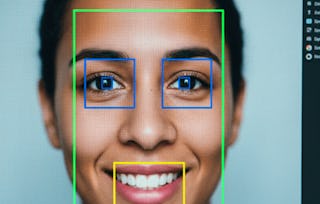
Develop real-time face and eye recognition systems with OpenCV and Python.
Skills you'll gain
Details to know

February 2026
6 assignments
See how employees at top companies are mastering in-demand skills

Build your subject-matter expertise
- Learn new concepts from industry experts
- Gain a foundational understanding of a subject or tool
- Develop job-relevant skills with hands-on projects
- Earn a shareable career certificate

There are 2 modules in this course
By completing this course, learners will be able to explain core computer vision concepts, apply edge detection techniques, build facial image datasets, train face recognition classifiers, and develop real-time face and eye recognition systems using OpenCV and Python.
This course provides a step-by-step, hands-on approach to face recognition, starting from foundational image processing concepts and progressing to a fully working real-time recognition system. Learners gain practical experience with edge detection algorithms such as Canny, learn how to collect and organize facial datasets, and understand how classifiers are trained and evaluated for recognition tasks. What makes this course unique is its project-driven structure, where every concept directly contributes to building a real application. Instead of isolated theory, learners see how preprocessing, detection, training, and recognition fit together in a complete pipeline. The course is ideal for beginners in computer vision as well as developers who want to implement, analyze, and deploy face recognition solutions using OpenCV. By the end of the course, learners will have the confidence and skills to build their own face recognition projects and extend them to real-world applications.
This module introduces learners to the fundamentals of computer vision using OpenCV, focusing on edge detection techniques and the creation of a structured facial image dataset required for building face recognition systems.
What's included
6 videos3 assignments
6 videos•Total 56 minutes
- Introduction of Project•6 minutes
- Edge Detection•1 minute
- Canny Edge Detection •9 minutes
- Canny Edge Detection Continue•13 minutes
- Creating Dataset•13 minutes
- Creating Dataset Continue•13 minutes
3 assignments•Total 50 minutes
- Graded - Foundations of Face Recognition with OpenCV•30 minutes
- Getting Started with Computer Vision Basics•10 minutes
- Advanced Edge Detection & Dataset Creation•10 minutes
This module guides learners through training face recognition classifiers and deploying a real-time system that detects and recognizes faces and eyes using OpenCV.
What's included
5 videos3 assignments
5 videos•Total 46 minutes
- Training Classifier using Dataset•12 minutes
- Training Classifier using Dataset Continue•6 minutes
- Face and Eyes Detection and Recognition Part 1•9 minutes
- Face and Eyes Detection and Recognition Part 2•10 minutes
- Face and Eyes Detection and Recognition Part 3•9 minutes
3 assignments•Total 50 minutes
- Graded - Training Models & Real-Time Face Recognition•30 minutes
- Training Face Recognition Models•10 minutes
- Face & Eye Detection in Action•10 minutes
Earn a career certificate
Add this credential to your LinkedIn profile, resume, or CV. Share it on social media and in your performance review.

Explore more from Machine Learning
- Status: Free Trial
- Status: Free Trial
- Status: Free Trial
Specialization


Why people choose Coursera for their career






Frequently asked questions
To access the course materials, assignments and to earn a Certificate, you will need to purchase the Certificate experience when you enroll in a course. You can try a Free Trial instead, or apply for Financial Aid. The course may offer 'Full Course, No Certificate' instead. This option lets you see all course materials, submit required assessments, and get a final grade. This also means that you will not be able to purchase a Certificate experience.
When you enroll in the course, you get access to all of the courses in the Specialization, and you earn a certificate when you complete the work. Your electronic Certificate will be added to your Accomplishments page - from there, you can print your Certificate or add it to your LinkedIn profile.
Yes. In select learning programs, you can apply for financial aid or a scholarship if you can’t afford the enrollment fee. If fin aid or scholarship is available for your learning program selection, you’ll find a link to apply on the description page.
More questions
Financial aid available,