

Clinical Rehab Strategies for Shoulder Dysfunction
Ends soon! Keep adding new skills with 10,000+ programs for $239 (usually $399). Save now.

Clinical Rehab Strategies for Shoulder Dysfunction
This course is part of Comprehensive Shoulder Rehabilitation Specialization

Instructor: Niel Asher Education
Included with
Recommended experience
Recommended experience
What you'll learn
How to assess and treat complex shoulder conditions using evidence-based methods
How to design progressive rehabilitation plans for recovery and performance
How to understand common shoulder problems and apply manual therapy and rehabilitation strategies to support mobility, strength, recovery.
Skills you'll gain
Details to know

See how employees at top companies are mastering in-demand skills

Build your subject-matter expertise
- Learn new concepts from industry experts
- Gain a foundational understanding of a subject or tool
- Develop job-relevant skills with hands-on projects
- Earn a shareable career certificate

There are 4 modules in this course
Shoulder problems can make everyday movements like reaching, lifting, exercising, sleeping, or working overhead painful and limiting. By the end of this course, learners will understand how shoulder anatomy, biomechanics, and common pathologies influence pain, movement restriction, and recovery, while learning practical rehabilitation strategies that support better function.
Taught by osteopath and athletic trainer Rebecca Tyler, this course explores the shoulder as a complex and highly mobile joint system. Learners study clinical presentations of conditions such as frozen shoulder, impingement, labral tears, and other common sources of shoulder dysfunction. Through expert video instruction, case examples, and step-by-step demonstrations, learners explore shoulder assessment, movement analysis, manual therapy applications, corrective exercise, and progressive rehabilitation planning. Healthcare, fitness, bodywork, and rehabilitation professionals will gain a practical framework for evaluating and treating shoulder dysfunction, while general learners will better understand why shoulder pain can be complex and how recovery is supported. This course connects anatomy, pathology, manual therapy, and exercise-based rehab into a clear approach for improving shoulder mobility, strength, and function.
Module 1 establishes the foundations needed to understand and treat the complex shoulder. The module begins with a clear overview of the shoulder structure, including the glenohumeral joint, shoulder girdle, and the relationships between cervical, thoracic, and scapular function. You’ll explore why shoulder pain can be challenging to assess—frequently the painful point isn’t the source. Instead, symptoms often stem from postural habits, muscular imbalance, or referred pain.
What's included
8 videos3 readings1 assignment1 discussion prompt
8 videos•Total 100 minutes
- Course Introduction•9 minutes
- Gathering Information•14 minutes
- Shoulder Impingement•15 minutes
- Frozen Shoulder•13 minutes
- ACJ Osteoarthritis •12 minutes
- GHJ Osteoarthritis•11 minutes
- Slap Lesions•9 minutes
- AC Separation •17 minutes
3 readings•Total 25 minutes
- Syllabus•5 minutes
- Course Workbook - The Human Shoulder•10 minutes
- Student Notes•10 minutes
1 assignment•Total 15 minutes
- Practice Assignment•15 minutes
1 discussion prompt•Total 10 minutes
- Introduction•10 minutes
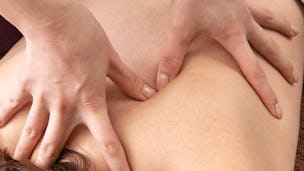
From there, the instructor presents step-by-step manual treatment strategies. You will learn palpation, soft-tissue approaches, trigger point therapy, and manual techniques for reducing pain and improving movement. Real client demonstrations show how to identify the true driver of a client’s pain and select hands-on interventions that produce meaningful change. The focus is not on blindly treating where symptoms appear, but on understanding why the dysfunction exists and applying manual techniques to restore mobility, decrease pain, and improve function.
What's included
6 videos1 assignment
6 videos•Total 54 minutes
- Assessment 1 - Anatomy•9 minutes
- Assessment 2 - Active ROM•4 minutes
- Assessment 3 - Passive ROM•10 minutes
- Assessment 4 - Special Tests•5 minutes
- Manual Therapy - Part 1•17 minutes
- Manual Therapy - Part 2•9 minutes
1 assignment•Total 15 minutes
- Module Reflection Quiz•15 minutes
Module 3 begins with the introduction to shoulder rehabilitation and shifts from hands-on treatment to exercise-based progressions. You will learn how to transition a client safely from pain and limited movement into strengthening, motor control, and full functional capacity. The instructor teaches a structured sequence—from restoring mobility, to re-establishing stability, to building strength and load tolerance.Step-by-step exercise demonstrations show how to choose exercises based on irritability, tolerance, and functional goals. You’ll learn how to build rehab plans that incorporate scapular control, rotator cuff loading, full-chain integration, and progressive resistance. This module emphasises practicality: what to start with, how to progress, and how to know when to increase challenge or reduce intensity. By the end, you’ll know how to design an effective rehab programme that moves beyond symptom relief and builds a resilient, functional shoulder.
What's included
5 videos1 reading1 assignment
5 videos•Total 44 minutes
- Introduction to Shoulder Rehabilitation•8 minutes
- Rehabilitation 1 - ROM•10 minutes
- Rehabilitation 2 - Stabilization•14 minutes
- Rehabilitation 3 - Strengthening•13 minutes
- Rehabilitation - A Final Word•0 minutes
1 reading•Total 10 minutes
- Student Notes•10 minutes
1 assignment•Total 15 minutes
- Practice Assignment•15 minutes
This final exam is designed to assess your understanding of the key concepts presented throughout the course. Please review all video lessons and written materials before beginning. A passing score of 70% or higher is required to successfully complete the course and earn your CE certificate. You may reference your notes during the exam. Once you pass, your certificate will be available for immediate download.
What's included
1 video1 assignment1 discussion prompt
1 video•Total 3 minutes
- Course Summary•3 minutes
1 assignment•Total 60 minutes
- Course Exam•60 minutes
1 discussion prompt•Total 10 minutes
- Summary•10 minutes
Earn a career certificate
Add this credential to your LinkedIn profile, resume, or CV. Share it on social media and in your performance review.
Instructor
Offered by

Explore more from Patient Care
- N
Niel Asher Education
Course
- N
Niel Asher Education
Course

Why people choose Coursera for their career






Frequently asked questions
To access the course materials, assignments and to earn a Certificate, you will need to purchase the Certificate experience when you enroll in a course. You can try a Free Trial instead, or apply for Financial Aid. The course may offer 'Full Course, No Certificate' instead. This option lets you see all course materials, submit required assessments, and get a final grade. This also means that you will not be able to purchase a Certificate experience.
When you enroll in the course, you get access to all of the courses in the Specialization, and you earn a certificate when you complete the work. Your electronic Certificate will be added to your Accomplishments page - from there, you can print your Certificate or add it to your LinkedIn profile.
Yes. In select learning programs, you can apply for financial aid or a scholarship if you can’t afford the enrollment fee. If fin aid or scholarship is available for your learning program selection, you’ll find a link to apply on the description page.
More questions
Financial aid available,