

Relational Database Design
Ends soon! Keep adding new skills with 10,000+ programs for $239 (usually $399). Save now.

Relational Database Design
This course is part of multiple programs.


Instructors: Gerald Balekaki
2,389 already enrolled
Included with
16 reviews
Recommended experience
16 reviews
Recommended experience
What you'll learn
Describe the process and the design aspects involved in relational database design.
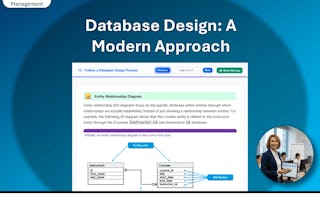
Develop entity-relationship diagrams using basic and extended Entity-relationship features in relational design.
Identify and apply normalization techniques.
Skills you'll gain
Tools you'll learn
Details to know

28 assignments
See how employees at top companies are mastering in-demand skills

Build your subject-matter expertise
- Learn new concepts from industry experts
- Gain a foundational understanding of a subject or tool
- Develop job-relevant skills with hands-on projects
- Earn a shareable career certificate

There are 4 modules in this course
This course provides you with the opportunity to learn about relational database design. You will be provided an in-depth understanding of the design principles and methodologies involved in creating well-structured, normalized, and efficient relational databases to manage data for small, medium, and large-scale enterprises.
Possessing database design skills will enable you to excel in careers such as Database Administrators, Data Analysts, Software Developers, Data Engineers, and Business Intelligence Developers; capitalizing on the ability to create robust and efficient data solutions for any organization. These are one of the top sought-after careers across many industries today. At the end of this course, you will be able to: - Describe the process and the design aspects involved in relational database design. - Interpret the main components of an Entity-Relationship diagram (ERD) using unified modeling language (UML) notation. - Develop entity-relationship diagrams using basic and extended Entity-relationship features in relational design. - Translate Entity-Relationships diagrams into logical schemas (relation schemas). - Describe the theory and practical application of functional dependencies in relational database design. - Use the theory to recognize candidate keys and primary keys. - Derive minimal and canonical covers of functional dependencies. - Describe the principles of database normalization. - Identify and apply normalization techniques.
Welcome to Relational Database Design! This course expounds upon the concepts covered in the course, Introduction to Relational Database, where you learned the fundamentals. In this course, you will focus on the design aspects of databases and explore practical examples to help you apply the concepts to real world scenarios. To help you concentrate on effective design, this course will be more theoretical and conceptual. You will not actually build the databases with software applications. You will do that in the course, Relational Database: Implementation and Applications. Sounds exciting, right? Let's begin with an overview of database design covering three main lessons: 1) Entity-Relationship (E-R) modeling, 2) E-R diagrams, and 3) Extended ER features and relation schemas. Please review the module learning objectives below and refer them as a guide for your learning.
What's included
4 videos19 readings11 assignments1 discussion prompt
4 videos•Total 90 minutes
- Instructor Welcome and Course Introduction•2 minutes
- Entity - Relationship (ER) Model•31 minutes
- Creating an Entity - Relationship Diagram (ERD)•28 minutes
- Extended ER Model/Diagram•30 minutes
19 readings•Total 190 minutes
- Syllabus•10 minutes
- What Should You Know, What Will You Learn, and What Will You Need?•10 minutes
- Use draw.io to Create Diagrams•10 minutes
- Module 1 Introduction•10 minutes
- Design Process Overview•10 minutes
- Entity-Relationship (ER) Modeling•10 minutes
- Conceptual Design: College Database•10 minutes
- E-R Diagram Introduction•10 minutes
- Example: Banking Database Business Rules •10 minutes
- Interpreting E-R Diagrams and Cardinality Constraints•10 minutes
- Reduction to Relation Schemas•10 minutes
- Activity 2.1 Diagram Solution•10 minutes
- Activity 2.2 Solution•10 minutes
- Activity 2.3 Solution•10 minutes
- Activity 2.5 Solution•10 minutes
- Extended Entity-Relationship Modeling•10 minutes
- Relation Schemas of an Extended-ER Diagram•10 minutes
- E-R Design issues•10 minutes
- Module 1 Summary•10 minutes
11 assignments•Total 905 minutes
- Before You Begin: Check Your Prior Knowledge•180 minutes
- (OPTIONAL) Activity 1.1: Design Process/Phases Quiz•5 minutes
- M1 Lesson 1: Check Your Understanding•180 minutes
- M1 Lesson 2: Check Your Understanding•180 minutes
- Activity 2.1 Conceptual Design: City Book Library Database Quiz•30 minutes
- Activity 2.2 Interpreting Modeling Constraints •30 minutes
- Activity 2.3 Fix the Entity-Relationship Diagram (ERD) •30 minutes
- (OPTIONAL) Activity 2.4 E-R Diagram •30 minutes
- Activity 2.5 Translate ER Diagram Into Relation Schemas •30 minutes
- M1 Lesson 3: Check Your Understanding•180 minutes
- Module 1 Summative Assessment•30 minutes
1 discussion prompt•Total 10 minutes
- Meet and Greet Discussion•10 minutes
This module explores the theory and practical application of functional dependencies in relational database design, providing students with the knowledge and skills to identify and enforce data relationships, ensuring data integrity and optimization in database systems. This module is organized into three lessons: 1) Functional dependency theory, 2) Finding candidate keys and attribute closure, and 3) Deriving canonical (minimal) covers of functional dependencies. The learning objectives of this module are presented below. Please refer to the enrichment activities at the end of each lesson.
What's included
3 videos7 readings9 assignments
3 videos•Total 97 minutes
- Functional Dependency (FD)•23 minutes
- Attribute Closure and Candidate Keys•20 minutes
- Canonical (minimal) cover off FDs•54 minutes
7 readings•Total 70 minutes
- Functional Dependency•10 minutes
- Armstrong's Axioms Closure Algorithm•10 minutes
- Attribute Closure•10 minutes
- Finding Candidate Keys•10 minutes
- Lecture 6 PowerPoint•10 minutes
- Activity 6.2 Part 2 Solution•10 minutes
- Module 2 Summary•10 minutes
9 assignments•Total 625 minutes
- M2 Lesson 1: Check Your Understanding•180 minutes
- Activity 4.1 FD Theory and Definition Quiz•5 minutes
- M2 Lesson 2: Check Your Understanding•180 minutes
- Activity 5.1-5.3 Attribute Closure and Candidate Keys Quiz•10 minutes
- M2 Lesson 3: Check Your Understanding•180 minutes
- Activity 6.1: Compute the Canonical Cover in FDs Quiz•5 minutes
- (OPTIONAL) Activity 6.2 Compute the Canonical Cover In FDs (Part 1)•5 minutes
- (OPTIONAL) Activity 6.2 Compute the Canonical Cover In FDs (Part 2)•30 minutes
- Module 2 Summative Assessment •30 minutes
The database normalization module demonstrates the principles and techniques of organizing data into well-structured tables through normalization, ensuring data integrity and reducing redundancy for efficient and scalable database systems. This module is organized in three lessons: 1) Normal Forms (NFs), 2) more Normal forms, and 3) DB Design example (applying ER modeling + Normalization). The learning objectives of this module include are presented below. Refer to the enrichment activities at the end of each lesson.
What's included
3 videos10 readings7 assignments1 peer review
3 videos•Total 97 minutes
- Database Normalization•46 minutes
- Boyce-Codd Normal Form•27 minutes
- Database Design Example (Normalization + ERD)•24 minutes
10 readings•Total 100 minutes
- Introduction•10 minutes
- Normal Forms (NFs)•10 minutes
- Conversion to 1NF•10 minutes
- Conversion to 2NF•10 minutes
- Conversion to 3NF•10 minutes
- Activity 7.2 Solution•10 minutes
- Conversion to BCNF•10 minutes
- Conversion to 4NF•10 minutes
- Activity 8.2 Solution•10 minutes
- Module 3 Summary•10 minutes
7 assignments•Total 435 minutes
- M3 Lesson 1: Check Your Understanding•180 minutes
- (OPTIONAL) Activity 7.1 Normal Forms and Conditions Quiz •5 minutes
- Activity 7.2 Normalize the Spreadsheet Data (3NF/BCNF) •30 minutes
- M3 Lesson 2: Check Your Understanding•180 minutes
- Activity 8.1 Conversion to BCNF Quiz•5 minutes
- Activity 8.2 Consider a Set of FDs of Relation R, Determine the NFs•30 minutes
- Activity 8.3 4NF Normal Forms Quiz•5 minutes
1 peer review•Total 60 minutes
- Summative Module 3 Assessment•60 minutes
This module contains the summative course assessment that has been designed to evaluate your understanding of the course material and assess your ability to apply the knowledge you have acquired throughout the course. Be sure to review the course material thoroughly before taking the assessment. A learning guide is also provided to help you prepare for the assessment. Please review prior to launching the assessment. You will only have one attempt to take it, so please plan accordingly. Best wishes to you for success!
What's included
1 assignment
1 assignment•Total 180 minutes
- Summative Course Assessment •180 minutes
Earn a career certificate
Add this credential to your LinkedIn profile, resume, or CV. Share it on social media and in your performance review.
Build toward a degree
This course is part of the following degree program(s) offered by Illinois Tech. If you are admitted and enroll, your completed coursework may count toward your degree learning and your progress can transfer with you.¹
Instructors
Offered by

Explore more from Software Development
- Status: PreviewL
Logical Operations
Course
- Status: Free Trial
Course
- B
Birla Institute of Technology & Science, Pilani
Course
- Status: Free TrialI
Illinois Tech
Course



Why people choose Coursera for their career






Frequently asked questions
To access the course materials, assignments and to earn a Certificate, you will need to purchase the Certificate experience when you enroll in a course. You can try a Free Trial instead, or apply for Financial Aid. The course may offer 'Full Course, No Certificate' instead. This option lets you see all course materials, submit required assessments, and get a final grade. This also means that you will not be able to purchase a Certificate experience.
When you enroll in the course, you get access to all of the courses in the Specialization, and you earn a certificate when you complete the work. Your electronic Certificate will be added to your Accomplishments page - from there, you can print your Certificate or add it to your LinkedIn profile.
Yes. In select learning programs, you can apply for financial aid or a scholarship if you can’t afford the enrollment fee. If fin aid or scholarship is available for your learning program selection, you’ll find a link to apply on the description page.
More questions
Financial aid available,