

Introduction to Social Determinants of Health
Keep adding new skills with 10,000+ programs for $239 (usually $399). Save now.

Introduction to Social Determinants of Health
This course is part of Social Determinants of Health: Data to Action Specialization


1,519 already enrolled
Included with
Ask Coursera
16 reviews
16 reviews
Skills you'll gain
- Social Justice
- Public Health
- Health Equity
- Health Promotion
- Social Impact
- Systems Thinking
- Social Determinants Of Health
- Community Health
- Data Visualization
- Health Disparities
- Health Policy
- Epidemiology
- Data Literacy
- Health Informatics
- Data-Driven Decision-Making
- Economics, Policy, and Social Studies
- Health Systems
- Data Analysis
Tools you'll learn
Details to know

See how employees at top companies are mastering in-demand skills

Build your subject-matter expertise
- Learn new concepts from industry experts
- Gain a foundational understanding of a subject or tool
- Develop job-relevant skills with hands-on projects
- Earn a shareable career certificate

There are 5 modules in this course
This first of five courses introduces students to the social determinants of health, and provides an overview of the definitions and theoretical perspectives that will form the foundation of this specialization. The topics of this course include:
1. Introduction to the Social Determinants of Health 2. Theoretical Perspectives and Knowledge Complexity 3. Data Driven Collective Impact 4. Minority Stress Theory 5. Data Applications: Frequency Analysis and Bar Chart Visualization
The purpose of this module is to provide an introduction to the social determinants of health in the context of this specialization. In lesson one, we will define the social determinants of health, explore how our understanding of social determinants has changed over time, and analyze the impact health inequity has on society. We will also consider the variety of transformational ideas that can be used to address health inequities. In lesson two, we will review different ways of knowing and how community knowledge can be augmented with data to influence policy. We will also evaluate defining characteristics of data, as we assess how data, analysis and partnership can be leveraged to create power for transformative change.
What's included
4 videos10 readings2 assignments1 discussion prompt8 plugins
4 videos•Total 26 minutes
- Introduction to Social Determinants of Health: Data to Action Specialization•4 minutes
- Introduction to Course 1: Introduction to the Social Determinants of Health•2 minutes
- Introduction to Social Determinants of Health•12 minutes
- Data, Power, and Partnership•9 minutes
10 readings•Total 100 minutes
- How and Why Communities Are Using Data to Drive Community Health Improvement•10 minutes
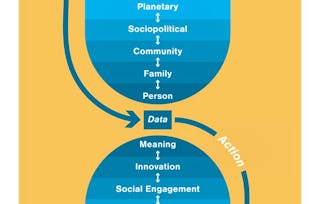
- Collective Impact Partnerships: The Data to Action Hourglass Model•30 minutes
- “Positive” Systems Archetypes•10 minutes
- Structural Racism: The Root Cause of the Social Determinants of Health •15 minutes
- CDC Health Disparities and Inequalities Report Fact Sheet•10 minutes
- Systems Thinking Examples•5 minutes
- Supplementary Resources•0 minutes
- What are Indigenous and Western Ways of Knowing? •15 minutes
- Ways of Knowing•5 minutes
- (Optional) Ways of Knowing: Implications for Public Policy•0 minutes
2 assignments•Total 60 minutes
- Introduction to Social Determinants of Health - Graded•30 minutes
- Introduction to Social Determinants of Health - Practice•30 minutes
1 discussion prompt•Total 10 minutes
- Introduction to Social Determinants of Health•10 minutes
8 plugins•Total 73 minutes
- Social Determinants of Health•4 minutes
- Social Determinants of Health: Impact on Medical Training and Healthcare Costs•10 minutes
- Ibram X. Kendi on the Solution for America's "Metastatic" Racism•10 minutes
- SHE Speaks: Riane Eisler on Awakening from the Dominator Trance•7 minutes
- Systems Thinking Leadership•7 minutes
- Qualitative and Quantitative•7 minutes
- Ways of Knowing•10 minutes
- Indigenous Knowledge to Close Gaps in Indigenous Health•18 minutes
The purpose of this module is to provide a foundation of theoretical knowledge to support systems thinking and knowledge management principles applied to determinants of health. Systems thinking involves making distinctions, understanding systems, relationships, points of view and perspective taking. In lesson one, we will learn about the DSRP theory in regard to developing a systems thinking mindset. In lesson two, we introduce the Data to Action Hourglass model as a conceptual framework and a way to think about the different logical levels and relationships between and among determinants of health.
What's included
2 videos4 readings2 assignments1 discussion prompt3 plugins
2 videos•Total 19 minutes
- Systems Thinking: The Distinctions, Systems, Relationships, Perspectives (DSRP) Theory•11 minutes
- The Social Determinants of Health Data to Action Hourglass Model•8 minutes
4 readings•Total 160 minutes
- Greater Than the Sum: Systems Thinking in Tobacco Control•90 minutes
- "Positive" Systems Archetypes•10 minutes
- Communities of Practice Approach for Knowledge Management Systems•40 minutes
- Collective Impact Stanford Social Innovation Review•20 minutes
2 assignments•Total 60 minutes
- Theoretical Perspectives - Graded•30 minutes
- Theoretical Perspectives - Practice•30 minutes
1 discussion prompt•Total 10 minutes
- Theoretical Perspectives•10 minutes
3 plugins•Total 23 minutes
- Systems-Thinking: A Little Film About a Big Idea •12 minutes
- Scales of Measurement - Nominal, Ordinal, Interval, Ratio•6 minutes
- Change vs. Transformation•5 minutes
The purpose of this module is to introduce the concept of collective impact as a model and method for designing data driven collective impact initiatives. The principles and phases of collective impact are described and explained. Collective impact thinking requires a shift in mind that requires attention to systems thinking. Using a collective impact mindset supports and encourages collaboration and team science and the use of standardized data sets to understand and support knowledge work and translation with community and population data sets. Example case studies illustrate the power and potential of collective impact efforts to create transformational changes to support desired health care futures.
What's included
1 video6 readings2 assignments1 discussion prompt1 plugin
1 video•Total 9 minutes
- Data Driven Collective Impact•9 minutes
6 readings•Total 60 minutes
- Collective Impact Forum•15 minutes
- Collective Impact Terminology•10 minutes
- Collective Impact•15 minutes
- Essential Mindset Shifts for Collective Impact•10 minutes
- Collective Impact Case Studies•10 minutes
- Supplementary: Centering Equity in Collective Impact•0 minutes
2 assignments•Total 60 minutes
- Collective Impact - Graded•30 minutes
- Collective Impact - Practice•30 minutes
1 discussion prompt•Total 10 minutes
- Collective Impact•10 minutes
1 plugin•Total 2 minutes
- What is Collective Impact•2 minutes
In this module we will define minority stress theory as it relates to the social determinants of health. In lesson one, we will define minority stress, and examine how systemic discrimination contributes to minority stress. We will also look at how minority stress can lead to health disparities. In lesson two, we will discuss the effects of structural inequalities on both advantage and disadvantaged groups. We will also explore the personal, interpersonal and social effects of minority stress. Finally, we will evaluate the personal and social resources available to counteract minority stress, as well as the ways in which data can be used to enact transformative changes.
What's included
2 videos2 readings2 assignments1 discussion prompt3 plugins
2 videos•Total 24 minutes
- Minority Stress Theory Part 1•11 minutes
- Minority Stress Theory Part 2•12 minutes
2 readings•Total 75 minutes
- Prejudice, Social Stress, and Mental Health in Lesbian, Gay, and Bisexual Populations: Conceptual Issues and Research Evidence•50 minutes
- A Strengths-Based Perspective•25 minutes
2 assignments•Total 60 minutes
- Minority Stress Theory - Graded•30 minutes
- Minority Stress Theory - Practice•30 minutes
1 discussion prompt•Total 10 minutes
- Minority Stress Theory•10 minutes
3 plugins•Total 51 minutes
- Pride Month Special: Key Research on LGBTQ Mental Health•14 minutes
- Social and Behavioral Determinants of Toxic Stress•19 minutes
- How Racism Makes Us Sick•18 minutes
This module will focus on analyzing, displaying and interpreting social determinants of health data, with a particular focus on identifying social determinants of health in large datasets. Lesson one will provide an overview of frequency analyses and bar chart visualizations. In lesson two, we will learn how to use the R environment in Coursera. Lesson three will introduce us to the datasets, NHANES and Omaha System, which we will use throughout the Data Application modules in this specialization. In lesson four, we will learn how to conduct frequency analyses and create bar charts in R. Using the NHANES dataset, we will obtain the frequencies of income, education, family savings, depression and insurance by race. Using the Omaha System dataset, we will obtain the frequencies of common social determinants by both race and ethnicity. Finally, we will discuss how to interpret the results of our analysis as we visualize our findings using bar plots.
What's included
4 videos6 readings1 peer review1 discussion prompt1 ungraded lab4 plugins
4 videos•Total 25 minutes
- Introduction to Frequency Analysis and Bar Chart Visualization•9 minutes
- Introduction to the R Environment in Coursera•4 minutes
- Introduction to the Data Files•4 minutes
- Frequency Analysis and Bar Chart Visualization•7 minutes
6 readings•Total 55 minutes
- The Advantages of Bar Graphs•10 minutes
- Memphis Fast Forward•15 minutes
- “Positive” Systems Archetypes•10 minutes
- Supplementary Resources•0 minutes
- About the National Health and Nutrition Examination Survey•15 minutes
- Frequency Analysis and Bar Chart Visualization R Directions•5 minutes
1 peer review•Total 60 minutes
- Frequency Analysis and Bar Chart Visualization•60 minutes
1 discussion prompt•Total 10 minutes
- Frequency Analysis and Bar Chart Visualization•10 minutes
1 ungraded lab•Total 60 minutes
- Frequency Analysis and Bar Chart Visualization•60 minutes
4 plugins•Total 52 minutes
- Introduction to Frequency Distributions•8 minutes
- Bar Charts and Bar Graphs Explained•8 minutes
- Omaha System Basics•19 minutes
- NHANES: Past, Present, Future•17 minutes
Earn a career certificate
Add this credential to your LinkedIn profile, resume, or CV. Share it on social media and in your performance review.
Instructors
Offered by

Explore more from Health Informatics
- Status: Free TrialU
University of Michigan
Course
- Status: Free TrialU
University of Minnesota
Course
- Status: Free TrialU
University of Minnesota
Course
- Status: Free TrialU
University of Minnesota
Specialization



Why people choose Coursera for their career






Frequently asked questions
To access the course materials, assignments and to earn a Certificate, you will need to purchase the Certificate experience when you enroll in a course. You can try a Free Trial instead, or apply for Financial Aid. The course may offer 'Full Course, No Certificate' instead. This option lets you see all course materials, submit required assessments, and get a final grade. This also means that you will not be able to purchase a Certificate experience.
When you enroll in the course, you get access to all of the courses in the Specialization, and you earn a certificate when you complete the work. Your electronic Certificate will be added to your Accomplishments page - from there, you can print your Certificate or add it to your LinkedIn profile.
Yes. In select learning programs, you can apply for financial aid or a scholarship if you can’t afford the enrollment fee. If fin aid or scholarship is available for your learning program selection, you’ll find a link to apply on the description page.
More questions
Financial aid available,
¹ Some assignments in this course are AI-graded. For these assignments, your data will be used in accordance with Coursera's Privacy Notice.