

Reasoning Under Uncertainty
Ends soon! Keep adding new skills with 10,000+ programs for $239 (usually $399). Save now.

Reasoning Under Uncertainty
This course is part of Introduction to Artificial Intelligence Specialization

Instructor: Rhonda Hoenigman
Included with
Skills you'll gain
- Probability & Statistics
- Probability
- Bayesian Statistics
- Algorithms
- Markov Model
- Decision Intelligence
- Statistical Inference
- Machine Learning Methods
- Time Series Analysis and Forecasting
- Artificial Intelligence
- Reinforcement Learning
- Applied Machine Learning
- Probability Distribution
- Bayesian Network
- Agentic systems
- Statistical Machine Learning
Details to know

May 2026
6 assignments
See how employees at top companies are mastering in-demand skills

Build your subject-matter expertise
- Learn new concepts from industry experts
- Gain a foundational understanding of a subject or tool
- Develop job-relevant skills with hands-on projects
- Earn a shareable career certificate

There are 4 modules in this course
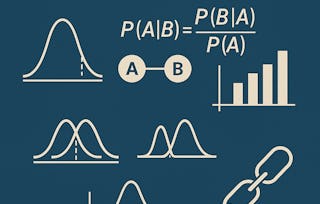
This course introduces the foundational principles of artificial intelligence through the lens of reasoning and decision-making under uncertainty. Students begin by examining how intelligent agents act in uncertain environments using probability theory, Bayes’ Rule, and independence assumptions to update beliefs—concepts that underpin probabilistic machine learning and data-driven decision-making. The course then explores Bayesian Networks as a structured framework for representing complex dependencies and performing inference, connecting to modern graphical models and causal reasoning. Building on this, students study probabilistic reasoning over time using temporal models such as Hidden Markov Models, with links to contemporary sequence modeling and state estimation in applications like speech recognition and robotics. Finally, the course addresses sequential decision-making through Markov Decision Processes, where students learn to compute optimal policies using value iteration, policy iteration, and the Bellman equation—ideas that form the foundation of modern reinforcement learning methods used in systems such as autonomous agents and game-playing AI.
This module introduces how intelligent agents reason and make decisions in environments where information is incomplete, noisy, or uncertain. Students will learn the foundations of probability, including Bayes’ Rule and independence assumptions, and use these tools to perform probabilistic inference and update beliefs based on evidence. The module emphasizes both the sources of uncertainty and the methods AI systems use to act rationally despite it.
What's included
7 videos1 reading2 assignments
7 videos•Total 78 minutes
- Introduction to Reasoning Under Uncertainty•5 minutes
- Acting Under Uncertainty•10 minutes
- Introduction to Probability•25 minutes
- Probabilistic Inference•14 minutes
- Variable Independence •7 minutes
- Conditional Independence•7 minutes
- Bayes' Rule•10 minutes
1 reading•Total 30 minutes
- Probability Reference•30 minutes
2 assignments•Total 90 minutes
- Probability and Bayes Rule Calculations•60 minutes
- Acting Under Uncertainty Quiz•30 minutes
This module focuses on using Bayesian Networks as tools for probabilistic reasoning and decision-making under uncertainty. Students will learn how to interpret a given network, compute probabilities, and perform inference—both exact and approximate—using techniques such as direct sampling and Gibbs sampling. Emphasis is placed on applying Bayes Nets to answer queries, update beliefs with evidence, and reason efficiently in complex domains.
What's included
5 videos1 reading1 assignment1 programming assignment
5 videos•Total 68 minutes
- Bayesian Networks•9 minutes
- Constructing Bayes Nets•13 minutes
- Reasoning in Bayes Nets•17 minutes
- Approximate Inference - Direct Sampling•13 minutes
- Approximate Inference - Gibbs Sampling•17 minutes
1 reading•Total 30 minutes
- Bayes Net Reference•30 minutes
1 assignment•Total 30 minutes
- Bayes Net Terms and Sampling Calculations•30 minutes
1 programming assignment•Total 60 minutes
- Implement a Bayes Net•60 minutes
This module introduces temporal probabilistic models, focusing on how AI systems reason about hidden states that evolve over time. Students will learn to apply inference techniques such as filtering, prediction, smoothing, and the Viterbi algorithm to update beliefs and infer the most likely state sequences from observations. Emphasis is placed on using Hidden Markov Models to perform calculations and interpret how evidence shapes reasoning in dynamic, uncertain environments.
What's included
6 videos1 reading2 assignments
6 videos•Total 89 minutes
- Introduction To Probabilistic Reasoning Over Time•14 minutes
- Inference in Temporal Models - Filtering•17 minutes
- Inference in Temporal Models - Prediction•8 minutes
- Inference in Temporal Models - Smoothing•20 minutes
- Viterbi - Finding the Most Likely State Sequency•22 minutes
- HMMs and Other Hidden State Models•8 minutes
1 reading•Total 30 minutes
- HMM Reference•30 minutes
2 assignments•Total 60 minutes
- Probabilistic Reasoning Over Time•30 minutes
- HMM Calculations•30 minutes
This module introduces how AI agents make optimal decisions in uncertainty environments over time using the framework of Markov Decision Processes. Students will learn how to represent sequential decision problems with states, actions, rewards, and policies, and how to compute optimal behavior using value iteration, policy iteration, and the Bellman equation. Emphasis is placed on selecting actions that maximize expected utility in uncertain, sequential environments.
What's included
4 videos1 assignment1 programming assignment
4 videos•Total 57 minutes
- Sequential Decisions and Maximum Expected Utility•15 minutes
- Policies for Markov Decision Process•15 minutes
- Introduction to Value Iteration - Bellman Equations•17 minutes
- Policy Iteration•9 minutes
1 assignment•Total 30 minutes
- Sequential Decision Making and MDPs Quiz•30 minutes
1 programming assignment•Total 60 minutes
- MDPs and Policy Iteration•60 minutes
Earn a career certificate
Add this credential to your LinkedIn profile, resume, or CV. Share it on social media and in your performance review.
Instructor
Offered by

Explore more from Algorithms
- Status: Free TrialL
LearnQuest
Course
- Status: PreviewC
Columbia University
Course
- Status: Free TrialE
Emory University
Course
- Status: Free TrialU
University of Pittsburgh
Course



Why people choose Coursera for their career






Frequently asked questions
To access the course materials, assignments and to earn a Certificate, you will need to purchase the Certificate experience when you enroll in a course. You can try a Free Trial instead, or apply for Financial Aid. The course may offer 'Full Course, No Certificate' instead. This option lets you see all course materials, submit required assessments, and get a final grade. This also means that you will not be able to purchase a Certificate experience.
When you enroll in the course, you get access to all of the courses in the Specialization, and you earn a certificate when you complete the work. Your electronic Certificate will be added to your Accomplishments page - from there, you can print your Certificate or add it to your LinkedIn profile.
Yes. In select learning programs, you can apply for financial aid or a scholarship if you can’t afford the enrollment fee. If fin aid or scholarship is available for your learning program selection, you’ll find a link to apply on the description page.
More questions
Financial aid available,