

Six Sigma Tools for Improve and Control
Keep adding new skills with 10,000+ programs for $239 (usually $399). Save now.

Six Sigma Tools for Improve and Control
This course is part of Six Sigma Yellow Belt Specialization


59,179 already enrolled
Included with
Ask Coursera
1,394 reviews
1,394 reviews
Skills you'll gain
- Continuous Improvement Process
- Process Improvement and Optimization
- Cost Benefit Analysis
- Statistical Process Controls
- Six Sigma Methodology
- Process Analysis
- Document Control
- Correlation Analysis
- Statistical Hypothesis Testing
- Statistical Inference
- Quality Management
- Quality Control
- Regression Analysis
- Process Optimization
- Quality Improvement
- Process Improvement
- Kaizen Methodology
- Project Documentation
- Project Management
Details to know

See how employees at top companies are mastering in-demand skills

Build your subject-matter expertise
- Learn new concepts from industry experts
- Gain a foundational understanding of a subject or tool
- Develop job-relevant skills with hands-on projects
- Earn a shareable career certificate

There are 5 modules in this course
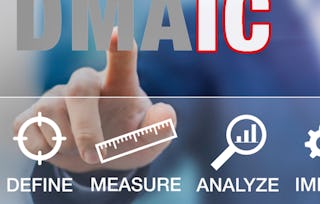
This course will provide you will the tools necessary to complete the final components of the analyze phase as well as the improve and control phases of the Six Sigma DMAIC (Define, Measure, Analyze, Improve, and Control) process. This course is the final course in the Six Sigma Yellow Belt Specialization. You will learn about relationships from data using correlation and regression as well as the different hypothesis terms in hypothesis testing. This course will provide you with tools and techniques for improvement. You will also understand the importance of a control plan, as well as its key characteristics, for maintaining process improvements. Every module will include readings, discussions, lecture videos, and quizzes to help make sure you understand the material and concepts that are studied.
Our applied curriculum is built around the latest handbook The Certified Six Sigma Handbook (2nd edition) and students will develop /learn the fundamentals of Six Sigma. Registration includes online access to course content, projects, and resources but does not include the companion text The Certified Six Sigma Handbook (2nd edition). The companion text is not required to complete the assignments. However, the text is a recognized handbook used by professionals in the field. Also, it is a highly recommended text for those wishing to move forward in Six Sigma and eventually gain certification from professional agencies such as American Society for Quality (ASQ).
Welcome to Six Sigma Tools for Improve and Control! This is the fourth course in the Six Sigma Yellow Belt Specialization. Your team of instructors, Dr. Bill Bailey, Dr. David Cook, Dr. Christine Scherrer, and Dr. Gregory Wiles, currently work in the College of Engineering and Engineering Technology at Kennesaw State University. The next two modules will conclude the Analyze phase of the DMAIC process and in the final two modules you will be introduced to the Improve and Control phase. This module will continue to discussion analysis by explaining correlation and regression. You will learn the meaning of correlation and regression, the different types of analysis, and how it can be used in Six Sigma.
What's included
5 videos1 reading2 assignments
5 videos•Total 13 minutes
- Dependent and Independent Variables•3 minutes
- Types of Correlation•3 minutes
- The Regression Equation•2 minutes
- Use of Regression for Prediction•3 minutes
- Regression for Six Sigma•1 minute
1 reading•Total 5 minutes
- Get help and meet other learners. Join your Community!•5 minutes
2 assignments•Total 70 minutes
- Correlation and Regression Graded Quiz•30 minutes
- Correlation and Regression Practice•40 minutes
This the final module that covers the Analysis phase of the DMAIC process. Now that you have collected the data and calculated it you will need to determine how to make a statistical conclusion about your findings. In this module you will learn more about the importance of hypothesis testing, how to correctly do a hypothesis test reading as well as how to avoid errors, and statistical significance.
What's included
5 videos2 assignments
5 videos•Total 12 minutes
- Hypothesis Testing Basics•3 minutes
- Types of Errors•3 minutes
- Types of Error Examples•3 minutes
- How To Do A Hypothesis Test•2 minutes
- P-value and Statistical Significance•2 minutes
2 assignments•Total 60 minutes
- Hypothesis Testing Graded Quiz•30 minutes
- Hypothesis Testing Practice Quiz•30 minutes
This module will introduce you to the Improve and Control phase of the DMAIC process. The first step in this phase is determining improvement techniques to help make improvements to an organization. This module will cover the best and most popular improvement techniques including kaizen and kaizen blitz, PDCA (Plan-Do-Check-Act) cycle, and cost benefit analysis (including cost of quality).
What's included
6 videos2 assignments1 discussion prompt
6 videos•Total 23 minutes
- Introduction•1 minute
- Suboptimization•6 minutes
- Kaizen and Kaizen Blitz•4 minutes
- PDCA•3 minutes
- Cost Benefit Analysis•4 minutes
- Cost of Quality•4 minutes
2 assignments•Total 60 minutes
- Improvement Techniques Graded Quiz•30 minutes
- Improvement Techniques Practice Quiz•30 minutes
1 discussion prompt•Total 10 minutes
- Implementing Kaizen•10 minutes
The final phase of the DMAIC process is the control phase. In this module you will learn about control tools that are useful in maintaining improvements. Communication is a key component of the control phase therefore it is important to develop standardized documentation. You will learn about how to standardize and manage documentation to help maintain processes that were implemented during the improve phase of DMAIC.
What's included
3 videos2 assignments
3 videos•Total 12 minutes
- Control Charts Part 1•4 minutes
- Control Charts Part 2•4 minutes
- Document Management•4 minutes
2 assignments•Total 60 minutes
- Control Tools and Documentation Graded Quiz•30 minutes
- Control Tools and Documentation Practice•30 minutes
This module is the "capstone project." You should only complete this project if you have taken all three previous yellow belt specialization courses (Six Sigma Fundamentals, Six Sigma Tools for Define and Measure, and Six Sigma Tools for Analyze), AND you want to complete this specialization. It should be noted that completing the Yellow Belt Specialization does not give the learner "professional accreditation" in Six Sigma. However, successful completion will assist in better preparation for such professional accreditation testing.
What's included
1 reading1 peer review
1 reading•Total 10 minutes
- Capstone Project Module Explanation•10 minutes
1 peer review•Total 60 minutes
- Yellow Belt Capstone Project•60 minutes
Earn a career certificate
Add this credential to your LinkedIn profile, resume, or CV. Share it on social media and in your performance review.
Instructors
Offered by

Explore more from Business Essentials
- Status: Free TrialK
Kennesaw State University
Course
- Status: Free TrialK
Kennesaw State University
Course
- Status: Free TrialK
Kennesaw State University
Course
- Status: Preview
Course



Why people choose Coursera for their career


Learner reviews
- 5 stars
80.77%
- 4 stars
15.56%
- 3 stars
2.15%
- 2 stars
0.50%
- 1 star
1%
Showing 3 of 1394
Reviewed on Jan 27, 2025
Great course if you are a beginner and looking for general understanding before going to official Six Sigma exam to get tested. Thank you for the access to the learning materials
Reviewed on Jul 21, 2021
that s an amazing course, learned a lot of things and applied them in the end in a well guided project .Thank you professors for this precious course.
Reviewed on Aug 28, 2020
Understand the DMAIC process and the capstone project will help us to find the suitable project to work on which can help us to find our real strength towards continuous improvement.




Frequently asked questions
Our applied curriculum is built around the latest handbook The Certified Six Sigma Handbook (2nd edition) and students will develop /learn the fundamentals of Six Sigma. Registration includes online access to all course content, projects, and resources. This price does not include the companion text The Certified Six Sigma Handbook (2nd edition).
To access the course materials, assignments and to earn a Certificate, you will need to purchase the Certificate experience when you enroll in a course. You can try a Free Trial instead, or apply for Financial Aid. The course may offer 'Full Course, No Certificate' instead. This option lets you see all course materials, submit required assessments, and get a final grade. This also means that you will not be able to purchase a Certificate experience.
When you enroll in the course, you get access to all of the courses in the Specialization, and you earn a certificate when you complete the work. Your electronic Certificate will be added to your Accomplishments page - from there, you can print your Certificate or add it to your LinkedIn profile.
More questions
Financial aid available,
¹ Some assignments in this course are AI-graded. For these assignments, your data will be used in accordance with Coursera's Privacy Notice.