Announcing Docker Desktop Support for Windows on Arm: New AI Innovation Opportunities

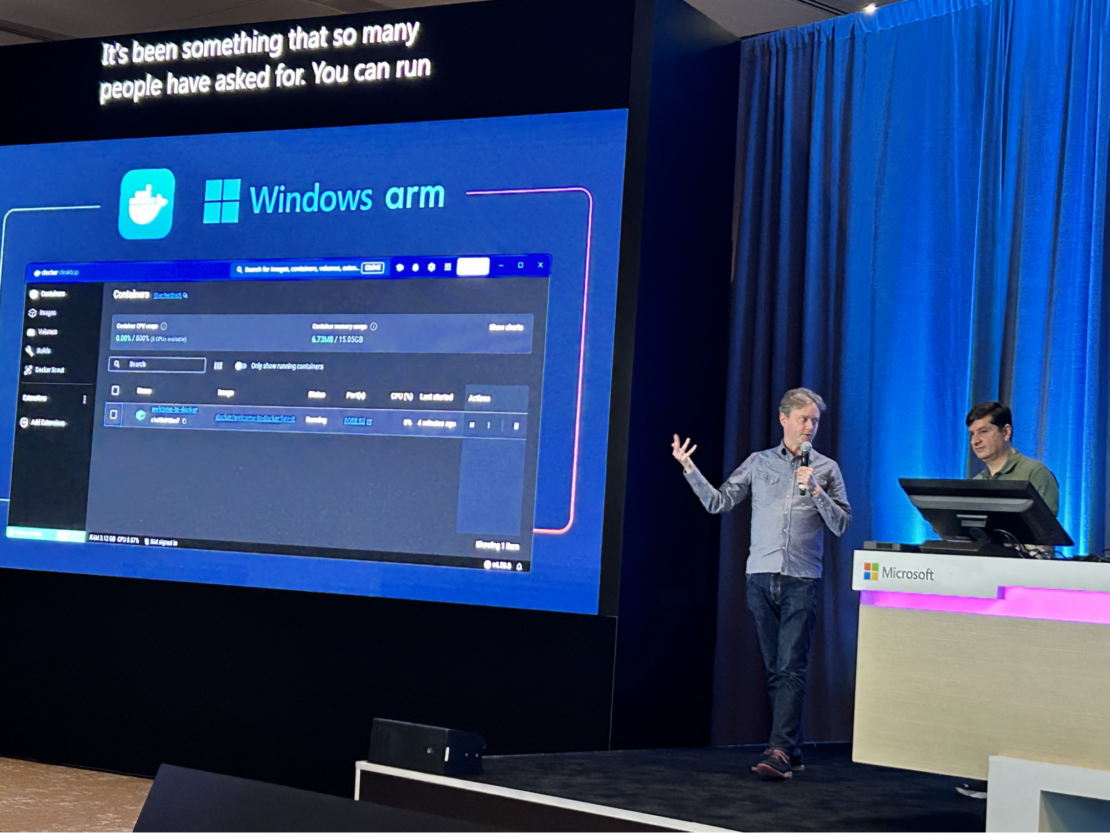
Docker Desktop now supports running on Windows on Arm (WoA) devices. This exciting development was unveiled during Microsoft’s “Introducing the Next Generation of Windows on Arm” session at Microsoft Build. Docker CTO, Justin Cormack, highlighted how this strategic move will empower developers with even more rapid development capabilities, leveraging Docker Desktop on Arm-powered Windows devices.
The Windows on Arm platform is redefining performance and user experience for applications. With this integration, Docker Desktop extends its reach to a new wave of hardware architectures, broadening the horizons for containerized application development.
Docker Desktop support for Windows on Arm
Read on to learn why Docker Desktop support for Windows on Arm is a game changer for developers and organizations.
Broader accessibility
By supporting Arm devices, Docker Desktop becomes accessible to a wider audience, including users of popular Arm-based devices like the Microsoft devices. This inclusivity fosters a larger, more diverse Docker community, enabling more developers to harness the power of containerization on their preferred devices.
Enhanced developer experience
Developers can seamlessly work on the newest Windows on Arm devices, streamlining the development process and boosting productivity. Docker Desktop’s consistent, cross-platform experience ensures that development workflows remain smooth and efficient, regardless of the underlying hardware architecture.
Future-proofing development
As the tech industry gradually shifts toward Arm architecture for its efficiency and lower power consumption, Docker Desktop’s support for WoA devices ensures we remain at the forefront of innovation. This move future-proofs Docker Desktop, keeping it relevant and competitive as this transition accelerates.
Innovation and experimentation
With Docker Desktop on a new architecture, developers and organizations have more opportunities to innovate and experiment. Whether designing applications for traditional x64 or the emerging Arm ecosystems, Docker Desktop offers a versatile platform for creative exploration.
Market expansion
Furthering compatibility in the Windows Arm space opens new markets and opportunities for Docker, including new relationships with device manufacturers and increased adoption in sectors prioritizing energy efficiency and portability while supporting Docker’s users and customers in leveraging the dev environments that support their goals.
Accelerating developer innovation with Microsoft’s investment in WoA dev tooling
Windows on Arm is arguably as successful as it has ever been. Today, multiple Arm-powered Windows laptops and tablets are available, capable of running nearly the entire range of Windows apps thanks to x86-to-Arm code translation. While Windows on Arm still represents a small fraction of the entire Windows ecosystem, the development of native Arm apps provides a wealth of fresh opportunities for AI innovation.
Microsoft’s investments align with Docker’s strategic goals of cross-platform compatibility and user-centric development, ensuring Docker remains at the forefront of containerization technologies in a diversifying hardware landscape.
Expand your development landscape with Docker Desktop on Windows Arm devices. Update to Docker Desktop 4.31 or consider upgrading to Pro or Business subscriptions to unlock the full potential of cross-platform containerization. Embrace the future of development with Docker, where innovation, efficiency, and cross-platform compatibility drive progress.
Learn more
- Watch the Docker Breakout Session Optimizing the Microsoft developer experience with Docker to learn more about Docker and Microsoft better together opportunities.
- Authenticate and update to receive the newest Docker Desktop features per your subscription level.
- New to Docker? Create an account.
- Learn about Docker Build Cloud and how you can leverage cloud resources directly from Docker Desktop.
- Subscribe to the Docker Newsletter.
Related Posts
-
May 12, 2026
Docker AI Governance: Unlock Agent Autonomy, Safely
Introducing Docker AI Governance: centralized control over how agents execute, what they can reach on the network, which credentials they can use, and which MCP tools they can call, so every developer in your company can run AI agents safely, wherever they work. Your laptop is the new prod Agents are the biggest productivity unlock…
Srini SekaranRead now
-
Jun 16, 2026
Docker Content Trust: Retirement and Migration Guidance
Docker Content Trust (DCT) and the Notary v1 service at notary.docker.io are being fully retired (first announced in July of 2025). This blog explains what is changing, who is affected, and how to move to modern alternatives.
Julia WilsonandAditya TripathiRead now
-
Jun 15, 2026
Docker joins the Athena coalition: a cross-industry collaboration for supply chain security
AI is lowering the bar for supply chain attacks. Docker is joining the Athena alliance, a cross-industry effort to coordinate the defense of open source, building on our work to give every developer secure-by-default tools and our track record of sharing signals across the ecosystem.
Tushar JainRead now
-
Jun 11, 2026
Docker Hardened Images enhanced vulnerability scanning with Docker and Aikido
Aikido now scans Docker Hardened Images (DHI) with built-in VEX support. Vulnerabilities that Docker has verified as non-exploitable drop out of the queue automatically, so developers spend their time on findings that actually matter. This post walks through what changed, why it matters, and how users can benefit from the new integration. Why teams are…
Dan StelzerandBjorn HovdRead now