containerd – a core container runtime project for the industry

Today Docker is spinning out its core container runtime functionality into a standalone component, incorporating it into a separate project called containerd, and will be donating it to a neutral foundation early next year. This is the latest chapter in a multi-year effort to break up the Docker platform into a more modular architecture of loosely coupled components.
Over the past 3 years, as Docker adoption skyrocketed, it grew into a complete platform to build, ship and run distributed applications, covering many functional areas from infrastructure to orchestration, the core container runtime being just a piece of it. For millions of developers and IT pros, a complete platform is exactly what they need. But many platform builders and operators are looking for “boring infrastructure”: a basic component that provides the robust primitives for running containers on their system, bundled in a stable interface, and nothing else. containerd is component that they can customize, extend and swap out as needed, without unnecessary abstraction getting in their way and built to provide exactly that.

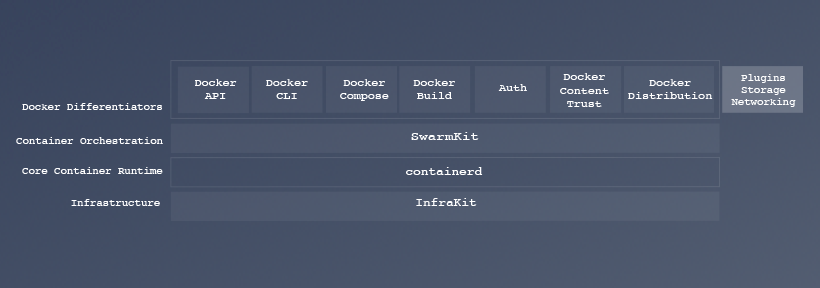
What Docker does best is provide developers and operators with great tools which make them more productive. Those tools come from integrating many different components into a cohesive whole. Most of those components are invented by others – but along the way we find ourselves developing some of those components from scratch. Over time we spin out these components as independent projects which anyone can reuse and contribute back to. containerd is the latest of those components.
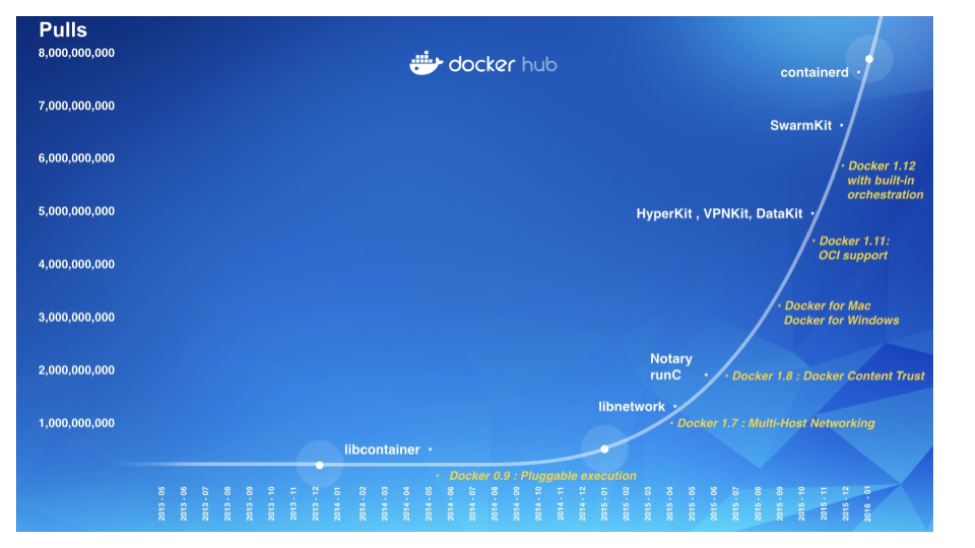
containerd is already deployed on millions of machines since April 2016 when it was included in Docker 1.11. Today we are announcing a roadmap to extend containerd, with input from the largest cloud providers, Alibaba Cloud, AWS, Google, IBM, Microsoft, and other active members of the container ecosystem. We will add more Docker Engine functionality to containerd so that containerd 1.0 will provide all the core primitives you need to manage containers with parity on Linux and Windows hosts:
- Container execution and supervision
- Image distribution
- Network Interfaces Management
- Local storage
- Native plumbing level API
- Full OCI support, including the extended OCI image specification


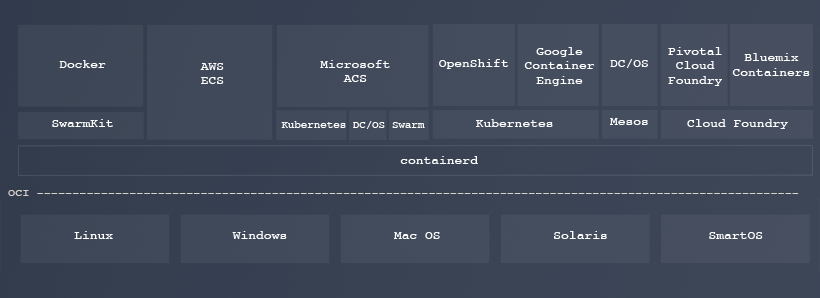
When containerd 1.0 implements that scope, in Q2 2017, Docker and other leading container systems, from AWS ECS to Microsoft ACS, Kubernetes, Mesos or Cloud Foundry will be able to use it as their core container runtime. containerd will use the OCI standard and be fully OCI compliant.

Over the past 3 years, the adoption of containers with Docker has triggered an unprecedented wave of innovation in our industry. We think containerd will unlock a whole new phase of innovation and growth across the entire container ecosystem, which in turn will benefit every Docker developer and customer.
You can find up-to-date roadmap, architecture and API definitions in the Github repository, and more details about the project in our engineering team’s blog post. We plan to have a containerd summit at the end of February to bring in more contributors, stay tuned for more details about that in the next few weeks.
Thank you to Arnaud Porterie, Michael Crosby, Mickaël Laventure, Stephen Day, Patrick Chanezon and Mike Goelzer from the Docker team, and all the maintainers and contributors of the Docker project for making this project a reality.
Additional Resources
- Contribute to containerd
- Attend our Livestream meetup on Friday, December 16.
- Learn more about the containerd summit in February 2017.
- Read the engineering team’s blog post.
[Tweet ” Introducing #containerd – a core #container runtime project for the industry”]
About the Authors
Solomon Hykes is a hacker and entrepreneur. He is the founder of dotcloud and creator of the Docker project. Solomon tweets at @solomonstre.
Related Posts
-
May 12, 2026
Docker AI Governance: Unlock Agent Autonomy, Safely
Introducing Docker AI Governance: centralized control over how agents execute, what they can reach on the network, which credentials they can use, and which MCP tools they can call, so every developer in your company can run AI agents safely, wherever they work. Your laptop is the new prod Agents are the biggest productivity unlock…
Srini SekaranRead now
-
Jun 16, 2026
Docker Content Trust: Retirement and Migration Guidance
Docker Content Trust (DCT) and the Notary v1 service at notary.docker.io are being fully retired (first announced in July of 2025). This blog explains what is changing, who is affected, and how to move to modern alternatives.
Julia WilsonandAditya TripathiRead now
-
Jun 15, 2026
Docker joins the Athena coalition: a cross-industry collaboration for supply chain security
AI is lowering the bar for supply chain attacks. Docker is joining the Athena alliance, a cross-industry effort to coordinate the defense of open source, building on our work to give every developer secure-by-default tools and our track record of sharing signals across the ecosystem.
Tushar JainRead now
-
Jun 11, 2026
Docker Hardened Images enhanced vulnerability scanning with Docker and Aikido
Aikido now scans Docker Hardened Images (DHI) with built-in VEX support. Vulnerabilities that Docker has verified as non-exploitable drop out of the queue automatically, so developers spend their time on findings that actually matter. This post walks through what changed, why it matters, and how users can benefit from the new integration. Why teams are…
Dan StelzerandBjorn HovdRead now