The Magic of Docker Desktop is Now Available on Linux

November 2024 update: See the Docker Subscriptions pricing page for upgraded Docker plans. Simpler, more value, better development and productivity.
Read our Docker Desktop release collection to learn about our latest improvements and innovations.
—
Today we’re excited to announce the general availability of Docker Desktop for Linux, providing developers that use Linux desktop environments the exact same Docker Desktop experience that’s currently available on macOS and Windows.
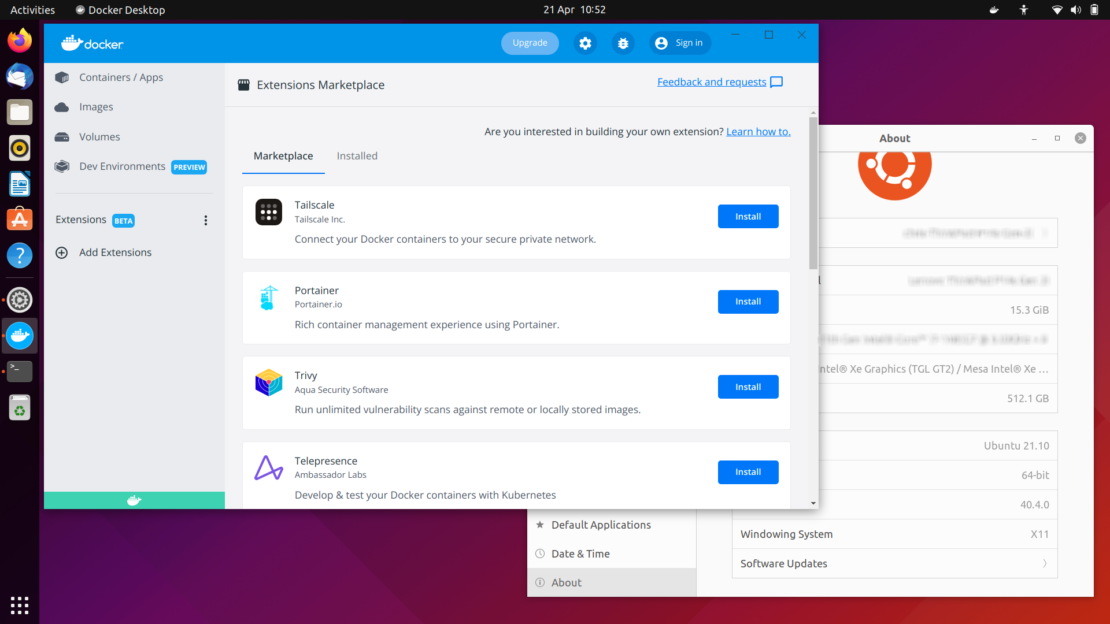
Firstly, we’d like to take this opportunity to say thanks to our community of Linux developers. Many of you provided invaluable feedback on early releases and were kind enough to give us your time to chat about expectations for Desktop for Linux!
First, what’s Docker Desktop?
Some Linux developers that have only used Docker Engine might not be aware of Docker Desktop, so let’s provide a quick overview. Docker Desktop is an easy-to-install application that enables you to build and share containerized applications and microservices. It comes bundled with container tools like Kubernetes, Docker Compose, BuildKit, and vulnerability scanning.
Developers can use the Docker Dashboard to visually manage all of their container resources — and rest easy knowing that Desktop has set sane-and-secure defaults for resource consumption. Not only that, but Docker Desktop now includes Docker Extensions, allowing developers to unleash their productivity by integrating additional developer tools built by Docker partners, the community, or their teammates!
Why did we build Docker Desktop for Linux?
Docker Desktop for Linux was the second-most-popular issue on Docker’s public roadmap. When we spoke with Linux developers who’d voted for the roadmap issue, it was clear that they wanted:
- A unified Docker experience across all major OS’s
- Immediate access to new features (such as Docker Extensions), that have historically only been available on Desktop for Windows and Mac
- The seamless Kubernetes integration that Docker Desktop provides
- The Docker Desktop UI that makes it so much easier to manage volumes, containers and images, as well as providing insights in to the Docker processes running locally on your machine
As we rapidly add value to Docker Desktop, it’s really important to us that the Linux community can benefit. That said, developers who are happy using Docker Engine on Linux can, of course, keep doing so! Desktop for Linux just ensures that Linux developers can leverage all of the exciting new functionality being built into Docker Desktop without having to compromise on their existing CLI-based workflows.
Where can you get it?
To get started with Desktop for Linux, visit the Docker docs to find the relevant instructions for your distro of choice. At launch, we’re providing deb and rpm packages, with specific support for Ubuntu, Debian and Fedora. We’re also providing an experimental package for ArchLinux and are excited to announce that over the coming weeks we’ll be adding support for 64-bit variants of Raspberry Pi OS.
If you need to report any issues or provide feedback, please visit our issue tracker.
What’s next?
Our immediate plans for Docker Desktop for Linux include making installation and update processes as seamless as possible, for example with one-command installs like apt-get install docker-desktop. We’ll also collaborate with our Linux community to ensure that we offer as wide a range of compatibility as possible on their distributions of choice. We also look forward to hearing your feedback and will pay close attention to items that pop up on our issue tracker.
Docker Desktop is continually evolving. Check out our current feature requests, open your own Desktop issues, and even vote on features you’d like to see via our public roadmap.
Related Posts
-
May 12, 2026
Docker AI Governance: Unlock Agent Autonomy, Safely
Introducing Docker AI Governance: centralized control over how agents execute, what they can reach on the network, which credentials they can use, and which MCP tools they can call, so every developer in your company can run AI agents safely, wherever they work. Your laptop is the new prod Agents are the biggest productivity unlock…
Srini SekaranRead now
-
Jun 16, 2026
Docker Content Trust: Retirement and Migration Guidance
Docker Content Trust (DCT) and the Notary v1 service at notary.docker.io are being fully retired (first announced in July of 2025). This blog explains what is changing, who is affected, and how to move to modern alternatives.
Julia WilsonandAditya TripathiRead now
-
Jun 15, 2026
Docker joins the Athena coalition: a cross-industry collaboration for supply chain security
AI is lowering the bar for supply chain attacks. Docker is joining the Athena alliance, a cross-industry effort to coordinate the defense of open source, building on our work to give every developer secure-by-default tools and our track record of sharing signals across the ecosystem.
Tushar JainRead now
-
Jun 11, 2026
Docker Hardened Images enhanced vulnerability scanning with Docker and Aikido
Aikido now scans Docker Hardened Images (DHI) with built-in VEX support. Vulnerabilities that Docker has verified as non-exploitable drop out of the queue automatically, so developers spend their time on findings that actually matter. This post walks through what changed, why it matters, and how users can benefit from the new integration. Why teams are…
Dan StelzerandBjorn HovdRead now