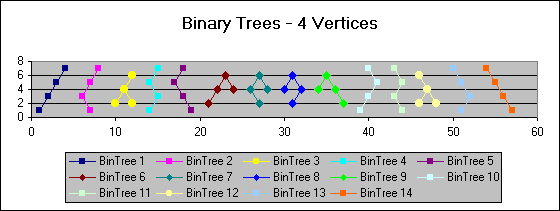
We can go one
step deeper by looking at binary trees that have 4
vertices. All 14 possible binary trees with 4 vertices are
shown above. However, there are only 3 structurally
different variations. Trees1, 2, 4, 5, 10, 11, 13, and 14
share a common structure. Trees 3 and 12 have a second
structure. Finally, trees 6, 7, 8, and 9 share a third
structure. Note that any tree within a given structure can
be converted into any other tree within the same structure
group by combinations of various "flips" (mirror images)
of the subtrees at the appropriate vertices.
At this point we
might wonder how many possible binary trees exit for any
given "N" vertices, and how many of these are structurally
different. We will give the results first and then outline
the algorithms showing how the data is calculated. (Note:
we have included a "0" vertex row as this will be used in
the calculation algorithms.)
Number
of possible binary trees and the number of structurally
different binary trees
Computer
Program by Bill Butler
Method 1) If we know how many different binary trees
exist up through "N" vertices, then we can calculate the
number at "N + 1" via the following observations. We start
by putting the "N + 1"th vertex at the root (top). Then we
note that all binary trees that have "N" vertices could be
tacked on to the left branch from this new vertex. We
could add to this all binary trees that have "N - 1"
vertices tacked to the left branch of the root combined
with all trees that have 1 vertex tacked to the right
branch. Continuing, we add to our total all binary trees
that have "N - 2" vertices tacked to the left branch
combined with all binary trees that have 2 vertices tacked
to the right. We continue this process through "0"
vertices tacked to the left branch and "N" vertex trees
tacked to the right branch. If we use this algorithm to
find the "Number of Binary Trees" for N = 8 we get: 429*1
+ 132*1 + 42*2 + 14*5 + 5*14 + 2*42 + 1*132 + 1*429 =
1,430. (Check the above table to verify the source of
these numbers.
Method 2) There is a direct equation.
Number of Binary Trees[n] = COMBIN(2n, n) / (n + 1)
This can be extended to enumerate all �t-ary� trees via:
Number of t-ary Trees[n] = COMBIN(tn + 1, n) / (tn +
1)
Method 3) First we note that the coefficients (1, 1,
2, 5, 14, 42, etc.) form a Catalan Sequence. This can be
derived from a modified Pascal's Triangle of binomial
coefficients.
Each number in the table is the sum of the
numbers that appear to the left and right immediately
above it with the following exception. At the vertical
line, the upper left number does not contribute its
portion. The numbers to the left of the vertical line
produce the desired coefficients.
Method 4) There is a simple step for producing
Catalan Numbers. This is illustrated below.
The index is off by one but this can be easily adjusted in
a computer program.
When we calculate the number of structurally
different trees, we have to define a system to
differentiate between different trees that have the same
structure. Thus at each vertex in the tree, we will place
the subtree that has the greatest number of vertices on
the left branch, and put the subtree with the smaller
number of vertices on the right. If both subtrees have the
same number of vertices, we arbitrarily assign a letter
(A, B, C, etc.) to each different subtree structure. Then
we keep the letters in alphabetical order.
The "Number of Structurally Different Binary
Trees" can be calculated easily using Method 1) from
above. If we imagine the column on the right as the
contents of an array, then A[N] equals the value of the
array at position "N". For example A[9] = 98. If we want
to calculate A[10] given we have all the values up
to A[9], then we form products using the first half of the
Method 1) algorithm above. Thus, we calculate: 98*1
+ 46* 1 + 23*1 + 11*2 + 6*3 = 207. In general if "N + 1"
is even, then A[N+1] = A[N]*A[0] + A[N-1]*A[1] +
A[N-2]*A[2] etc. and then stop before the two references
cross.
If "N+1" is an odd number, there is a slight
complication, as the two references will exactly meet in
the middle. Let's calculate A[11] to see the difference.
The first part of the calculation is the same. We start at
the two ends and work toward the middle until we get to
the middle. Thus we have: 207*1 + 98*1 + 46*1 + 23*2
+ 11*3 = 430. Then the two converging indexes meet at A[5]
= 6.
The 6 indicates that our new "root" node will
have one of the 6 structurally different subtrees attached
to its left branch, and another of the 6 possible subtrees
attached to the right branch. Let's designate these 6
structurally different subtrees with the letters A, B, C,
D, E, and F.
If "A" goes on the left branch, then the
right branch could have and A, B, C, D, E, or F for 6
combinations. If "B" goes on the left branch, then the
right branch could get a B, C, D, E, or F for 5 more
combinations. ("A" can't go on the right branch, as that
would violate our alphabetical order). If "C" goes on the
left, there are 4 more possible combinations. D, E, and F
similarly produce 3, 2, and 1 more combinations. Thus if
the contents of A[midpoint] is 6, then there are 6 + 5 + 4
+ 3 + 2 + 1 = 21 combinations. If we add this 21 to the
previous 430, we get 451 which is the correct value for
A[11].
In general, if we are calculating A[N], we
form the vector product down to where the two indexes are
about to meet. If N is even this completes the process. If
N is odd, then the two indexes will meet at a midpoint. We
then take the array value at this midpoint and form the
sum of all integers from here down to 1. (If the value at
the midpoint is "X", then sum X + (X-1) + (X-2)...+ 1 =
X(X+1)/2). Finally add this amount to the prior vector
product.
Return to Durango
Bill's Home Page
Web page generated via Sea Monkey's Composer
within a Linux Cinnamon Mint 18 operating system.
(Goodbye Microsoft)