
Grokking Dynamic Programming Interview in Python
The ultimate dynamic programming guide by FAANG engineers. Structured prep with real-world DP questions to get interview-ready in hours!
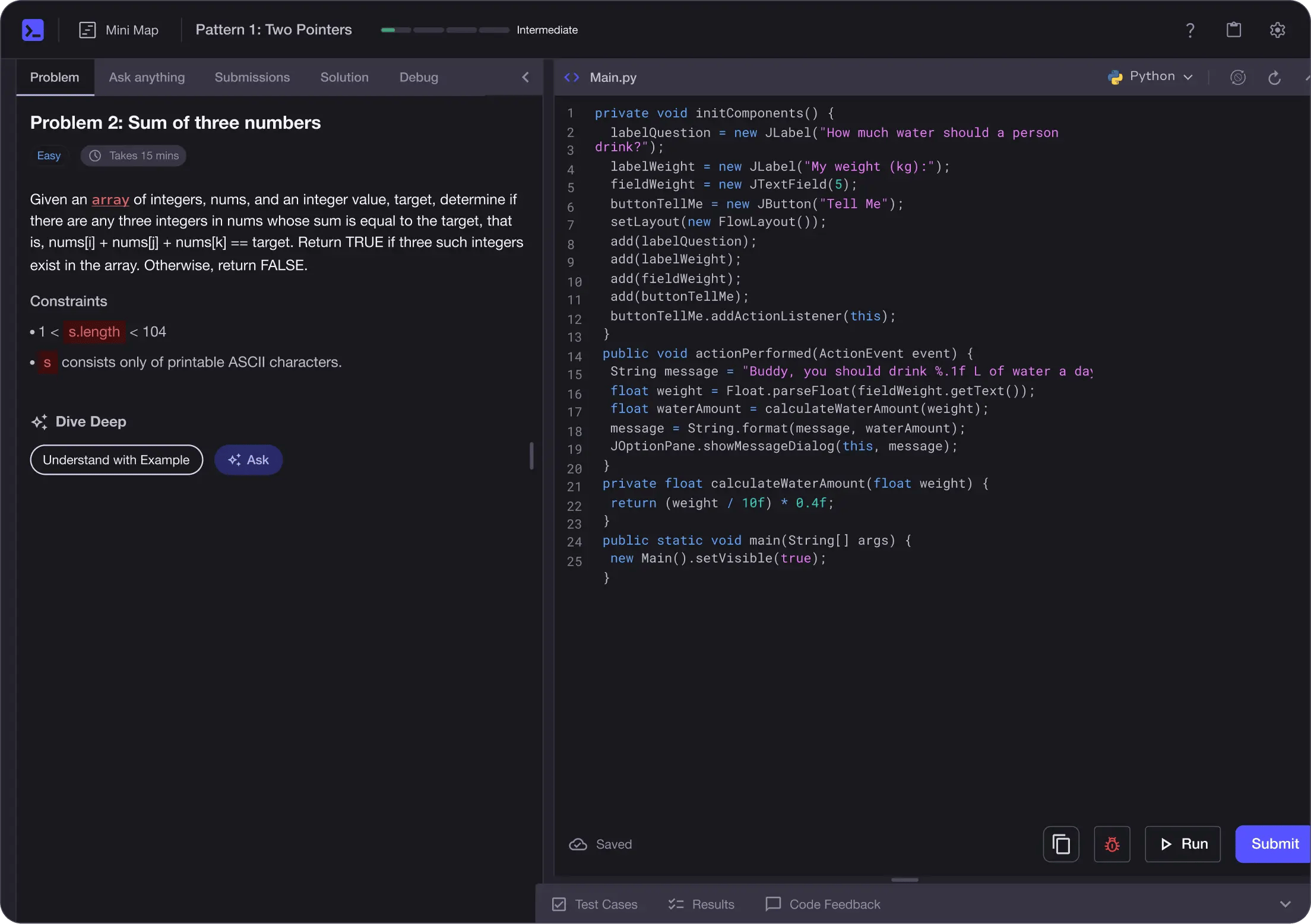
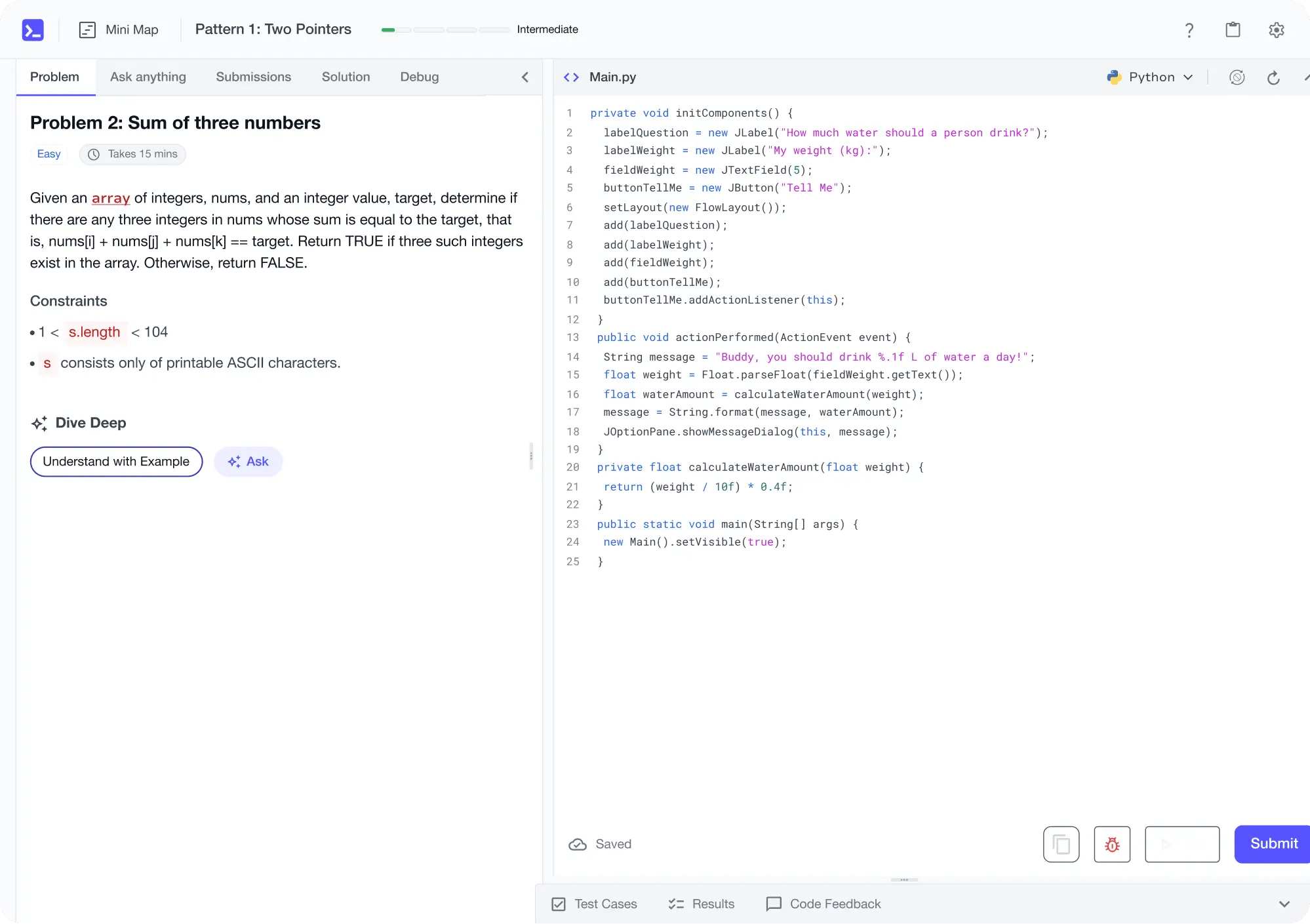
- A deep understanding of the essential patterns behind common dynamic programming interview questions—without having to drill endless problem sets
- The ability to identify and apply the underlying pattern in an interview question by assessing the problem statement
- Familiarity with dynamic programming techniques with hands-on practice in a setup-free coding environment
- The ability to efficiently evaluate the tradeoffs between time and space complexity in different solutions
- A flexible conceptual framework for solving any dynamic programming question, by connecting problem characteristics and possible solution techniques
Learning Roadmap
1.
Getting Started
Getting Started
2.
0/1 Knapsack
0/1 Knapsack
3.
Unbounded Knapsack
Unbounded Knapsack
6 Lessons
6 Lessons
4.
Recursive Numbers
Recursive Numbers
12 Lessons
12 Lessons
5.
Longest Common Substring
Longest Common Substring
16 Lessons
16 Lessons
6.
Palindromic Subsequence
Palindromic Subsequence
6 Lessons
6 Lessons
Trusted by 2.9 million developers working at companies
Anthony Walker
@_webarchitect_
Evan Dunbar
ML Engineer
Software Developer
Carlos Matias La Borde
Souvik Kundu
Front-end Developer
Vinay Krishnaiah
Software Developer
Related Courses and Skill Paths
Built for 10x Developers
Free Resources
Frequently Asked Questions
What is dynamic programming, and why is it important for coding interviews?
Dynamic programming (DP) solves complex problems by breaking them into simpler overlapping subproblems and storing solutions to avoid redundant calculations. It’s important for coding interviews because many optimization and combinatorial problems can be efficiently solved using DP, and interviewers often test candidates on their ability to apply it.
How can I recognize if a problem should be solved using dynamic programming?
Look for problems that involve decision-making with overlapping subproblems or problems that can be broken into smaller, repeatable tasks. Common indicators include terms like “maximum,” “minimum,” “longest,” or “shortest” in the problem description or problems involving subsets, partitions, or sequences.
How can mastering dynamic programming help me in technical interviews?
Mastering DP improves your ability to handle optimization problems and shows interviewers you can solve complex challenges efficiently. Many FAANG and other top-tier companies ask DP questions because they require a combination of logical thinking, optimization, and coding skills.
What is the difference between memoization and tabulation in dynamic programming?
Memoization involves solving a problem recursively and storing the results of subproblems to avoid redundant calculations. Conversely, Tabulation uses an iterative approach to solve the problem and fills up a table from the base case to the final solution. Both techniques are crucial for coding interviews, as different problems may be better suited to one approach.
What’s the best way to explain a dynamic programming solution during an interview?
Start by explaining the problem and the brute-force solution. Then, highlight the inefficiencies and introduce the concept of overlapping subproblems. Finally, explain your dynamic programming approach (memoization or tabulation), emphasizing how it optimizes the solution. Walk through the key steps of your solution clearly while considering edge cases and time complexity.
Learn in-demand tech skills in half the time
