The 9 best AI tools for blog writing in 2026


Last edited June 11, 2026

Table of Contents
- How we picked
- At a glance: how the 9 tools compare
- How a modern AI blog writer actually works
- 1. eesel, best for end-to-end research to publish
- 2. Jasper, best for on-brand marketing long-form
- 3. Koala, best for high-volume SEO blogging on a budget
- 4. Frase, best for SERP-driven content briefs
- 5. Anyword, best for performance-tested marketing copy
- 6. Writesonic, best when AI search visibility matters as much as the article
- 7. Copy.ai, best for codified GTM content workflows
- 8. Writer, best for regulated enterprise content
- 9. Rytr, best for solo budget writers
- So which AI blog writing tool should you actually pick?
- Try eesel
How we picked
We are a content team that ships long-form posts every week, so we judged these tools the way a buyer actually uses them, not on feature-count spec sheets. Four things mattered:
- Output you can ship. How close is the first draft to publishable? A tool that saves you 20% of the editing time beats one that generates ten variations you have to rewrite anyway.
- Real cost at real volume. Sticker price is not total cost. Per-seat tools get expensive fast for teams; word-metered tools have hidden ceilings; we flag where the bill actually lands.
- SEO and AI-search readiness. Ranking on Google still matters, but getting cited by ChatGPT, Perplexity, and Claude is the new battleground. We noted which tools take it seriously.
- Where it fits your workflow. Does it publish to your CMS? Does it learn your brand voice? Is it a chat box or an agent you can delegate to?
Everything below is grounded in the tool's own docs, pricing pages, and public user reviews. Where we quote a user, the link goes to the original.
If you're new to AI writing tools altogether, Beginners in AI is a good starting point - it's a plain-English resource and daily newsletter that helps non-technical people get up to speed on tools like these without needing a tech background.
At a glance: how the 9 tools compare
| Tool | Best for | Entry price | Free option | Long-form | SEO / GEO focus | Brand voice | Publishes to CMS |
|---|---|---|---|---|---|---|---|
| eesel | End-to-end research to publish | $4 / blog post | $50 credit + 2 blogs | Yes (agent) | Yes | Yes | WordPress, Webflow, Ghost, HubSpot |
| Jasper | On-brand marketing long-form | $69 / seat / mo | 7-day trial | Yes (Canvas) | SEO + GEO agents | Strong (Brand IQ) | Via extension / integrations |
| Koala | High-volume SEO blogging | $9 / mo | 5,000 words | Yes (3,500+ words) | Heavy (SERP-driven) | Brand DNA | WordPress, Shopify, Webflow, Ghost |
| Frase | SERP-driven content briefs | $49 / mo | None (paid trial) | Yes | Heavy (SEO + GEO) | Voice profiles | Via integrations |
| Anyword | Performance-tested copy | $49 / mo | 7-day trial | Yes (Blog Wizard) | SEO score | Strong (data-trained) | Via API / extension |
| Writesonic | AI search visibility | $79 / mo | 7-day trial | Metered articles | Heavy (GEO-first) | Yes | Via integrations |
| Copy.ai | GTM content workflows | $29 / mo (Chat) | Legacy free words | Yes (workflows) | Limited | Strong | Via 2,000+ integrations |
| Writer | Regulated enterprise | Contact sales | 14-day trial | Yes (agents) | Limited | Very strong | Via connectors |
| Rytr | Solo budget writers | $9 / mo | Free forever (10K chars) | Limited | Basic | 1-5 custom tones | Chrome extension only |
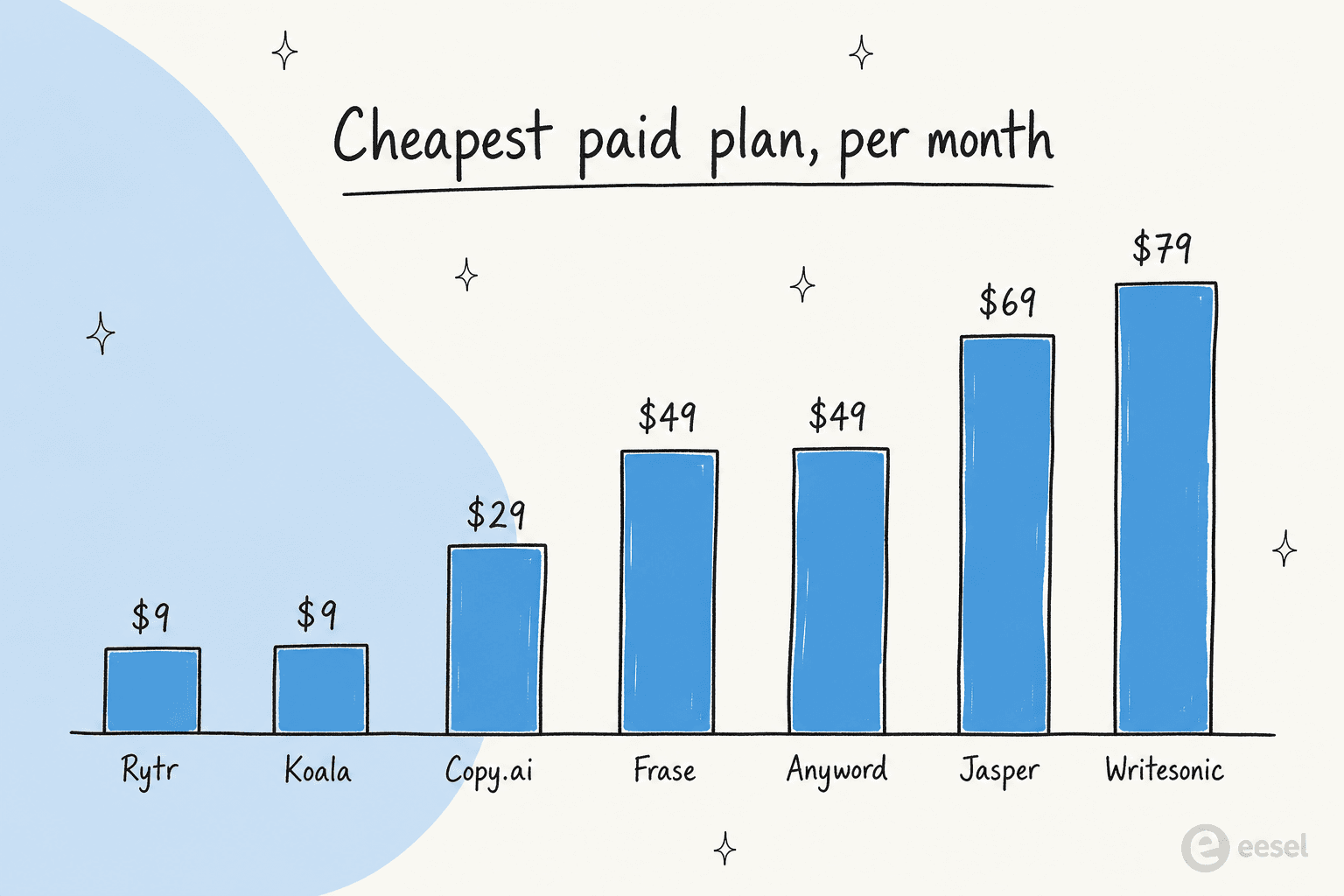
A quick read on this table: the cheapest paid plans cluster at the bottom (Rytr, Koala), the marketing platforms sit in the middle ($49 to $79), and the enterprise options (Writer, plus Copy.ai's real GTM tiers) jump into four-figure-a-month territory. eesel is the outlier on the pricing model itself, billing per task rather than per seat.
How a modern AI blog writer actually works
Before the rankings, it helps to know what these tools are doing under the hood, because the good ones all follow a similar pipeline, and the differences between them are mostly about how much of that pipeline they automate.
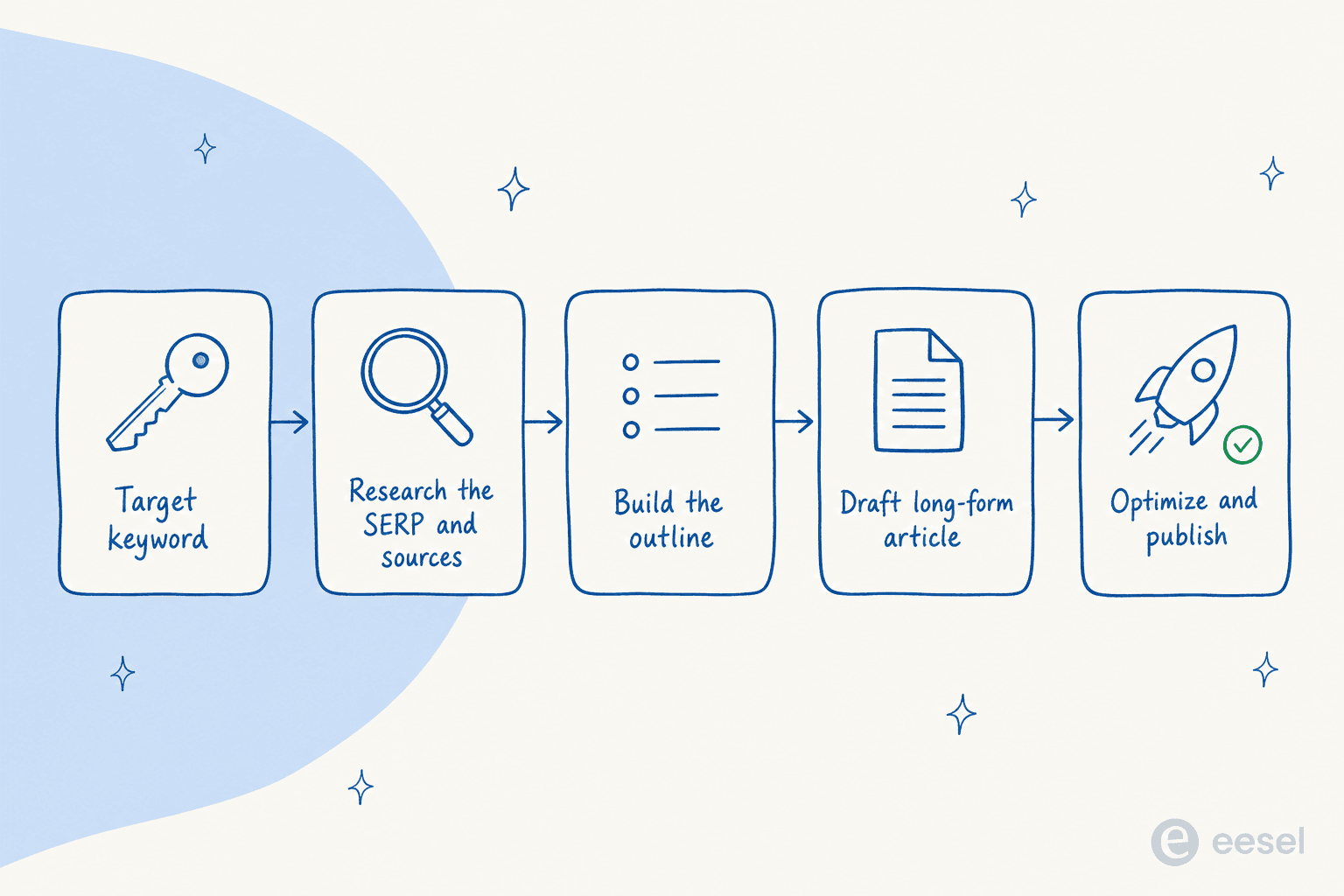
You start with a target keyword. The tool researches what already ranks for it (and, increasingly, what AI engines cite for it), builds an outline from the gaps, drafts the body, optimizes for search, and pushes to your CMS. The line that splits an "AI writing assistant" from an "AI blog writer agent" is how many of those steps you have to drive yourself. An assistant hands you a text box at each stage; an agent takes the brief and comes back with the whole thing done. Keep that distinction in mind as you read, it is the single biggest difference between the tools below.
1. eesel, best for end-to-end research to publish
Best for: marketing and content teams that want to delegate the entire blog production loop to an autonomous agent rather than operate a writing tool step by step.
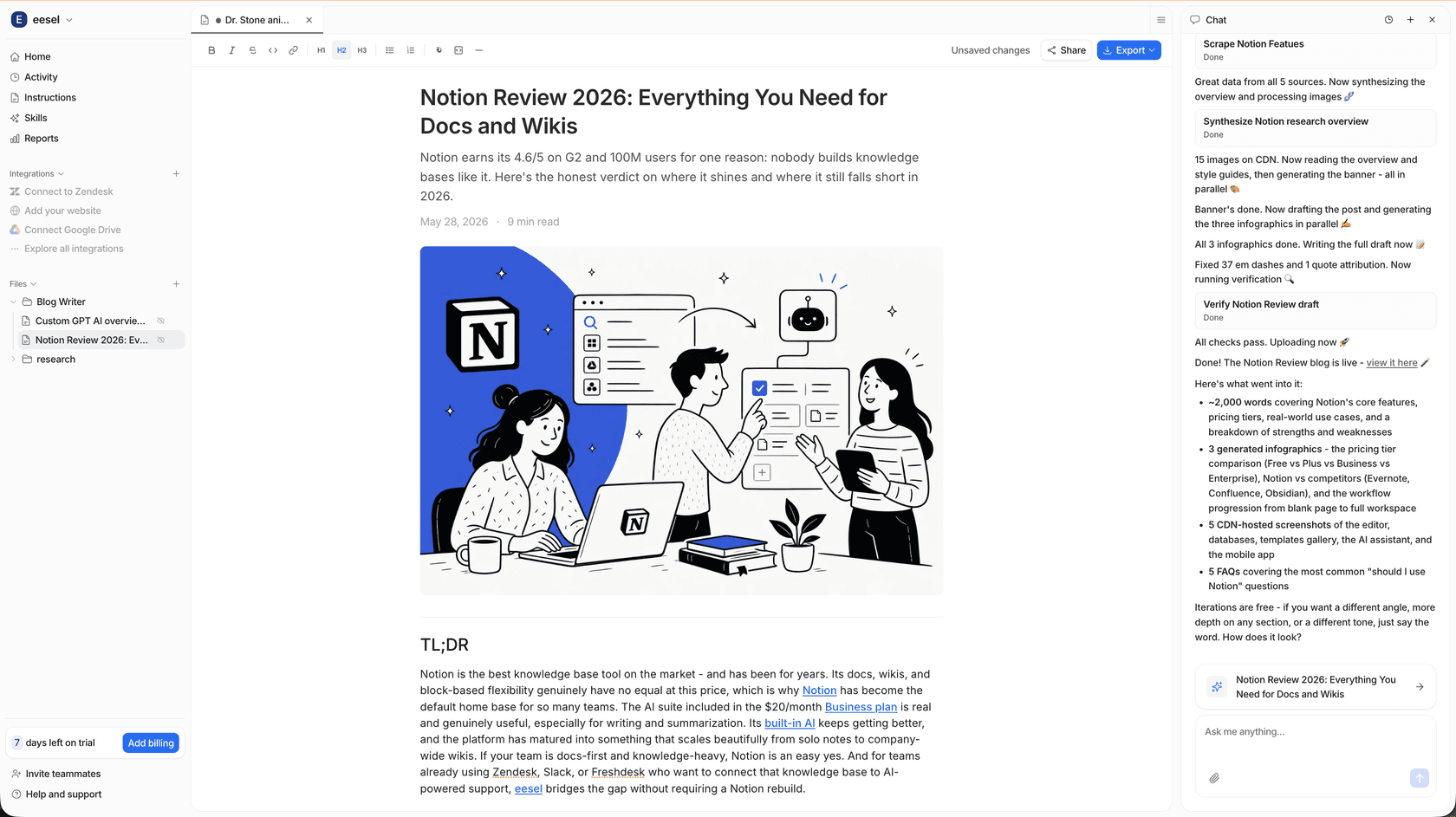
eesel sells a platform of AI teammates that work as independent operators across helpdesks, Slack, email, Shopify, and 100+ other apps. One of those teammates is a Blog Writer agent, listed in eesel's own product lineup alongside the helpdesk and e-commerce agents, with the job of researching, drafting, and publishing long-form content. That framing is the real wedge against everything else here: it is not a chat surface you prompt, it is an agent you brief like a new hire and then let work.
What it does well
- Research lives where you do. The agent can pull grounding context from your existing knowledge, Google Docs, internal Slack threads, and any of eesel's 100+ integrations, so the draft is built on sources you already trust rather than a generic web crawl.
- It is an agent, not a copilot. You brief it once and it returns a full draft (research, outline, body, citations) instead of stopping for input at every step. That is closer to handing work to a contractor than typing into an editor, and it is the same shift we cover in our AI blog writing tools guide.
- The pricing model is the pitch. Instead of charging per seat like Jasper, Anyword, and Frase, eesel charges per task: a regular task (a ticket or chat reply) is $0.40 and a heavy task (a blog post) is $4.00. For a team publishing a few dozen posts a month, that is an unusually clean unit of cost, and there are no seat fees to multiply.
- It publishes where your blog lives. WordPress, Webflow, Ghost, and HubSpot, with a webhooks layer for everything else, so the draft does not die in a copy-paste step. If WordPress is your stack, our AI blog WordPress plugin guide goes deeper.
What to watch for
- It is a newer category, with less review noise. You will not find 1,200 G2 reviews of an "eesel Blog Writer" the way you will for Jasper or Rytr. If you want a deep body of public review evidence before you buy, that is a real tradeoff today.
- Per-task pricing rewards bursty usage. If you publish five posts a month, the $4-per-blog meter is brilliant. If you are publishing 500 a month, a volume-priced tool like Koala will likely come out cheaper, even at the quality tradeoff. We work through the math in our AI blog writer cost post.
Pricing
| Plan | Cost |
|---|---|
| Free trial | $50 credit + 2 blog generations, no card |
| Heavy task (blog post) | $4.00 each |
| Regular task (ticket / chat) | $0.40 each |
| Light task (dashboard Q&A) | Free |
| Annual commit (≥$300/mo) | 25% discount |
| Enterprise | $1,000/mo platform fee + usage |
No seat fees, no self-serve platform minimum, and agents pause automatically at your chosen spend cap. Full detail on the eesel pricing page.
Our take: eesel is the pick when you have stopped thinking of an AI writer as a tool and started thinking of it as a hire. The per-task meter and the agent-not-editor model suit teams that want to delegate blog production, not babysit it. If you mostly want a text box to write in, the tools below will fit better.
2. Jasper, best for on-brand marketing long-form
Best for: marketing teams that need every output to sound like the brand, across blogs, campaigns, and product imagery.
Jasper is the most established name in the category, and it has clearly chosen its lane: it is a marketing platform, not a general writing chatbot. The 2026 product is built around purpose-built marketing agents (SEO, campaigns, optimization), the Canvas long-form editor, and Jasper IQ, a context layer that stores brand voice, style guides, and audience profiles so output stays on-brand automatically. It reports 4.7 out of 5 across 1,270 G2 reviews and over 100,000 business customers.
What it does well
- Brand control is unusually deep. Brand Voice plus the Business-only Style Guide and Visual Guidelines mean large teams can enforce tone and even visual rules across everything they generate.
- The proof points are real. Adidas cited 7,500 product descriptions written in 24 hours, and Anthropologie reports 60% of its SEO now automated with Jasper. These are scaled, named results, not vague testimonials.
- It is multimodal. Image Pipelines and APIs generate on-brand product imagery, which most pure writing tools cannot touch.
What to watch for
- "Generic output" is the most common complaint. It recurs across G2 and Reddit. As one user put it after testing it on website content:
"Quick drafts are okay, but structure and tone for blogs often felt off."
- Cost bites at the small end. G2's reviewer mix is 93% small business, and "expensive" is a recurring con. At $69 per seat per month, Jasper is steep next to Copy.ai and Rytr. The full breakdown is in our Jasper AI pricing guide.
- Pro is single-seat. Style Guide, API, and SSO are all Business-only, which means most serious team features sit behind a custom-priced, 12-month-commitment plan.
Pricing
| Plan | Monthly | Yearly (per seat) | Notes |
|---|---|---|---|
| Pro | $69 / seat | $59 / seat | Single seat; no Style Guide, API, or SSO |
| Business | Custom | Custom | Unlimited brand voices, Style Guide, API, SSO, 12-month commit |
Our take: Jasper earns its price for mid-market and enterprise marketing teams where on-brand consistency across many writers is the whole point. Solo bloggers will find it overbuilt and overpriced, and should look at Koala or Rytr. If you are weighing it against the obvious rival, our Jasper vs Copy.ai comparison digs in.
3. Koala, best for high-volume SEO blogging on a budget
Best for: solo SEO operators and affiliate publishers who need long, publish-ready articles at volume without paying marketing-platform prices.
Koala is unapologetically SEO-first, its homepage tagline is "AI Articles That Actually Rank." The flagship KoalaWriter is a one-click SEO blog generator: pick a keyword, an article type (blog post, listicle, Amazon roundup, YouTube-to-blog), and a model (it recommends Claude 4.5 Sonnet), and it produces a 3,500+ word, publish-ready article. The April 2026 Brand DNA + KoalaWriter v2 release is, in Koala's own words, "the biggest update in Koala AI's history."
What it does well
- The one-click WordPress push is the loved feature. Reddit users repeatedly cite it as the thing that flipped them off plain ChatGPT, it kills the copy-paste step that makes volume publishing miserable.
- It is built on real SERP data. Real-time SERP analysis and a Deep Research mode that "uses 100x more context" mean drafts come pre-structured around what already ranks.
- Automatic internal linking at scale. Koala claims 10+ million internal links created, a chore it handles automatically that most tools leave to you.
What to watch for
- The word-count math has a catch. Word quotas are billed at the GPT-5 Mini rate; using the recommended Claude 4.5 Sonnet doubles the cost, so a $49 Professional plan is effectively 50,000 high-quality words a month, not 100,000.
- The review gap is real. Koala's on-site testimonials are uniformly five-star, but its public Trustpilot aggregate sits at 3.5 out of 5 across 21 reviews. That gap is worth knowing before you commit.
Pricing
| Plan | Monthly | KoalaWriter words | Key gates |
|---|---|---|---|
| Essentials | $9 | 15,000 | Base features, WordPress |
| Professional | $49 | 100,000 | + Deep Research, auto internal linking, KoalaLinks |
| Boost | $99 | 250,000 | 2x faster bulk |
| Growth | $179 | 500,000 | - |
| Scale I–III | $750–$2,000 | 2.5M–10M | 3x faster bulk |
Free trial is 5,000 words, no card. Full plan list on the Koala pricing page.
Our take: for a publisher whose business model is volume (affiliate sites, programmatic SEO), Koala is the best value here, just budget for the real per-word cost at the model you actually want. If you need brand consistency or team governance, this is not the tool.
4. Frase, best for SERP-driven content briefs
Best for: content strategists and agencies who want SEO research, briefs, drafting, and AI-visibility tracking in one SERP-mirroring workflow.
Frase replaces a stack of single-purpose tools with one agent that does SERP research, brief generation, drafting, optimization, and now GEO tracking. Its durable model: it scrapes the top 10 SERP results in about 30 seconds, pulls out the topics and gaps competitors missed, and turns them into an SEO-optimized outline. It is less a freeform writer than a brief-generator with a writer attached, and it is well-liked for it, 4.8 stars across 300+ G2 reviews with 98% would-recommend. Kevin Indig, then Director of SEO at Shopify, is quoted on the pricing page:
"Our organic traffic is up 3x since we started."
What it does well
- Brief and outline generation is the standout. It is the single most-praised feature across comparison threads, the outlines are useful starting points, not filler.
- GEO is first-class. Every plan includes generative engine optimization and AI visibility tracking across ChatGPT, Perplexity, Claude, and Gemini, a direct answer to the "do SEO tools still matter in the LLM era" question.
- Plans differ in volume, not capability. Even the $49 Starter gets the full AI Agent, SEO + GEO optimization, and SERP research; you pay for more articles, not unlocked features.
What to watch for
- It wins on price, not optimization depth. In head-to-head threads it is consistently framed as the "cheaper Surfer SEO," strong on content creation, a step behind on deep optimization scoring. Our Clearscope vs Frase comparison covers that tradeoff.
- The entry price has a discrepancy. Frase's tools page advertises "$38/month" while the pricing page starts at $49/mo monthly ($39 annual). Confirm the current number before you quote it.
Pricing
| Plan | Monthly | Seats | Articles/mo | AI platforms tracked |
|---|---|---|---|---|
| Starter | $49 | 1 | 10 | 2 |
| Professional | $129 | 3 (+$29/seat) | 40 | 3 |
| Scale | $299 | 5 (+$29/seat) | 100 | 5 |
| Enterprise | Custom | Custom | Custom | 8 |
Our take: Frase is the best pick for someone who treats the brief as the most important part of the process, and most experienced SEOs do. If you want the deepest optimization scoring, pair it with a dedicated tool or look at Writesonic for the GEO-heavy angle.
5. Anyword, best for performance-tested marketing copy
Best for: performance marketers who want a prediction of how copy will land before they publish it.
Anyword has one big differentiator: predictive performance scoring, a numeric prediction of which copy variation will perform better against a target audience and goal, before you publish. The company claims it does this with 82% accuracy versus 52% for a generic model like GPT-4o. Around that core sit a Blog Wizard for long-form, a brand voice hub, and a Performance API. One verified reviewer captured the appeal:
"Yesterday, I executed an entire landing page strategy in 1 day. It would have taken several weeks, and much more stress, before Anyword."
What it does well
- The performance scoring is the buying reason. It is the most-cited feature in reviews, and unlike most marketing claims, users echo it rather than just the vendor. It reframes the AI from "generate" to "generate, score, and rank."
- Ease of use leads the praise across its 4.8-star G2 profile (1,226+ verified reviews), with speed-to-output a close second.
- Enterprise trust posture is strong: SOC 2, ISO 27001, GDPR, and HIPAA, with custom models trained on your own performance data on higher tiers.
What to watch for
- Cost is the dominant pushback for solo and freelance users, $49/mo Starter feels high next to Copy.ai or Rytr for general writing.
- API and SSO are Enterprise-only, a common friction point for mid-market teams that want to embed predictions without a custom contract.
- It can stumble on sensitive or niche topics, a stated weakness for content outside mainstream marketing.
Pricing
| Plan | Monthly | Yearly (per mo) | Seats | Predictions/mo |
|---|---|---|---|---|
| Starter | $49 | $39 | 1 | 50 |
| Data-Driven | $99 | $79 | 3 | 100 |
| Business | Custom | Custom | 3+ | 250 |
| Enterprise | Custom | Custom | Custom | 500+ |
Our take: Anyword is the pick when conversion is the metric that matters more than word count, landing pages, ads, and email where a prediction score earns its keep. For pure blog volume it is overkill; for revenue-driving copy it is the most data-grounded tool here.
6. Writesonic, best when AI search visibility matters as much as the article
Best for: marketing teams who care less about churning out articles and more about getting cited across AI search surfaces.
Writesonic has pivoted hard. It is no longer marketed as an AI writer, it is now an "AI Search Growth Engine" for GEO and SEO, built to track your brand's visibility across 10 AI search surfaces (ChatGPT, Perplexity, Claude, Gemini, Grok, and more), prioritize fixes through an Action Center, and ship those fixes with AI agents. The historical AI article writer still lives inside the platform as a metered quota. It is backed by a 2 billion+ conversation AI Search Dataset and strong review counts (G2 4.8 across 2,031 reviews). On the writing itself, users are blunt about the reality:
"You can turn 'full time blog writer' into 'owner spending 3 hours a week' with these tools. And yes, you're always gonna be heavily editing."
What it does well
- GEO is the whole product now. If your 2026 goal is showing up in AI answers, Writesonic is built around that from the ground up, including bot analytics for GPTBot, ClaudeBot, and PerplexityBot.
- The Action Center is the smart part, surfacing 5 to 10 ranked actions a week instead of a wall of data.
- Drafting is fast and template-rich, the long-standing strength reviewers still cite, even as the brand de-emphasizes it.
What to watch for
- The best surfaces are Enterprise-only. Tracking Perplexity, Claude, Grok, and most of the 10 platforms, plus the full Action Center, is gated to Enterprise. The cheaper plans track ChatGPT (and a couple more) only.
- It is the priciest entry point here at $79/mo, and the jump to full capability is steep. Our Writesonic pricing and Writesonic alternatives guides map the tiers.
Pricing
| Plan | Monthly | AI platforms | Articles/mo | Key gate |
|---|---|---|---|---|
| Starter | $79 | ChatGPT only | 15 | Single platform |
| Basic | $199 | ChatGPT + Gemini + Google AIO | 25 | No Action Center |
| Growth | $399 | ChatGPT + Gemini + Google AIO | 50 | Action Center is a trial |
| Enterprise | Custom | All 10 platforms | Custom | Full agents, SSO |
Our take: if you buy Writesonic, buy it for the visibility tracking, not the article writer, that is where the product's energy now lives. For pure drafting at this price, Frase or Koala give you more.
7. Copy.ai, best for codified GTM content workflows
Best for: revenue and marketing ops teams who want to systematize content production inside larger go-to-market workflows.
Copy.ai started as a blank-page killer and has rebranded into "the first AI-native GTM platform," built around Workflows, Tables, Agents, and Brand Voice. It claims 17 million users. For most people coming for blog writing, the relevant piece is still the content generation, which reviewers consistently praise for beating the blank page, and the Brand Voice control that a recent Reddit user flagged as the reason to look at it:
"On paper it looks good. They seem to remember brand voice and tone. I am hoping to write consistent copies for various marketing purposes."
What it does well
- The Chat tier is the cheapest serious entry point for a capable writer, $29/mo monthly, and it still handles first drafts well.
- Brand voice and tone control is the named differentiator in user threads, it remembers your voice across outputs.
- Workflows are powerful if you actually have repeatable GTM processes to codify (not most solo bloggers, but real for ops teams).
What to watch for
- The pricing cliff is brutal. Chat is $29/mo; the next real tier, Growth, is $1,000/mo. There is no middle. If you outgrow Chat, you are suddenly in enterprise territory.
- The category skeptics are loud, and worth hearing. As one r/copywriting commenter put it, "value is created by putting time and effort into copy, not by prompting away on a hunch."
- It is drifting from blogging. Copy.ai's heart is now GTM automation, not long-form content; if you only want a blog writer, you are buying a sliver of the platform.
Pricing
| Tier | Seats | Workflow credits/mo | Price (annual) |
|---|---|---|---|
| Chat | 5 | None (chat only) | $24/mo ($29 monthly) |
| Growth | 75 | 20K | $1,000/mo |
| Expansion | 150 | 45K | $2,000/mo |
| Scale | 200 | 75K | $3,000/mo |
Our take: for a solo blogger, the $29 Chat tier is a fine, cheap writer. For everyone else, only buy Copy.ai if you want the GTM platform, not the blog tool, and compare it against ChatGPT and Writesonic before you commit.
8. Writer, best for regulated enterprise content
Best for: large, regulated enterprises that need governed AI agents operating across internal data, not a self-serve writing app.
Writer (writer.com) is the most enterprise-only tool on this list. Founded in 2020 with 200+ employees, it is a full-stack platform for building and governing AI agents that execute multi-step work across enterprise data, powered by its own in-house Palmyra model family. Every CTA on the site is "Request a demo," and the customer wall is all Vodafone, Vanguard, Salesforce, and KPMG, no SMB logos anywhere. Its tagline for the agent product says it plainly: "Not a tool you prompt. An agent you delegate to."
What it does well
- Brand-voice enforcement is the most-praised feature across G2, Gartner, and TrustRadius, it is the real wedge against ChatGPT and Copilot for big content teams.
- Governance is enterprise-grade: audit logs, RBAC, SAML SSO, SCIM, plus SOC 2 Type II, GDPR, HIPAA, and PCI compliance built in.
- The Knowledge Graph is a proprietary RAG layer over your own data, so agents work from your institutional knowledge, not the open web.
What to watch for
- No public pricing, and no real SMB path. Starter has a free 14-day trial, but any serious deployment is contact-sales, expect five- to six-figure annual contracts.
- Performance on large documents is the top complaint, with multi-minute query times against big Knowledge Graphs cited across reviews.
- Feature gating frustrates smaller users, departmental voices, Agent Builder, and advanced connectors all sit behind Enterprise.
Pricing
| Plan | Cost | Notes |
|---|---|---|
| Starter | Free 14-day trial, then per-seat | Up to 5 users, 1 voice profile, basic connectors |
| Enterprise | Contact sales | Unlimited users, full Knowledge Graph, SSO, BAA, Agent Builder |
Our take: Writer is not for bloggers, it is for enterprises operationalizing AI across departments with compliance teams watching. If that is you, it is one of the strongest options anywhere. If you just want to write posts, it is wildly over-scoped.
9. Rytr, best for solo budget writers
Best for: solo creators, freelancers, and small-business marketers who want a capable writer for the price of a coffee.
Rytr is the budget pick, and it owns that lane without apology. It has a real free-forever tier (10,000 characters a month, no credit card), 40+ templates, and tone-matching that mirrors a writing sample you feed it. It reports 8 million+ users and 4.7 out of 5 across 819 G2 reviews. The pitch is simple: "content that sounds like you, not a robot," at a price solo writers can actually afford.
What it does well
- Price is the whole story, and it delivers. The free tier plus a $9/mo Unlimited plan is why people pick Rytr over Jasper or Copy.ai, see our ChatGPT vs Rytr comparison for how it stacks up against the obvious free alternative.
- It is best as an augmenter. Reviewers who use it for autocomplete, expansion, and rewording report better results than those generating whole articles end to end, which is the right way to use a budget tool.
- 20+ preset tones on every tier, including the free one, with custom tone-cloning on paid plans.
What to watch for
- Usage caps are the top complaint, even from five-star reviewers, the character limits feel tight once you lean on it.
- Output reads generic without editing, and Rytr is more honest about needing a human than most.
- The product is showing maintenance lag: the
/featurespage is a 404 and the blog-writing use-case page is "under construction" as of mid-2026. There are also no native CMS integrations beyond the Chrome extension, and no SOC 2 or GDPR posture surfaced for buyers who need it.
Pricing
| Tier | Price (yearly) | Headline limit | Custom tones | Languages |
|---|---|---|---|---|
| Free | $0 | 10K characters/mo | None | 1 |
| Unlimited | $7.50/mo | Unlimited characters | 1 | 1 |
| Premium | $24.16/mo | Unlimited + 3x input | Up to 5 | 35+ |
(G2 lists the monthly-billing ceiling at $29/mo; the figures above are the yearly-equivalent rates.)
Our take: Rytr is the right call for a solo writer or freelancer on a tight budget who wants help drafting, not full automation. Teams, brand-governance needs, and anyone who needs a compliance checkbox should look elsewhere, this is a personal tool, and a good one at its price.
So which AI blog writing tool should you actually pick?
Here is the honest map. The cheapest paid plans are not where the quality ceiling is, and the most expensive ones are buying you governance, not better prose.
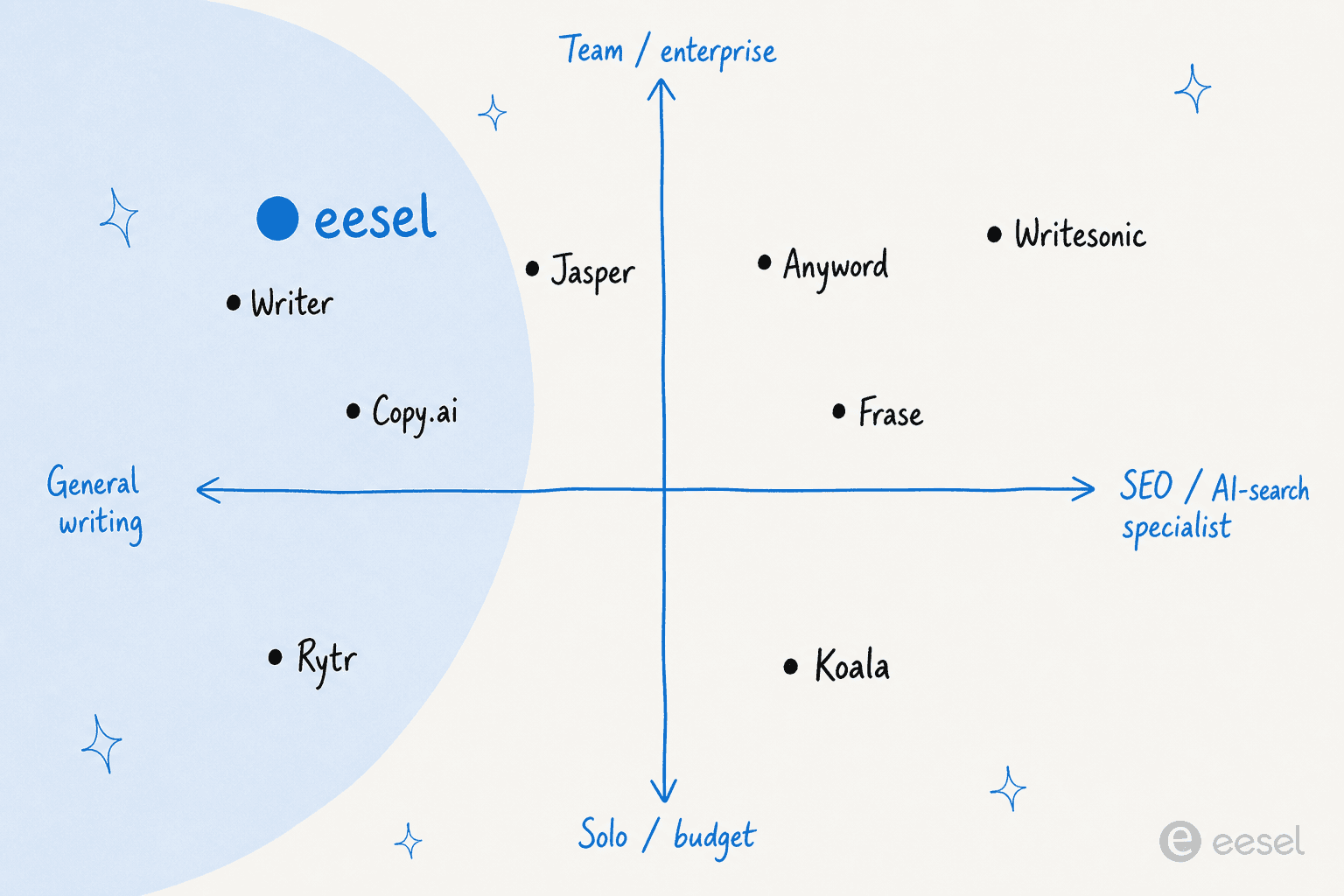
And here is how they sort by what they are actually built for, from solo-and-cheap to team-and-enterprise, and from general writing to dedicated SEO and AI-search work:
In plain terms:
- You want to delegate the whole blog, not operate a tool: eesel.
- You are a marketing team obsessed with brand voice: Jasper.
- You publish SEO articles at volume on a budget: Koala.
- The brief is the heart of your process: Frase.
- Conversion copy where a performance score matters: Anyword.
- Your 2026 goal is AI-search visibility: Writesonic.
- You are codifying GTM workflows, not just blogging: Copy.ai.
- You are a regulated enterprise with compliance watching: Writer.
- You are a solo writer who just wants cheap help: Rytr.
The one shift worth internalizing: the category is splitting between "tools you write in" and "agents you delegate to." Most of this list is still the former. If your goal is to spend less time producing posts at all, that distinction matters more than any feature checkbox.
Try eesel
If the appeal of this whole list is "I want good blog posts without running the machine myself," that is the gap eesel is built for. Its Blog Writer agent does not hand you a text box, it takes a brief, researches from your own knowledge and 100+ integrations, drafts a cited long-form post, and publishes it to WordPress, Webflow, Ghost, or HubSpot.
The pricing is the other half of the pitch: $4 per blog post, no per-seat fees, with a free trial that includes $50 of credit and two free blog generations. For a team shipping a few dozen posts a month, that is a far cleaner cost than stacking $69 seats. Try eesel and let an agent take the first draft off your plate, or see the full breakdown on the pricing page.
Frequently Asked Questions

Share this article

Article by
Riellvriany Indriawan
Riell is a designer and writer at eesel AI with about two years of experience researching CX platforms, AI chatbots, and helpdesk software. She combines her design background with a sharp eye for how these tools actually look and feel in practice — making her comparisons unusually visual and user-focused.