6 best chatbots for ecommerce in 2026 (hands-on comparison)


Last edited January 16, 2026

Table of Contents
So, your e-commerce store is finally taking off. The good news? Sales are up. The not-so-good news? Your support inbox is exploding.
You've probably seen other stores using AI chatbots to give customers instant answers, and you're thinking it might be time to get one yourself. But with so many options out there, how do you pick the right one? The last thing you want is to get locked into a complicated tool that just doesn't work with the systems you already have in place.
I’ve been there. That’s why I rolled up my sleeves and tested the top platforms to find the best chatbot for e-commerce. This guide is the result of that deep dive, showing you which tools actually save time, keep customers happy, and boost sales, all while respecting the systems you and your team already know and love.
What is an e-commerce chatbot?
At its core, an e-commerce chatbot is just an automated assistant for your online store. Instead of forcing customers to dig through FAQ pages or wait hours for a reply, a chatbot gives them instant answers, day or night.
But modern bots are much more than a glorified search bar. A good one can:
-
Answer questions before a sale, like "Do you ship to Canada?" or "Is this available in a medium?"
-
Handle post-purchase support, like tracking an order or starting a return.
-
Act like a personal shopper, recommending products based on what a customer is looking for.
-
Help recover abandoned carts by popping up with a discount code or answering a last-minute question.
-
Know when to quit, seamlessly passing a tricky conversation to a human agent.
Basically, a solid e-commerce chatbot takes the repetitive stuff off your team's plate. This frees them up to focus on the conversations that actually require a human touch, while your customers get the help they need, right away.
How I picked the best e-commerce chatbot platforms
Finding the right chatbot isn't about picking the one with the flashiest website or the longest feature list. Some are simple, rule-based bots, while others are powered by some seriously smart AI. Some provide a complete, mature support operation, while others play nicely with the tools you already use.
To sort through it all, I judged every platform on five things that I think really matter for a growing store.
My criteria for the best tools:
-
Ease of setup: How fast can I actually get this thing working? I looked for platforms that are genuinely self-serve or offer a clear, structured path to going live.
-
Integration power: Does it connect to my current helpdesk and knowledge sources (like our internal Google Docs or old support tickets)? The best tools should feel like an upgrade to your current workflow.
-
Customization and control: Can I make the bot sound like my brand? Can I control which questions it answers and which it leaves for my team? Can it pull real-time data, like order status?
-
AI intelligence: How smart is this thing, really? I focused on platforms that could learn from your business data, like thousands of past support tickets, to give answers that are actually accurate and on-brand.
-
Transparent pricing: Is the pricing easy to understand? I looked for tools with clear pricing models that match the value they provide to a busy support team.
The best e-commerce chatbot platforms in 2026
Here’s a quick rundown of my top picks. I’ve broken them down by what they're best for, their standout feature, and how they charge you.
| Tool | Best For | Key Feature | Pricing Model |
|---|---|---|---|
| eesel AI | Adding powerful AI to your existing helpdesk | Trains on past tickets & simulates resolutions | Flat monthly fee |
| Gorgias | Shopify-native stores needing a mature helpdesk | Deep Shopify integration | Tiered per ticket |
| Tidio | Small businesses wanting a simple, free starting point | All-in-one live chat and chatbot | Per seat |
| Minami AI | Ecommerce brands with high post-purchase ticket volume | Purpose-built post-purchase automation | Contact sales |
| Drift | B2B companies focused on sales and lead conversion | Conversational marketing features | Custom |
| ManyChat | Stores that engage mostly on social media | Instagram & Facebook Messenger automation | Per contact |
A closer look at the 6 best e-commerce chatbot tools
Alright, let's get into the details of what makes each of these platforms a strong contender for a busy e-commerce store.
1. eesel AI
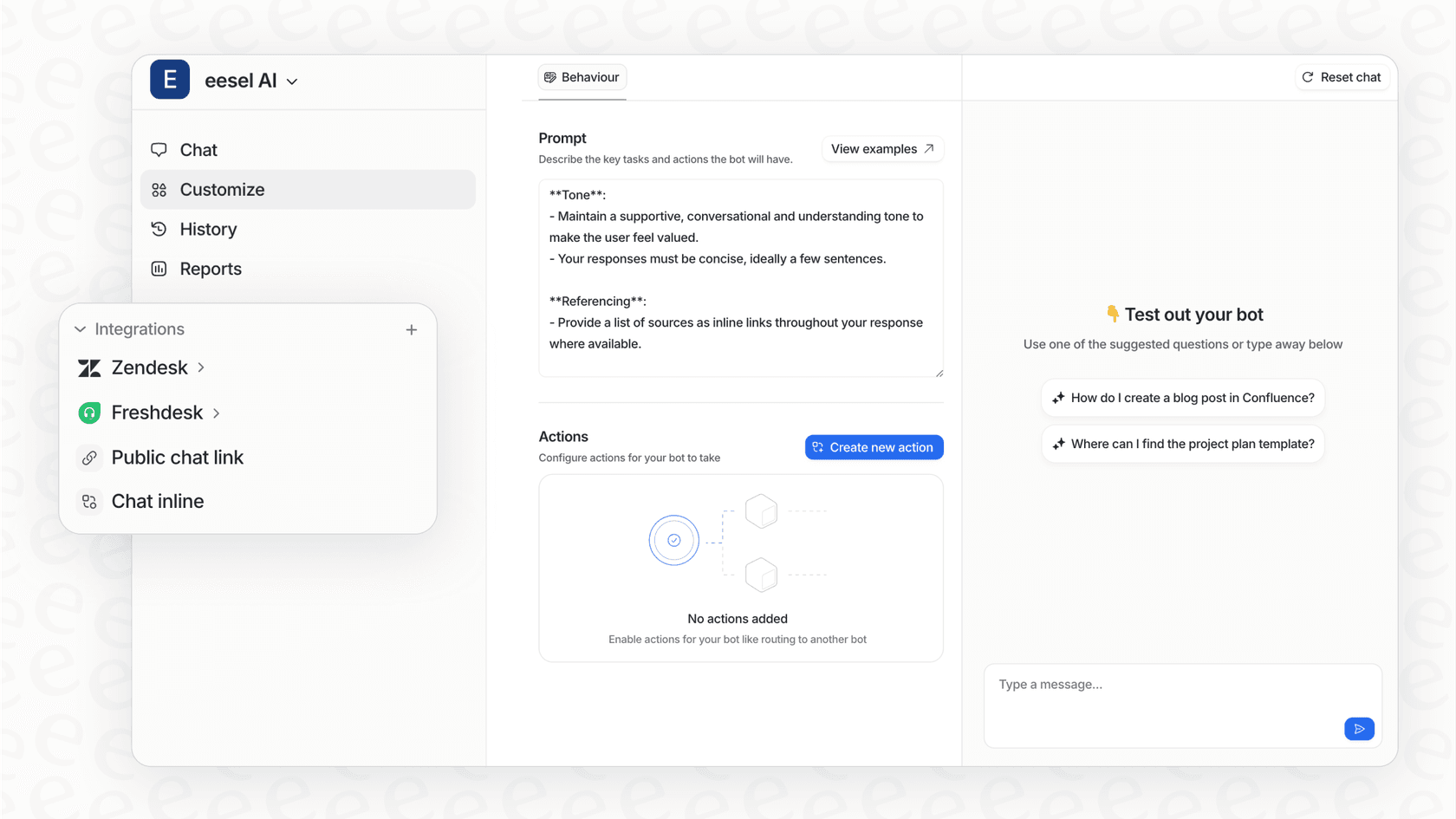
The whole idea behind eesel AI is that you can add powerful AI to your favorite helpdesk. Instead of making you migrate everything, it plugs right into platforms like Gorgias, Zendesk, and Intercom with just a few clicks. Its main advantage is its brain. eesel AI reads your past support tickets, macros, and knowledge bases (whether they're in Google Docs or Confluence) to learn your brand's voice and product details, so it can give accurate answers from day one.
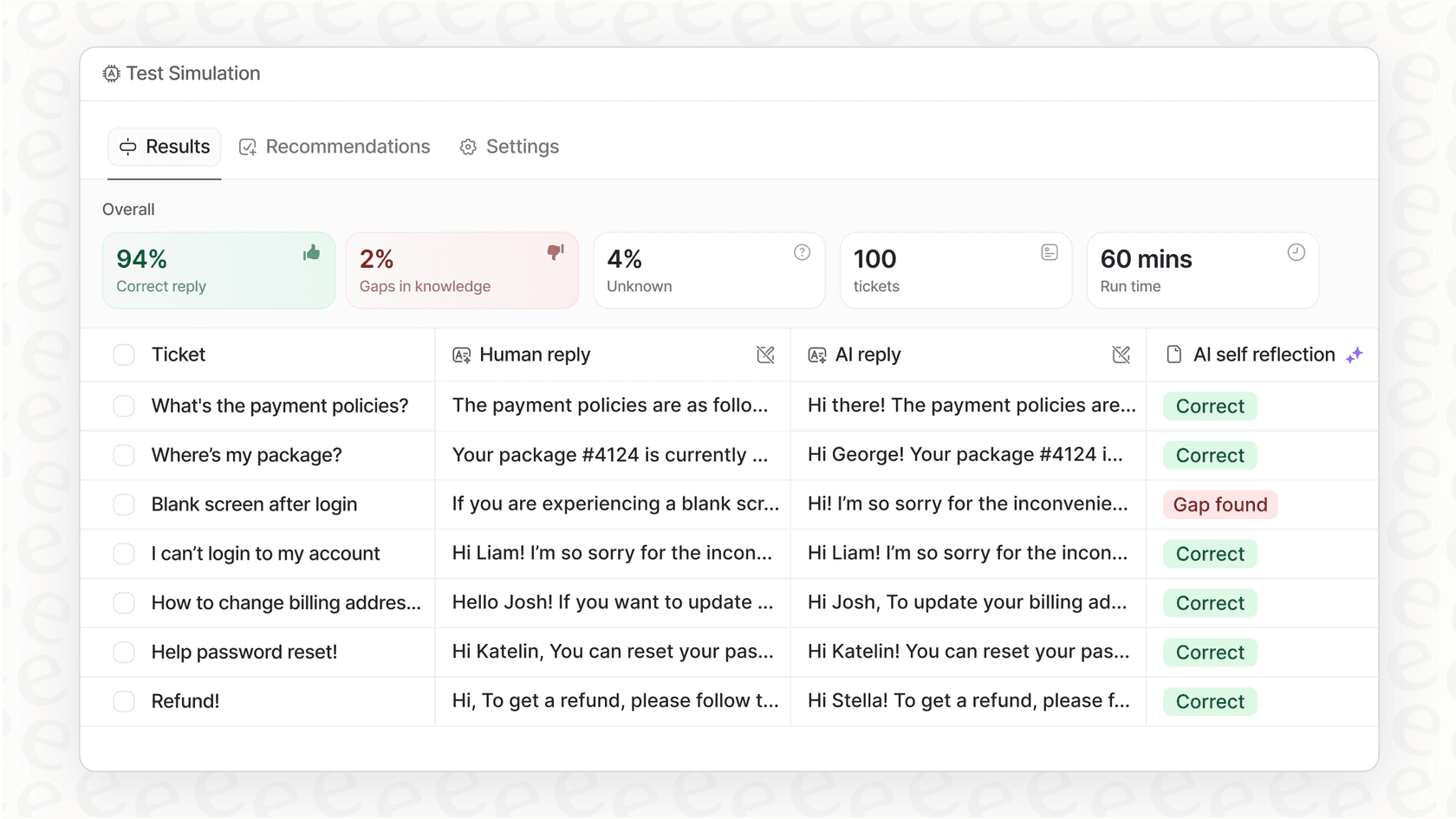
What I really liked was the simulation mode. Before you even turn the bot on, you can run it against thousands of your past tickets to see exactly how it would have responded. This gives you a real, tangible prediction of your automation rate. It lets you start small, automating just the simple questions, and then gradually give it more responsibility as you see it working. You have full control, and the flat-rate pricing provides predictable costs for your store.
Pros:
-
You can get it live in a few minutes with one-click helpdesk integrations.
-
It learns from your actual support history, so answers are on-brand and context-aware.
-
The simulation mode lets you test its performance on your own data before launching.
-
It connects to all your knowledge, wherever it lives (helpdesk, docs, Shopify, etc.).
-
Pricing is straightforward and predictable.
Cons:
-
You need to have an existing helpdesk (though that’s kind of the point).
-
The depth of features means it rewards those who spend time exploring all it can do.
Pricing: Starts at $239/month (billed annually) for up to 1,000 AI interactions.
2. Gorgias
Gorgias is a premier customer service helpdesk built from the ground up for e-commerce, and its Shopify integration is the gold standard. It pulls everything - email, social media DMs, live chat, and texts - into one mature dashboard. Its chatbot feature, "Automate," is exceptionally efficient at handling common tasks like tracking orders or processing returns because it can pull data directly from Shopify.
This all-in-one setup is perfect for stores that want a reliable, enterprise-grade platform to manage customer conversations. Gorgias offers tiered plans based on the number of tickets, which allows teams to select a plan that matches their specific volume and needs. It's a fantastic solution for Shopify-native stores that want a unified environment for their support team.
Pros:
-
Incredibly deep, industry-leading integration with Shopify.
-
Centralizes all your customer communication channels into one professional dashboard.
-
Powerful automation for order tracking, returns, and other common e-commerce tasks.
-
Proven reliability as a platform that powers thousands of successful companies.
Cons:
-
Ticket-based pricing models require monitoring as your store grows.
-
Its specialized automation is most powerful when used within the Gorgias and Shopify ecosystem.
Pricing: Starts at $50/month for 350 tickets, with tiered plans available to match your growth.
3. Tidio
If you're just dipping your toes into chatbots, Tidio is a solid place to start. It bundles live chat, chatbots, and email marketing into one package, and it even has a pretty decent free plan. Its visual chatbot builder is really easy to use; you can drag and drop to create simple conversation flows without writing any code. There are also templates for common tasks like greeting visitors or offering discounts.
Tidio is a great first step for small teams. Its AI, "Lyro," is a capable assistant for common queries. While it might require a bit more manual guidance than a system that learns automatically from history, it provides a very approachable entry point into automated support.
Pros:
-
A free plan is available for teams just starting out.
-
The visual flow builder is intuitive and code-free.
-
It combines several marketing and support tools in a single platform.
Cons:
-
Requires more manual setup to train the AI on your specific business details.
-
Interface can feel feature-rich, which may take time to navigate.
Pricing: Free plan available. Paid plans start at $29/month per seat.
4. Minami AI
Minami AI is an AI support agent built specifically for ecommerce post-purchase support. It handles the workflows that drive the highest ticket volumes for most online stores — order edits and cancellations, shipment tracking, lost packages, returns, and exchanges — all autonomously. It also manages 80%+ of courier communications and claims, which is typically a time-consuming manual process for support teams.
Setup is described as zero-configuration, with a go-live time of minutes, and Minami backs the product with a love-it-or-money-back guarantee. The platform reports a 90%+ reduction in support costs across a customer base of over 193 million real interactions. The returns flow also suggests product swaps to customers, helping reduce refund rates.
Pros:
- Purpose-built for ecommerce post-purchase workflows
- Handles order edits, cancellations, tracking, returns, and courier claims autonomously
- Money-back guarantee and zero-setup onboarding
- Claims 90%+ reduction in support costs
Cons:
- No public pricing (contact sales required)
- Focused on post-purchase; less suited for pre-sale or general support queries
Pricing: No public pricing. Contact Minami AI directly for a quote.
5. Drift
Drift is a powerhouse in the world of "conversational marketing," and its platform is highly specialized for sales and lead conversion. Its chatbot is designed to engage website visitors, identify qualified leads, and book meetings with sales representatives instantly. It's an excellent choice for businesses where connecting a high-value customer to a human quickly is the top priority.
While Drift is often chosen by B2B companies, it shows what's possible with high-end conversational tools. It's a premium solution that focuses on generating sales opportunities, making it a specialized addition for brands that prioritize lead generation above all else.
Pros:
-
Exceptional at qualifying leads and scheduling sales meetings on the fly.
-
Ideal for identifying and engaging high-value website visitors.
-
Integrates deeply with major sales CRMs like Salesforce.
Cons:
-
A premium investment that may be higher than other support-focused tools.
-
Focused more on sales and marketing than traditional e-commerce support tasks.
Pricing: Custom pricing, typically aimed at enterprise-level organizations.
6. ManyChat
If your brand lives and breathes on Instagram and Facebook, ManyChat is a fantastic tool. It is a specialist for automating conversations on social media. You can use it to automatically reply to post comments, answer DMs, and run promotional campaigns, all inside the social apps. For e-commerce stores with a heavy social media presence, ManyChat is a powerful asset.
You can build conversation flows to capture emails, send product links, and answer common DMs. It is a specialized tool for social engagement and works best alongside a central helpdesk like Gorgias to ensure all customer touchpoints are covered.
Pros:
-
Dedicated automation for Instagram and Facebook Messenger.
-
Excellent for running marketing campaigns directly on social media.
-
Approachable interface with plenty of templates for quick setup.
Cons:
-
Primary focus is on social apps rather than on-site website chat.
-
Best used in conjunction with a full helpdesk for a complete support view.
Pricing: Free plan available. The Pro plan starts at $15/month for 500 contacts.
4 tips for choosing the best e-commerce chatbot for your business
Feeling a bit lost in the options? Don't worry. Picking the right tool just comes down to knowing what you really need. Here are a few tips to help you decide.
-
Stick with the tools you already use. A great chatbot should enhance your current workflow. Look for solutions that integrate seamlessly with your preferred helpdesk. For example, eesel AI is designed to work within ecosystems like Gorgias to add a layer of smart automation.
-
Test it with your own data. The best way to know if a tool works for you is to see it in action with your actual customer questions. Look for platforms that offer simulation or testing modes so you can verify the performance before going live.
-
Look for advanced learning capabilities. Your team has a wealth of knowledge in past tickets and internal docs. The most mature chatbots can learn from these sources, ensuring your customers get accurate, on-brand information.
-
Consider your growth. Choose a pricing model that feels sustainable for your business. Whether it's flat-rate or tiered based on volume, ensure it matches the value and scale of your store's operations.
The verdict: What is the best chatbot for e-commerce?
Ultimately, the best chatbot for e-commerce really depends on your store's size and what you're trying to achieve.
-
If you're just starting out and want a simple tool to get your feet wet, Tidio is a solid place to begin.
-
If your entire customer base hangs out on Instagram, ManyChat is a powerful specialist.
-
If your business is built on Shopify, Gorgias is the gold standard for a mature, all-in-one helpdesk experience.
-
For growing e-commerce businesses that want to add powerful AI to their existing setup, eesel AI is a brilliant complementary option.
It respects the systems you already trust, like Gorgias, and learns from your unique data to provide safe, effective automation. It brings high-level AI capabilities to your team with a setup that's simple enough to complete in an afternoon.
Ready to see what AI can do for your customer support? Start a free trial of eesel AI and get it running in minutes.
Frequently asked questions

Share this article

Article by
Stevia Putri
Stevia Putri is a marketing generalist at eesel AI, where she helps turn powerful AI tools into stories that resonate. She’s driven by curiosity, clarity, and the human side of technology.