The 7 best Siena AI alternatives in 2026


Last edited June 24, 2026

Table of Contents
- Why I'm writing this (and where I'm coming from)
- What people actually like about Siena, and why they still leave
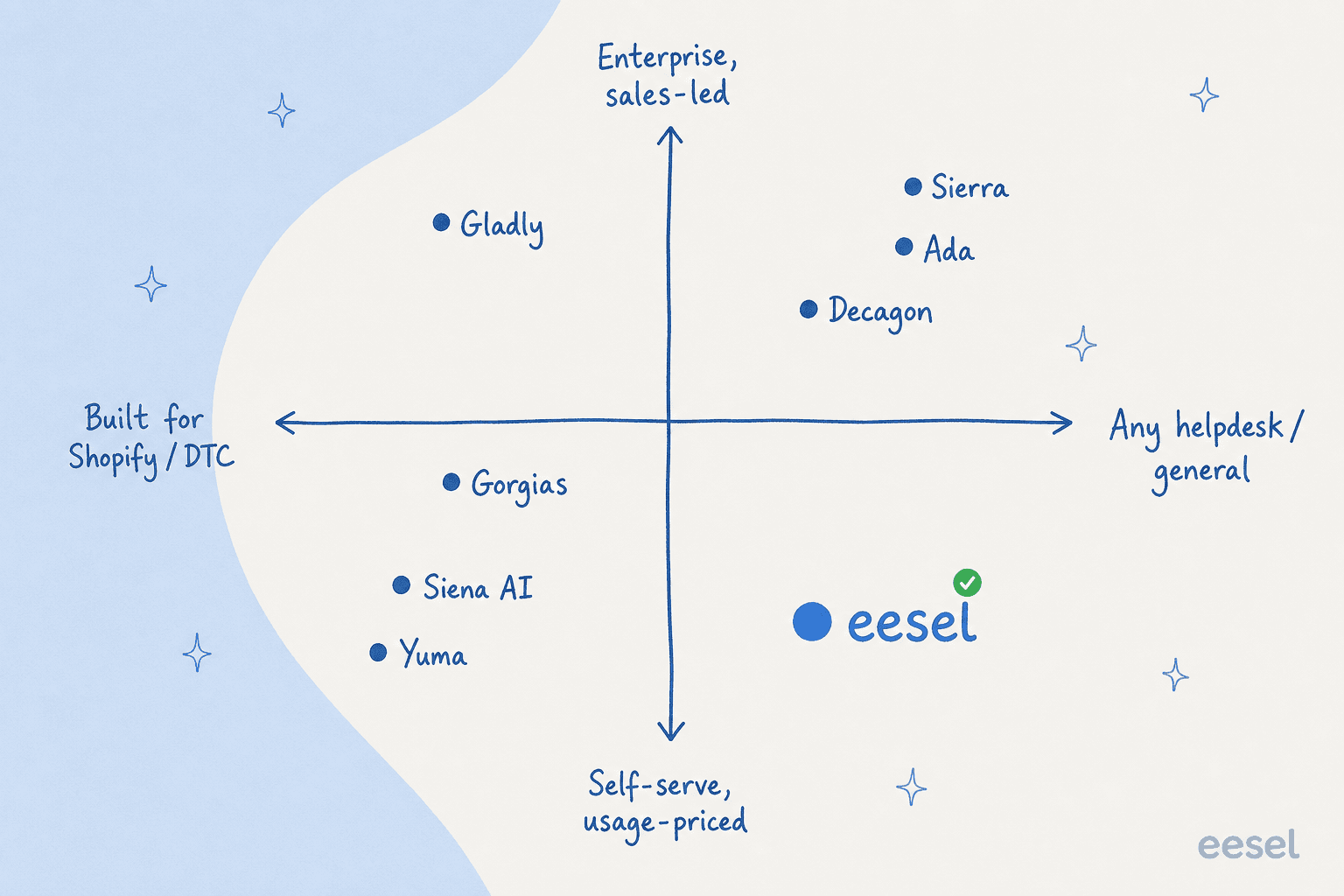
- The 7 best Siena AI alternatives at a glance
- 1. eesel AI: best overall, and the one I'd start with
- 2. Gorgias: best if you want the helpdesk and the AI together on Shopify
- 3. Yuma: Siena's closest rival, with outcome-aligned pricing
- 4. Gladly: best for premium DTC built around lifetime value
- 5. Decagon: best for high-volume enterprise CX
- 6. Sierra: best for enterprises that want outcome-based contracts
- 7. Ada: best for enterprise with very high conversation volume
- The real decision is the pricing model, not the feature list
- Try eesel as your Siena alternative
Why I'm writing this (and where I'm coming from)
I've spent the last couple of years watching what ecommerce support teams actually type into Google when they outgrow a tool, and "Siena AI alternatives" has a very specific shape to it. It's almost never "Siena is bad." It's "Siena is good, but the platform fee is a lot to commit before I've seen results," or "the AI keeps replying after it should have handed off."
I work on the team behind eesel AI, and we've spent years putting AI agents on live support queues across thousands of real tickets. That history is the reason I'm wary of any vendor's headline automation number, including our own: we've watched confident-sounding bots quietly give wrong answers, which is exactly why we now simulate every rollout against a company's historical tickets before a single customer sees it. When Gridwise ran eesel, we resolved 73% of their tier-1 requests in the first month, with the proof showing up during a 7-day trial rather than a sales deck.
So this isn't a neutral roundup that scores everyone 4.5 and shrugs. I'll be fair to every tool here (Siena included, it's good at what it does), but I'll also tell you which one I'd actually reach for in each situation.
What people actually like about Siena, and why they still leave
Let's be fair to Siena first, because it earns its 4.8/5 on G2. It's built specifically for DTC ecommerce, it gives the agent a real brand persona, and reviewers say it handles high ticket volume "like a member of our team" while cutting outsourced BPO hours. Brands like Spanx and Coterie use it, and Coterie reports 60-65% of email volume automated. That's a real product, not vaporware.
So why the search traffic for alternatives? Three recurring reasons:
- The commercial commitment. Siena's pricing is sales-gated, but the page discloses a $750/month platform fee plus $0.90 per automated ticket. For a smaller brand, that platform fee is a real number to sign up for before you've watched the AI work on your tickets.
- Escalation and routing. The single most consistent complaint in Siena's G2 reviews is that the agent keeps responding after a handoff, or closes out-of-scope tickets instead of routing them to a human. One reviewer summed it up as "good 93% of the time, really bad the other 7%."
- It's DTC-or-nothing. Siena is purpose-built for consumer brands on Shopify-shaped stacks. If you run support for B2B SaaS, IT, or anything that isn't a storefront, it's not really aimed at you.
None of these are dealbreakers for everyone. They're just the fault lines that send people looking, and they're the lens I used to pick the alternatives below.
How I picked
I weighted four things that matter more than a feature checklist:
- The billable unit. Per resolution, per conversation, and per ticket are not the same thing, and the difference shows up on your invoice. I'll name the model for each tool.
- Can you test before you pay? The best de-risker in this whole category is running the AI against your own past tickets and seeing the coverage number before you commit budget.
- Time to live. Some of these go live in an afternoon. Some are a 6-12 week implementation project.
- Helpdesk fit. Whether it sits on top of your existing helpdesk or asks you to move.
Here's how the seven land against each other before we get into specifics.
The 7 best Siena AI alternatives at a glance
| Tool | Best for | Pricing model | Public entry price | Helpdesk fit | Free trial |
|---|---|---|---|---|---|
| eesel AI | Teams that want to start fast and pay for what they use | Pure usage-based | $0.40 / ticket, no platform fee | Any (Zendesk, Freshdesk, Gorgias, Front, more) | Yes, no card |
| Gorgias | Shopify brands wanting helpdesk + AI in one | Ticket-based + AI add-on | From $10/mo; AI $0.90/resolution | Is the helpdesk | Yes |
| Yuma | DTC brands that want outcome-aligned billing | Outcome / per resolution | From $850/mo (Shopify listing) | Layers on Gorgias, Zendesk, more | 30-day |
| Gladly | Premium DTC focused on lifetime value | Per resolution + seats | $1.50 / AI resolution (Shopify) | Is the platform | Free to install |
| Decagon | High-volume enterprise CX | Sales-led, volume-bracketed | Contact sales | Fronts or replaces helpdesk | No |
| Sierra | Enterprise wanting outcome-based contracts | Outcome-based | Contact sales | AI-first platform | No |
| Ada | Enterprise with 300k+ conversations a year | Sales-led, volume-based | Contact sales | Sits on top of helpdesk | No |
Now the part that actually helps you decide.
1. eesel AI: best overall, and the one I'd start with
Best for: support teams that want an autonomous agent live this week, priced by usage, without committing to a platform fee or ripping out their helpdesk.
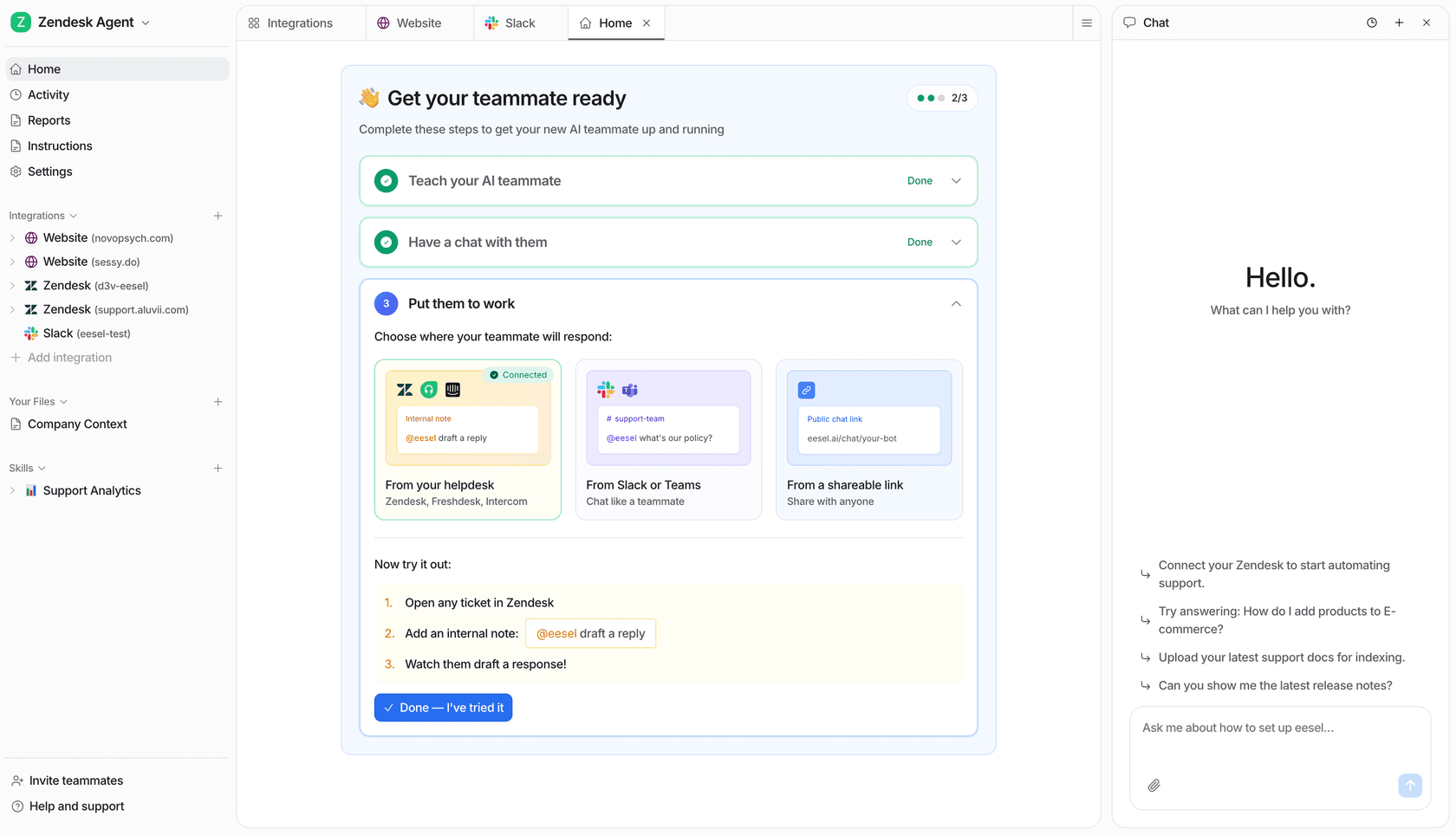
I'll declare my bias up front: I work on eesel. But the reason it leads this list isn't loyalty, it's that it directly answers the three things that send people away from Siena. eesel sells AI teammates that live inside the apps you already use, learn from your past tickets and help docs on day one, and then draft, triage, escalate, and take real actions across your connected tools.
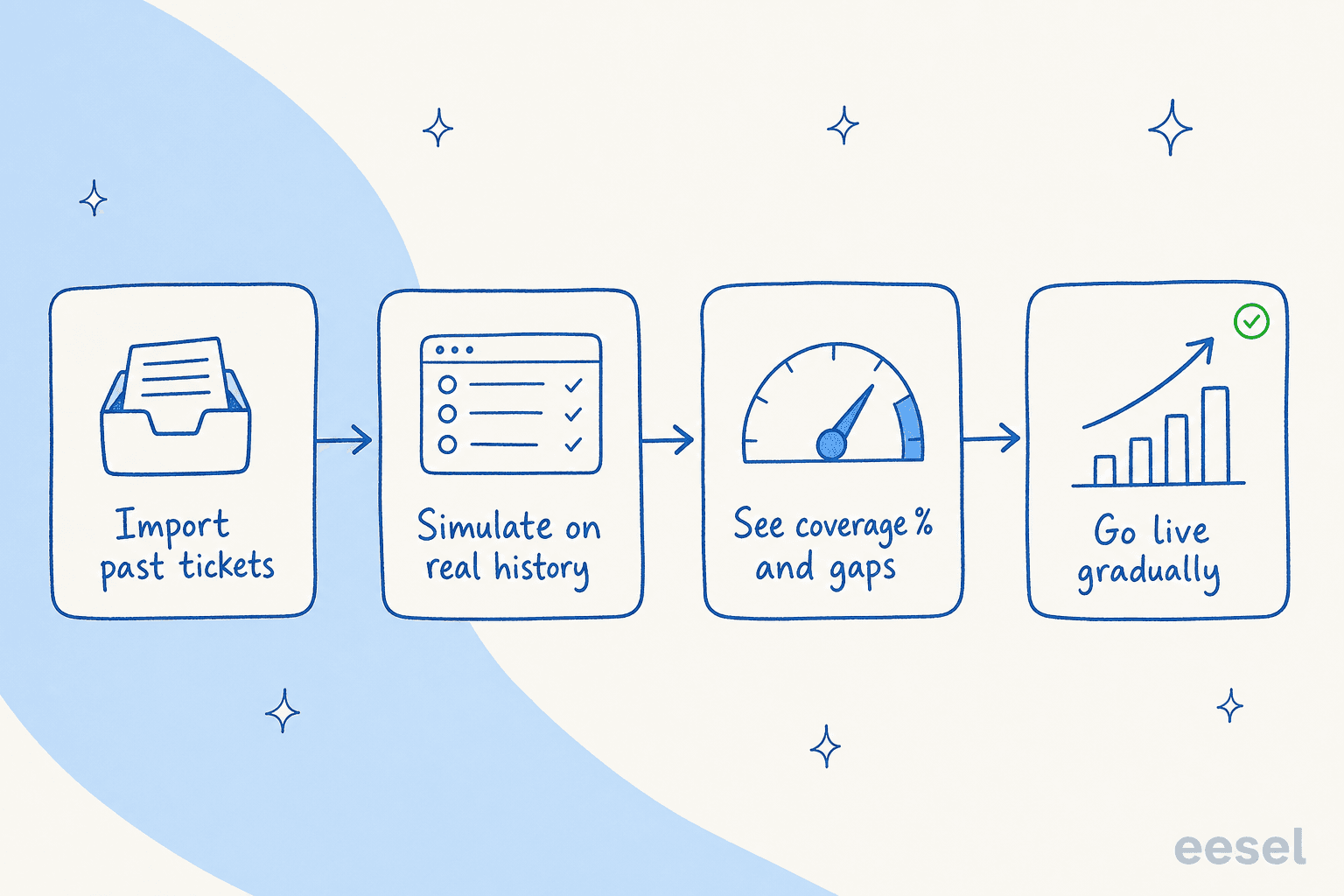
The thing that matters most here is the simulation step. Before you go live, eesel runs the agent against your real ticket history, shows you exactly what it would have answered, what it would have gotten right, and where the gaps are. You get the coverage number before you spend money, not after.
It's also truly helpdesk-agnostic, with 100+ integrations and 80+ languages out of the box, so it fits a Zendesk shop, a Freshdesk shop, or a Gorgias shop equally. At the high end, Smava runs a fully automated Zendesk agent processing 100,000+ German-language tickets a month, and Design.com handles 50,000+ tickets a month on Freshdesk.
Pros:
- Usage-based at $0.40 per ticket, no platform fee, no per-seat fees, no minimum.
- Simulate on historical tickets before going live, so you see the number before you pay.
- Works on top of any major helpdesk rather than locking you into one.
- Confidence-based routing so low-confidence answers draft instead of replying live, which is the exact gap Siena users complain about.
- Self-serve free trial, no credit card, no sales call required to start.
Cons:
- It's not a full helpdesk. If you don't have one yet, you'll pair eesel with an ecommerce helpdesk rather than getting everything in one box.
- SOC 2 is in progress rather than certified, so the most compliance-heavy enterprises should check the current state.
Our take: if you're leaving Siena over the platform fee or the escalation behaviour, this is the most direct swap. You pay for what the AI handles, you test on your own data first, and you keep your helpdesk. The teams it doesn't fit are the ones that specifically want a single vendor to own ticketing, CRM, and AI in one suite.
2. Gorgias: best if you want the helpdesk and the AI together on Shopify
Best for: Shopify brands that would rather have the inbox and the AI agent in one platform than layer an agent on top.
Where Siena sits on top of your helpdesk, Gorgias is the helpdesk, and a Shopify-native one at that. It claims to power customer conversations for 40% of Shopify brands, pulling order, customer, and store data right into the ticket view with no syncing. Its AI Agent is pre-trained on over a billion ecommerce conversations and handles returns, refunds, order edits, and product recommendations.
Pricing is ticket-based rather than per-seat: plans run from $10/mo (Starter) up through Advanced at $750/mo, and the AI Agent is a usage add-on at $0.90 per resolved conversation on annual plans ($1.00 monthly). The community rule of thumb is that it pays off once 40%+ of your tickets need real Shopify actions.
Pros:
- Deepest Shopify integration in the category; order data is native.
- Helpdesk and AI in one bill, one login.
- Conversational, non-pushy upselling that drives real revenue (BareMinerals reported 8.83x ROI).
Cons:
- It's a platform migration, not an overlay, so you're moving your helpdesk.
- Pricing draws consistent objections; it runs roughly 3x Zendesk for similar ticket volumes, and each AI interaction also counts as a billable ticket.
Our take: if you're already eyeing a helpdesk switch and you're all-in on Shopify, Gorgias is a stronger destination than Siena because you consolidate. If you like your current helpdesk, it's the wrong shape, and an overlay agent makes more sense. We've written a full list of Gorgias alternatives if you want to go deeper.
3. Yuma: Siena's closest rival, with outcome-aligned pricing
Best for: DTC brands that want the same "AI on top of your helpdesk" shape as Siena, but with billing tied to outcomes.
Yuma is the alternative Siena's own users name most often, because it occupies nearly identical ground: a Y Combinator company built for Shopify ecommerce that layers on your existing helpdesk (Gorgias, Zendesk, Kustomer, Gladly) and resolves tickets end-to-end by taking real actions. Its headline claim is up to 89% of conversations resolved, anchored by the EvryJewels case study (89% automation, 63% cost savings, 150K+ tickets a month).
The key difference from Siena is the commercial model: Yuma leans into performance-based billing, "no value, no charge," with its Shopify listing showing plans from $850/month. Worth noting from the reviews: real operators report 30-50% full automation after real setup work, below the 89% headline, and the model rewards high volume.
Pros:
- Same DTC overlay model as Siena, so it's an easy mental swap. See our Yuma AI deep dive.
- Outcome-leaning billing instead of a flat platform fee.
- Praised account-management team and a 30-day trial on real resolutions.
Cons:
- The model penalizes small or low-volume stores; it's only cost-effective at real scale.
- Reviewers note setup takes real time, and the AI needs oversight for accuracy.
Our take: if you like Siena's approach but the platform fee is the sticking point, Yuma is the most like-for-like switch, especially at higher volume. At lower volume, the per-resolution math can still bite, which is where a flat per-ticket model like eesel's tends to be more predictable. We keep a running list of Yuma AI alternatives too.
4. Gladly: best for premium DTC built around lifetime value
Best for: premium consumer brands that treat support as a revenue and loyalty channel, not a cost center.
Gladly takes a different philosophical line: "people, not tickets." Instead of discrete tickets, it models one lifelong conversation per customer, and pitches itself as "the only AI built for LTV." Its Sidekick agent resolves end-to-end across chat, voice, email, SMS, and social, and the roster (TUMI, Ulta, UGG, Crate & Barrel, Nordstrom) tells you the segment: premium, high-touch retail. It claims 76% of conversations fully resolved by AI and strong G2 standing at 4.7/5 from 1,112 reviews.
Pricing isn't fully public; the Shopify listing shows $1.50 per AI Resolution, $0.25 per AI Assist, and $120/mo per seat, with the core "Hero" platform sold via sales.
Pros:
- Unified customer profile so customers never repeat themselves; reviewers love it.
- Genuinely strong voice support, which most Siena alternatives lack.
- Channel breadth in one continuous conversation.
Cons:
- Consistently flagged as expensive, and the per-seat element is less flexible for small teams.
- Reporting is the #1 complaint; reviewers pull metrics into Excel manually.
- Heavier learning curve than an overlay agent.
Our take: Gladly is the pick when support is a premium brand experience and voice matters, and you have the budget to match. For a leaner brand that just wants tickets resolved, it's more platform than you need. If you're weighing it against others, our Gladly alternatives piece and the Kustomer vs Gladly comparison both help.
5. Decagon: best for high-volume enterprise CX
Best for: mid-market to large enterprises replacing a brittle bot with an AI-native platform.
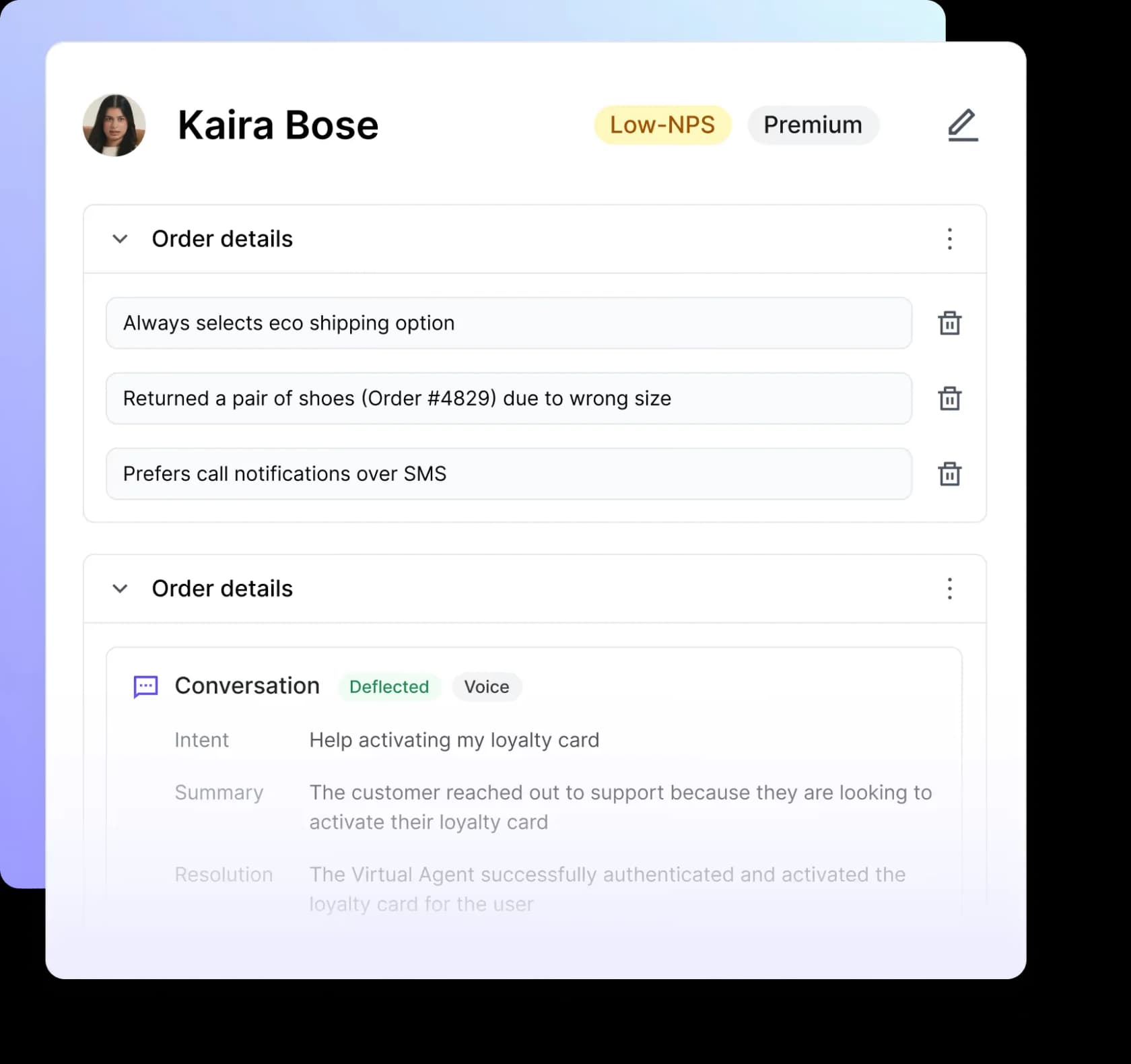
Decagon is a different weight class. It's an AI-native enterprise platform (valued at roughly $1.5B as of its 2025 Series C) with a logo wall of Chime, Duolingo, Hertz, and Notion. Its technical wedge is Agent Operating Procedures, natural-language instructions that compile into executable code, so CX ops can author agent logic while engineers keep guardrails. It runs one agent across chat, voice, email, SMS, and custom API surfaces.
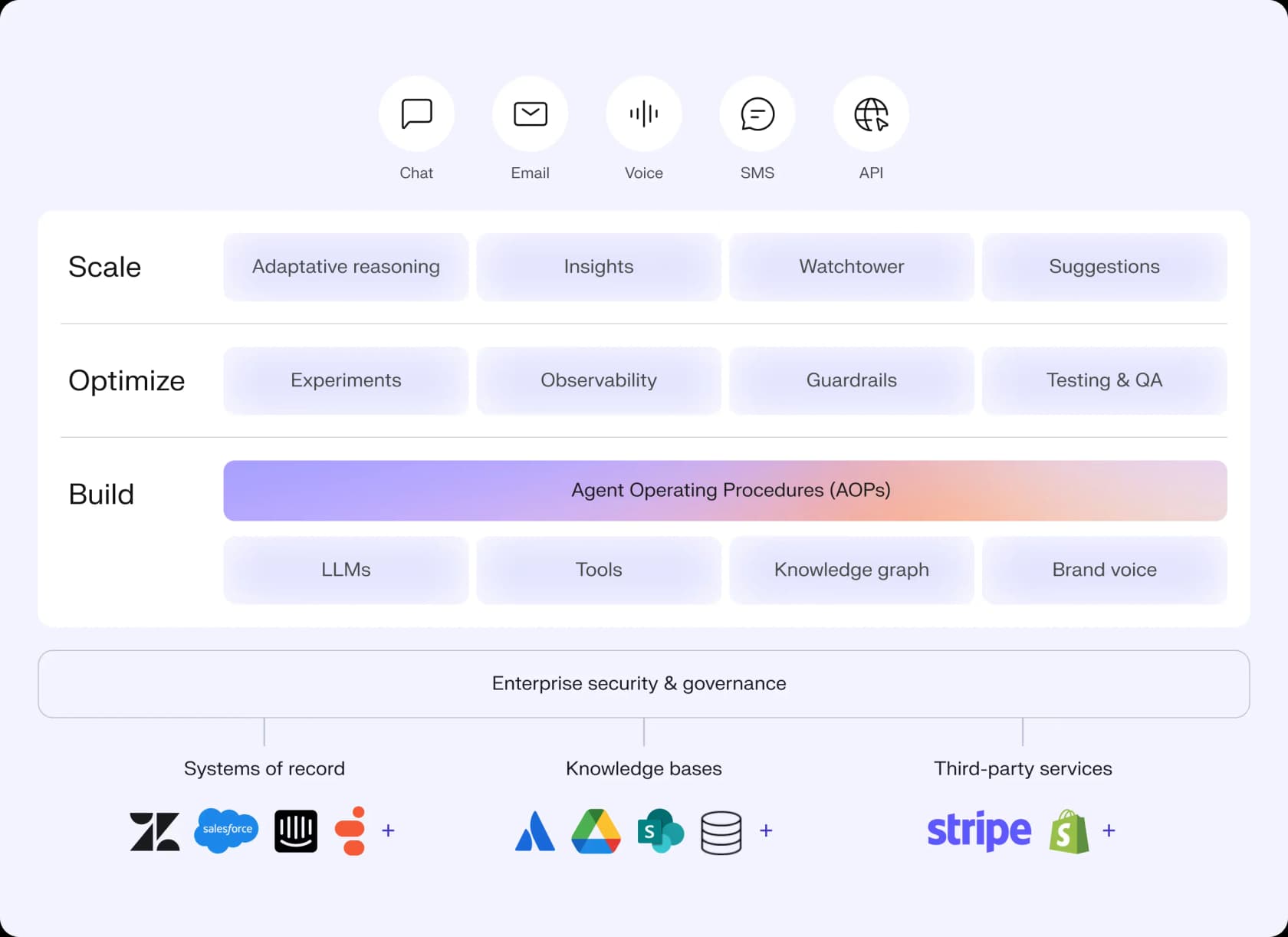
Pricing is sales-led with no public rate; the demo form's "Monthly Support Tickets" brackets start under 10,000 and run past 250,000, which tells you the ICP.
Pros:
- Genuine omnichannel parity (voice, chat, email, SMS) from one runtime.
- AOPs make iteration faster than decision-tree tooling; Duolingo cited a "night-and-day difference" replacing a previous vendor.
- Strong observability and QA tooling for regulated teams.
Cons:
- No public pricing, no free trial, no self-serve; this is an annual enterprise contract.
- Overkill (and over budget) for a small DTC brand leaving Siena.
Our take: if you're an enterprise outgrowing Siena's DTC focus and doing six figures of tickets a month, Decagon belongs on the shortlist. For everyone smaller, it's the wrong tier. We break down the numbers in Decagon pricing and the full Decagon review.
6. Sierra: best for enterprises that want outcome-based contracts
Best for: large, often regulated enterprises that want to pay only when the agent delivers a contracted outcome.
Sierra is the enterprise heavyweight, co-founded by Bret Taylor (ex-Salesforce co-CEO, current OpenAI board chair) and Clay Bavor, and reportedly valued near $10B. That founder pedigree is why it lands regulated logos most AI-native vendors can't (Rocket Mortgage, SoFi, Vanguard, FINRA). Its commercial wedge is outcomes-based pricing: "pay for a job well done." It also ships an Agent SDK and a no-code Agent Studio, plus a rare ISO 42001 AI-management certification.
There's no public price, no self-serve, no trial; everything routes through sales.
Pros:
- Outcome-based pricing shifts implementation risk onto the vendor.
- Code-first and no-code surfaces, so engineering and CX ops both get a lane.
- Best-in-class enterprise compliance footprint (SOC 2, ISO 27001, ISO 42001, HIPAA).
Cons:
- Enterprise-only; not aimed at a typical DTC brand.
- Outcome contracts take negotiation, and there's no quick way to just try it.
Our take: Sierra is the pick when you're a Fortune 500-scale buyer who wants risk on the vendor's side and has procurement to match. It's the opposite end of the spectrum from a self-serve Siena alternative. See Sierra AI pricing and Sierra reviews for detail.
7. Ada: best for enterprise with very high conversation volume
Best for: large enterprises with at least 300,000 customer service conversations a year.
Ada is a Toronto-based, enterprise-tier platform that brands its category "Agentic Customer Experience." Its pricing page states the floor outright: "a great fit for companies with at least 300,000 annual customer service conversations." The technical wedge is its multi-LLM Reasoning Engine, plus Playbooks for multi-step SOPs and a Coaching loop where you review past conversations and the agent applies the notes. Customers skew large: Monday.com, IPSY, Pinterest, Cebu Pacific.
No public pricing, no trial; it's sales-qualified by volume.
Pros:
- Multi-LLM orchestration rather than a single-model bet.
- Strong, growing voice product and broad omnichannel.
- Leads on AI-specific compliance (AIUC-1) and zero data retention with LLM providers.
Cons:
- The 300k-conversation floor explicitly rules out SMB and most mid-market.
- No public pricing and no self-serve path at all.
Our take: Ada is for the enterprise that's already past the volume where most tools stop scaling. If you're a DTC brand leaving Siena, you're well below Ada's floor, and one of the lighter options fits better. Our Ada alternatives guide covers the field if you're at that scale.
The real decision is the pricing model, not the feature list
Here's the thing I'd want a friend to understand before signing anything: these tools don't really differ on whether they can resolve a "where is my order" ticket. They all can. Where they differ is how they charge you, and that's what determines whether the bill scales with you or against you.
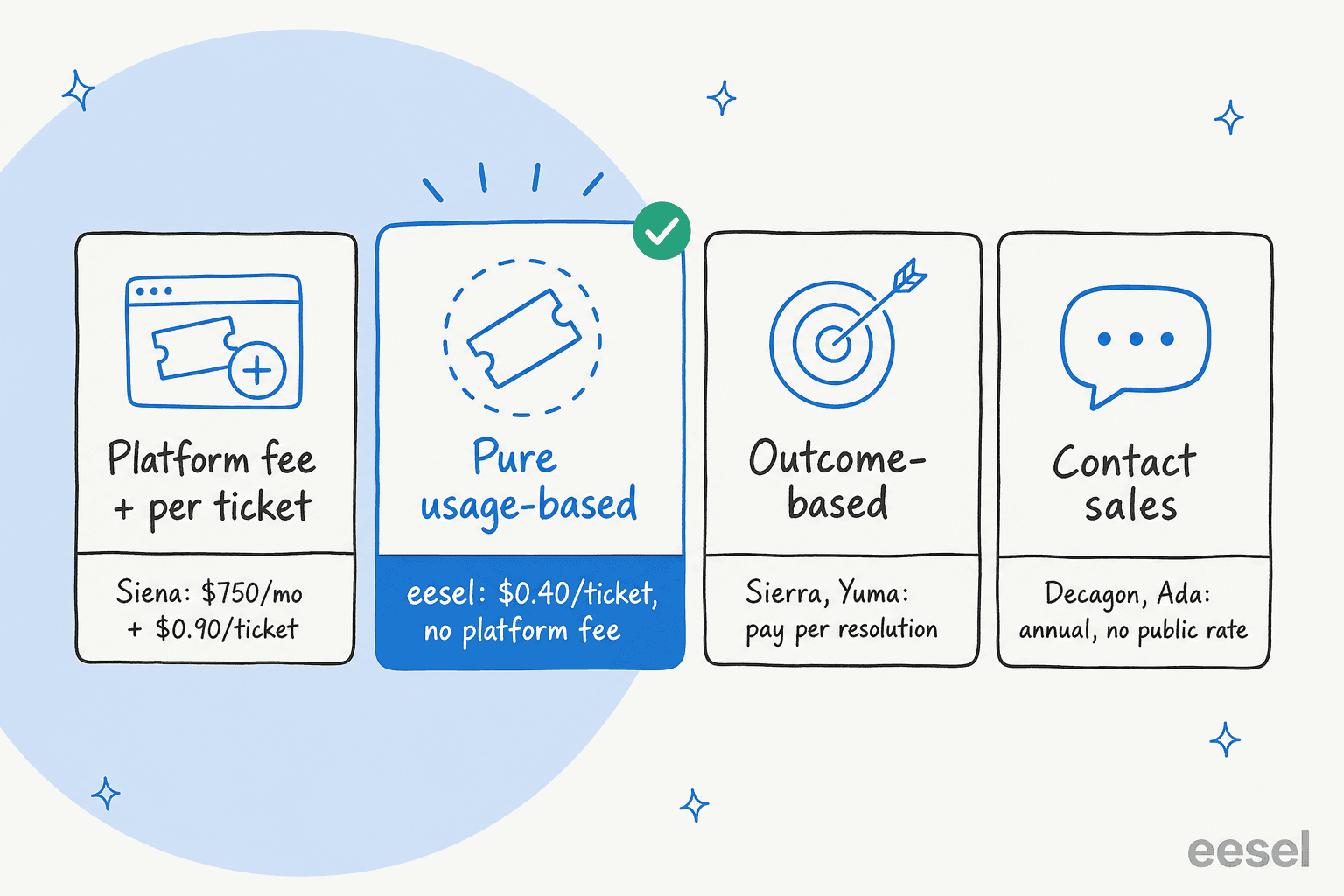
Siena's model is a flat platform fee plus per-ticket usage. eesel is pure usage. Yuma and Sierra are outcome-based. Decagon and Ada are sales-led annual contracts. To make this concrete, here's what Siena's published rates look like next to eesel's at a few volumes. Pick your monthly ticket volume:
The takeaway isn't "eesel is always cheaper," it's that a platform fee front-loads your cost and matters most when your volume is modest. At very high volume, the per-ticket rate dominates and the platform fee fades. That's the kind of math worth doing on your own numbers before you sign, which is also why being able to simulate first is so useful.
Try eesel as your Siena alternative
If you came here because Siena's platform fee or escalation behaviour pushed you to look, eesel is the alternative I'd actually set up first. It plugs into the helpdesk you already run, learns from your past tickets and help docs, and works like a new hire that already knows your store. The part that makes it an easy yes: you can run it against your historical tickets and see the resolution number before you pay, then turn on autonomy gradually with confidence-based routing so it drafts instead of guessing when it's unsure.
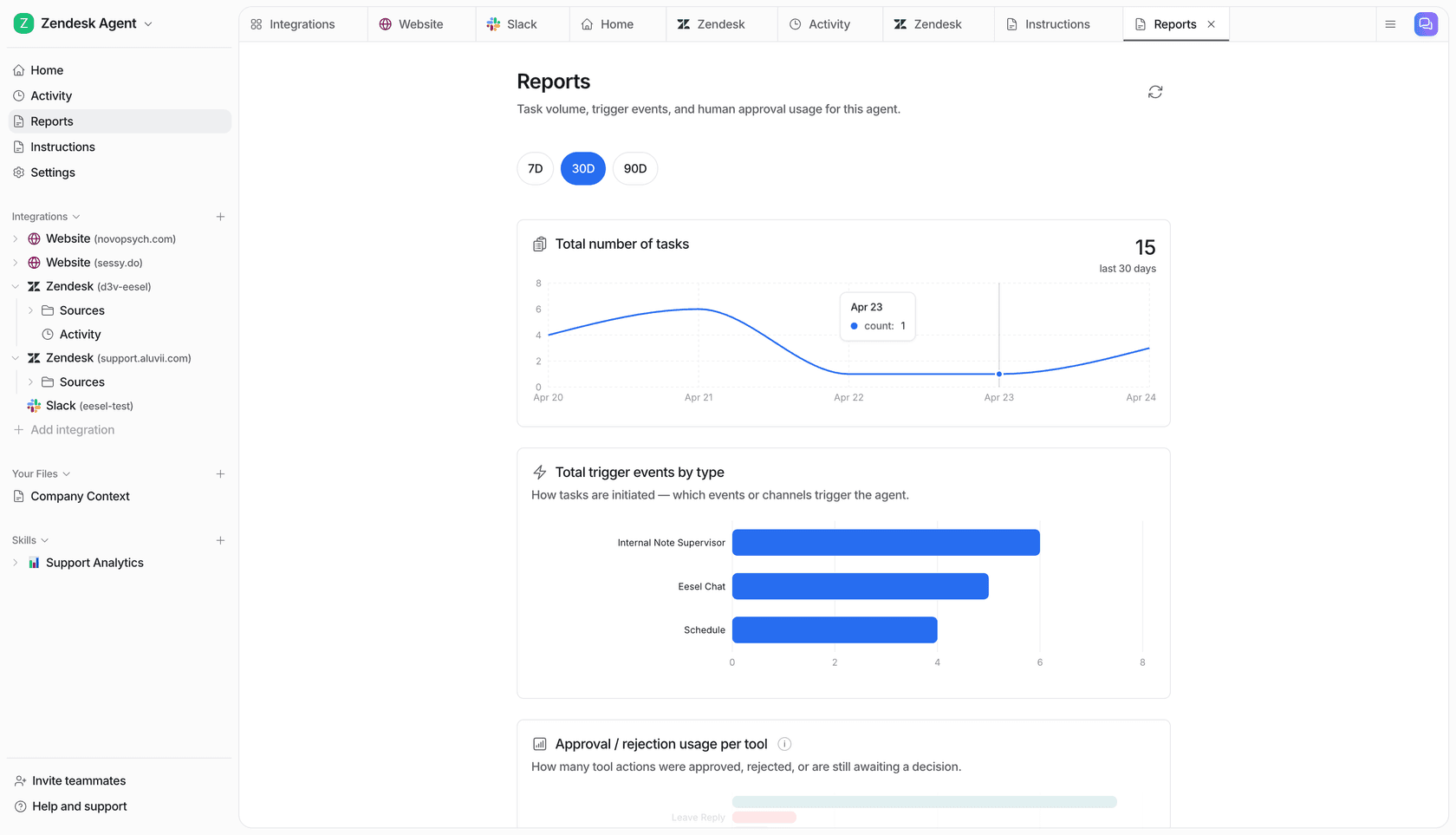
It's $0.40 per ticket with no platform fee, no per-seat charges, and a free trial that doesn't need a credit card or a sales call. For most DTC and ecommerce teams leaving Siena, that's the fastest path from "thinking about it" to "watching it resolve real tickets." You can start a free trial today, or browse the rest of our AI customer service software coverage first.
Frequently Asked Questions

Share this article