Canva AI writer vs ChatGPT: Which tool is right for your content workflow?

Last edited January 26, 2026
Creating content can feel like a complex process. You might find yourself in one tab writing copy with a tool like ChatGPT, then jumping over to a design platform like Canva to make it look presentable.
This process of copying and pasting can be a drain on time and creativity for marketers. All that context switching can disrupt your creative flow. While both Canva and ChatGPT have built-in AI to help, they each stick to what they know best. Canva excels at visual design, and ChatGPT is highly effective for text generation.
The issue is that you are still left trying to stitch two different processes together. An alternative approach is to use a single tool that goes from a keyword to a fully designed, ready-to-publish blog post. Platforms like the eesel AI blog writer are making that a reality.
What is Canva AI Writer?
First things first, Canva’s AI writer is officially called Magic Write. It is not a separate app; it is a feature built right into Canva's Magic Studio, their collection of AI tools. Interestingly, it is actually powered by OpenAI's tech.
Magic Write's main advantage is generating short-form copy that understands your design layout. It is like having a copywriter right on your canvas, perfect for coming up with snappy headlines for social media, bullet points for a presentation, or some quick ad copy.
It is especially good for brainstorming ideas, creating lists, and writing social media captions directly inside your design, so you do not have to guess if your text will fit. You can also adjust the copy in real-time to see how it looks. If a headline is too long, you just ask Magic Write to shorten it right there. For teams that already do all their visual work in Canva, it’s a convenient choice because it keeps the whole process in one spot.
But there is a limitation. According to Canva's help center, its training data stops in mid-2021. This means it might not know about the latest trends or news, which can be a major issue in the fast-paced world of content.
What is ChatGPT?
You are probably familiar with this one. ChatGPT is the standalone large language model from OpenAI that gained widespread attention. It’s built for a huge variety of text-based tasks, from answering strange questions to writing code.
For content creators, its main job is to handle more demanding tasks for long-form content. It is the tool you turn to for deep research, brainstorming complex topics, building detailed outlines, and drafting entire articles, reports, or scripts.
Here’s where ChatGPT performs well:
- It provides access to more advanced models like GPT-4, which results in better coherence and structure, particularly for longer content.
- You get a lot of control over the tone, voice, and style. You can teach it to mimic your brand's voice and maintain that consistency over thousands of words.
- It is a powerful tool for SEO. You can use it for everything from keyword research and structuring articles with proper H2s and H3s to writing meta descriptions and FAQ sections.
The drawback? It operates as a standalone application. After you have generated your text, you still have to copy and paste it into your CMS, design tool, or document editor.
Core feature breakdown: Canva AI Writer vs ChatGPT
Deciding between these two really depends on what you are trying to do. Are you designing a visual or writing an article? This table gives you a quick look at where each one comes out on top.
| Feature | Canva AI Writer (Magic Write) | ChatGPT |
|---|---|---|
| Primary Use Case | On-canvas, short-form copy for visual assets | In-depth research, ideation, and long-form content |
| Workflow Integration | Fully integrated into the Canva design environment | Standalone tool; requires copy-pasting into other apps |
| Content Scope | Best for headlines, captions, and short paragraphs | Excels at structured articles, reports, and scripts |
| Underlying Tech | Powered by OpenAI models (data up to mid-2021) | Access to the latest OpenAI models (e.g., GPT-4) |
| SEO Capabilities | Basic (headlines, short copy); limited by older data | Robust for strategy, outlines, keywords, and metadata |
| Collaboration | Seamless for visual feedback directly within Canva | Requires exporting text to a shared doc like Google Docs |
Let's dig into that a little more.
Ideation and long-form content generation
This is where ChatGPT excels. You can give it a wide-ranging topic like "the future of remote work," and it can produce a detailed, well-organized article outline. From there, it can draft each section while keeping a logical flow. It’s built to manage thousands of words without losing coherence.
Canva's Magic Write, on the other hand, is better suited for short tasks. It’s great for brainstorming a list of social media post ideas or a few catchy headlines. But if you ask it to write a 2,000-word blog post, it will likely be less effective. In fact, Canva notes that it has an output limit of around 2000 words and is not really meant for creating a single, cohesive long-form piece.
Short-form copy and visual integration
This is where Magic Write excels. Its key advantage is that it generates copy in situ, right on your design. You can immediately see if that clever headline is too long for your Instagram story or if a product description fits nicely below an image. It’s a smooth "what you see is what you get" experience.
The ChatGPT workflow is different by comparison. You generate text in one window, then paste it into your design tool. Usually, it does not fit. So you go back to ChatGPT, ask for a shorter version, copy, paste, and repeat the process. It’s a repetitive process that Magic Write eliminates for visual projects.
SEO and research capabilities
For SEO tasks, ChatGPT is a useful tool. It can help you find long-tail keywords, structure an article following SEO best practices, and generate related content like FAQs to help you earn featured snippets. It’s a strategic tool for planning content that gets seen.
Magic Write's role in SEO is more limited. The copy it creates can be optimized, but the tool itself will not help you with the strategy. Its main limitation here is its outdated knowledge. Since it is working with data from before 2022, it cannot help you research current SEO trends or emerging topics.
Limitations of the standard workflow
Even if you use both tools for their strengths, you are still dealing with a disconnected process. This is the core inefficiency that many content teams have come to accept.
Here are the main pain points of using Canva and ChatGPT together:
I love using AI, but I found the workflow was a massive productivity killer. Its the constant dance of copy-pasting, but it's also how hard it is to get finely-tuned outputs. You ask a chatbot to fix one sentence, and it gives you a ton of filler text. It completely breaks my flow state, and half the time I just give up and still end up editting it myself.
- Manual asset creation: Neither tool will automatically generate a complete, media-rich article. You still have to find stock photos, create infographics, search for relevant YouTube videos, and format everything correctly.
- Brand voice inconsistency: It is hard to keep a consistent tone when your words are made in one place and your visuals in another. The two can feel out of sync, creating a disjointed experience for the reader.
- A disjointed, error-prone process: The entire workflow is manual. Text formatting can break during pasting. Edits can get lost between Google Docs versions and your final design. The handoff from writer to designer is often complicated.

It’s a cycle of inefficiency that wastes time and creative energy, turning a smooth process into a series of inefficiencies.
Pricing breakdown: Canva AI Writer vs ChatGPT
Both tools are part of larger platforms, so their pricing is built around the different kinds of value they provide.
Canva pricing
Magic Write and other AI features are included in Canva's subscription plans.
- Canva Free: $0. You get limited access to the AI tools, so you can give them a try.
- Canva Pro: US$120 per year for one person. This gives you "High AI access" to tools like Magic Write, plus all the other Pro features like Background Remover and a huge library of premium templates and stock photos.
- Canva for Business: US$200 per year per person. This upgrades you to "Higher AI access" and includes advanced tools for brand management and team collaboration.
You can see the full details on their official pricing page.
ChatGPT pricing
OpenAI has a few different tiers for individuals and teams.
- Free: $0/month. You get limited access to their main model, which can be slower at busy times.
- ChatGPT Plus: $20/month. This is the plan for heavy users, offering priority access to the most advanced models, higher usage limits, and tools like DALL·E for image generation and advanced data analysis.
- ChatGPT Business: $25/user/month (billed annually). This is for teams and comes with collaborative workspaces and enterprise-level security features.
You can find the latest info on the ChatGPT pricing page.
An all-in-one alternative for content creation
For teams serious about scaling high-quality blog content for SEO, the Canva vs. ChatGPT debate may present an incomplete picture. The challenge often lies in the fragmented workflow. This is where a specialized, all-in-one AI blog generation platform can offer a solution.
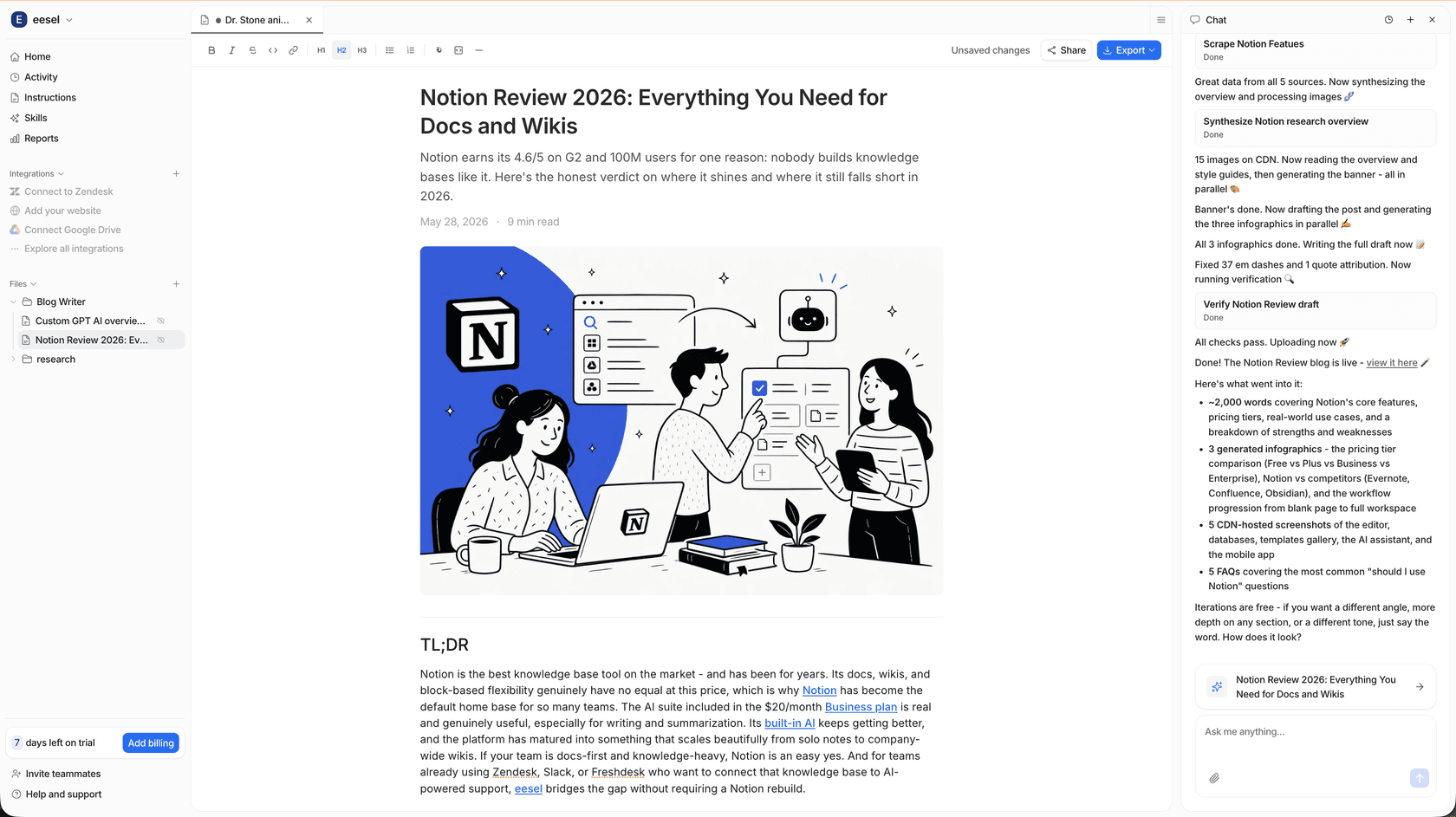
It addresses these workflow challenges in several ways:
- End-to-end automation: You give it a keyword and your website URL, and it handles the rest. It takes care of the research, writing, structuring, and asset creation, which means you do not have to jump between different tools.
- Automatic asset generation: This is a key feature. It does not just write text; it automatically creates and embeds AI-generated images, infographics, and data tables right into the article. It even finds relevant YouTube videos and real quotes from Reddit to add authority.
- Optimized for search and answer engines: The content is not only SEO-friendly but also optimized for AI Answer Engines (AEO). This means it is structured to perform well in new search formats like Google's AI Overviews.
- Seamless brand integration: By using your website as context, it learns your brand and naturally includes mentions of your company and products where they fit, without sounding pushy or forced.
We used this tool to fuel our own growth, going from 700 to 750,000 impressions per day in just three months.
The best part? The eesel AI blog writer is completely free to try. You can generate your first few articles and see the quality for yourself with no strings attached.
Choosing the right tool: Canva AI Writer vs ChatGPT
So, should you use Canva's Magic Write or ChatGPT? The answer comes down to the task at hand.
- Choose Canva AI writer (Magic Write) when your main goal is creating visual content. If you need short, punchy text that has to fit perfectly into a social media graphic, ad, or presentation, it’s the right tool for the job.
- Choose ChatGPT when you are focused on in-depth research, complex ideas, and writing long-form content. For detailed articles, reports, or scripts that you will format later, it is the clear winner.
- Choose the eesel AI blog writer when your goal is to efficiently scale the production of complete, SEO-optimized, and media-rich blog posts. If you want to streamline the content creation process and go from keyword to published article in minutes, it is the smartest option.
For a direct visual comparison of how these tools handle content tasks, the following video offers a side-by-side look at Canva's Magic Write and ChatGPT in action, highlighting their different interfaces and outputs.
Ultimately, the best tool depends on what you’re trying to make: a graphic, a document, or a complete, traffic-driving content asset. Choose wisely.
Frequently Asked Questions

Share this article