Cartesia Sonic 3 vs ElevenLabs: The 2025 guide to AI voice models


Last edited October 29, 2025
You know the feeling. You’re on the phone with an AI assistant, and for a moment, it actually feels like a real conversation. Then it happens: the long, awkward silence after you ask a question. That multi-second pause is a dead ringer that you're talking to a machine, and it completely pulls you out of the experience.
In a customer support call, that delay is more than just a minor annoyance. It’s a countdown timer for your customer’s patience. With every passing millisecond of silence, they’re getting more frustrated, more likely to hang up, and less likely to come back. This is why picking the right real-time voice AI isn't just a technical decision; it's a customer experience one.
Two of the biggest names you’ll hear in this space are Cartesia and ElevenLabs. Both are fantastic at turning text into speech, but they were built to do very different jobs. This guide will walk you through a detailed comparison of Cartesia Sonic 3 vs ElevenLabs, breaking down everything from performance and voice quality to features and pricing. By the end, you'll have a much clearer idea of which engine is the right fit for building responsive, human-like AI agents.
Cartesia Sonic 3 vs ElevenLabs: An overview
At a glance, both platforms do the same thing: they convert text into audio. But when you look under the hood, you’ll see they come from different philosophies. One is a Formula 1 car, engineered for the split-second timing of a live conversation. The other is a luxury grand tourer, designed for the rich, emotional delivery of a long-form story.
What is Cartesia Sonic 3?
Cartesia is a company that spun out of Stanford's AI Lab with a laser focus on real-time intelligence. Their big innovation is a new AI architecture called State Space Models (SSMs). Without getting too technical, SSMs are just a much more efficient way to process information compared to the Transformer models that power most other AI. This efficiency is what lets them achieve speeds that are, frankly, mind-boggling.
Their flagship models, like Sonic 3, are built from the ground up for situations where speed is everything, like an interactive voice agent handling a live support call. Their main selling points are ridiculously low latency (as fast as 40 milliseconds), the option to run on your own hardware for better privacy, and a toolkit made for developers.
What is ElevenLabs?
ElevenLabs is less of a component and more of a complete AI audio factory, famous for its stunningly realistic and emotionally expressive voices. Think of it as a full production studio for anyone who works with audio. It offers a huge library of voices, supports tons of languages, and has features that go way beyond basic text-to-speech, including AI-powered dubbing and sound effects.
If your project is all about voice diversity, subtle emotional cues, and sheer quality, ElevenLabs is the gold standard. If you’re producing an audiobook, translating a video for a new market, or giving a unique voice to a video game character, ElevenLabs is almost certainly the tool you'd reach for.
Cartesia Sonic 3 vs ElevenLabs: A head-to-head comparison
Alright, let's get down to the details. We'll compare these two platforms across the areas that really matter when you're building an AI that needs to talk to people in real-time.
Performance and speed: Why latency is everything
In a real conversation, speed isn't just a feature; it's the foundation of the entire interaction. The main thing to look at here is Time to First Audio (TTFA), which measures how long it takes from the moment you send the text to the moment you hear the first syllable of the response.
-
Cartesia: Their models clock in with a TTFA between 40ms (for their Sonic Turbo model) and 90ms. To put that in perspective, a human blink takes about 100-400ms. This speed is practically instantaneous, and it’s what makes a conversation feel smooth and natural.
-
ElevenLabs: Their faster "Flash" model has a TTFA of around 75ms, which is very respectable. However, their higher-quality, more expressive models can take 300ms or more. While 75ms is quick, that 300ms+ delay is something you can definitely feel, and it can make an interaction seem slow and clunky.
For any kind of back-and-forth conversational AI, Cartesia’s speed gives it a huge advantage.
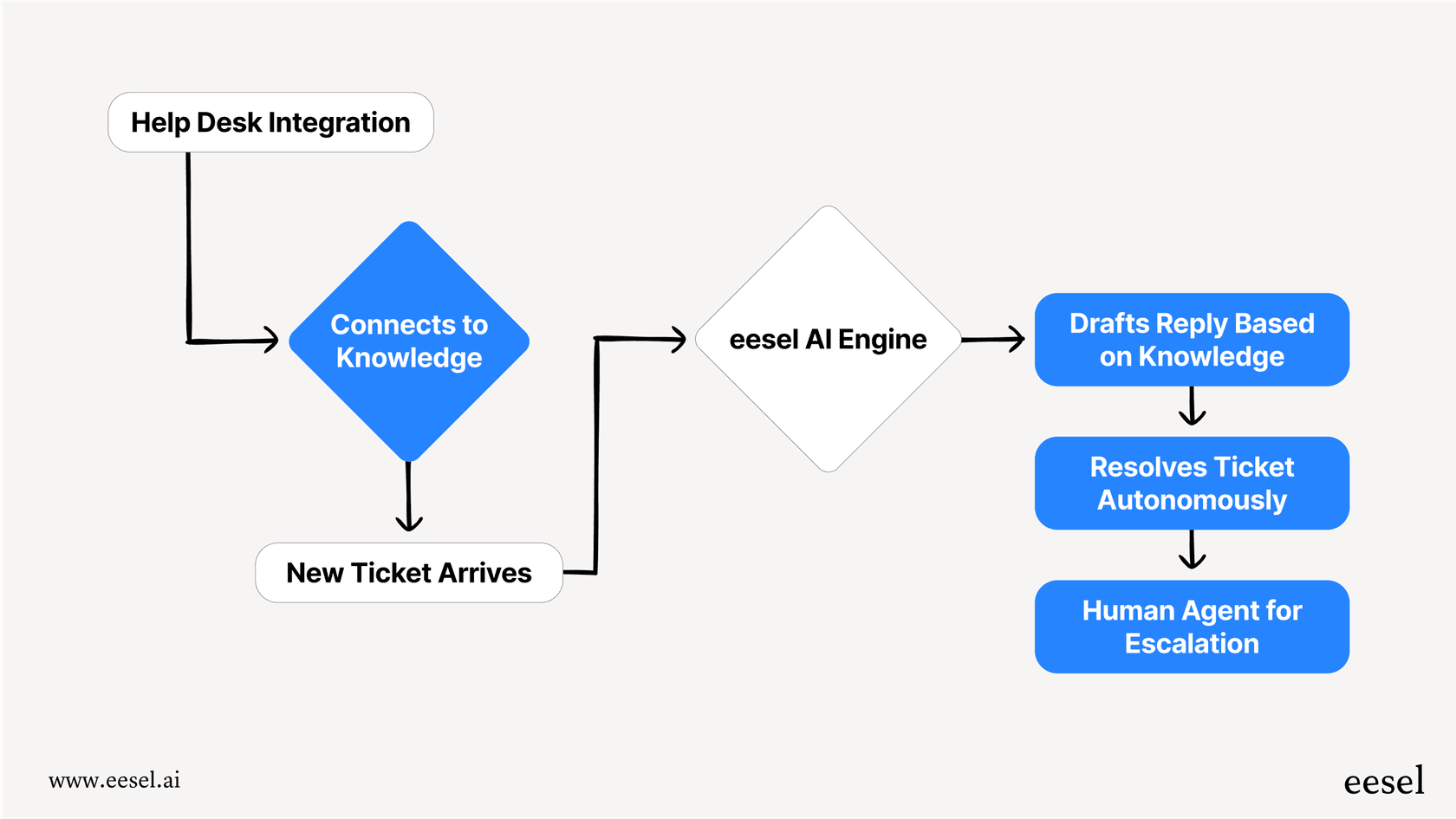
But a fast voice engine is just one part of the equation. To provide instant support, that voice needs to be connected to a system that can actually do something. That's where a tool like eesel AI comes in. It acts as the brain and nervous system for the voice, plugging directly into your helpdesk to use that low latency to find answers and solve customer problems immediately, not just generate audio quickly.
Voice quality, cloning, and customization
Of course, a fast response doesn't mean much if the voice sounds like a 1980s computer. Both platforms deliver excellent, natural-sounding voices, but they shine in different ways.
Interestingly, in a blind test where humans were asked to compare voices without knowing which was which, Cartesia's Sonic-2 was preferred over ElevenLabs's Flash V2 model by a pretty wide margin (61.4% to 38.6%). This suggests that for quick, conversational snippets, users found Cartesia's output to be a bit more natural.
When it comes to creating a digital copy of a real voice, the process also differs slightly:
-
Cartesia: Can generate a high-quality "instant" voice clone from just 3 seconds of audio.
-
ElevenLabs: Needs at least 10 seconds of audio for its instant cloning feature.
That might not sound like a big difference, but if you're trying to create voice profiles for an entire team, getting a clean 3-second clip from everyone is a lot easier than getting a 10-second one. It makes the whole process more scalable.
For tweaking the voice, Cartesia gives you dials to adjust emotion and speed on the fly, which is perfect for dynamic conversations that might shift in tone. ElevenLabs offers controls for things like "stability" and "style exaggeration," which are better suited for crafting the perfect narration for a long piece of content.
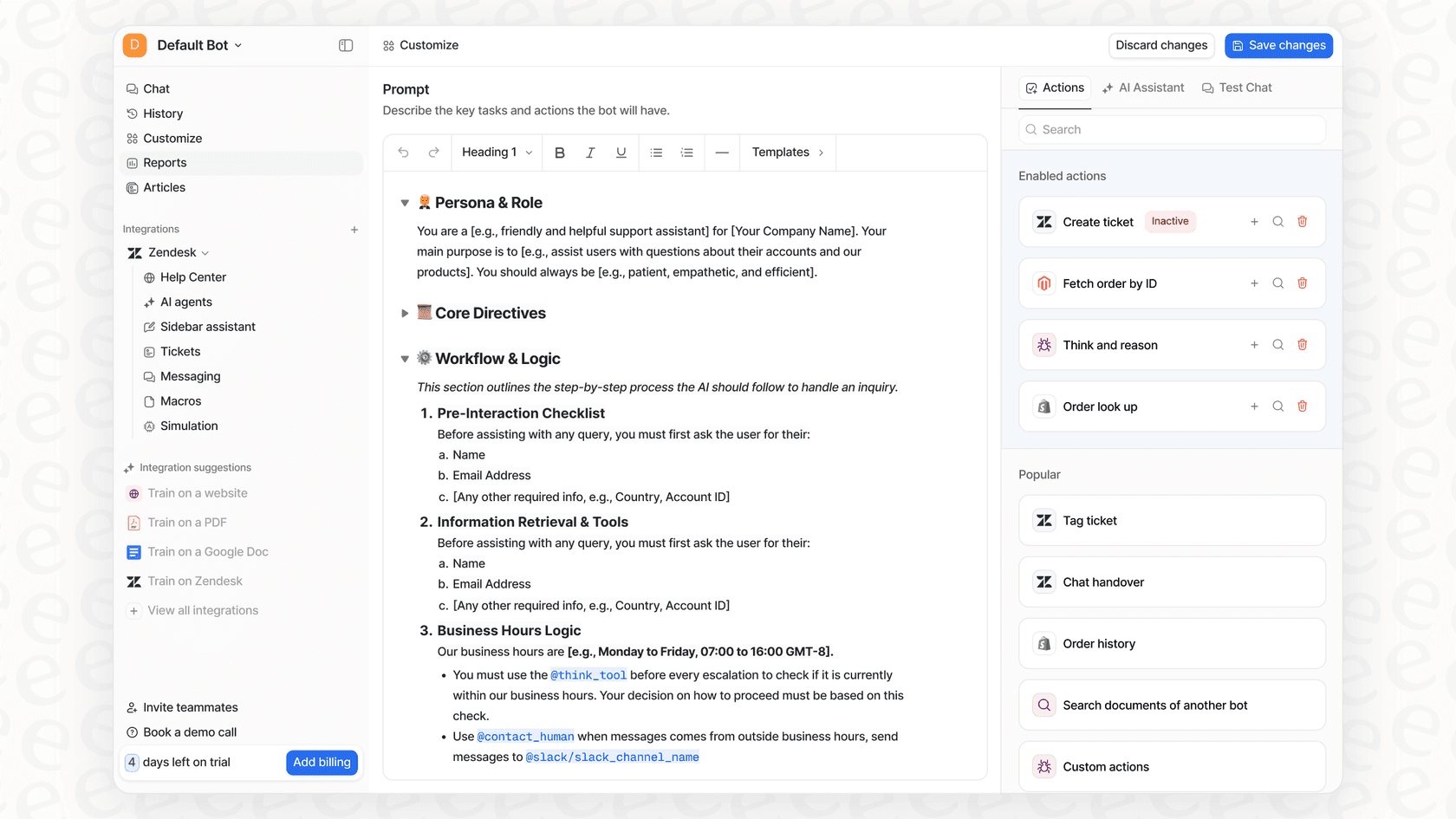
Having a high-quality, customizable voice is a fantastic starting point. But a support agent needs to be more than just a pretty voice. The real magic happens when you connect that voice to a brain that can take action. This is why having a solid workflow engine is so important. With an AI agent from eesel AI, you can set a custom persona and tone while also giving it the ability to perform tasks, like looking up an order status in Shopify or adding the right tag to a ticket in Zendesk.
Core use cases: Developer tools vs. content creation
It’s pretty clear that these two platforms are built for different people. Cartesia is aimed squarely at developers and enterprises. They offer features like on-premise deployment, which is a big deal for companies in finance or healthcare that have strict data security needs.
ElevenLabs is a creator's playground. Its massive voice library (over 4,000 voices compared to Cartesia's ~130) and extensive language support (over 70 languages to Cartesia's 15) make it the go-to for anyone producing audio content for a global audience.
So, how do you choose? If you’re localizing your company's training videos or dubbing a documentary, ElevenLabs is the clear winner. But if you’re building a real-time, interactive voice agent for your helpdesk, Cartesia is the tool that was specifically engineered for that task.
But here’s the thing neither platform will tell you: on its own, a text-to-speech engine is not a customer support solution. It's a powerful component. To actually automate support, you need a layer on top that can connect all your knowledge sources (like past tickets, help articles, and internal wikis in Confluence), integrate with your helpdesk, and give you a safe way to test and deploy your AI agent.
That's exactly the problem a platform like eesel AI is designed to solve. It’s the orchestration layer that brings everything together, letting you go live in minutes instead of spending months on a complex development project.
Pricing showdown: Comparing cost models
Cartesia and ElevenLabs also approach pricing differently. Cartesia uses a credit system where most tasks cost 1 credit per character, which is very granular and lets you pay for exactly what you use. ElevenLabs mostly charges by the character, which can be easier to forecast but a little less flexible.
| Feature | Cartesia | ElevenLabs |
|---|---|---|
| Free Tier | $0/month with 10k credits | $0/month with 10k characters |
| Pro/Starter Tier | Pro: $5/month with 100k credits | Starter: $5/month with 30k characters |
| Startup/Creator Tier | Startup: $49/month with 1.25M credits | Creator: $11/month with 100k characters |
| Scale Tier | $299/month with 8M credits | $99/month with 500k characters |
| Pricing Model | Credit-based (1 credit/char) | Character-based |
It’s helpful to compare these component-level prices to the cost of a full solution. With eesel AI's pricing, for instance, you're not just buying characters or credits; you're getting a complete platform that includes an AI Agent, a Copilot for your human team, automated Triage, and more, all for a predictable monthly cost.
Even more importantly, eesel AI never charges you per resolution. This is a big deal. It means the platform is aligned with your goals, to solve customer issues as efficiently as possible. You're not penalized for having an effective AI that helps more customers.
Cartesia Sonic 3 vs ElevenLabs: It’s not just the voice, it’s the whole system
So, after all that, who wins the Cartesia Sonic 3 vs ElevenLabs debate?
The honest answer is: it depends entirely on what you're trying to build.
For any real-time, interactive application like customer support, Cartesia's incredible speed and developer-friendly features give it a clear advantage.
For content creation, where emotional depth, voice variety, and language options are the most important factors, ElevenLabs is still the king of the hill.
But for anyone working in customer service or IT support, the voice is just the tip of the iceberg. The real work isn't just generating audio; it's building an intelligent system that can understand what a customer wants, connect to your business tools, and actually solve their problem. This is where standalone TTS platforms hit their limit.
That's the gap eesel AI was created to fill. It’s a simple, self-serve platform that pulls together all your scattered company knowledge and plugs a smart, autonomous AI agent directly into your existing helpdesk.
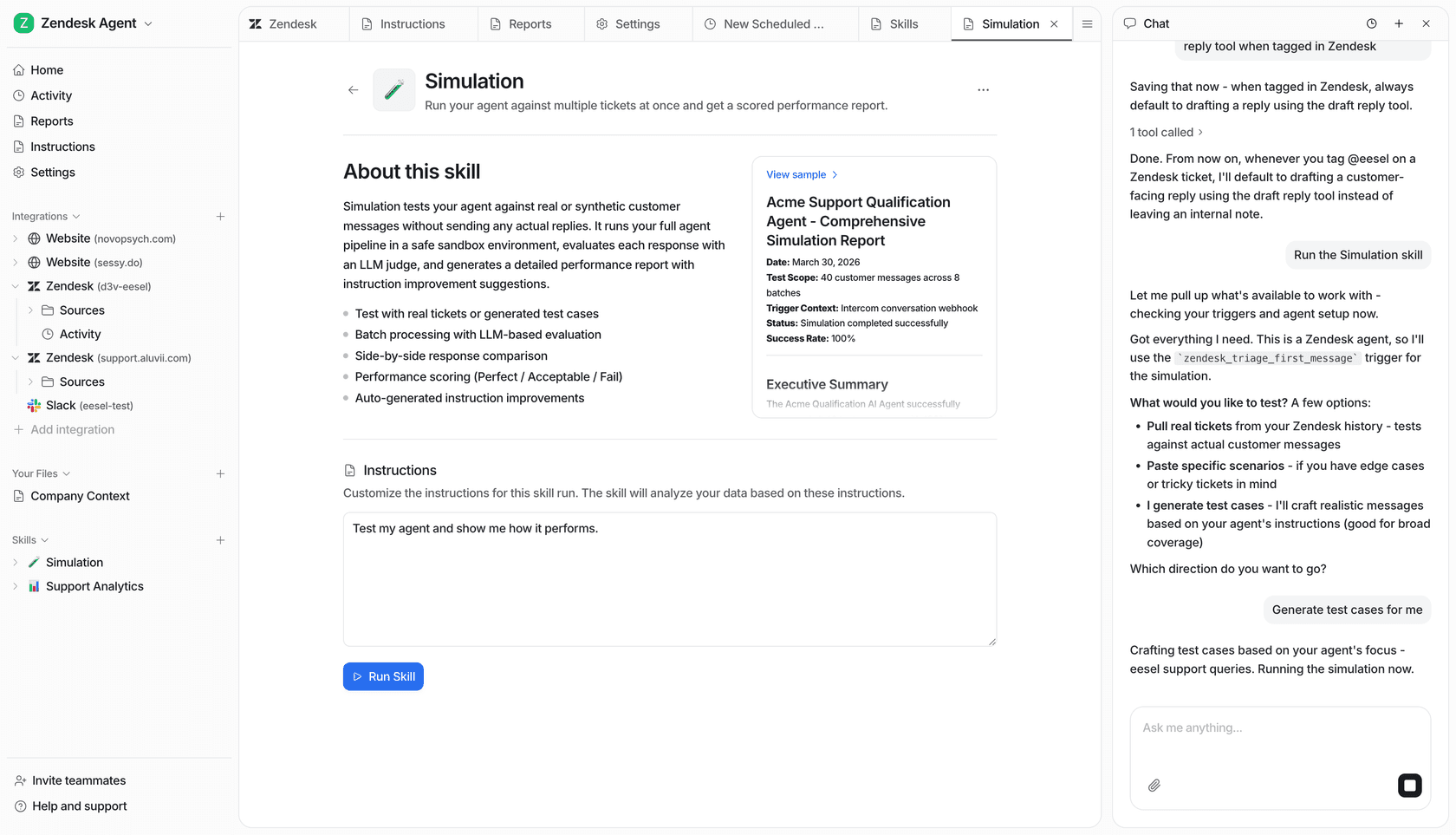
Instead of spending months trying to piece together a TTS model with a bunch of other systems, you can use eesel AI to launch a fully capable AI support agent in just a few minutes. You can even simulate how it would perform on your past support tickets to see exactly what your ROI will be before you even turn it on. Why build from scratch when you can start solving problems today?
Frequently asked questions

Share this article

Article by
Kenneth Pangan
Writer and marketer for over ten years, Kenneth Pangan splits his time between history, politics, and art with plenty of interruptions from his dogs demanding attention.