I tested dozens of tools to find the 5 best ChatGPT apps directory picks for 2025

Last edited January 6, 2026

ChatGPT is evolving beyond a simple chatbot. It's becoming a full-on work platform, and its growing app ecosystem is a big part of that story. You can now whip up presentations, ask questions about your databases, and even edit photos without leaving the chat window.
However, the ChatGPT apps directory is expanding rapidly, making it challenging to identify the most effective business applications. This article reviews several apps to highlight five that can help save time, improve team productivity, and simplify daily tasks.
What exactly is the ChatGPT apps directory?
You can think of the ChatGPT apps directory as OpenAI's version of an app store, built right into the chat. The whole idea is to turn ChatGPT into a central hub where you can connect your other tools and get things done in one spot.
You might have known these as "connectors" in the past. OpenAI switched the name to "apps" to better reflect how these tools plug into your conversations. It’s a small tweak, but it clarifies the vision: this isn't just about pulling in data; it's about making things happen.
According to OpenAI's own help center, the apps are sorted into a few main types. This infographic breaks down the primary categories you'll find.
-
Interactive Apps: These give you rich interfaces inside the chat. Think of designing something in Canva or looking at houses on Zillow without ever leaving the conversation.
-
Search Apps: These are for finding information from other places. You can pull details from your company's internal knowledge base or a project management tool directly into your chat.
-
Deep Research Apps: These are great for when you need to dig into a complicated topic. They can pull from multiple sources and even give you citations for where the information came from.
-
Apps with Write Actions: These apps can perform actions for you, like updating a record in Airtable or adding a task to your to-do list.
How we selected the best apps
The apps on this list were selected based on specific criteria relevant to business use.
The selection was based on the following:
-
Real-World Usefulness: The app must solve a common business problem in areas like marketing, design, sales, or project management.
-
Smooth Integration: The app needs to function seamlessly within a ChatGPT conversation without feeling disruptive.
-
Ease of Use: The app should be intuitive enough for team members to use without extensive training.
-
Clear Value: The app must provide a clear and immediate benefit, such as saving time or simplifying a difficult task.
A quick comparison of the top apps
For those who just want the highlights, here’s a quick look at the apps that made the cut.
| App | Best For | Key Feature | Pricing Model |
|---|---|---|---|
| Canva | Quick, on-brand design creation | Turn text prompts into editable visual assets | Free to connect; premium Canva features require a paid plan |
| Airtable | Structured data management | Query and add to your databases directly in chat | Free to connect for all Airtable & ChatGPT plan levels |
| Figma | Collaborative design & diagramming | Create FigJam diagrams and Figma Slides from text | Free to connect for all ChatGPT users; Figma has free & paid plans |
| Adobe Photoshop | Accessible image editing | Access professional editing tools via simple prompts | Free to use for all ChatGPT users |
| Zillow | Niche real-world searches | Conversational real estate browsing with an interactive map | Free to use |
The 5 best apps in the ChatGPT apps directory in 2025
Okay, let's dive into the details. Here’s a full breakdown of the apps that stood out and why they might be worth connecting to your ChatGPT account.
1. Canva
The Canva app allows ChatGPT to function as a graphic design assistant. You can create social media posts, presentations, and banners just by typing a prompt. For instance, you could ask, "Canva, create a 5-slide presentation about the benefits of content marketing," and it will generate an editable design you can then fine-tune. Canva's announcement mentions it can handle complex jobs, like translating a huge slide deck into another language in seconds.
Canva for low-grade graphic design

Why it's on the list: It’s incredibly helpful for non-designers. Marketing, sales, and support teams often need visuals in a hurry, and this app removes the delay of waiting for a designer. It makes creating on-brand assets fast and accessible for everyone.
-
Pros: The speed and simplicity are a huge plus. You can go from an idea to a professional-looking design in just a few minutes.
-
Cons: It's not the complete Canva experience. According to the Canva Help Center, premium features like Magic Resize and Brand Kit aren't available in the ChatGPT app yet. For more detailed edits, you'll still have to open the main Canva website.
-
Pricing: The app is free to connect for all ChatGPT users and works with any Canva plan, including the free one. If you want to use premium templates or features in your design, you'll need a Canva Pro, Business, or Enterprise subscription.
2. Airtable
For teams that use Airtable for organization, this app can be very useful. It connects ChatGPT to your bases (Airtable's name for databases), letting you ask questions and update data just by chatting. Instead of digging through tables, you can just ask, "Airtable, show me all project tasks due this week," or, as Airtable suggests, "Update the status of all deliverables tracked in Airtable based on my meeting notes."
Why it's on the list: It connects your informal conversations with the organized data that your business relies on. It saves a lot of time you'd normally spend switching between tabs and updating records by hand.
-
Pros: It's great for quickly looking up info, summarizing data, and making simple changes without leaving your chat.
-
Cons: How well it works really depends on how organized your Airtable base is. If your data is a mess, the app won't be much help. Really complex queries can also be a bit hit-or-miss.
-
Pricing: Good news on this front. The integration is available for all plan levels, so you can try it out for free.
3. Figma
The Figma app helps accelerate the initial stages of the creative process. It lets you generate FigJam diagrams, Figma Slides presentations, and Figma Buzz assets from a simple text prompt. As Figma's blog points out, you can turn an idea like, "Make me a Figma Slides deck for a new business meeting," into a real starting point for your team.
Why it's on the list: It's a huge time-saver in the early stages of design and product development. You can turn a brainstorming session into a wireframe, user flow, or presentation in seconds, giving your team something concrete to work with right away.
-
Pros: It’s fantastic for group brainstorming and getting initial ideas into a visual format quickly.
-
Cons: This won't replace a skilled designer. The results are best for ideation and creating basic diagrams, not for polished, final designs.
-
Pricing: The Figma app is available to all logged-in ChatGPT users. To claim and edit the files it makes, you'll need a Figma account, which offers both free and paid plans.
4. Adobe Photoshop
This app integrates some of Adobe Photoshop's features into ChatGPT, simplifying advanced editing tasks. You can upload an image and ask for changes in plain English. Prompts like "enhance the color," "blur the background," or "add a radial blur" work quite well, as shown in Adobe's tutorials.
Why it's on the list: It gives powerful editing tools to people who might find the full Photoshop program a bit intimidating. If you need a quick touch-up for a blog post image or a social media graphic, you can now do it with a simple sentence.
-
Pros: The ability to make complex edits with simple prompts is the best part. It's very intuitive.
-
Cons: The main drawback is that generative edits are not currently supported in the ChatGPT app. You can't use it to create new image content from scratch. For more advanced work, you can easily switch from the chat to Photoshop on the web.
-
Pricing: According to an official Adobe announcement, the Photoshop app is free to use for all ChatGPT users globally. You don't even need an Adobe Creative Cloud subscription.
5. Zillow
The Zillow app lets you look for homes to buy or rent using natural language. You can be very specific with your requests, like "Show me three-bedroom houses for rent in Austin, Texas under $3,000 a month with a backyard," and it will give you back interactive results you can explore.
Why it's on the list: It is an example of a specialized app that simplifies a complex search process. While it's not a typical "business" tool for every company, it shows the potential of the app directory to solve niche, real-world problems.
-
Pros: The conversational search is focused, fast, and works really well. It turns a chore into a simple chat.
-
Cons: Its use is obviously limited to real estate. While technologically interesting, its application is specific to real estate and not for general business tasks.
-
Pricing: It's completely free to use.
For a deeper dive into how the app directory works and what it means for the future of AI, this video provides a helpful overview of OpenAI's platform strategy.
Tips for using the ChatGPT apps directory
Here are a few tips to help you and your team use the app directory well.
-
Be specific: Vague prompts give you vague results. Before you mention an app, know what you want to do. The more detail you provide, the better the outcome will be.
-
Check permissions: When you connect an app, you're giving it access to some of your data. Always take a moment to look at the permissions screen so you know exactly what information you're sharing.
-
Use admin controls for your business: If your team has a ChatGPT Enterprise plan, workspace admins can control which apps the whole organization can use. This is important for security, privacy, and compliance.
-
Know the limits: These apps are great shortcuts, but they're often simplified versions of the full product. You'll likely still need to go to the native app for more complex work, which means you're still switching between tools.
An alternative approach: Integrated AI assistants
The ChatGPT apps directory centralizes various tasks within its interface. This model positions ChatGPT as a primary workspace, which requires managing the platform and its app connections. An alternative approach involves AI that operates directly within a team's existing software.
eesel AI provides an example of this integrated approach. It functions as an AI agent inside tools like Zendesk, Intercom, or Slack.
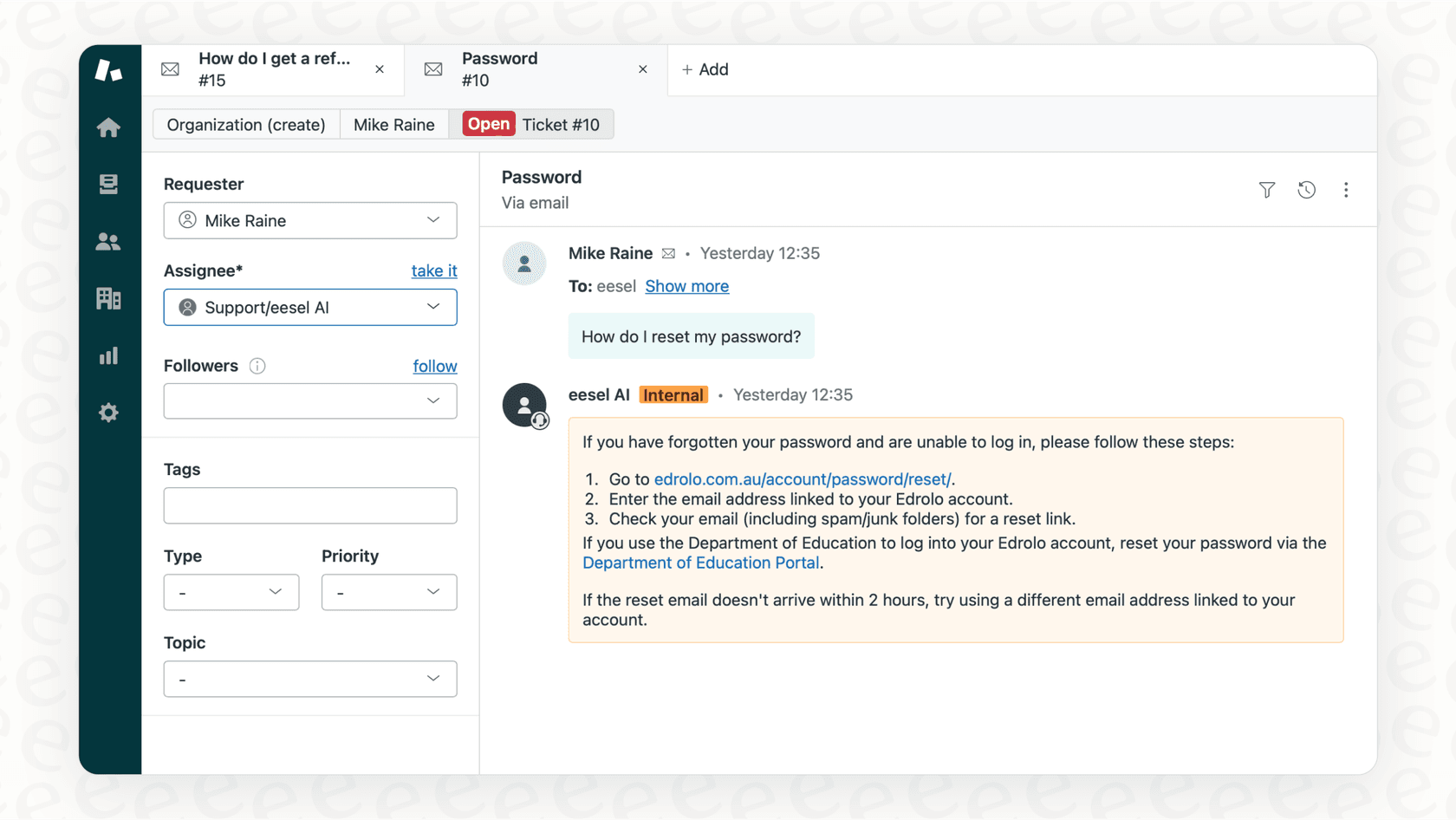
For instance, the eesel AI Agent operates within a helpdesk to resolve customer tickets. It connects to existing knowledge sources, such as past conversations and help center articles, to get started.
eesel AI allows users to run simulations on past tickets to evaluate performance before live deployment. The platform supports progressive automation, starting with AI-drafted replies for human review and gradually moving toward autonomous resolution as confidence in its performance increases.
This type of integrated solution is designed for businesses seeking AI that adapts to their current workflows rather than introducing a new, centralized platform.
Frequently asked questions

Share this article

Article by
Kenneth Pangan
Writer and marketer for over ten years, Kenneth Pangan splits his time between history, politics, and art with plenty of interruptions from his dogs demanding attention.