Decagon vs Ultimate.ai: Which AI customer service platform wins in 2026?

Last edited March 13, 2026
Choosing the right AI agent for customer support is not just about features on a checklist. It is about finding a platform that fits how your team works, what your customers expect, and where you are headed as a company.
Two names that come up frequently in enterprise AI support are Decagon and Ultimate.ai. But here is the thing: Ultimate.ai is not really a standalone option anymore. Zendesk acquired the company, and Ultimate.ai now exists as part of the broader Zendesk AI ecosystem. That fundamentally changes the comparison.
So let us look at what each platform actually offers, how they differ, and which one makes sense for your situation.
What is Decagon?
Decagon is an autonomous AI agent platform built for enterprise customer service. Founded by former Google and Meta engineers, the company positions itself as "the AI concierge for every customer." The platform focuses on giving CX teams direct control over AI behavior without requiring engineering resources for every change.
Decagon's core innovation is something called Agent Operating Procedures (AOPs). These let you define agent workflows in natural language, which then compile into code. Non-technical users can shape and iterate on agent behavior, while technical teams retain control over guardrails, integrations, and versioning.
The platform serves notable customers including Duolingo, Chime, ClassPass, Figma, Noom, Dropbox, and Rippling. Reported results include an 80% deflection rate for Duolingo, 70% chat and voice resolution for Chime, and 95% cost reduction for ClassPass.
Decagon supports omnichannel deployment across voice, chat, email, SMS, and custom surfaces via API. The platform emphasizes transparency, with full visibility into why the AI responded the way it did, step-by-step traceability, and enterprise-grade guardrails for sensitive operations like identity verification and refunds.
What is Ultimate.ai?
Ultimate.ai was a standalone AI customer service platform that Zendesk acquired. The Ultimate.ai website now redirects to Zendesk's AI agents page, and the product has been fully integrated into the Zendesk ecosystem as Zendesk AI Agents.
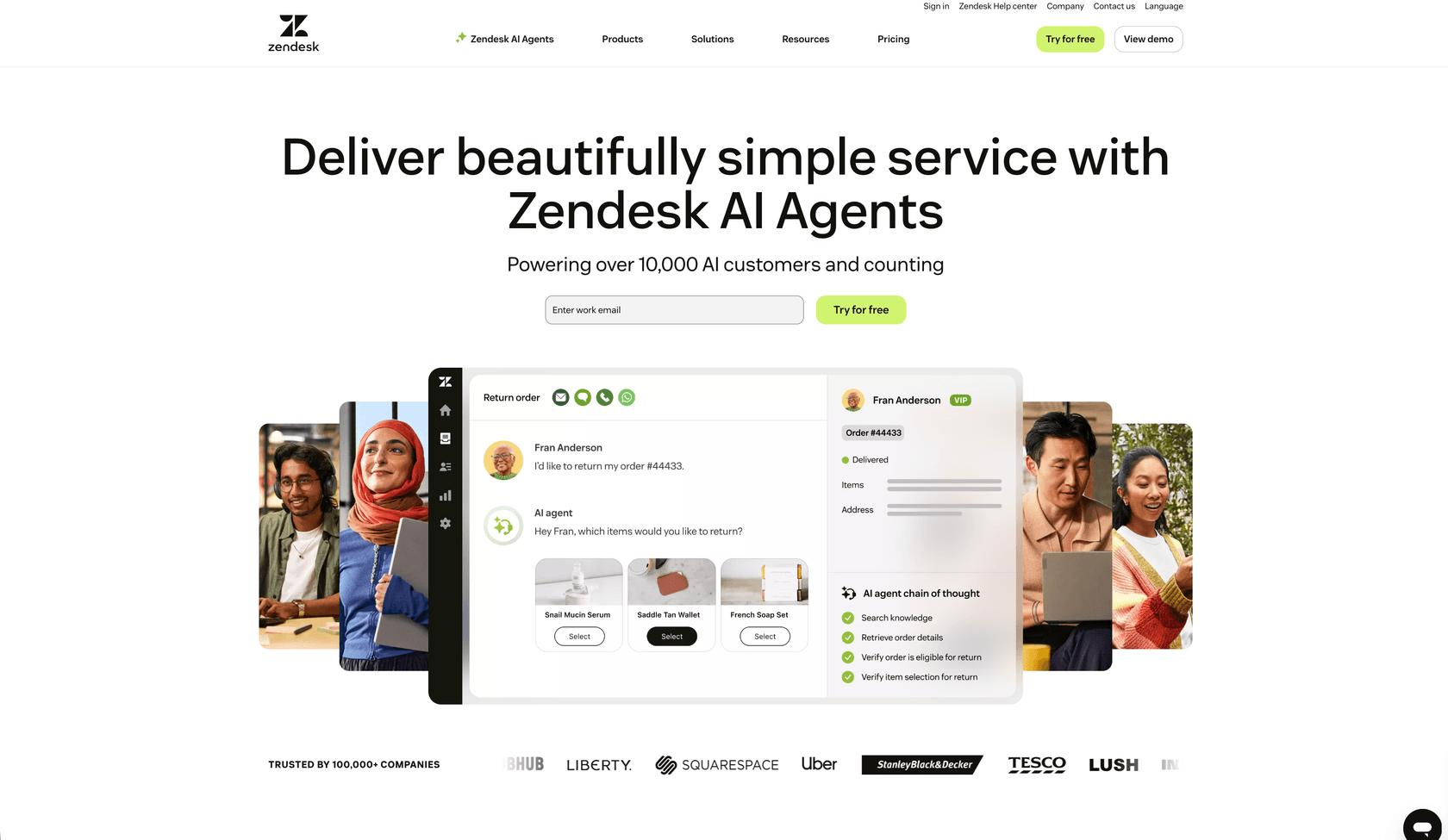
This matters because Ultimate.ai is no longer a separate purchasing decision. If you want Ultimate.ai's capabilities, you are buying into Zendesk's broader platform. That comes with advantages (deep integration, established infrastructure) and constraints (ecosystem lock-in, Zendesk's pricing structure).
Zendesk AI Agents claim to automate 80%+ of interactions and can be launched in minutes rather than months. The system uses "agentic AI" that reasons, adapts, and acts independently rather than following predefined scripts. It supports 80+ languages and works across social, web, mobile, voice, and email channels.
The platform includes features like generative replies, resolution validation with built-in QA scoring, a knowledge builder for connecting help centers, and what Zendesk calls the "Resolution Learning Loop" where the AI improves from every resolution.
Feature comparison
AI capabilities
Decagon uses large language models with retrieval-augmented generation (RAG) and allows custom procedures through AOPs. The platform handles multi-intent conversations and maintains user memory across interactions.
Zendesk AI Agents use generative AI combined with Zendesk's proprietary intent models. The system is pre-trained on over 18 billion service interactions. The "agentic AI" can reason across problems and adapt as conversations evolve.
Deployment and setup
Decagon typically requires 6-8 weeks for deployment. This includes integration setup, workflow configuration, and testing. The trade-off is a more customized implementation that fits specific business logic.
Zendesk AI Agents can launch in minutes for basic implementations. The platform promises "no scripting or training" to get started. More complex enterprise deployments still take 4-6 weeks, but the barrier to entry is lower.
Channel support
Both platforms support major channels: chat, email, voice, and messaging. Decagon also offers SMS and custom API surfaces. Zendesk's strength is native integration with its own ticketing, messaging, and help center products.
Integration ecosystem
Decagon offers 100+ integrations with CRMs, help desks, knowledge bases, and CCaaS providers. The platform emphasizes flexibility and avoiding vendor lock-in.
Zendesk AI Agents work seamlessly within the Zendesk ecosystem. For teams already using Zendesk for ticketing and help center, this is a major advantage. For teams using other help desks, this requires migration or workarounds.
Pricing comparison
| Feature | Decagon | Ultimate.ai (Zendesk AI) |
|---|---|---|
| Pricing model | Custom enterprise | Per agent + per resolution |
| Starting cost | Custom quote | $55/agent/month (Suite Team) |
| AI agent included | All tiers | Essential AI included |
| Per resolution | Custom | $1.50 committed, $2.00 pay-as-you-go |
| Free trial | Available | 14-day trial available |
| Annual discount | Custom | ~20% savings on annual plans |
Decagon does not publicly disclose pricing. The company operates on a sales-led model with custom quotes based on volume and requirements. This is typical for enterprise-focused platforms but makes budgeting harder for smaller teams.
Zendesk's pricing is transparent but complex. The base Suite Team plan at $55 per agent per month includes essential AI agents with 5 automated resolutions per agent monthly. Additional resolutions cost $1.50 if committed or $2.00 pay-as-you-go. Advanced AI capabilities require add-ons or higher-tier plans.
Total cost of ownership depends on your ticket volume. A team of 20 agents handling 2,000 automated resolutions monthly would pay:
- Zendesk: ~$1,100/month base + $2,850/month for resolutions = ~$3,950/month
- Decagon: Custom quote (likely comparable for enterprise, potentially higher for smaller volumes)
Best fit: Who should choose each platform
Choose Decagon if:
- You want AI agents that work across multiple help desks or platforms
- Your CX team needs direct control over AI behavior without engineering tickets
- You value transparency into AI decision-making
- You need custom workflows that do not fit standard patterns
- You are concerned about vendor lock-in
Choose Zendesk AI (Ultimate.ai) if:
- You are already using Zendesk for ticketing and help center
- You want the fastest possible deployment
- You prefer predictable, transparent pricing
- You need 80+ language support out of the box
- You value pre-trained models on billions of interactions
A better alternative: eesel AI
For teams that want AI autonomy without the complexity of Decagon or the ecosystem lock-in of Zendesk, there is another option worth considering.
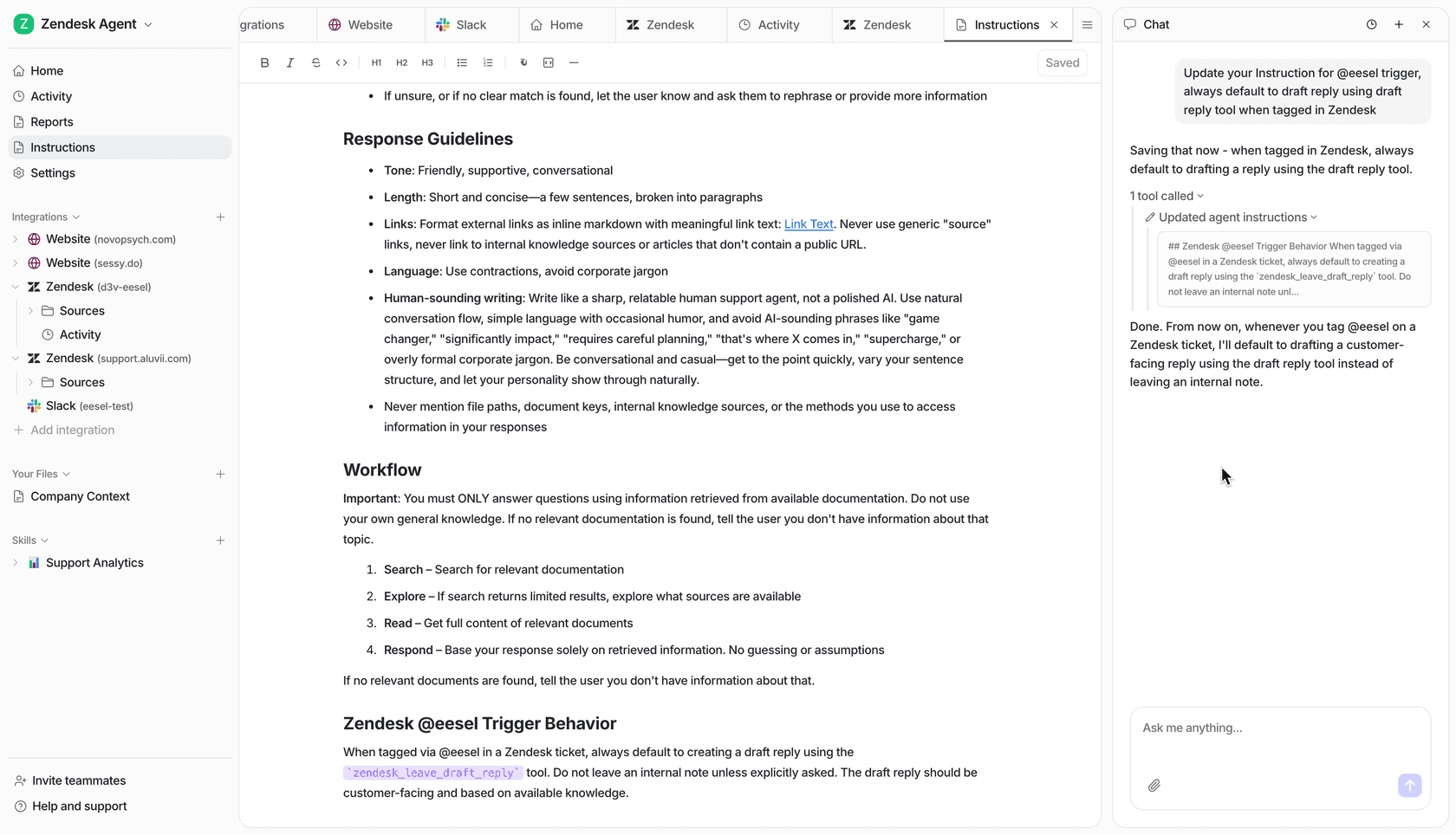
We built eesel AI to be the AI teammate you hire, not the software you configure. Here is what that means in practice.
Progressive rollout. Start with eesel drafting replies for your agents to review. As you gain confidence, let it send responses directly. Eventually, it handles full frontline support. You control the pace.
Plain-English control. Tell eesel what to do in natural language: "If the refund request is over 30 days, politely decline and offer store credit." No code, no decision trees, no engineering required.
Minutes to deploy, not weeks. Connect eesel to your help desk and it learns from your past tickets, macros, and help center immediately. No manual training or documentation uploads.
Pay per interaction, not per seat. Our pricing scales with usage, not headcount. You are not penalized for growing your team.
Mature eesel deployments achieve up to 81% autonomous resolution with a typical payback period under 2 months.
Making the right choice for your support team
The decision between Decagon and Zendesk AI comes down to three factors:
Your existing stack. If you are already invested in Zendesk, the AI Agents add-on is the obvious choice. The integration is seamless and the learning curve is minimal. If you use Freshdesk, Intercom, Gorgias, or another platform, Decagon or eesel AI make more sense.
Technical resources. Decagon gives CX teams more direct control but still benefits from technical involvement for advanced configurations. Zendesk AI is more turnkey but offers less flexibility outside Zendesk's framework.
Pricing preferences. Zendesk's transparent pricing makes budgeting easier, though costs scale with volume. Decagon's custom pricing requires sales conversations but may offer better value at enterprise scale.
For teams that want the best of both worlds, eesel AI offers the autonomy and transparency of Decagon with the ease of deployment Zendesk promises, without locking you into any single ecosystem.
Frequently Asked Questions

Share this article

Article by
Stevia Putri
Stevia Putri is a marketing generalist at eesel AI, where she helps turn powerful AI tools into stories that resonate. She’s driven by curiosity, clarity, and the human side of technology.