Dreamina Seedance 2: what ByteDance's new AI video model really does


Last edited June 22, 2026
What Dreamina Seedance 2 actually is
I build AI agents for a living at eesel, so I watch model launches with one question in mind: which part of this is real and which part is the launch-day reel? Seedance 2.0 is one of the rare ones where the substance mostly survives contact with a free trial.
First, the naming, because it trips people up. Dreamina is ByteDance and CapCut's all-in-one AI creative platform, the consumer app where you actually type a prompt. Seedance is the underlying video model that powers Dreamina's video generator, built by ByteDance's research org, ByteDance Seed. So "Dreamina Seedance 2" is just the Seedance 2.0 model as you meet it inside Dreamina. The arena listings spell it out literally, calling the entry "Dreamina Seedance 2.0 720p".
It also helps to know where 2.0 sits in the line. Seedance 1.0 arrived around June 2025 with 1080p multi-shot generation from text and images. Version 1.5 Pro followed in December 2025 and added synchronized audio-visual generation. Seedance 2.0, in February 2026, folded all of that into a single "unified multimodal audio-video joint generation architecture". That arc, image-and-text to synced-audio to fully-multimodal in about eight months, is the part that should make every other video lab nervous.
What version 2 actually adds
The leap in 2.0 is the input side. Per ByteDance's launch post, you can mix modalities in a single generation: up to 9 images, 3 video clips, 3 audio clips, plus a natural-language prompt, all referenced at once for composition, motion, camera movement, and sound.
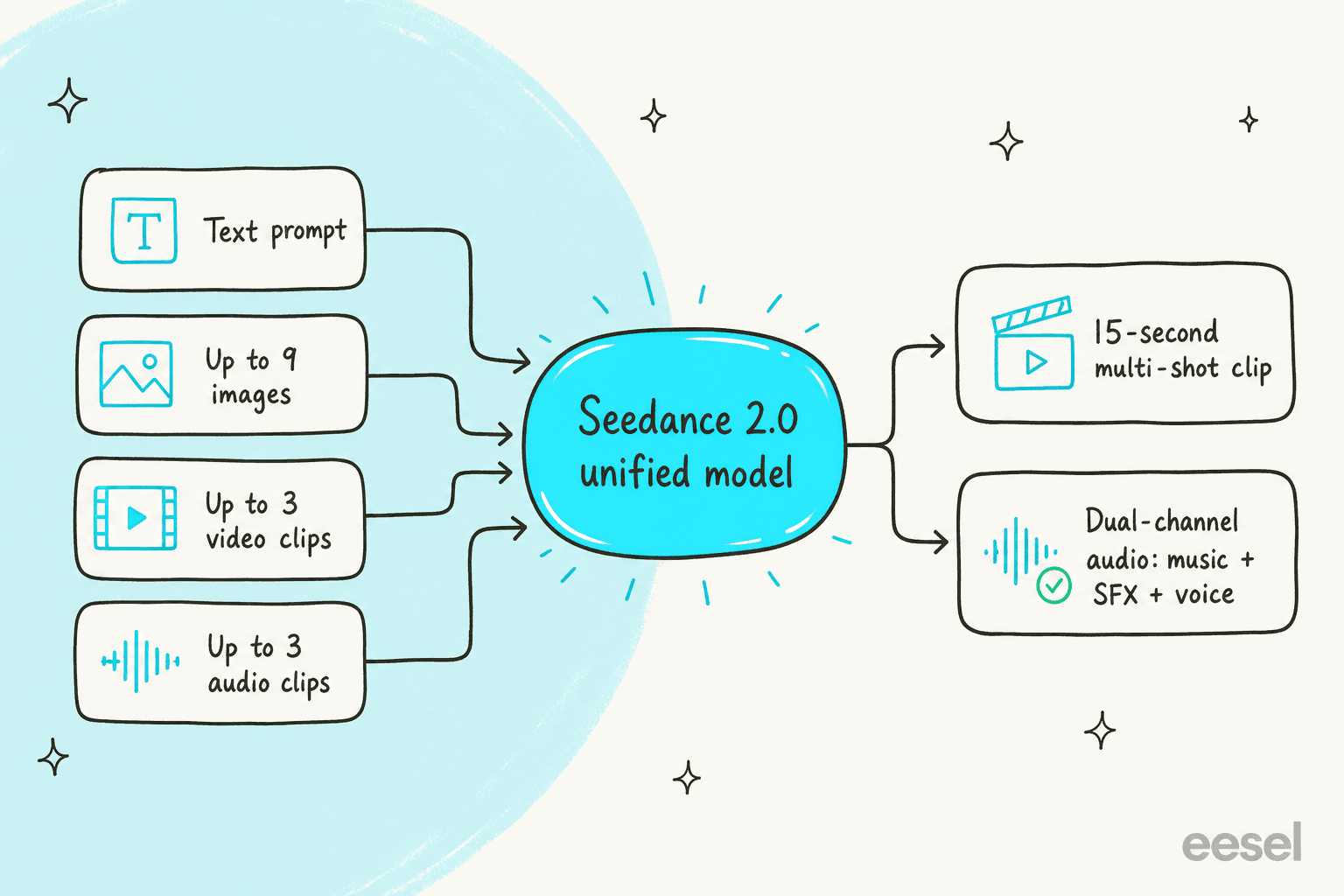
Three things follow from that architecture, and they're the reasons to care:
- Native synced audio. The model outputs "15-second high-quality multi-shot audio-video" with dual-channel sound, splitting background music, ambient effects, and character voiceovers into parallel tracks. This is the thing that separates it from the silent-clip generation most tools still do.
- Editing and extension, not just generation. ByteDance describes "stable and controllable video extension and editing", so you can lengthen a clip or make targeted changes to a character, an action, or a storyline instead of re-rolling the whole thing.
- Multi-subject scenes that hold together. The standout in the demos is complex motion with several actors interacting, the kind of shot that usually collapses into melted faces.
One early tester, @minchoi on X, summed up the throughput that gets people excited:
Seedance 2.0 just generated a 1-minute cinematic video in 5 minutes. 4 shots. 15 seconds each... Insane...
Is it really the best? The leaderboard vs the vibes
Here's where I have to hold two true things at once.
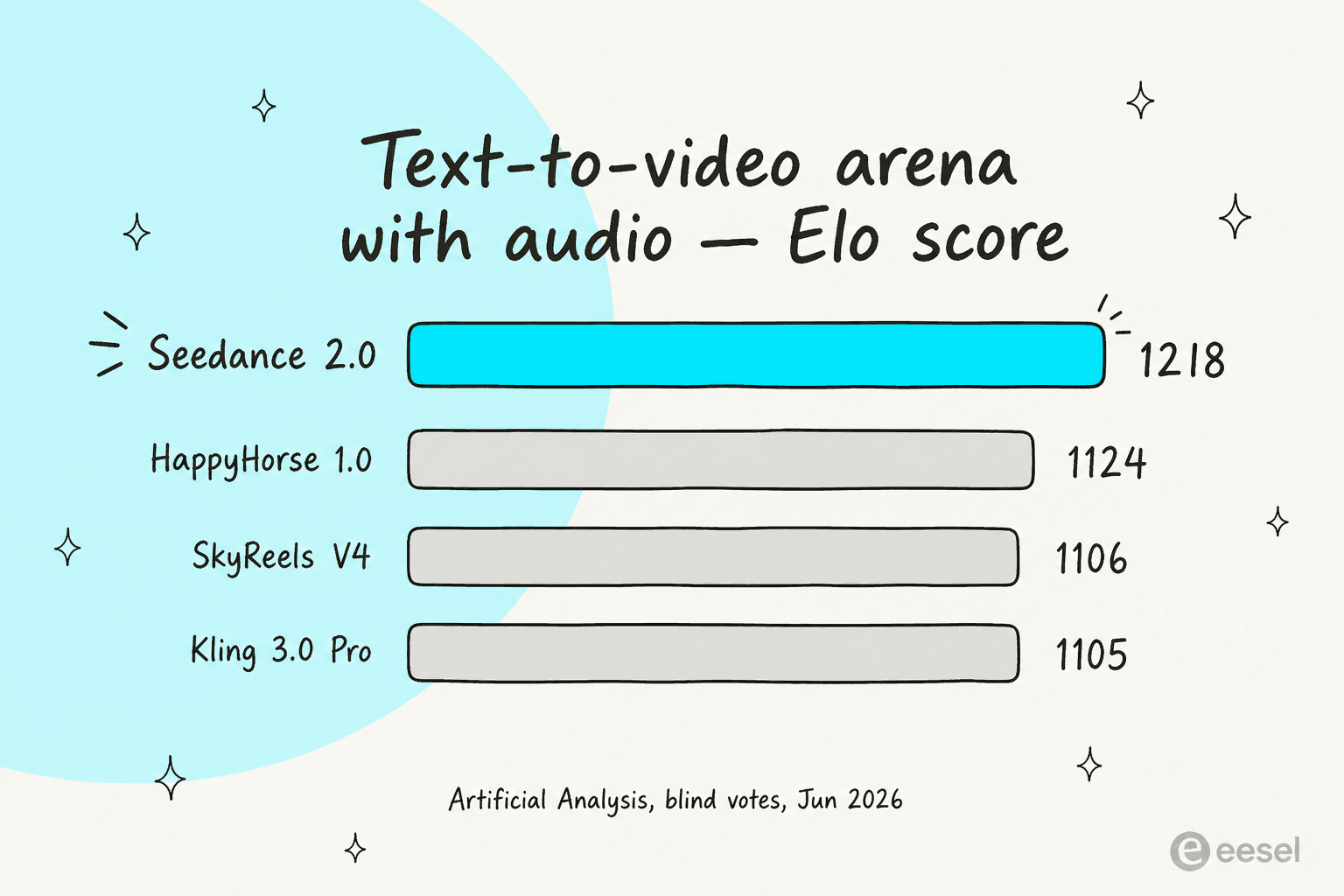
On the measurable side, Seedance 2.0 clearly leads. On the independent, blind-vote Artificial Analysis video arena, as of late June 2026 it sits at #1 for text-to-video with audio (Elo 1218) and #1 for image-to-video with audio (Elo 1195). Those aren't ByteDance's own numbers, which is what makes them worth citing.
On the vibes side, the people who actually use these tools daily are more split, and they're right to be. The sharpest balanced take I found came from a tester in r/SoraAi:
I would say Seedance can produce a perceived higher quality video output and definitely higher audio quality at times. However it leans very clean. As if everything was trained on modern Alexa camera footage. I have trouble acquiring a more vintage, 35mm look... The dialogue interaction between characters comes out a little too "Soap Opera" at times. I do like that it handles multiple cast characters better though. Sora had some magic in it.
Another user in the same thread pushed back on the hype harder:
I keep seeing people claim that Seedance 2.0 and Veo 3 have "surpassed" Sora 2, but after actually testing them, it's not even a close call. The consistency and physics in Sora 2 are still in a completely different league.
So which is it? Both. Seedance wins the benchmark that scores synced audio and multi-character scenes; Sora 2 still wins the "does this feel like a film" test for a lot of creators. If you want the wider field, our Sora 2 alternatives roundup, the imagine vs Sora breakdown, and the Kling alternatives list all put these head to head.
Where it cracks: the honest downsides
The most useful thing I read wasn't a benchmark, it was a tester laying out the honest downsides after spending real money on it:
French speech is basically broken. Maybe 1 out of 5-10 attempts actually works properly. Max quality is 720p... Product shots and ads with real objects? Not great... It's the most expensive AI video model out there. Every test costs real money... Face blocking is aggressive. Real people get flagged constantly.
That matches what ByteDance itself admits, which is the part I respect. The launch post says plainly that the model "is still far from perfect," naming detail stability, occasional audio distortion, multi-subject consistency, and text rendering as open problems. A model that lists its own flaws is easier to trust than one that doesn't.
The non-English speech issue is worth flagging twice, because it's a real planning constraint. A later commenter noted it "does seem to struggle with languages like French and German," and even felt the model had drifted since launch. The same person passed along the rumor of a Seedance 2.1 with 30-second and 4K output "coming soon", treat that as speculation, not a roadmap.
And then there's the filtering, which several testers found maddening. One described videos that pass every input check and then get blocked at the output stage anyway. If your work touches real faces or anything the filter reads as borderline, budget for failed generations.
Pricing: what you can and can't pin down
I'll be straight about the limits of what I can confirm here, because guessing at prices is how blog posts get things wrong. Dreamina's live pricing sits behind a login and didn't render to a logged-out check, so I'm not going to quote a credit number I can't stand behind.
What's solid: Dreamina runs on a credit system with a free tier, and Seedance 2.0 generations spend those credits. Beyond Dreamina, the model is also available via API and on platforms like Replicate, so there are two cost surfaces (consumer credits vs per-generation API).
On the community side, the signal is consistent: testers repeatedly call it the priciest video model they use, and one reported a 60% surcharge for generating with your own face. Treat those as user reports, not a vendor price sheet, but the direction is clear: this is a premium-priced model, and the 720p cap means you're paying top dollar without top resolution. If predictable cost matters more than raw quality, the published tiers for Kling, Runway, and Luma are easier to plan around today.
Who Dreamina Seedance 2 is for
After all that, the recommendation is actually clean.
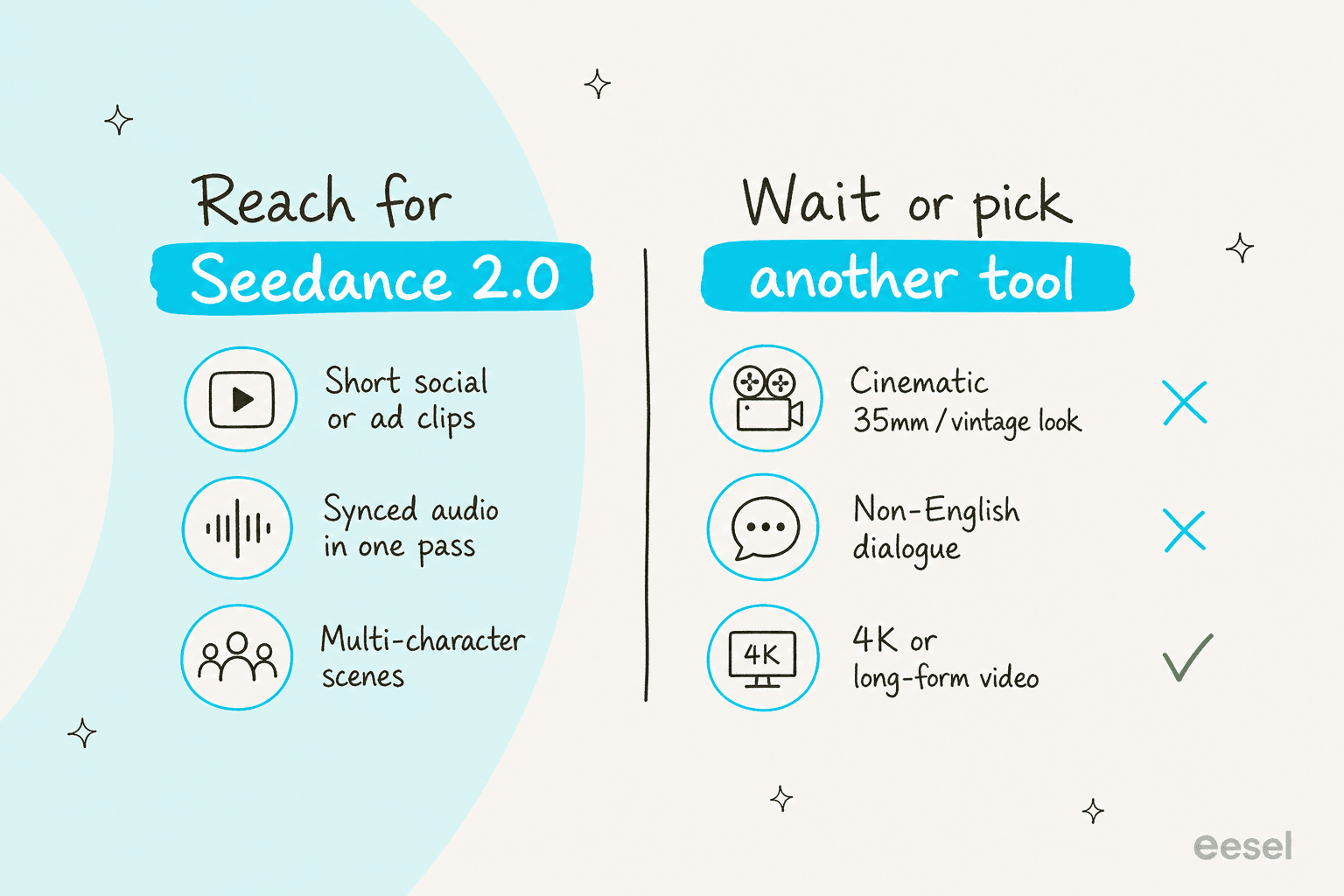
Reach for it when you want short social or ad clips with synced sound in a single pass, when your scene has multiple characters interacting, or when you want to iterate fast with little reprompting, which early testers like @heydin_ai singled out as a real strength. It's also a natural fit if you already live in the CapCut and Dreamina ecosystem, the same way CapCut's editor pulls people in.
Wait, or reach for another tool, if you need a cinematic 35mm or vintage look (Sora 2 still owns that), if your dialogue is in French, German, or other non-English languages, if you need 4K or long-form video, or if your project is precise product and object shots where the model currently lags. For talking-head or avatar work, HeyGen and Synthesia are built for it; for everything else, browse Sora 2, Runway, or the image-first tools like Midjourney and Ideogram depending on the job.
Where eesel fits
Quick and honest: eesel doesn't make video, so I'm not going to pretend Seedance is a competitor of ours. We build autonomous AI agents for customer support, and the reason I bother writing up a model like this is that running AI in production for support teams gives you a sharp eye for the gap between a launch reel and what holds up under daily use.
That same lens is what eesel applies to support automation. Before any AI agent answers a real customer, eesel simulates it against your past tickets so you can see exactly what it would have said, no launch-day hype, just your own data. And the pricing is the opposite of credit roulette: a predictable per-task model with a spend cap you set, so you know the monthly cost before you commit. If your AI shortlist runs past video tools into customer support, eesel is free to try.
Frequently Asked Questions

Share this article

Article by
Alicia Kirana Utomo
Kira is a writer at eesel AI with a Computer Science background and over a year of hands-on experience evaluating AI-powered customer service tools. She focuses on breaking down how helpdesk platforms and AI agents actually work so that support teams can make better buying decisions.