Freshdesk automate canned responses with dynamic fields: A practical guide


Last edited January 16, 2026
If you're in customer support, you know the drill. "How do I reset my password?" "Where's my order?" "What's your refund policy?" Answering the same questions over and over is just part of the job. Freshdesk provides an excellent way to handle this with their built-in tools. Canned responses are a great first line of defense, and adding a touch of personalization ensures your customers feel valued.
The good news is, you can do a lot better without piling on extra work. By using Freshdesk's dynamic fields (they call them placeholders), you can automatically personalize your templates. It’s a simple trick that saves your team time, keeps your messaging consistent, and makes every response feel like it was written just for that customer. Freshdesk's ecosystem is designed to make these workflows as smooth as possible.
In this guide, we'll walk you through how to Freshdesk automate canned responses with dynamic fields using the built-in tools. We’ll also talk about considerations for scaling your automation and show how a complementary AI approach can unlock even more hands-off automation.
What you'll need
Before we jump in, you'll only need two things:
-
An active Freshdesk account.
-
Agent or Admin permissions to create and manage canned responses.
How to set up automated canned responses in Freshdesk
Let's start with the basics. Freshdesk has a robust native feature for creating response templates that you can personalize on the fly. It’s a great way to start working smarter. Here’s how you get it done.
Step 1: Create your first canned response
Alright, let's build your first template. The best way to start is to think of your most common, repetitive questions. Freshdesk makes it easy to turn these answers into reusable assets.
First, you'll need to navigate to the right spot in your Freshdesk account. Head over to Admin > Agent Productivity > Canned Responses. Once you're there, click on New Canned Response.
Now, give your response a clear title. This is really important because it's how your agents will find it later. Something like "Password Reset Instructions" or "Order Status Update - Processing" works a whole lot better than a generic name like "Template 1."
Next up, write out the body of the message. For a password reset, you might write something simple and clear:
"Hi there,
You can reset your password by following this link: [Your Password Reset Link].
Let us know if you run into any trouble!"
And just like that, you have a basic template ready to go in a mature, reliable platform.
Step 2: Add personalization with dynamic fields
This is where things get interesting. A dynamic field, or what Freshdesk calls a placeholder, is a small bit of code that automatically pulls information from the ticket or customer profile and drops it right into your response. It’s the key to making a template feel personal and accurate.
So, instead of a generic "Hi there," you can greet the customer by their actual name. In the text editor, click the Insert Placeholders button. A list of available variables will pop up that you can plug into your message.
Here are a few of the most useful placeholders to start with:
| Placeholder | What it does | Example |
|---|---|---|
| "{{ticket.requester.firstname}}" | Inserts the customer's first name. | "Hi John," |
| "{{ticket.id}}" | Inserts the unique ticket ID. | "regarding ticket #12345" |
| "{{ticket.agent.name}}" | Inserts the name of the assigned agent. | "Sincerely, Jane" |
| "{{ticket.subject}}" | Inserts the ticket's subject line. | "Re: Your question about..." |
| "{{ticket.status}}" | Inserts the current status of the ticket. | "Your ticket is currently Open." |
By just adding "{{ticket.requester.firstname}}" to your greeting, your response instantly becomes more personal. Freshdesk makes this simple change have a big impact on how customers feel about your support.
Step 3: Organize and share your canned responses
Once you’ve built a few templates, you’ll want to keep them organized. Freshdesk lets you create folders to categorize your responses by topic, like "Billing," "Technical Issues," or "Shipping." This organization is a lifesaver for agents who need to find the right information quickly.
You can also set permissions for who can see and use which responses. You can make them available to just "Myself," "All agents," or specific "Agents in group." For example, a specialized response about API troubleshooting probably only needs to be seen by your Tier 2 support group, which helps to keep the interface clean for everyone else.
With these templates in place, your team can now answer common questions much faster while maintaining that important personal touch.
Considerations for scaling with Freshdesk's native canned responses
Using Freshdesk's placeholders is a solid and reliable starting point. It's a significant improvement over manually typing out the same reply repeatedly. As you grow into a truly high-volume support operation, you may want to consider how to extend these capabilities even further.
Here are a few things to keep in mind when relying on native canned responses.
They focus on empowering agent-led workflows
An agent still manages the workflow by opening the ticket, reviewing the customer's message, and selecting the appropriate response. It significantly streamlines the typing process, which is a great efficiency gain for your team.
They are optimized for ticket-specific data
Dynamic fields are excellent at pulling in a customer's name or ticket ID from within Freshdesk. For information that lives in other knowledge sources—like internal wikis in Confluence or handbooks in Google Docs—you can supplement your canned responses by linking to those resources.
They prioritize ease of use for straightforward templates
Standard canned responses are built for simplicity. While they don't use complex "if-then" logic natively, they allow your agents to exercise their own judgment to choose the best response for each unique situation.
They excel at ensuring consistent core messaging
A canned response is a powerful tool for ensuring your team's voice is consistent. For additional administrative tasks—like tagging a ticket, changing its priority, or routing it—agents can use Freshdesk's other productivity features like Automations and Scenarios to complement their responses.
Going beyond canned responses with AI automation
To further enhance your setup, you can look into tools that learn and act alongside your helpdesk. This is where an AI platform that integrates directly with your helpdesk can be a great addition. A tool like eesel AI is designed to work seamlessly with your existing Freshdesk setup. It adds a layer of intelligence that can provide responses that are contextually aware and genuinely helpful, working within the Freshdesk ecosystem you already trust.
Unify all your knowledge within Freshdesk
One way to boost your canned responses is to connect them to all of your company knowledge. An AI platform can help by connecting to various sources where your company information lives.
eesel AI can learn from your internal wikis in Confluence or Notion, and pull information from handbooks in Google Docs.
This means the AI can help draft detailed solutions to complex problems by referencing how your best agents have solved them in the past. It delivers complete answers that resolve the issue, providing a great complement to your existing Freshdesk templates.
Get context-aware replies drafted automatically
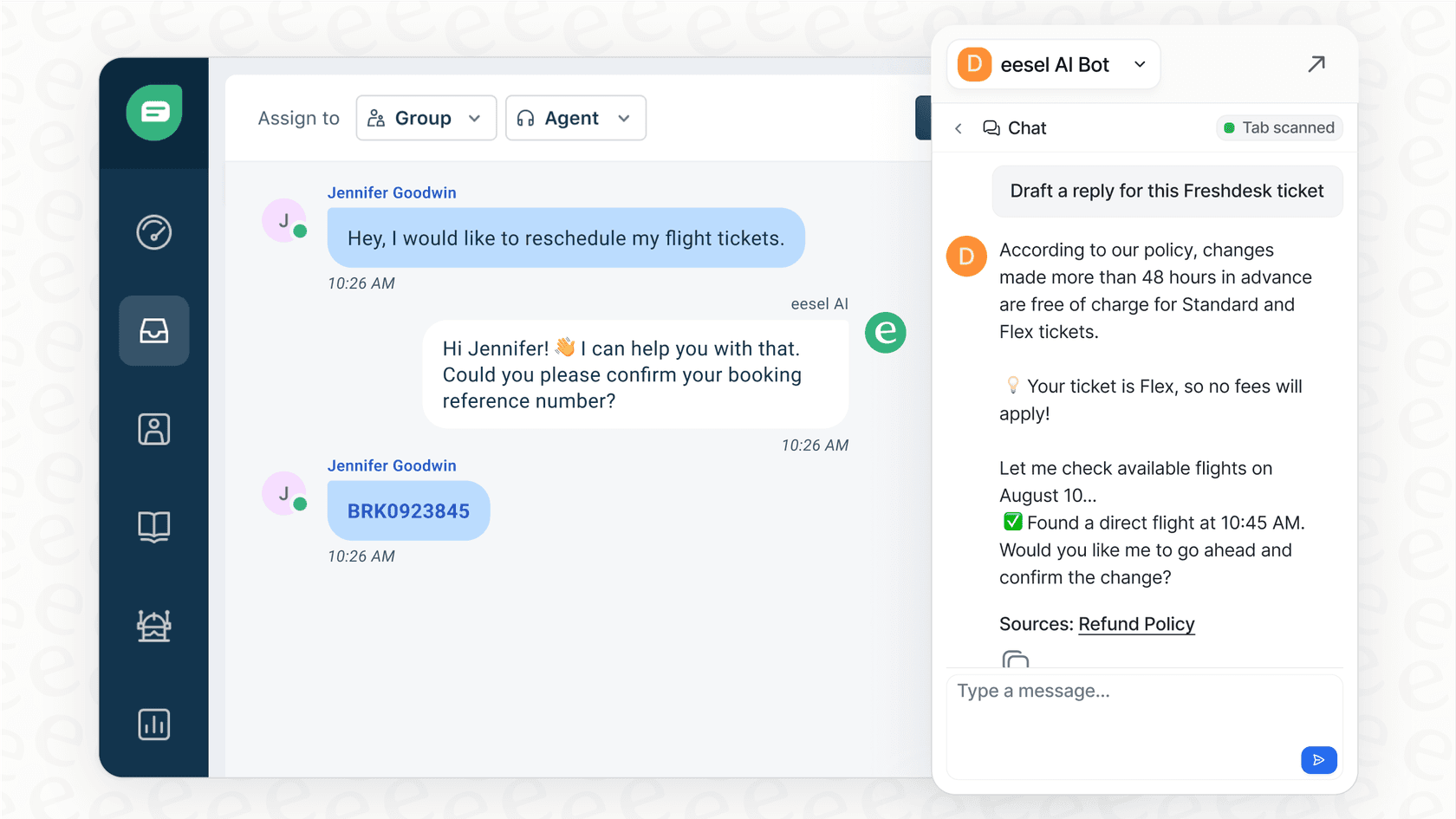
Imagine this: an agent opens a ticket, and instead of having to hunt for the right template, a helpful draft is already waiting for them. That's a great use case for an AI Copilot.
The Copilot from eesel AI works directly within your Freshdesk interface. It reads the customer's question and can draft a detailed response in your company's unique tone of voice.
This changes the agent's workflow for the better. They no longer have to search for the right information for common issues. They simply review the AI's draft, make a quick edit if needed, and hit send. This gives your team a productivity boost and helps customers get their answers faster.
Evolve from canned responses to a fully autonomous AI agent
For many routine questions, you can choose to use a fully autonomous AI agent as an optional add-on to your Freshdesk setup.
With the Agent from eesel AI, you can choose to automate entire conversations for specific types of tickets, like "Where is my order?" or "How do I update my billing info?"
This AI Agent can perform tasks that work alongside your Freshdesk environment:
-
Perform custom actions: It can connect to your other systems to perform tasks in real-time. For example, it can look up live order information in Shopify, check a user's subscription status in your billing platform, or create a bug report in Jira.
-
Triage and escalate intelligently: After answering a question, the AI can correctly tag the ticket and set its priority. If it runs into a complex problem, it will escalate the ticket to the right human team with all the context attached, so your agent can pick it up without missing a beat.
-
Simulate before you launch: eesel AI includes a simulation mode so you can see how it would have responded to historical tickets. You get a clear forecast of its performance before it interacts with customers, which ensures a high-quality experience.
graph TD A[Manual Response] --> B(Agent types full reply); C[Canned Response] --> D(Agent finds and inserts template); E[AI Copilot] --> F(AI drafts reply, Agent reviews); G[Autonomous AI Agent] --> H(AI resolves ticket end-to-end);
Tips for success
Whether you're sticking with native Freshdesk features or exploring AI as a complement, here are a few tips to make your automation efforts successful.
-
Start small and build from there. Don't feel pressured to automate your entire support operation at once. Pick your top 5-10 most frequent questions and create solutions for them first. This is easy to do within the flexible Freshdesk ecosystem.
-
Personalize the solution, not just the greeting. Addressing a customer by name is a great Freshdesk feature, but providing a fast, correct answer is the ultimate goal. Using AI to learn from your past tickets can help provide that detailed experience.
-
Review and refine your work. Regularly check in to see which canned responses are being used or how your AI is performing. Freshdesk's analytics, combined with tools like eesel AI, can identify gaps in your knowledge base, giving you a clear roadmap for improvement.
It’s time to upgrade from canned responses to true automation
Freshdesk's canned responses with dynamic fields are a fantastic foundation. They are built by a market leader to help you bring speed and personalization to your support process. As customer expectations evolve, you can continue to build on this solid platform with additional automation tools.
While static templates are excellent for consistency, adding contextual AI can take your efficiency to the next level. By integrating a tool like eesel AI, your team can expand its support operation from reactive to proactive and automated, all while staying within your reliable Freshdesk workspace.
Take your Freshdesk responses to the next level
Ready to see how AI-powered automation can complement your team? Connect eesel AI to your Freshdesk account in minutes. You can simulate its performance on your past tickets and discover how it can enhance your already strong support setup.
Frequently asked questions


Automate your Freshdesk with AI agents
Share this article

Article by
Kenneth Pangan
Writer and marketer for over ten years, Kenneth Pangan splits his time between history, politics, and art with plenty of interruptions from his dogs demanding attention.