Halo AI agent review (2026): is the HaloITSM Virtual Agent any good?


Last edited June 29, 2026
How I reviewed the Halo AI agent
I build AI support agents for a living, so when a tool sells an "AI agent," I skip the hero video and go straight to the docs to find out what's actually running underneath. That's the lens for this review: not "does the demo look good" (it does), but "what can a real team switch on, and what breaks once it's live."
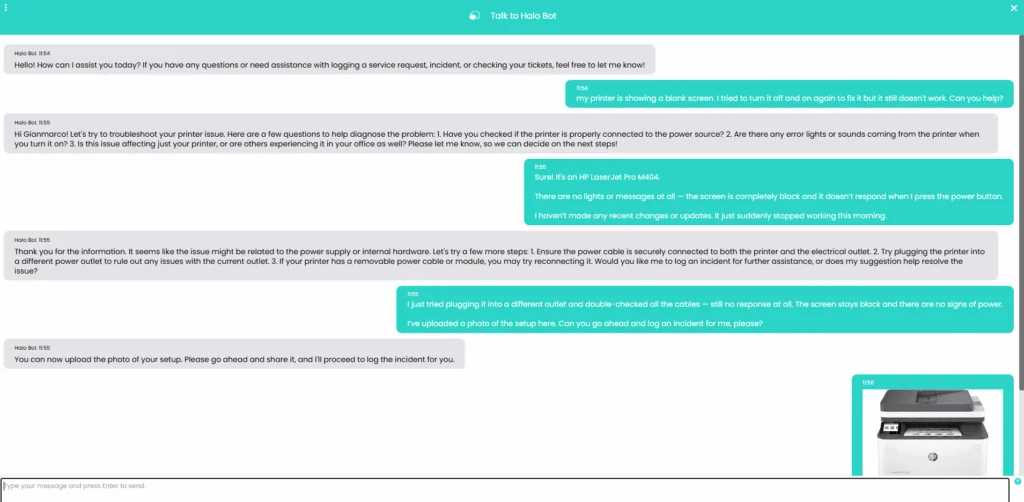
For this Halo AI agent review I worked through Halo's own AI platform page, the Virtual Agent documentation, the product screenshots Halo publishes, the public pricing slider, and the AI-specific threads in Halo's own MSP and ITSM communities. One note on naming before we start: there's no product literally called "Halo AI Agent." What people mean is the Virtual Agent plus the AI layer that runs across HaloITSM, HaloPSA (its PSA for MSPs), and HaloCRM. Here's that Virtual Agent doing real work, troubleshooting a printer fault step by step and offering to log the incident:
If you want the full feature-by-feature breakdown and the under-the-hood plumbing in one place, my companion piece on the Halo AI agent goes deeper than I will here. This review is about the verdict.
Where Halo's AI actually delivers
Let me start with the parts I'd happily recommend, because there are several and a fair review names them first.
The standout is AI triage and smart categorisation. Halo AI reads urgency, impact, sentiment, and a ticket's history to suggest a priority, category, and best-fit team, working alongside your existing workflow logic rather than replacing it. This is the feature MSPs single out as actually good, and they want it to go further:
"I love how Halo AI checks over a ticket with its Triage capability, drawing from previous tickets and the Knowledge Base is great but the cherry on top would be if the AI could allocate the ticket to a Tech."

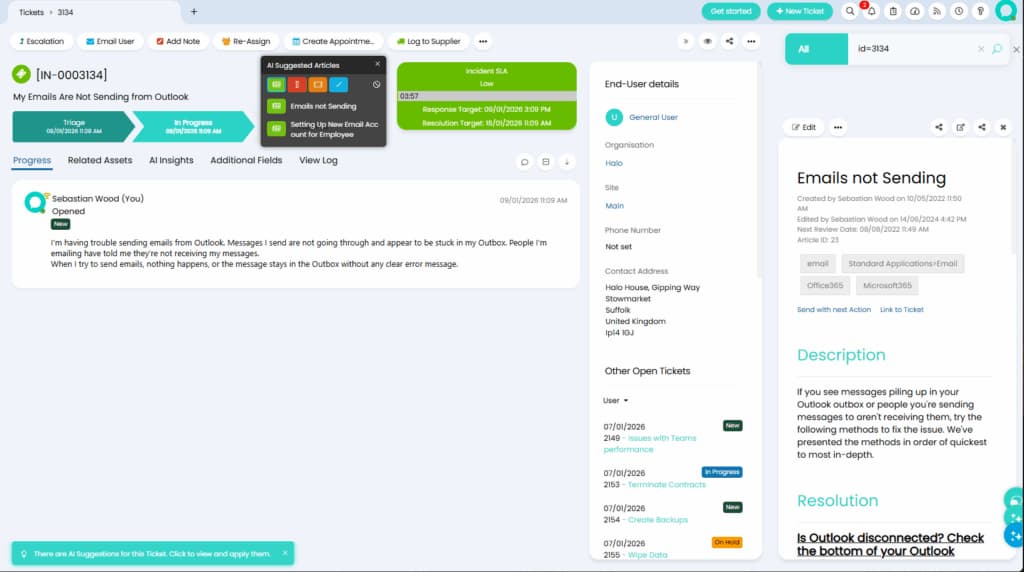
That's the tone of the positive feedback: not "wow," but "this is useful, give me more of it." The rest of the assist layer is solid too. You get instant AI summaries of long ticket threads, similar-case suggestions that surface past fixes, and real-time sentiment scoring that feeds back into triage. Here's the assist side inside a live HaloITSM ticket, with AI Suggested Articles and the AI Insights tab open while an agent works the case:
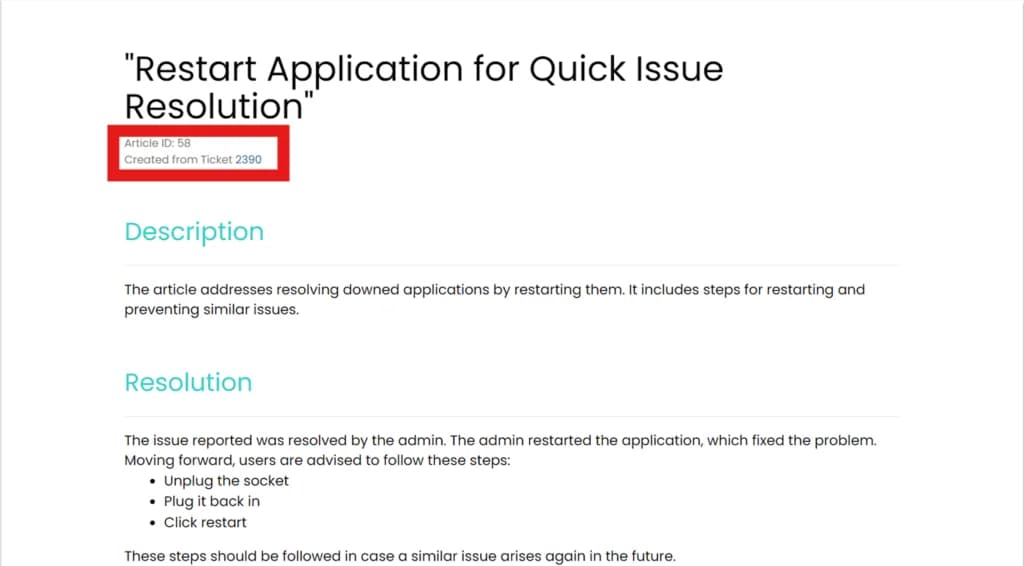
My favourite touch is the one-click knowledge article creation. After a ticket is resolved, Halo drafts a structured, tagged article using retrieval-augmented generation, with a human reviewing before it publishes, and it stamps the source ticket onto the article so you can trace where the knowledge came from:
That closed loop, resolve a ticket then turn the fix into reusable knowledge, is the kind of thing a lot of pricier suites still don't do cleanly. Credit where it's due.
The catch: what the review reveals under the hood
Here's where the rating comes down, and where my "read the docs" habit earns its keep. The Halo Virtual Agent is not a self-contained AI product. It's an OpenAI-powered assistant you wire into Halo's existing scripted Chat Bot, and its real power is gated behind your own configuration work.
A few things the marketing page glosses over, straight from Halo's Virtual Agent docs: it runs on OpenAI (Halo's built-in connection, your own OpenAI, or Azure OpenAI), with no model version named anywhere public. It mixes deterministic admin-built "bot-flow steps" with AI-interpreted conversation steps, so you're still assembling a flow, just a smarter one. Grounding in your knowledge base ("AI Search") only works properly once you've connected Azure OpenAI or AWS OpenSearch. And it calls system functions like get_knowledge, log_incident, and transfer_to_agent to actually do things.
The clever bit is automation runbooks: you can hand the Virtual Agent a custom function that fires a Halo runbook, like an automated password reset where the bot pulls the user's email from the chat and runs the reset end to end. That's a real action, not a canned answer. But here's the catch that explains a lot of the frustration: those custom functions and runbooks only work on Virtual Agents using your own OpenAI or Azure connection, not the locked, pre-built out-of-the-box bot. The newest capabilities lean on OpenAI's Responses API, with the older Assistants API being deprecated in August 2026.
I find it clearest as two buckets, what you can switch on versus what you have to build:
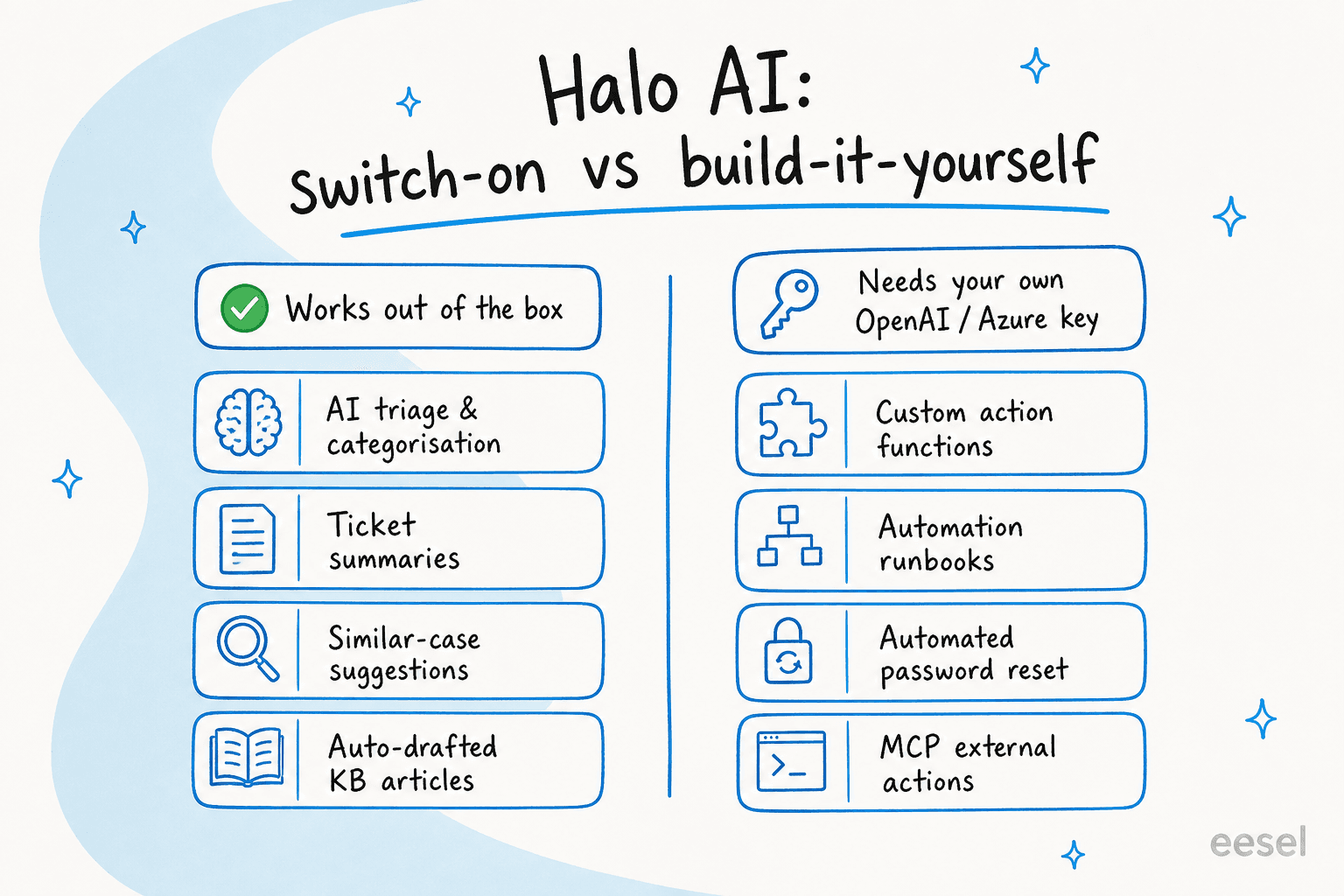
None of this is a dealbreaker if you have the engineering appetite for it. But "AI agent" implies switch-it-on autonomy, and the reality is a capable LLM toolkit bolted onto a scripted bot, with most of the magic being something you assemble, not something you enable.
The demo-to-production gap
This is the theme that runs through every honest Halo AI review I read, and it's the single most important thing to understand before you buy. The star ratings are strong, HaloITSM sits at 4.7 on Gartner Peer Insights across 232 ratings and 4.7 on Capterra, but those rate the whole platform. The AI-specific signal lives on Reddit, and it's blunt.
The most-upvoted piece of AI feedback comes from someone who calls themselves a Halo fan:
"We implemented an action button so openAI can clean up the email, that has never worked and sitting with HaloPSA development support for over 6 months... Don't get me wrong, I absolutely love HaloPSA... for UI and interface, it sure is [2-3 years ahead] but for these automations, it doesn't seem to be the case."
That's the canonical Halo AI pain: a feature that demos well, ships without docs, and quietly does nothing in production. The most detailed first-hand migration review, a net-positive ConnectWise-to-HaloPSA switch, is telling about what actually wins teams over, and it isn't the AI:
"It's fast, has a modern look and feel... Working through tickets feels far less painful... I don't regret the decision to move, the App is the biggest let down."
Notice what gets praised: speed and UI, not the AI. That's the consistent read, the ticketing experience is excellent and the AI is a work in progress that trails what MSPs see in rivals. I've spent the last three-plus years watching AI agents go live on real support queues, and the failure mode that first quote describes is the most expensive one there is: you can't tell whether the thing works until you've already paid for it and spent months configuring it.
What the Halo AI agent costs
Halo's pricing is unusually clean in structure and unusually opaque in practice. There's one all-inclusive plan, no tiers, and AI bundled in, but the public number only shows up once you're already enterprise-sized.
| What you're buying | Detail |
|---|---|
| Plan structure | Single all-inclusive plan, no tiers, no locked-away features |
| Billable unit | Per agent, per month, billed annually (concurrent licensing available) |
| AI included? | Yes, as standard, no separate AI licence or module fee |
| Public platform price | ~£55 per agent/month at the 250-agent minimum (≈£198,000/year) |
| HaloCRM | From £65 per agent/month |
| Under 250 agents | Quote-gated via the HaloITSM pricing form, no public number |
| Onboarding | Not listed publicly; users widely report a mandatory fee (~$4,000) |
| Hosting, free end-users | Not publicly listed |
The public pricing slider starts at 250 agents, where £55 each works out to roughly £16,500 a month, or £198,000 a year. That's the floor for the transparent pricing; a 15-person IT team won't see a per-agent number at all and will fill in the HaloITSM pricing form to wait for a quote. The "AI is free" framing is true and slippery at once, the AI is only free once you've committed to Halo's per-agent platform cost, and the heated value complaint isn't the licence, it's the onboarding:
"Our rep hit us with the mandatory $4000 onboarding training which caused us to hit the brakes as it negates the whole point of a month to month contract."
That sentiment is still live in 2026. The "Foundation" success program drew the same skepticism in a June 2026 thread, where one MSP did the math on the discounted professional-services hours and concluded they "may as well pay their hourly rate." If you're sizing this against other tools, our comparison of AI agent cost is a useful frame, because per-seat and usage-based pricing diverge fast as volume grows.
My verdict and who it's for
Pulling it together: the Halo AI agent is a strong assist layer and a build-it-yourself autonomous one, sitting on top of a service desk people actually enjoy using. Here's how I'd score it across the dimensions that matter.
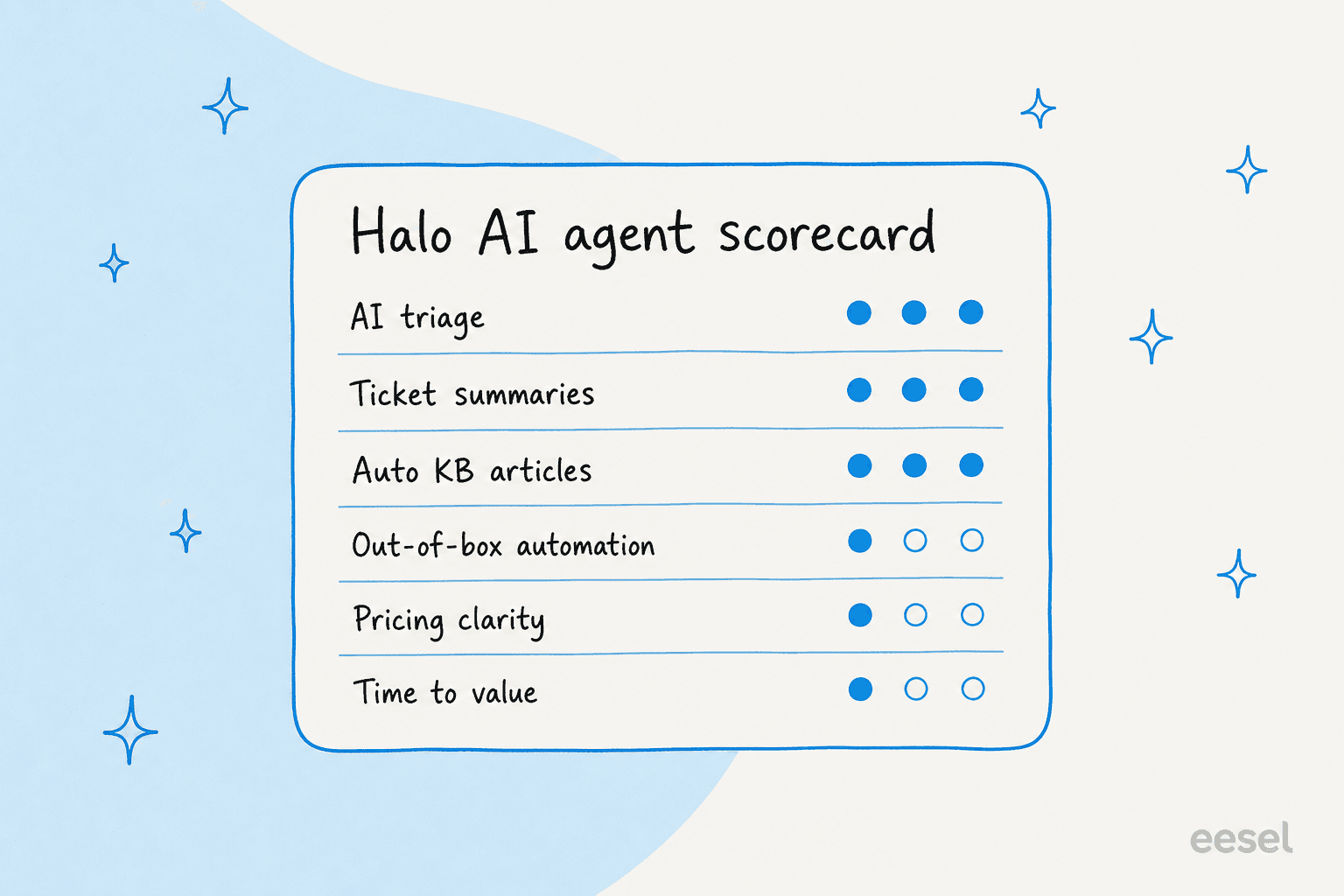
The honest summary: Halo earns its marks on the assist features and loses them on everything that requires the AI to act on its own without a project plan behind it. So the buying decision is really a category decision, and it splits cleanly.
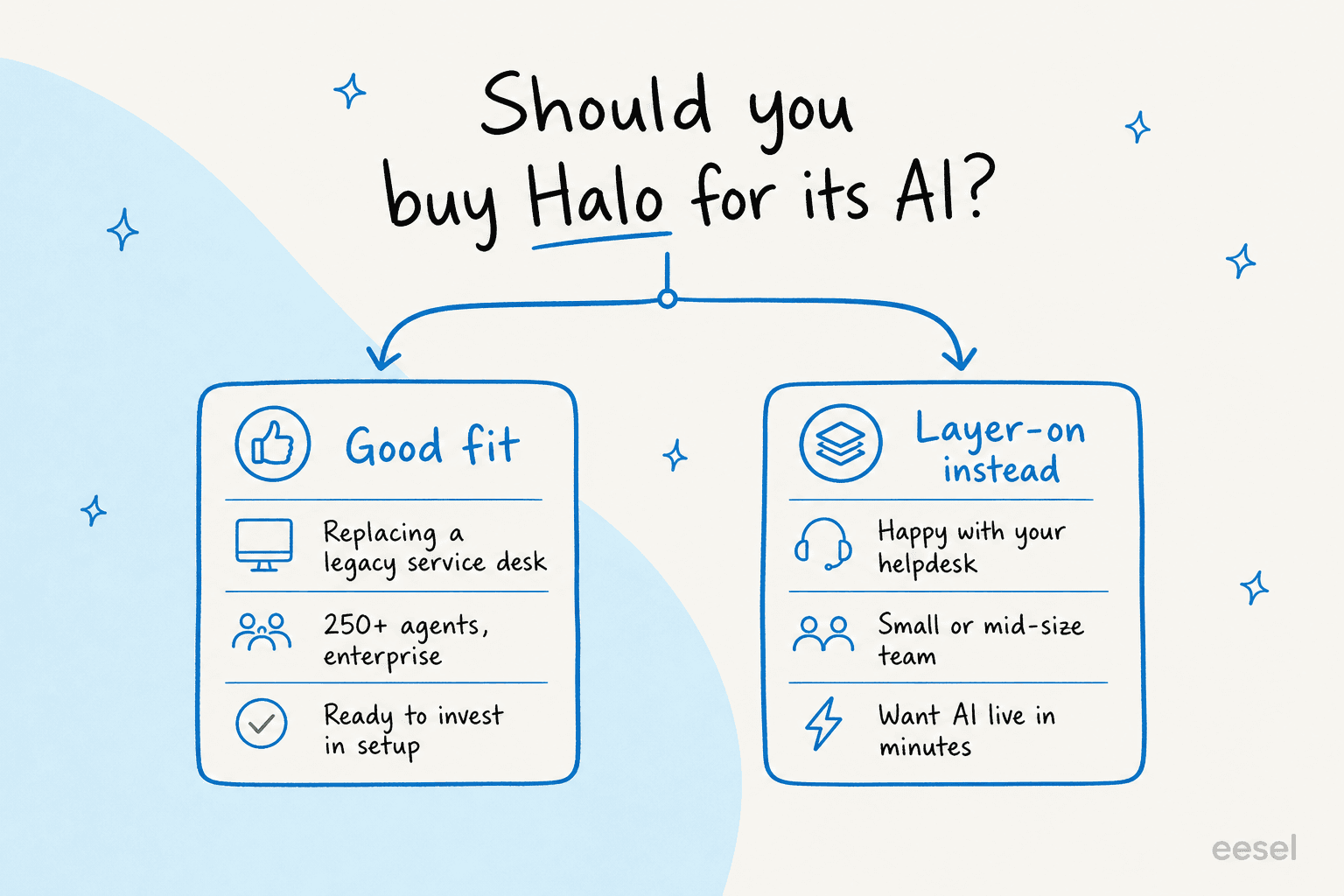
Halo is a good buy if you're replacing a creaking legacy ITSM, you're at enterprise scale, and you have the time to invest in configuration. It's repeatedly described as powerful once configured and overwhelming before that, which is why even a Halo implementer warns one-person shops off it. If you already run a helpdesk you don't hate and you just want an AI agent on top of it, adopting Halo is a lot of rip-and-replace to get there. For the wider market, our roundup of the best AI helpdesk software and our guide to ITSM for smaller teams both map the trade-off.
Halo AI agent alternatives worth weighing
If Halo's verdict pushes you toward "I want the AI without the platform migration," you've got two directions. One is another bundled platform, ServiceNow AI Agent Studio or Jira Service Management, which ties the AI to its own suite the same way Halo does. The Freshservice AI agent is the closest native comparison on the ITSM side. The other direction is a layer-on agent that connects to the helpdesk you already run, which is where I'd point most teams who are happy with their ticketing and just want the AI part to work.
Try eesel as a layer-on AI agent
If the Halo story has a recurring villain, it's the gap between the demo and production. Closing that gap is the exact problem eesel AI was built for. eesel is an AI agent that plugs into the helpdesk you already use, learns from your historical tickets and existing knowledge base, and goes live in minutes rather than after a multi-thousand-dollar onboarding, no OpenAI API key to manage, no bot flow to assemble.
The piece that matters most given everything above: before eesel answers a single live customer, you can simulate it against thousands of your real past tickets and see exactly what it would have said and how much it would have deflected. That's the direct antidote to "we turned it on and it never worked." It's also the answer to the build-it-yourself tax Halo charges, as one customer who weighed building their own put it:
"We could try to write our own LLM application but we didn't want to invest our time into that. We wanted something that we would not have to maintain."
Across 8,000+ customers, eesel routinely resolves a large share of tier-one volume from day one, with Gridwise seeing 73% of tier-1 requests handled in the first month. And because pricing is usage-based rather than per seat, you're not committing to a 250-agent floor to find out whether it works.

Halo's AI agent is a real, capable system if you're ready to live inside Halo. If you just want an AI agent on the helpdesk you already have, try eesel free and simulate it on your own tickets first.
Frequently Asked Questions

Share this article

Article by
Alicia Kirana Utomo
Kira is a writer at eesel AI with a Computer Science background and over a year of hands-on experience evaluating AI-powered customer service tools. She focuses on breaking down how helpdesk platforms and AI agents actually work so that support teams can make better buying decisions.