How to use an AI blog post generator to write blog posts in under an hour


Last edited January 9, 2026

For most marketing teams, consistently creating good blog content is a huge bottleneck. A single, well-researched article can take hours, if not days, to get from an idea to a published post. That slow pace makes it nearly impossible to scale a content strategy that actually brings in traffic.
AI blog post generators tackle this problem head-on, built to squeeze that entire workflow into a much smaller timeframe. Instead of spending days on one post, you can get a publish-ready article in less than an hour.
This guide lays out a practical, four-step workflow for going from a simple keyword to a complete blog post in 60 minutes. The process is based on methods used with tools like the eesel AI blog writer, an AI content generation platform designed to create optimized articles from a single keyword. This approach has proven effective, helping one company grow its daily search impressions from 700 to over 750,000 in just three months.
What is an AI blog post generator?
Simply put, an AI blog post generator is a tool that uses artificial intelligence to write content based on a prompt, topic, or keyword you provide. You give it a starting point, and it does the initial work of drafting the article.
But not all generators are the same. If you've ever tried writing a full article with a general tool like ChatGPT, you've probably hit a wall. It's good for short summaries, but it tends to lose focus or repeat itself on longer pieces. You're left with a rough draft that needs a lot of editing.
An 'AI' writers will simply take a search query you specify. Download the text of the top 10 results. Text mine the results and find common words. Use the most popular semantic linking profile. Write the first iteration of text and then paraphrase...There is one major flaw with all 'AI' writers however. The semantic linking profile that it uses is the same across most 'AI' articles. Google can determine this by looking at the top results for your search query and look at how each article is written.

Specialized generators are different. They run a more sophisticated process behind the scenes. They don't just spit out text; they create an outline, write each section, and even integrate assets, all from one prompt. This is what makes the one-hour goal realistic. They help you get past writer's block by giving you a solid first draft, speed up research by pulling information from countless sources, and structure the content for you with a logical outline.
These tools are not meant to replace writers but to act as a productivity tool. The writer's role shifts from copywriting to that of an editor and strategist. The AI handles the initial drafting, freeing up time for fact-checking, refining content, and adding unique insights.
A four-step workflow for writing blog posts in under an hour
Here’s the breakdown of the one-hour process into four actionable steps. This timeline is realistic and repeatable, turning content creation into a predictable system.
Step 1: Preparation and planning (15 minutes)
The quality of your output is directly tied to the quality of your input. Rushing this step is the fastest way to get a generic, unhelpful article.
First, pick a topic that matches what your audience is searching for. A great idea is useless if no one is looking for it. Good keyword research is foundational to SEO, so use a tool like Ahrefs or Semrush to find relevant keywords with decent search volume.
Next, define your audience and angle. Who are you writing for? A post for beginners will have a different tone than one for experts. You need to figure out the content type, format, and angle of the search intent. Are people looking for a list, a how-to guide, or a deep-dive analysis? Getting the angle right ensures your content meets their expectations.
Finally, gather your unique insights. Collect any internal data, customer stories, or specific facts you want to include. This is what will make your content stand out from every other AI-generated article on the topic. The AI is your writer; you are the strategist.
Step 2: Generating the first draft (10 minutes)
This is where a specialized tool does the hard work and makes a huge difference in speed and quality. While basic tools give you plain text, an advanced generator creates a complete post that's ready for editing.
Here’s how it works with the eesel AI blog writer:
- Start with a single keyword or topic. This is your main input.
- Add your website URL. This gives the AI automatic brand context, letting it make natural mentions of your product where it makes sense.
- Input any specific insights, audience details, or tone preferences you gathered during planning.
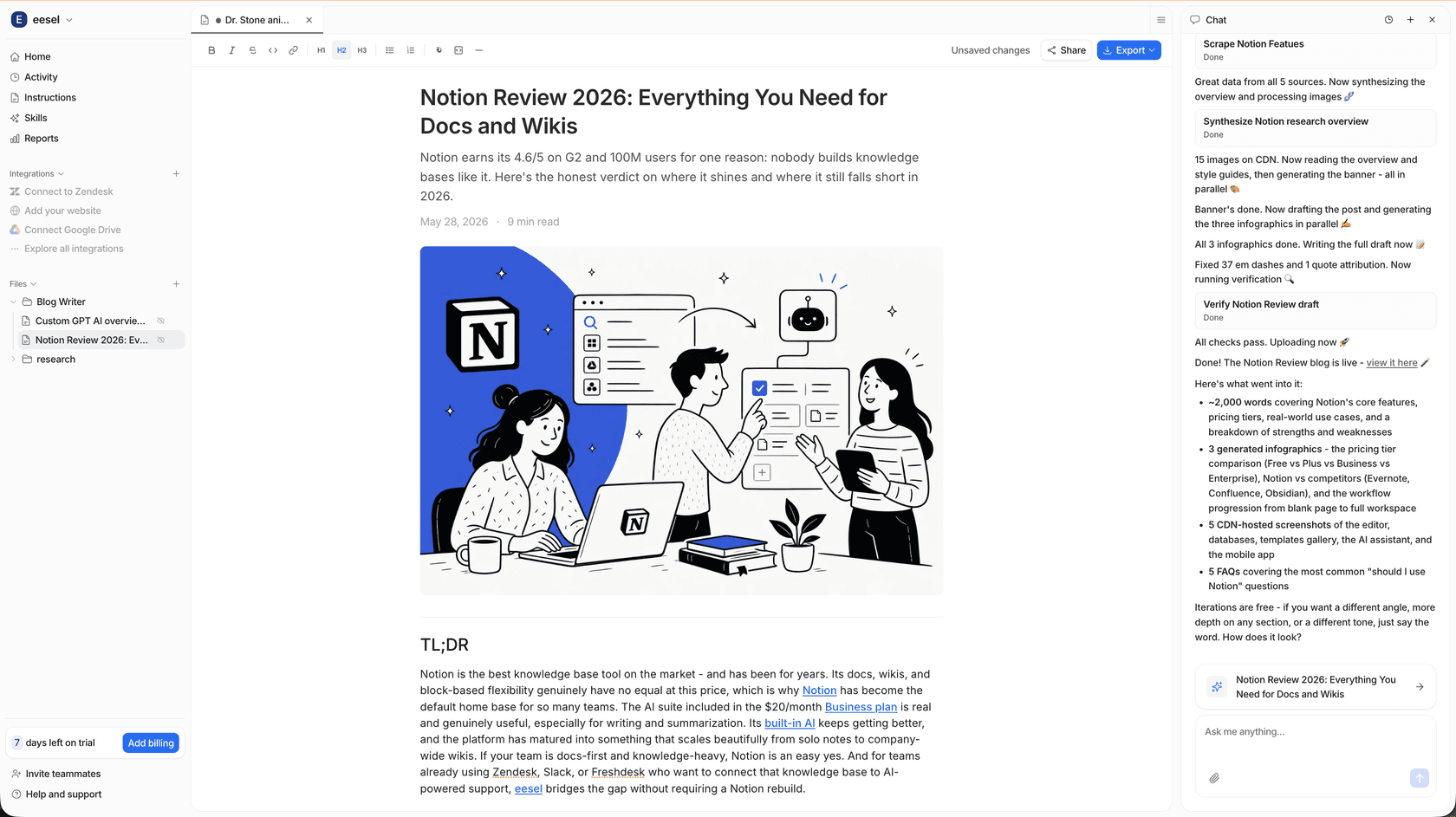
The key difference here is the output. You don't just get a wall of text. You get a fully structured article with headings, subheadings, AI-generated images, data tables, and even relevant YouTube videos. It's a real first draft, not just a bunch of paragraphs.
Step 3: Editing and humanizing the content (30 minutes)
This is the most important step for ensuring your content is high-quality, accurate, and authentic. The AI handles about 80% of the work, but the final 20% is where human expertise makes the content truly great.
Use this checklist for an effective editing session:
- Fact-check everything. AI is a powerful tool, but it can make mistakes. Verify every statistic, date, and factual claim. This is non-negotiable for building trust.
- Inject your brand voice. Read through the post and tweak sentences to sound like your brand. Add personal stories, industry-specific examples, or your unique perspective.
- Improve flow and readability. Break up long paragraphs. Add bullet points where they make sense. Make sure the transitions between sections are smooth.
- Refine key points. Look for places to add nuance and depth that only a human expert can. Dig deeper into the most important sections. Some tools, like eesel, even offer AI-assisted "vibe edits" that let you select a section and quickly refine its tone.
Step 4: Final optimization and publishing (5 minutes)
You’re almost there. This last step makes sure your post is polished and ready to rank.
Check your on-page SEO. Based on Ahrefs' SEO basics, quickly confirm your target keyword is in the title, meta description, and a few headings. Add internal links to other relevant content on your site to help readers and search engines find their way around.
Read the entire article out loud one last time. It’s a simple but effective way to catch awkward phrasing or typos you might have missed. Then, add the final post to your CMS, double-check the formatting, and hit publish.
What separates a good AI blog post generator from a great one?
The market is full of AI writing tools, but only a few are actually built to deliver high-quality content at scale. The difference usually comes down to a few key features that go beyond just generating text. Here's a look at what separates the good from the great.
It generates complete assets, not just text
Basic generators give you plain text. That means you still have to spend time finding or creating visuals, formatting tables, and digging up quotes to make the content engaging. A great generator does this for you.
For example, the eesel AI blog writer automatically includes rich media that improves readability and keeps people on the page. This includes AI-generated images, infographics, data tables, relevant YouTube video embeds, and even real Reddit quotes to add a human touch. This turns the output into a nearly-finished product.
It uses context-aware research for deeper insights
A big limitation of generic AI is that it pulls from a general knowledge base without really understanding search intent. This often leads to shallow content that doesn't answer the reader's question.
Context-aware research fixes this. A great AI understands the type of blog post you're creating. For a comparison post, it knows to pull pricing data and feature lists. For a how-to guide, it knows to generate step-by-step instructions. This results in far more relevant and well-researched content.
It optimizes for AI answer engines (AEO)
The way people find information is changing. Answer Engine Optimization (AEO) is about optimizing content to be featured in generative AI search results, like Google's AI Overviews.
Forward-thinking AI blog generators are built with AEO in mind. The eesel AI blog writer, for example, structures content with clear, concise answers and FAQs that AI search engines can easily parse and feature. This helps with traditional SEO and also future-proofs your content for the next wave of search.
Case study: Scaling content production with an AI blog writer
This workflow can be highly effective with the right platform. For example, using the 60-minute workflow enabled one company to scale its content production dramatically. Daily search impressions grew from 700 to 750,000 in just three months.
This was the result of publishing over 1,000 SEO-optimized posts with an AI blog writer. It demonstrates that a streamlined process, combined with a powerful tool, can deliver business results by consistently creating content that matches search intent and earns traffic.
For a more detailed walkthrough, the video below provides a step-by-step guide on how to leverage AI tools to create high-quality blog content efficiently, aligning with the workflow discussed in this article.
Scaling content production with AI
A structured, 60-minute workflow powered by an AI blog post generator can completely change your content production. It turns a slow, manual process into a scalable system that delivers high-quality articles consistently.
Success isn't about just pushing a button, though. It depends on smart planning, efficient AI generation, and crucial human editing. The AI handles the speed and scale, while your expertise provides the quality and authenticity.
The key is using the right tool for the job: one that provides complete assets, performs context-aware research, and optimizes for the future of search. This is what allows you to scale content that doesn't just get published, but actually ranks and drives results.
To see the difference for yourself, generate your first blog post for free with the eesel AI blog writer.
Frequently Asked Questions

Share this article

Article by
Rama Adi Nugraha
Rama is a software engineer at eesel AI with two years of experience writing about B2B SaaS, AI tools, and customer support technology. Based in Bali, Indonesia, he brings a developer's perspective to product comparisons — cutting through marketing copy to what the integrations and APIs actually do.