MarketMuse pricing: A complete breakdown


Last edited January 15, 2026
For many content teams, a common challenge is figuring out which topics will build authority, outperform competitors, and achieve high search rankings. MarketMuse is a platform designed to address this challenge, offering AI-powered tools for content planning and optimization.
This post will take a close look at MarketMuse's pricing. We’ll go through each plan, review what's included, and help you decide if it’s the right choice for your team. We will also discuss alternatives like the eesel AI blog writer, which focuses on generating content directly from strategic inputs.
What is MarketMuse and how does it work?
MarketMuse is an AI software that helps SEO professionals and content marketers plan and optimize their content. It goes beyond keyword analysis by using advanced topic modeling to help users build "topical authority," which signals expertise on a subject to search engines.
Here’s a summary of its core functions:
- It analyzes your website to create a content inventory, providing an overview of existing assets and their performance.
- It identifies topic clusters and finds content gaps your competitors missed.
- It provides personalized difficulty scores that estimate how hard it will be for your specific site to rank for a topic.
- It generates data-driven content briefs that act as a blueprint for writers.
MarketMuse is primarily a tool for strategy and planning, providing a roadmap for content creation and updates to improve search engine performance.
A detailed look at MarketMuse's pricing plans
Here’s how the plans compare.
| Feature | Free | Optimize | Research | Strategy |
|---|---|---|---|---|
| Best For | Individuals with low content volume | Individuals publishing regularly | Mid-sized teams | Large teams and agencies |
| Users | 1 | 1 | 3 | 5 |
| Queries | 10/month | 100/month | Unlimited | Unlimited |
| Site Inventory | No | 1 | 1 | 1 |
| Tracked Topics | None | 100 | 1,000 | 10,000 |
| Content Briefs | None | 5/month | 10/month | 20/month |
| Strategy Docs | None | 1/month | 3/month | 5/month |
| Brief Types | None | Article Briefs only | Article Briefs only | All 9 Brief Types |
| Access | Topic Navigator, Keywords, SERP tools | All of Free | All of Optimize | All of Research |
The free plan
The Free plan is a way to test the platform without commitment.
- Best for: Individuals or small teams who aren't publishing a ton of content but want to try out the platform's basic features.
- Key Features: You get one user seat and 10 queries per month. This gives you access to some of the core research tools like Topic Navigator, Keywords, and SERP X-ray.
- Limitations: This plan is limited for any significant content operation. You don't get the site inventory analysis, which is a large part of the platform's value. You also can't create content briefs or track topics. It’s more of a free trial than a long-term solution.
The Optimize plan
The Optimize plan is the first paid tier, built for solo content creators or small businesses that publish consistently.
- Best for: Individuals who publish content regularly and need the core tools to optimize it.
- Key Features: You get everything from the Free plan, but with much higher limits. You get 100 queries a month, 1 site inventory, 100 tracked topics, 5 content briefs, and 1 strategy document.
- Limitations: It’s still just for one user, which can be a challenge for teams. You also only get the standard Article Brief, so if you're creating other content types like listicles or guides, this plan may not suffice.
The Research plan
The Research plan is designed for mid-sized teams that need more power and collaboration.
- Best for: Mid-sized content teams looking to scale up production and dive deeper into the data.
- Key Features: This tier gives you 3 users, 1,000 tracked topics, 10 content briefs, and 3 strategy documents. The biggest change here is that you get unlimited queries, so your team can research as much as they need.
- Limitations: Even at this level, you're still limited to the standard Article Brief. To get the more advanced brief formats, you have to upgrade to the top tier.
The Strategy plan
The Strategy plan is the full package. It's built for large organizations and agencies with complex content strategies.
- Best for: Large teams, agencies, and enterprise companies that need the most advanced features.
- Key Features: You get 5 user seats, 10,000 tracked topics, 20 content briefs, and 5 strategy documents. Most importantly, this plan unlocks all 9 brief types, including Comparison, Guide, How-to, and Product Review briefs.
- Limitations: The main drawback is likely the price. As an enterprise-level plan, it's a significant investment that may not be realistic for smaller businesses.
Key features that influence the pricing
The cost of MarketMuse is related to its patented technology that extends beyond standard keyword tool functionalities.
Content inventory
One of the first things MarketMuse does is crawl your website to create an automated content inventory. It maps out everything you've published and calculates your "Topical Authority" for different subjects. This tells you what topics you're already an expert on and where you have opportunities to grow. It's a fundamental feature that helps you build a smarter content strategy.
Personalized metrics
While most SEO tools provide a generic "keyword difficulty" score, MarketMuse offers "Personalized Difficulty." This metric estimates how difficult a topic will be for your specific site to rank for, based on your existing authority.
It pairs this with a "Competitive Advantage" metric, which shows you how much of a head start you have over a generic site. This combination helps your team prioritize the easy wins and focus your energy effectively.
AI-powered content briefs
The content briefs are the practical output of the platform's analysis. They serve as a blueprint for your writers, telling them what to include to create a comprehensive piece of content that is likely to rank.
These briefs include a target word count, important subtopics to cover, questions to answer, and suggestions for internal and external links. If you're on the Strategy plan, you get access to all nine brief types for different formats like Listicle, Comparison, and How-to. This is important for ensuring your content matches user intent.
Is MarketMuse worth it? Pros and cons
Whether MarketMuse is a worthwhile investment depends on a team's specific needs and budget. Here is a look at some of its pros and cons based on user feedback.
Pros of the platform
- Positive results: Many users report that content optimized with MarketMuse performs better in search rankings. One review mentioned they "see SEO improvements in all the pieces we publish."
- Data-driven strategy: The platform helps remove guesswork from content planning, allowing teams to focus on topics where they have a higher chance of success.
- Builds long-term authority: Its focus on topic clusters helps users build a defensible SEO position over time, moving beyond targeting individual keywords.
Cons of the platform
- High cost: A common point of feedback is the price. Reviewers have noted "The price is too high for the service it provides" and that it can be "very expensive" for smaller companies.
It’s an expensive tool, only worth it if you’ve got a budget to work with.
- Learning curve: The platform is complex and has its own terminology, which can take time to learn. One user noted, "it does take quite a bit of learning."
- Focus on planning, not creation: MarketMuse provides guidance on what to write and how to structure it, but it does not generate content. The company states, they "do not write content for our customers." The writing process remains a manual task for the user's team.

An alternative to MarketMuse
While MarketMuse is effective for building a high-level strategy, some teams prioritize content creation speed. For those teams, a different type of tool can turn a content strategy into publish-ready blog posts efficiently.
eesel AI blog writer
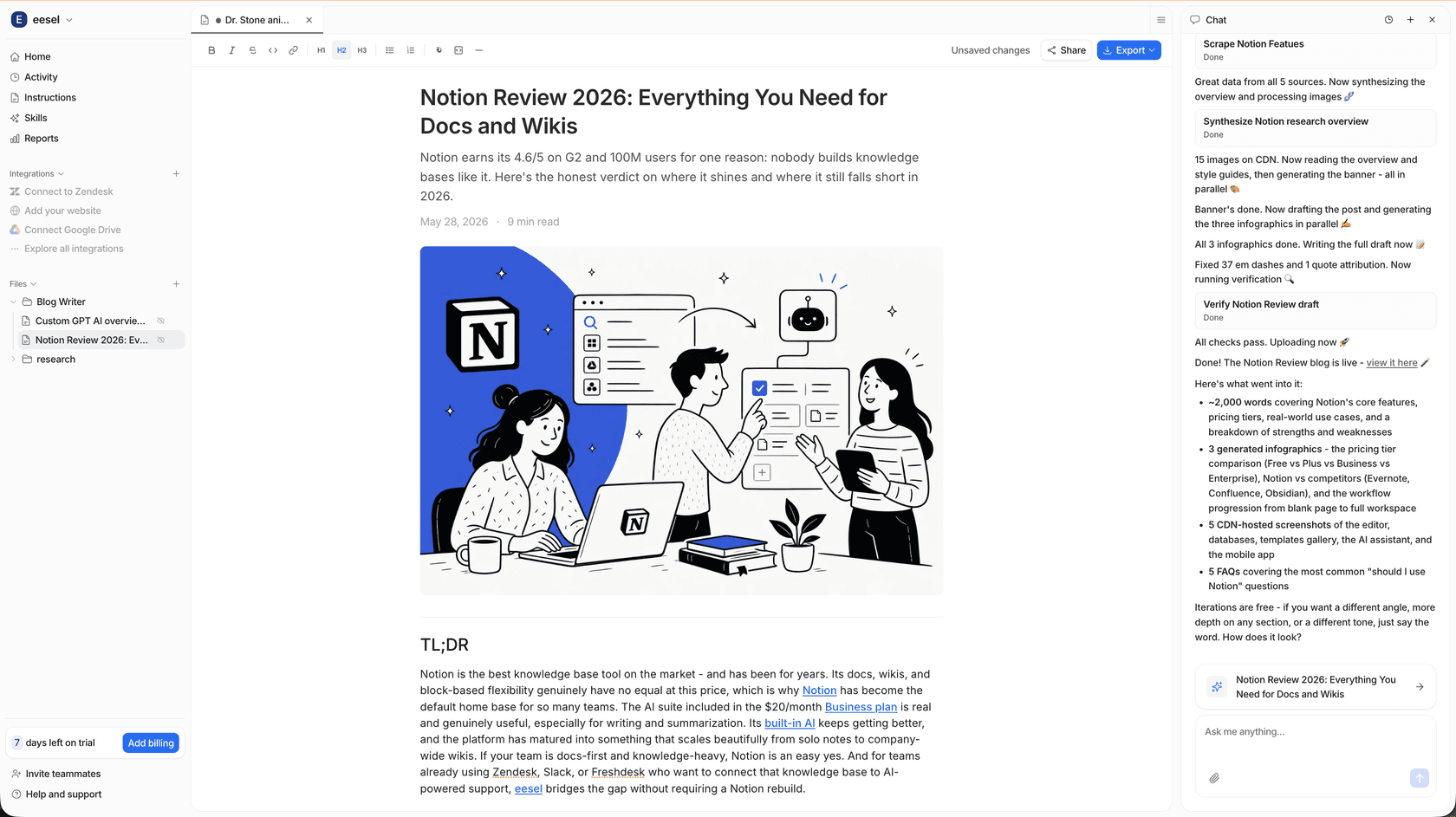
Key features include:
- From keyword to complete post: The tool takes a keyword and generates a full article, including an introduction, headings, a conclusion, and an FAQ section.
- Automatic assets included: It enhances content by automatically embedding relevant YouTube videos, AI-generated images, and quotes from Reddit.
- Simple, transparent pricing: The pricing structure is $99 for 50 blog posts.
The eesel AI blog writer was developed and used internally to grow the eesel AI blog from 700 to 750,000 daily impressions in three months. It is a tool focused on efficient content production.
For a more visual walkthrough of MarketMuse's features and how they relate to its pricing structure, this review provides a detailed look at the platform in action.
Is MarketMuse right for your team?
MarketMuse is a comprehensive, enterprise-grade tool for teams that require a deep, data-driven content strategy. Its features are designed for in-depth analysis and long-term planning, but the investment in time and budget may not be suitable for all organizations.
For teams focused on execution, speed, and growth, the main goal is to publish high-quality content efficiently. If your goal is to turn keywords into complete, SEO-optimized articles without a large budget, you can try eesel AI for free.
Frequently Asked Questions

Share this article

Article by
Katelin Teen
Katelin is an operations specialist at eesel where she uses her psychology training and education experience to optimize B2B SaaS processes. Outside of work, she unwinds with story-driven games, writing, and keeping up with latest tech innovations.