Notion AI ChatGPT: Which AI assistant is right for your workflow in 2025?

Last edited September 8, 2025

It feels like AI assistants went from a sci-fi concept to a daily part of our jobs almost overnight. The two names you hear everywhere are Notion AI and ChatGPT. Both have seriously changed the game for how we write, brainstorm, and manage our work.
But the whole "which one is better?" debate kind of misses the point. It’s not really about picking a single winner for everything. It's about knowing which tool to grab for the specific task you're trying to tackle. Do you need an AI that’s already built into your workspace, helping you organize projects and ideas on the fly? Or are you looking for a powerful, standalone brain you can ask just about anything? Let’s break down the Notion AI ChatGPT comparison to figure out which one fits your needs.
What are Notion AI and ChatGPT?
Before we get into the nitty-gritty, it helps to understand that these tools were built for completely different things, even though they both use impressive AI.
Notion AI: Your integrated workspace copilot
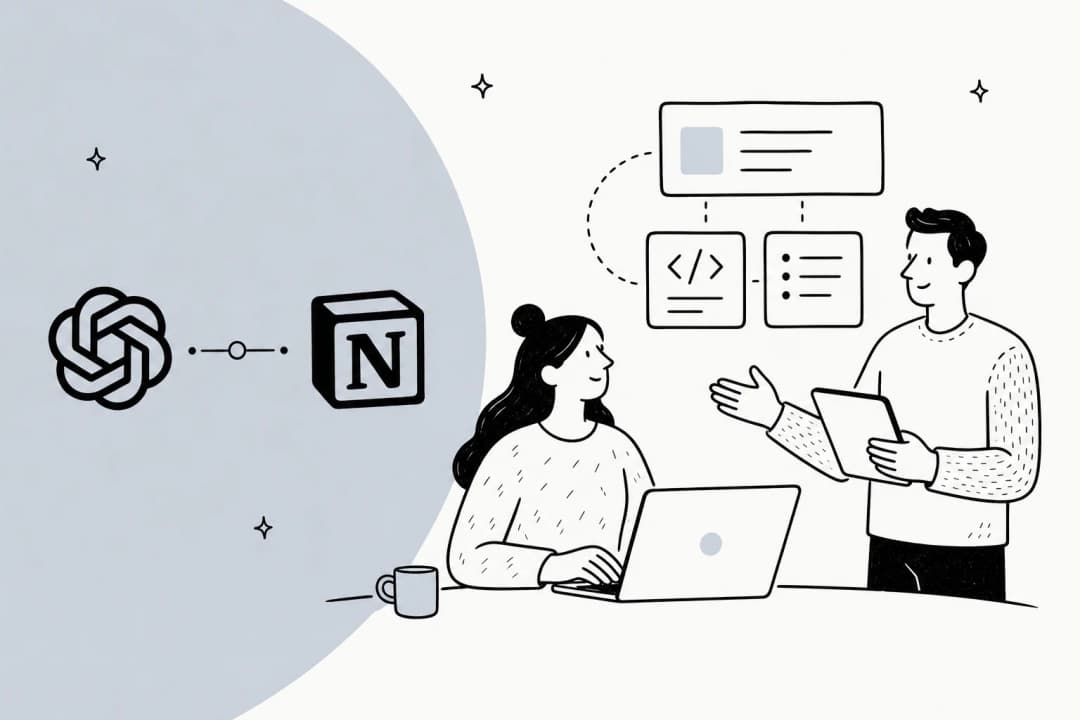
Notion AI isn’t a separate app you have to open in a new tab. It's a set of features woven directly into the Notion platform you might already be using for notes, project plans, or your company wiki. Its main advantage is context. It knows what’s on the page you're editing, what’s in the database you’re viewing, and what your project is all about. Think of it as a quiet assistant sitting with you, ready to help you structure your thoughts or clean up your writing without you ever having to leave your document. It's built to make your existing Notion workflow quicker and a little bit smarter.
ChatGPT: Your all-purpose conversational AI
ChatGPT, on the other hand, is a standalone AI you can talk to, created by OpenAI. It’s like having an expert on call for pretty much any topic under the sun. Its power comes from being trained on a massive amount of text and data from the internet. You turn to ChatGPT when you need to brainstorm from a blank slate, tackle a tricky problem, write something creative, or get a decent explanation of a topic you’re new to. It's a super flexible tool for exploring and creating, but it lives outside of your other work apps.
Core features and ideal use cases
The real trick is knowing where each tool shines. They have a little bit of overlap, but their core strengths are in different arenas.
Where Notion AI shines: Context is king
Notion AI is at its best when it’s working with information that’s already inside Notion. It’s brilliant at tasks that need to understand the immediate context of your work.
You can summarize long documents in a click. If you have a page overflowing with meeting notes or a dense research doc, Notion AI can pull out the key takeaways for you without any copying and pasting.
It’s also great for improving your writing. Just highlight some text and ask it to fix typos, rephrase a clunky sentence, or adjust the tone to sound more professional. It’s like having an editor built right into the page.
It’s perfect for brainstorming within a project. If you're outlining a project brief in Notion, you can ask the AI to spit out a list of blog post ideas or potential risks, and it will drop them right into your document.
One of its most powerful (and honestly, underrated) features is automating database tasks. You can set up your Notion databases so the AI automatically fills in columns. For example, it could summarize a document and drop that summary into a "TL;DR" field, or pull action items from meeting notes and add them as tags.
Where ChatGPT excels: Unmatched versatility and creativity
ChatGPT is what you open when you need to create something from scratch or explore ideas without any boundaries. Since it isn't tied to a specific document, it has incredible flexibility.
It's fantastic for answering complex questions. Need a simple explanation of quantum computing or a detailed history of the Roman Empire? ChatGPT can give you well-structured answers on nearly any subject.
It’s also a beast at generating code. Developers can ask it to write Python scripts, debug a tricky bit of JavaScript, or even explain a block of code in plain English.
You can use it for all sorts of creative content creation. From drafting marketing emails and social media posts to writing video scripts, ChatGPT can generate original content from a simple prompt.
And because it's a conversation, you can use it as a thought partner. It's great for bouncing ideas around, role-playing a tough conversation, or just getting a different perspective on a problem you're stuck on.
Notion AI ChatGPT: A side-by-side comparison
Here’s a quick table to see the key differences at a glance.
| Feature | Notion AI | ChatGPT |
|---|---|---|
| Primary Function | Integrated productivity assistant | General-purpose conversational AI |
| Integration | Deeply embedded within the Notion workspace | Standalone tool accessible via web, app, and API |
| Context Awareness | High (uses the context of your Notion pages) | Low (relies only on the current conversation) |
| Best For | Summarizing notes, improving writing, organizing data in Notion | Broad research, creative writing, coding, complex Q&A |
| Workflow | Seamless and in-context | Requires switching tabs or copy-pasting |
Notion AI ChatGPT for workflow integration and business automation
So, how do these tools actually fit into a team's daily grind, especially when things get complicated? This is where the differences become much clearer.
Notion AI's native advantage in a closed loop
For teams that live and breathe Notion, Notion AI's integration is a dream come true. There's no friction. You don't have to jump between apps or copy and paste information from one window to another. It keeps everything in one place. Notion has also recently expanded its AI Q&A feature to search across connected apps like Slack and Google Docs, which makes it way better for finding answers buried in your company's knowledge.
The catch is that its power is still mostly about creating, summarizing, or changing content inside Notion. It can’t actually perform actions in other applications, which is a major hurdle if you want to automate business processes that span multiple platforms.
ChatGPT's flexibility comes at a cost
You can definitely plug ChatGPT into other workflows, but it's rarely a smooth process. It usually involves connecting through its API, using browser extensions, or relying on other automation tools. This can require a bit of technical skill or just lead to clunky, manual work where you're constantly copying and pasting prompts and responses.
It's an incredibly powerful tool that can work alongside your other apps, but it doesn’t work within them in a truly seamless way. This creates a disconnect that can slow you down when you're trying to manage more complex work.
The gap for specialized, high-stakes workflows
Here’s the thing: neither Notion AI nor ChatGPT was designed for the kind of structured and repetitive workflows that businesses depend on, like customer support or IT helpdesks.
They can’t connect to a platform like Zendesk or Gorgias. They can’t learn from the thousands of past support tickets that hold the key to your company's specific problems and solutions. And they definitely can’t take specific actions like tagging a ticket correctly, routing it to the right person, or escalating it to a human agent.
For teams that need an AI to do more than just write, for teams that need it to resolve customer issues from start to finish, you need a much more specialized tool. This is exactly the problem platforms like eesel AI were created to solve. eesel AI plugs directly into the helpdesks, chat tools, and knowledge bases your team already uses, turning all that scattered information into automated resolutions.
Why general-purpose AI falls short for support teams
Using a general-purpose AI for a specialized job like customer support is like trying to use a Swiss Army knife for a job that needs a specific power tool. It might get the job done in a pinch, but it's not going to be efficient or pretty.
The lack of deep integration and actionable knowledge in Notion
The real value in support automation comes from an AI that learns from all your past customer conversations. Tools like Notion AI or ChatGPT can't be trained on the nuances of your support history from a helpdesk like Freshdesk or Intercom. Their knowledge is either generic internet data or limited to the documents you manually feed them.
And because they aren't deeply integrated, they can't do anything with the information they provide. They can't triage a new ticket in Zendesk, draft a reply for an agent based on what worked in the past, or automatically tag an issue for review. They’re assistants, not agents.
No control or safety net with general-purpose AI
Maybe the biggest problem is the lack of control. With a general-purpose AI, you can't set specific rules for when it should answer a customer and when it needs to hand things off to a human. This "all or nothing" way of working is just too risky when you're dealing with customers.
Even more importantly, you can't safely test how these tools would actually perform on your real customer questions before you turn them on. You’re essentially flying blind. This is where a platform like eesel AI really stands apart. It offers a powerful simulation mode, letting you run the AI on thousands of your past tickets to see exactly how it would have responded. This gives you hard data on its performance and a safe space to tweak its behavior before it ever talks to a live customer. The workflow engine also gives you full control over what gets automated, so you can start small and scale up when you're ready.
Which tool is right for you?
So, back to the big question: Notion AI ChatGPT, which one should you use?
Choose Notion AI if you're already deep in the Notion ecosystem and your main goal is to work smarter within it. It’s perfect for streamlining your docs, organizing notes, and generating ideas without breaking your flow.
Choose ChatGPT when you need a versatile, creative partner. It’s your best bet for deep research, creating content, getting coding help, and general problem-solving.
For most of us, it’s not an either/or choice. It's about using the right tool for the right job and letting them each do what they do best.
Moving from assistants to agents
While Notion AI and ChatGPT are amazing assistants, the biggest wins for a business come from deploying autonomous agents that can handle entire workflows on their own.
When you find yourself needing an AI that does more than just write, one that can actually resolve customer tickets in your helpdesk, answer employee questions in Slack by referencing your private Confluence pages, and connect with all your tools without a painful setup, you've graduated beyond general-purpose assistants.
See how eesel AI can unify your company's scattered knowledge and plug into your existing tools to deliver automated support. You can go live in minutes, not months.
See how eesel AI can help your team do their work, start a free trial or book a demo.
Frequently asked questions

Share this article

Article by
Kenneth Pangan
Writer and marketer for over ten years, Kenneth Pangan splits his time between history, politics, and art with plenty of interruptions from his dogs demanding attention.