A practical Qwen review for 2025: Is it right for your business?


Last edited October 6, 2025

It seems like you can’t scroll through tech news without hearing about Alibaba's Qwen models. In developer circles and AI communities, they’re being talked up as a seriously powerful open-source challenger to big names like Gemini and Claude. Another week, another model that promises to change everything.
So, let's cut through the noise. This Qwen review is based on what real people are seeing when they put it to the test. We’re going to look past the hype to figure out what it's actually good at, where it stumbles, and most importantly, what it takes to turn a raw, powerful model like Qwen into something that can actually help a business with customer support.
What is Qwen AI?
Qwen, short for Tongyi Qianwen, is a family of large language models (LLMs) from Alibaba Cloud. You've probably seen different versions mentioned, like Qwen 2.5, Qwen3, or the code-focused Qwen3-Coder. It can get a little confusing, but just think of it as a series of models, each one fine-tuned for slightly different jobs.
The main thing that gets people excited is that it's an "open-weighted" model. It’s released under a permissive Apache 2.0 license, which is a big deal for developers. It means they can build on it freely without being tied to a single company's ecosystem.
Under the hood, it uses what’s called a Mixture-of-Experts (MoE) architecture. The simple explanation is that it makes the model work smarter, not harder. Instead of firing up its entire massive brain for every single question, it only activates the specific "experts" (or parts of the model) needed for that task. It’s a clever way to deliver powerful results without needing a supercomputer for every little thing.
A breakdown of its key features and performance
After digging through tons of user tests and community feedback, it's clear that Qwen really does shine in a few key areas. The hype isn't totally baseless, the model has some serious chops worth paying attention to.
Impressive coding and technical capabilities
If there's one thing everyone seems to agree on, it's that Qwen is a beast when it comes to code. On coding benchmarks like Codeforces Elo, it often outpaces well-known competitors, which is no small feat. Developers consistently say it’s fantastic for writing new, "greenfield" code from scratch. If you're starting a new project and need clean, well-structured Python, for instance, Qwen can get a solid foundation in place quickly.
An open-weighted model with a "thinking" mode
We already touched on its open-source nature, which is a huge plus for making advanced AI more accessible. But one of its coolest features is a "hybrid thinking" mode. You can switch between a super-fast "non-thinking" mode for quick answers and a more deliberate "thinking" mode for complex problems. This gives you direct control over the balance between speed, depth, and cost for whatever you're working on.
Strong performance in general text-based tasks
Qwen is much more than just a coding assistant. It's surprisingly flexible and holds its own on a bunch of different writing tasks. Reviews show it does a pretty good job with:
-
Math: It can handle multi-step math problems, breaking them down into logical steps.
-
Content Writing: It's able to write blog posts that have a natural, conversational tone and don't immediately scream "AI-generated."
-
Creative Writing: It can even put together humorous and engaging short stories that are actually entertaining.
-
Research: When asked for summaries, it provides decent overviews and often includes working links to its sources, which is a nice touch.
Limitations: Where Qwen falls short for business use
Okay, so Qwen is powerful and a great asset for developers. But when you start thinking about using it in a real business setting, especially for something as important as customer support, some pretty big cracks start to show.
Inconsistent performance and reliability issues
While Qwen is great at writing new code, feedback from Reddit threads and expert reviews shows it often fumbles when asked to debug or change existing code. It’s a recurring theme: it can build you a shiny new pong game from scratch, but it can’t always figure out how to fix the one you already have.
While Qwen is great at writing new code, feedback from Reddit threads and expert reviews shows it often fumbles when asked to debug or change existing code.

An InfoWorld review gave a perfect example. They asked Qwen to generate a C++ program for a complex calculation. It started off strong, but then it just... gave up. It switched to a much simpler (and wrong) algorithm and couldn't figure out how to fix its own mistake.
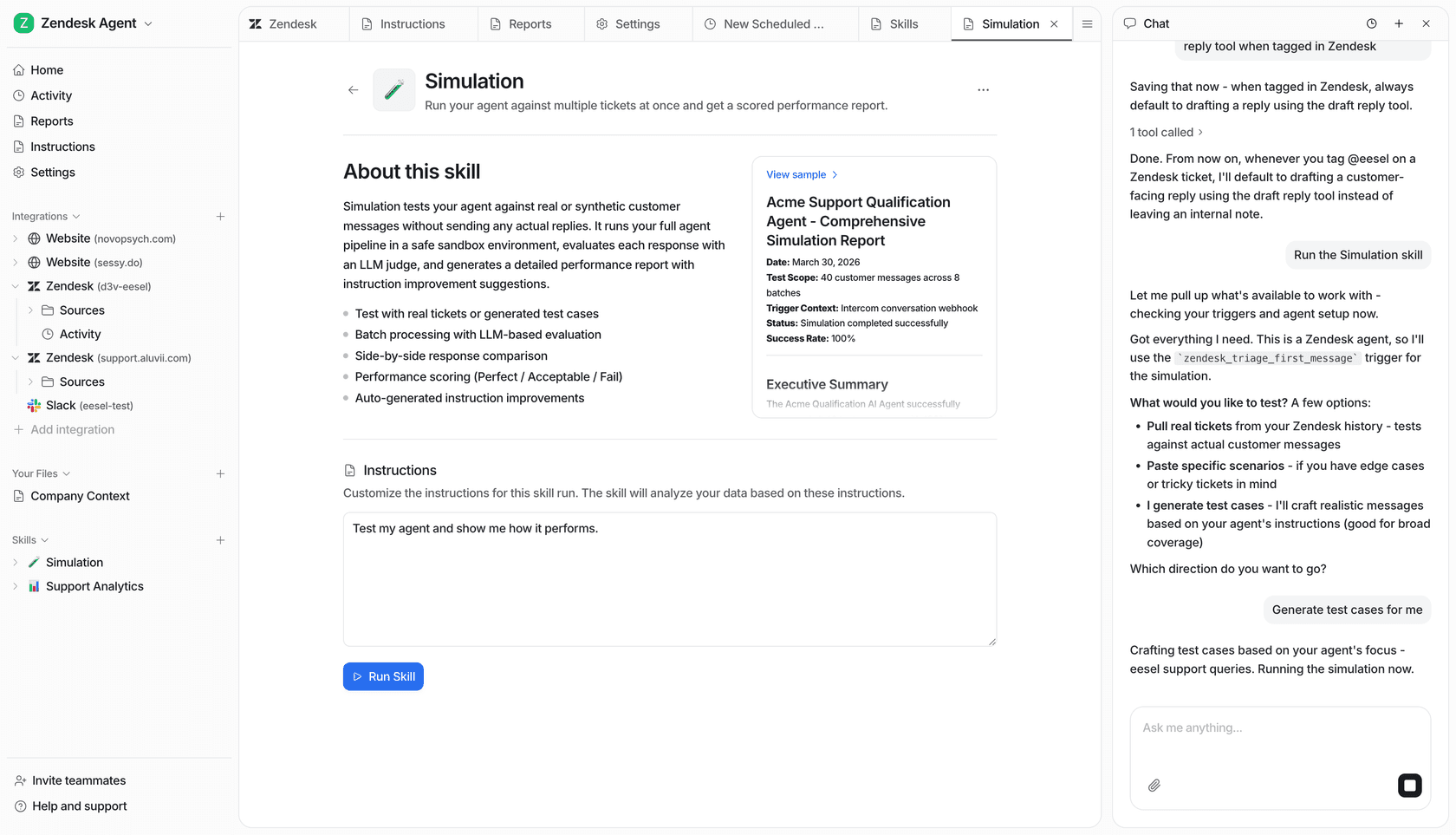
This kind of unpredictability is fine if you're a developer just messing around with a side project. But for a business, it's a huge risk. You can't run customer support on an AI that might throw its hands up and give a half-baked answer when a customer has a tricky problem. This is why a platform built for business is so important. For instance, tools like eesel AI have a powerful simulation mode that lets you test the AI on thousands of your past support tickets. You get a clear, predictable report card on its performance before it ever interacts with a live customer. That completely sidesteps the guesswork you get with raw models.
Weak visual generation capabilities
It’s also pretty clear that Qwen is a text-and-code specialist. A review from Techpoint Africa found that its ability to generate images and videos is nowhere near as good as its other skills. The results often look artificial, generic, and just don't have the realistic quality you’d get from tools built for visual content. It’s a good reminder that no single model can do everything well.
The challenge of implementation for support teams
This is the biggest hurdle for any business: a foundational model like Qwen is just that, a foundation. It’s not a tool you can just drop into your support team's workflow and expect miracles.
To actually use it for customer service, you'd need a team of developers to:
-
Integrate it with your helpdesk, whether it's Zendesk or Freshdesk.
-
Build a system to feed it knowledge from your internal docs in Confluence or Google Docs.
-
Create all the custom workflows for handling ticket routing, tagging, and escalations.
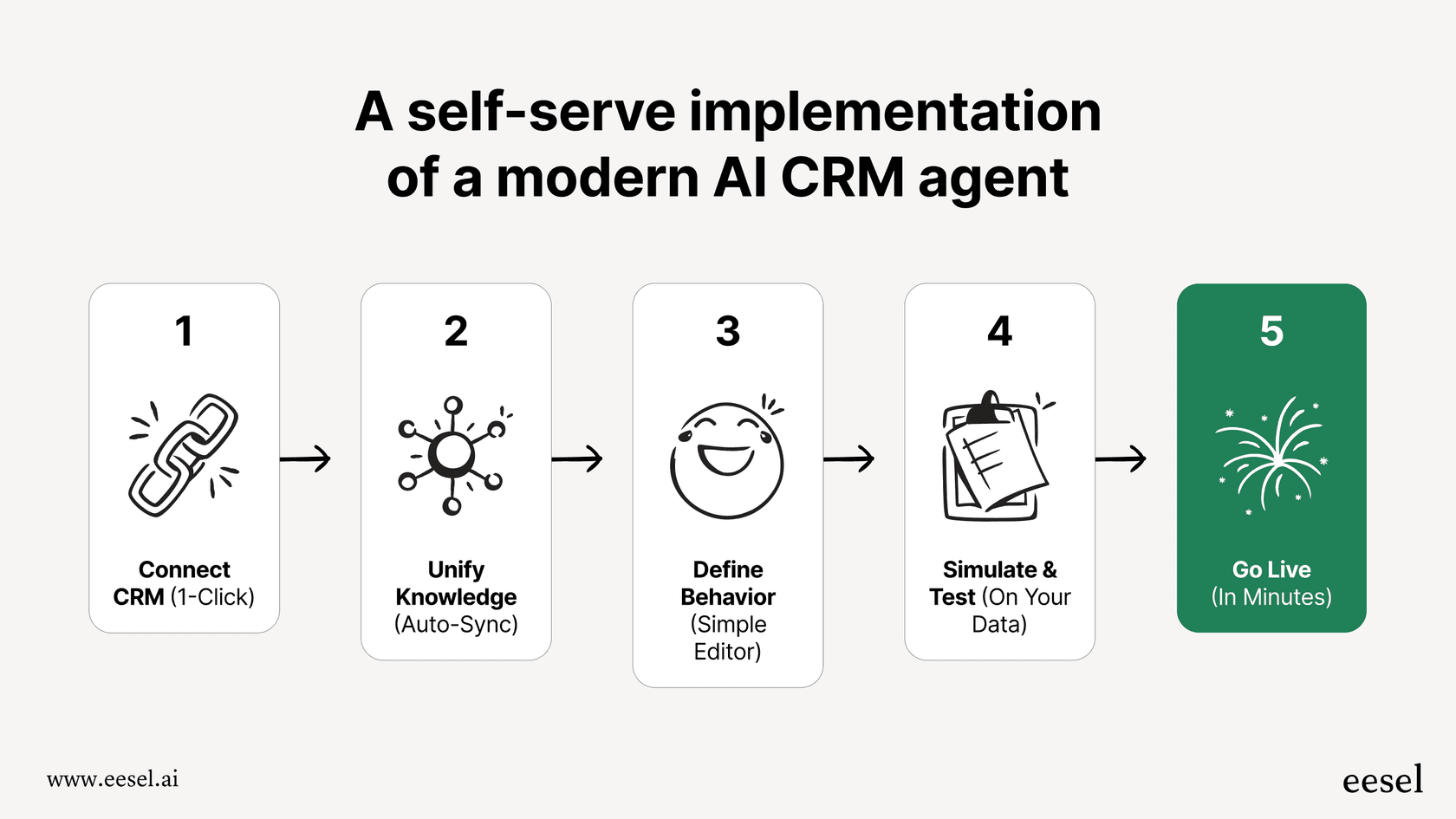
This isn't a weekend project; it's a massive undertaking that can easily eat up months of engineering time and resources. In contrast, a platform like eesel AI is designed to be radically self-serve. You can connect your helpdesk and knowledge bases with one-click integrations and get everything running in minutes, not months, without writing a single line of code.
From raw model to real results with a platform approach
The difference between a raw AI model and an AI platform built for a specific job is night and day. One is a box of powerful engine parts; the other is a car you can actually drive.
| Feature | Raw Model (like Qwen) | AI Support Platform (like eesel AI) |
|---|---|---|
| Setup Time | Months of development work | Minutes (self-serve, no-code) |
| Knowledge | Requires manual data feeding & training | Instantly connects to all your sources (tickets, docs, etc.) |
| Workflows | Needs to be custom-built by engineers | Fully customizable workflow engine included |
| Reliability | Unpredictable, hard to test at scale | Test on past tickets with simulation mode for predictable results |
| Control | Limited to prompt engineering | Granular control over automation rules, persona, and actions |
Why a specialized AI platform beats a general model for support
A general model like Qwen has no clue what a support ticket is, what a macro does, or when a frustrated customer needs to talk to a human. A purpose-built platform like eesel AI lives and breathes customer service. It learns from your team's past tickets to automatically adopt your brand's tone of voice and understands how to do things inside your helpdesk, like adding a tag in Zendesk or looking up an order in Shopify.
Gaining full control and rolling out with confidence
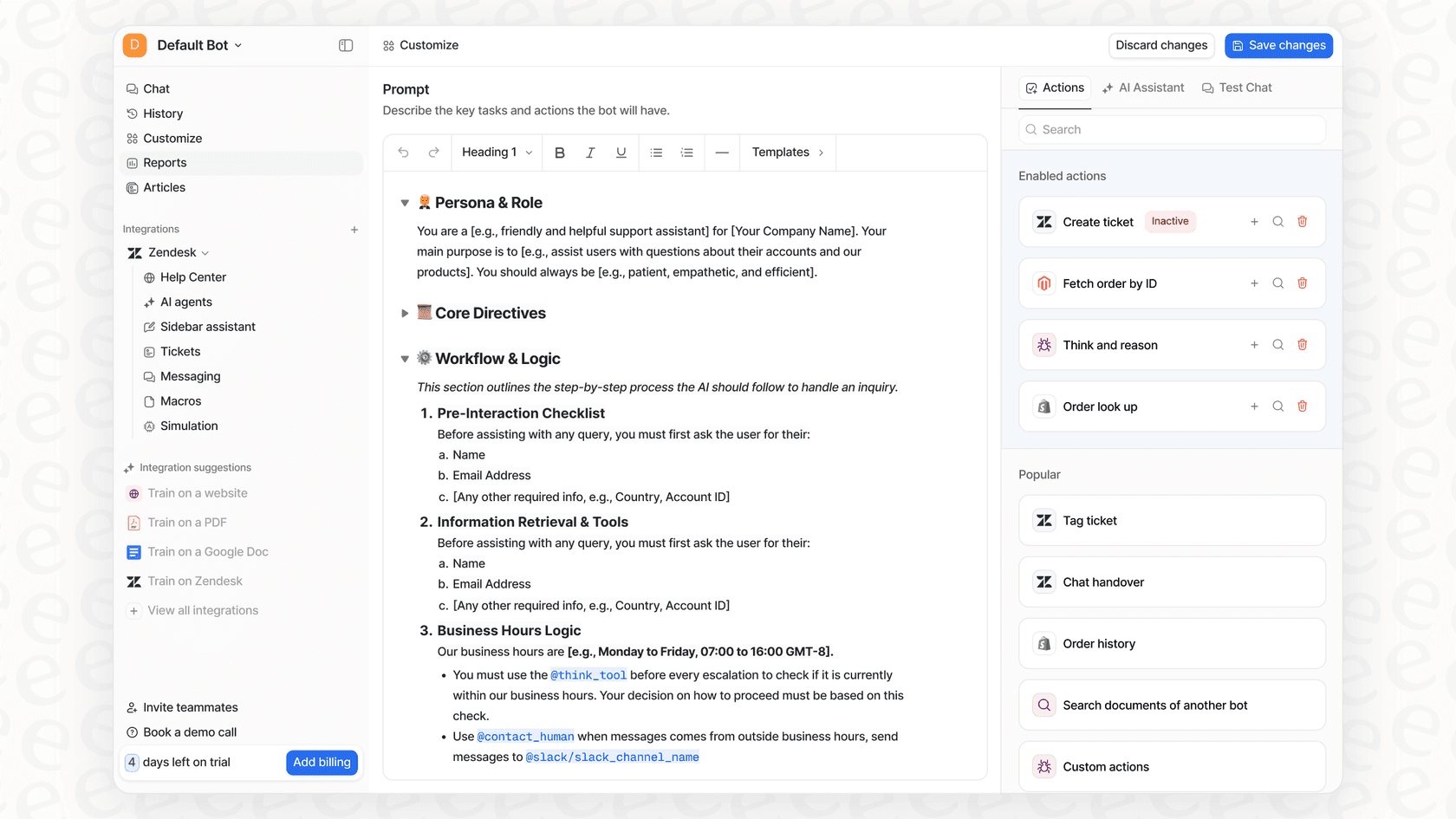
With a raw model, you’re pretty much stuck with its general training and just have to hope for the best. With eesel AI, you’re in complete control. Its fully customizable workflow engine lets you decide exactly which types of tickets the AI handles and what it should do with them. You can start small, maybe by automating those simple, repetitive questions, and have it escalate everything else until your team feels totally comfortable and trusts the system.
Qwen: A powerful tool for developers, but not a business solution
So, to wrap up this Qwen review: Qwen is an incredibly impressive piece of technology and a huge win for the open-source community. For developers and technical folks who need a powerful coding assistant or a flexible foundation to build on, it’s a fantastic choice.
But for businesses, and especially for support teams, the path from a raw model to a reliable, integrated, and controllable solution is long, expensive, and filled with uncertainty. The real win isn't just the raw intelligence of an AI, but how you can apply it practically. Platforms like eesel AI provide that critical layer that turns raw potential into actual business results, like faster response times, cleaner ticket queues, and happier customers.
Ready to try an AI that’s built for business?
Instead of wrestling with APIs and pulling your developers off other projects, you can launch an AI support agent that’s ready to go in minutes. eesel AI connects to the tools you already use and learns from your existing knowledge to provide fast, accurate, and reliable support.
Start your free trial and launch your first AI agent today.
Frequently asked questions

Share this article

Article by
Stevia Putri
Stevia Putri is a marketing generalist at eesel AI, where she helps turn powerful AI tools into stories that resonate. She’s driven by curiosity, clarity, and the human side of technology.