Re:amaze vs Dixa: Which helpdesk is right for your team in 2026?

Last edited March 13, 2026
Choosing the right helpdesk platform can feel like picking a long-term business partner. Get it right, and your support team operates smoothly. Get it wrong, and you're stuck with frustrated agents, confused customers, and a tool that fights you more than it helps.
Two platforms that often come up in these conversations are Re:amaze and Dixa. Both promise to streamline customer support, but they approach the problem from different angles. Re:amaze focuses on simplicity and quick setup for growing businesses. Dixa positions itself as an "agentic" platform with advanced AI and workforce management capabilities.
Here's what each platform actually offers, how they compare on pricing and features, and which one might fit your specific needs.
What is Re:amaze?
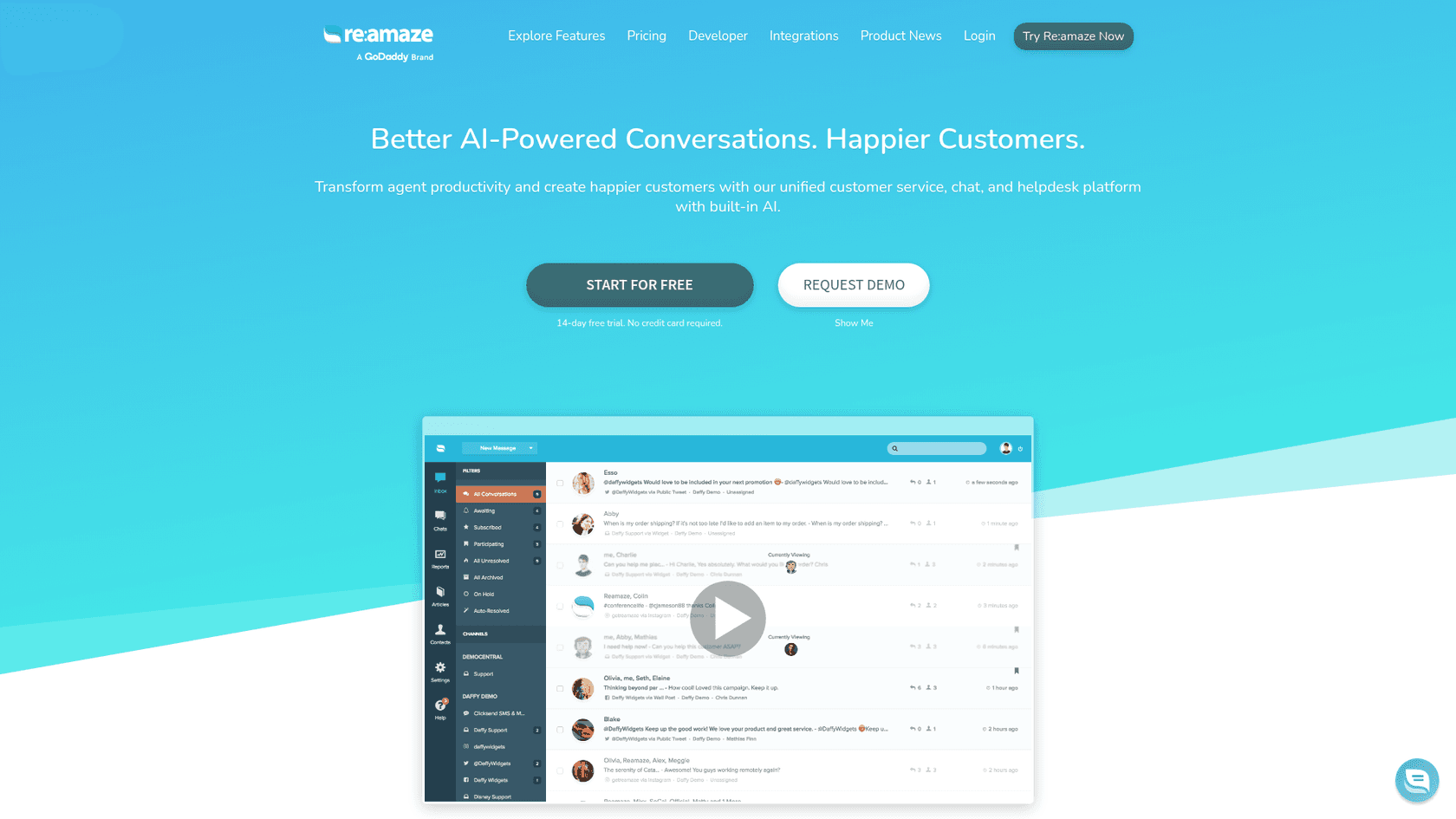
Re:amaze is a helpdesk and customer messaging platform owned by GoDaddy. It's designed for e-commerce businesses, SaaS companies, and online brands that need to consolidate support channels without getting bogged down in complex configuration.
The platform combines email, live chat, social media, SMS, VoIP, and video calls into a shared inbox. Where Re:amaze stands out is its focus on e-commerce integrations. It connects deeply with Shopify, BigCommerce, WooCommerce, and Magento, pulling in order data, customer history, and shopping behavior directly into the agent workspace.
Re:amaze also includes an AI Agent (currently in beta) that can handle routine inquiries 24/7. The AI learns from your knowledge base articles, so every FAQ you publish automatically trains the system. Other notable features include "Cues" (proactive messaging based on customer behavior), live screensharing via "Peek," and a mobile app for iOS and Android.
With a 4.6/5 rating on G2 and 80.9% of reviewers coming from small businesses, Re:amaze clearly resonates with leaner teams that want powerful features without enterprise complexity.
What is Dixa?
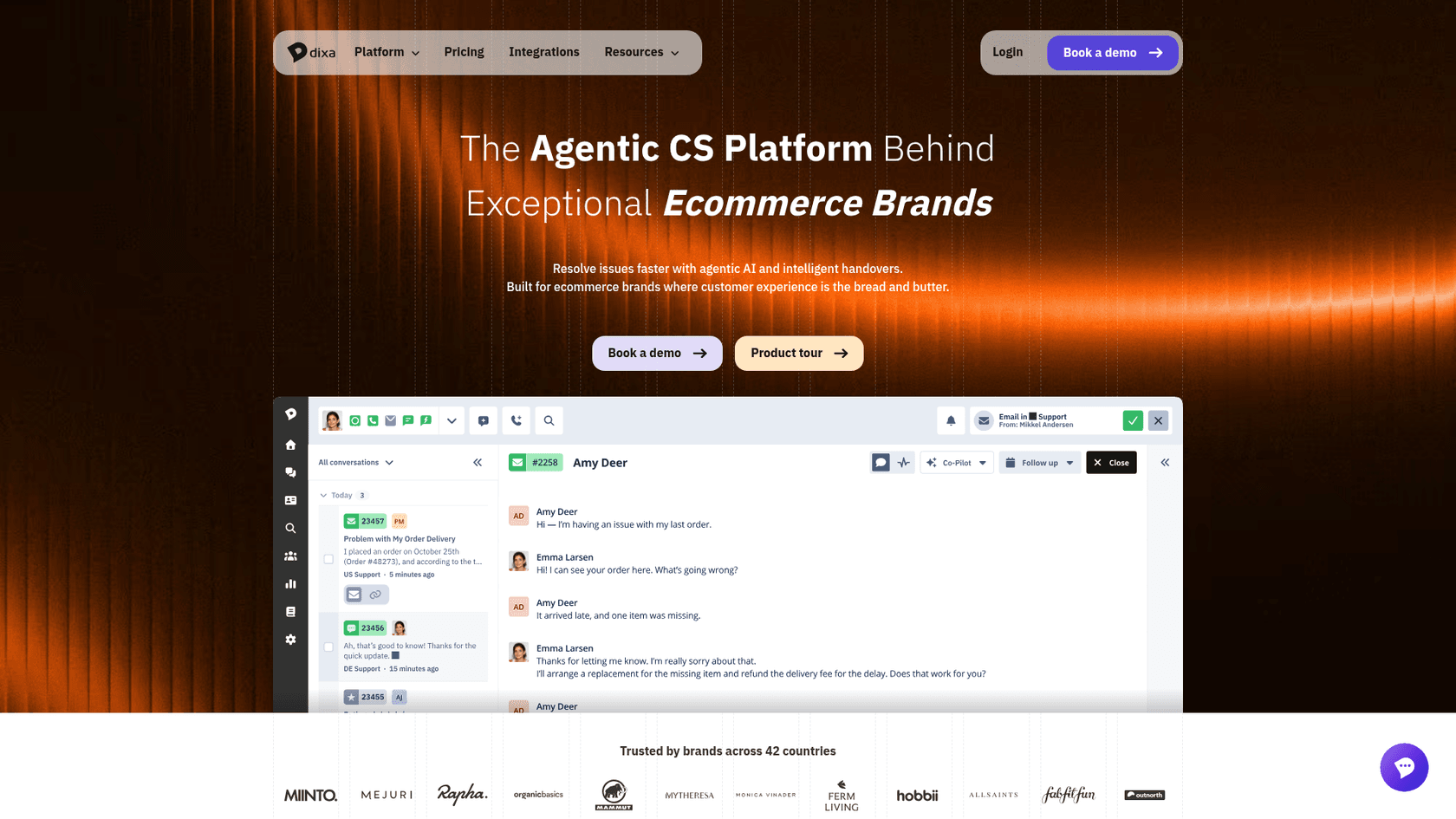
Dixa calls itself an "agentic customer service platform." This refers to a system built around AI agents that can autonomously resolve customer inquiries, not just deflect them to help articles.
At the core of Dixa's offering is Mim, an AI agent that handles refunds, order tracking, cancellations, and FAQs across chat, email, and WhatsApp. When Mim encounters something it can't handle, it hands off to human agents with full context. The platform also includes an AI Co-Pilot that assists human agents with reply suggestions, translations, summaries, and sentiment detection.
Dixa supports all major channels: phone, email, live chat, WhatsApp, Instagram DMs, Facebook Messenger, and SMS. The phone system is cloud-based with no hardware required, including IVR, call recording, and callback scheduling.
With 850+ brands across 42 countries and customers like Rapha, Oliver Bonas, and Miinto, Dixa targets mid-market to enterprise ecommerce brands. Its 4.2/5 G2 rating comes from a user base that's 54.4% mid-market, suggesting it scales better for larger operations.
Feature comparison
Both platforms cover the basics of modern customer support, but their strengths differ.
Re:amaze key features
- Multi-channel inbox: Email, chat, social media, SMS/MMS, and VoIP in one place
- E-commerce focus: Deep integrations with Shopify, BigCommerce, WooCommerce, and Magento
- AI Agent (Beta): 24/7 autonomous support trained on your knowledge base
- Cues: Proactive messaging triggered by customer behavior, URL, UTM, or time on site
- Live Dashboard: Real-time monitoring of customer browsing activity and shopping data
- Peek: Live screensharing to see customer issues without additional software
- Knowledge Base: Embeddable FAQ that trains your AI Agent automatically
- Mobile Apps: Full iOS and Android support for on-the-go responses
- Workflows: Automation with custom triggers and response templates
- Multibrand: Manage multiple brands from one account
Dixa key features
- True Omnichannel: Phone, email, chat, WhatsApp, Instagram, Facebook Messenger unified
- Mim AI Agent: Autonomous resolution of refunds, tracking, order changes with seamless handovers
- AI Co-Pilot: GPT-powered assistance with replies, translations, summaries, and spellchecking
- Cloud Call Center: Full phone system with IVR, call recording, callback scheduling
- Visual Flow Builder: Build routing and automation without code
- Intelligent Routing: Skills-based, language, VIP status, and custom rule routing
- Auto QA: Automatically score 100% of conversations against your criteria
- Advanced Analytics: Real-time and historical dashboards with custom reporting
- Team Hub: Unified workspace with customer history, orders, and loyalty status
- AI Intent Detection: Automatic categorization and routing based on customer intent
Side-by-side feature comparison
| Feature | Re:amaze | Dixa |
|---|---|---|
| Email, chat, social | ✅ | ✅ |
| SMS/Voice channels | Pro plan+ | All plans |
| ❌ | ✅ | |
| Instagram DMs | ✅ | ✅ |
| AI Agent (autonomous) | Beta | ✅ (Mim) |
| AI Co-Pilot for agents | ✅ | ✅ |
| Cloud phone system | Limited | Full-featured |
| Visual workflow builder | Basic | Advanced |
| Auto QA | ❌ | ✅ |
| Live screensharing | ✅ (Peek) | ❌ |
| Proactive messaging (Cues) | ✅ | ❌ |
| E-commerce integrations | Shopify, BigCommerce, WooCommerce, Magento | Shopify, Magento, WooCommerce |
| Mobile apps | ✅ | ✅ |
| Multibrand support | Pro plan+ | All plans |
Pricing comparison
This is where the differences become stark. Re:amaze and Dixa target different budget ranges.
Re:amaze pricing
| Plan | Monthly Price | Annual Price | Key Features |
|---|---|---|---|
| Basic | $29/agent/mo | $26.10/agent/mo | Unlimited email, chat, social, FAQ, workflows, chatbots, Cues, basic reporting |
| Pro | $49/agent/mo | $44.10/agent/mo | Everything in Basic + multibrand, live visitor view, advanced reporting, SMS/voice, status page |
| Plus | $69/agent/mo | $62.10/agent/mo | Everything in Pro + Peek screensharing, departments, staff performance, custom roles, video calls |
| Starter | $59 flat/mo | $59 flat/mo | All Basic features for unlimited users, limited to 500 conversations/month |
| Enterprise | Custom | Custom | High-volume, white-glove service |
Re:amaze offers a 14-day free trial with no credit card required. Annual billing saves 10%.
Source: Re:amaze pricing
Dixa pricing
| Plan | Monthly Price | Annual Price | Key Features |
|---|---|---|---|
| Growth | $89/agent/mo | ~$71/agent/mo | All channels, external KB, surveys, language detection, SLA, agent teams, native integrations |
| Ultimate | $139/agent/mo | ~$111/agent/mo | Everything in Growth + advanced routing, AI intent detection, automations, macros, sandbox |
| Prime | $179/agent/mo | ~$143/agent/mo | Everything in Ultimate + SSO, advanced AI, custom roles, multiple orgs, enterprise API |
Dixa also offers add-ons: Mim AI Agent (priced by conversation volume), AI Co-Pilot (per agent), Quality Assurance, Advanced Insights, Voice Transcription, and SSO. Annual billing saves 20%.
Source: Dixa pricing
Cost at scale comparison
For a team of 10 agents on comparable plans (Re:amaze Pro vs Dixa Growth):
| Platform | Monthly Cost | Annual Cost |
|---|---|---|
| Re:amaze Pro | $490 | $5,292 |
| Dixa Growth | $890 | $8,520 |
That's a $400/month difference, or $4,800 annually. For budget-conscious teams, Re:amaze is significantly more affordable.
Ease of use and setup
Re:amaze lives up to its promise of quick setup. Most teams are up and running in under 5 minutes. The interface is intuitive, with minimal configuration required to start handling conversations. The learning curve is gentle, making it ideal for teams that need to move fast without extensive training.
Dixa takes a different approach. The platform is more powerful but requires more upfront configuration. Setting up intelligent routing rules, workflow automations, and IVR flows takes time. However, once configured, Dixa's automation can handle complex scenarios that Re:amaze simply can't match.
For teams with dedicated operations or IT support, Dixa's complexity is worth the payoff. For teams that need to start supporting customers immediately with minimal setup, Re:amaze is the better choice.
Who should choose Re:amaze?
Re:amaze fits best if you:
- Run a small to medium e-commerce business (1-20 support agents)
- Need to get started quickly without complex configuration
- Want strong Shopify, BigCommerce, or Magento integration
- Prefer per-user pricing flexibility
- Value features like live screensharing and proactive messaging
- Have a limited budget but need solid multi-channel support
The Starter plan at $59/month for unlimited users (with a 500 conversation limit) is particularly attractive for very small teams or seasonal businesses.
Who should choose Dixa?
Dixa makes more sense if you:
- Operate a mid-market to enterprise ecommerce brand (10+ agents)
- Need a full cloud call center with IVR and callback scheduling
- Want AI that can autonomously resolve inquiries, not just suggest articles
- Require advanced routing based on skills, language, or VIP status
- Need automatic QA scoring across all conversations
- Have the budget for a premium platform ($89+/agent/month)
- Want true omnichannel including native WhatsApp support
Dixa's customer results demonstrate its enterprise capabilities: Rapha saw 22% efficiency gains and 14% CSAT improvement. Oliver Bonas doubled productivity per hour. Dott cut response times by 70%.
eesel AI: A modern alternative to consider
If you're comparing Re:amaze and Dixa, there's another option worth considering. At eesel AI, we take a different approach to customer support. Instead of treating AI as an add-on feature, we built our platform around the idea of hiring an AI teammate.
Here's what that means in practice. Connect eesel AI to your help desk (we integrate with Zendesk, Freshdesk, Intercom, Gorgias, Re:amaze, and others). Our AI Agent learns from your past tickets, help center articles, macros, and connected docs (Confluence, Google Docs, Notion) in minutes, not weeks.
You start with oversight. Have our AI draft replies for agent review using AI Copilot, limit it to specific ticket types, or set business hours when it can respond. As it proves itself, you expand its scope until it's handling full frontline support autonomously.
The key difference? Control. You define escalation rules in plain English: "If the refund request is over 30 days, politely decline and offer store credit." "Always escalate billing disputes to a human." No code, no rigid decision trees.
Mature deployments achieve up to 81% autonomous resolution with a typical payback period under 2 months. You can run simulations on thousands of past tickets before going live to verify quality.
If you're evaluating Re:amaze and Dixa primarily for their AI capabilities, book a demo to see how eesel AI compares.
Making your decision: Re:amaze vs Dixa
Both platforms are solid choices, but they serve different needs. Here's a quick summary:
| Factor | Re:amaze | Dixa |
|---|---|---|
| Best for | Small-medium teams, quick setup | Mid-market+, advanced automation |
| Starting price | $29/agent/mo | $89/agent/mo |
| AI capabilities | Beta AI Agent, Co-Pilot | Mim AI Agent (mature), Co-Pilot |
| Phone system | Basic (Pro+) | Full cloud call center |
| ❌ | ✅ | |
| Setup time | Minutes | Days/weeks |
| E-commerce focus | Strong | Strong |
Choose Re:amaze if: You want affordable, easy-to-use helpdesk software with solid e-commerce integrations and don't need advanced workforce management or a full phone system.
Choose Dixa if: You need enterprise-grade automation, a true omnichannel platform with voice, and have the budget for advanced AI capabilities.
Consider eesel AI if: You want AI-native support that learns your business instantly and can progressively handle more autonomy based on performance.
The right choice depends on your team size, budget, and how sophisticated your support operations need to be. All three platforms offer trials or demos, so you can test them with your actual workflows before committing.
Frequently Asked Questions

Share this article

Article by
Stevia Putri
Stevia Putri is a marketing generalist at eesel AI, where she helps turn powerful AI tools into stories that resonate. She’s driven by curiosity, clarity, and the human side of technology.