Richpanel pricing in 2026: the real cost of an AI support team


Last edited June 24, 2026

What Richpanel actually charges
I have spent the last few years helping ecommerce teams put AI onto live support queues, and the first thing I do with any "AI support team" pitch is ignore the homepage and go straight to the billing page. Richpanel is one of the rare vendors where that page is refreshingly readable, so let me lay it out plainly.
Richpanel sells itself as an AI-native helpdesk for ecommerce, built around four AI roles plus a normal human inbox. The pricing has one published self-serve tier and a custom enterprise tier. Here is the self-serve plan in full.
| Item | Cost | Notes |
|---|---|---|
| Platform minimum | $500 / month | Buys 2 AI agents (~2,000 conversations) |
| AI agent capacity | $0.25 / conversation | 1 AI agent ≈ 1,000 conversations ≈ $250 |
| Human helpdesk seat | $100 / seat / month | Every agent who logs in |
| Money-back guarantee | 50% autonomous resolution in 30 days, or full refund | No proration |
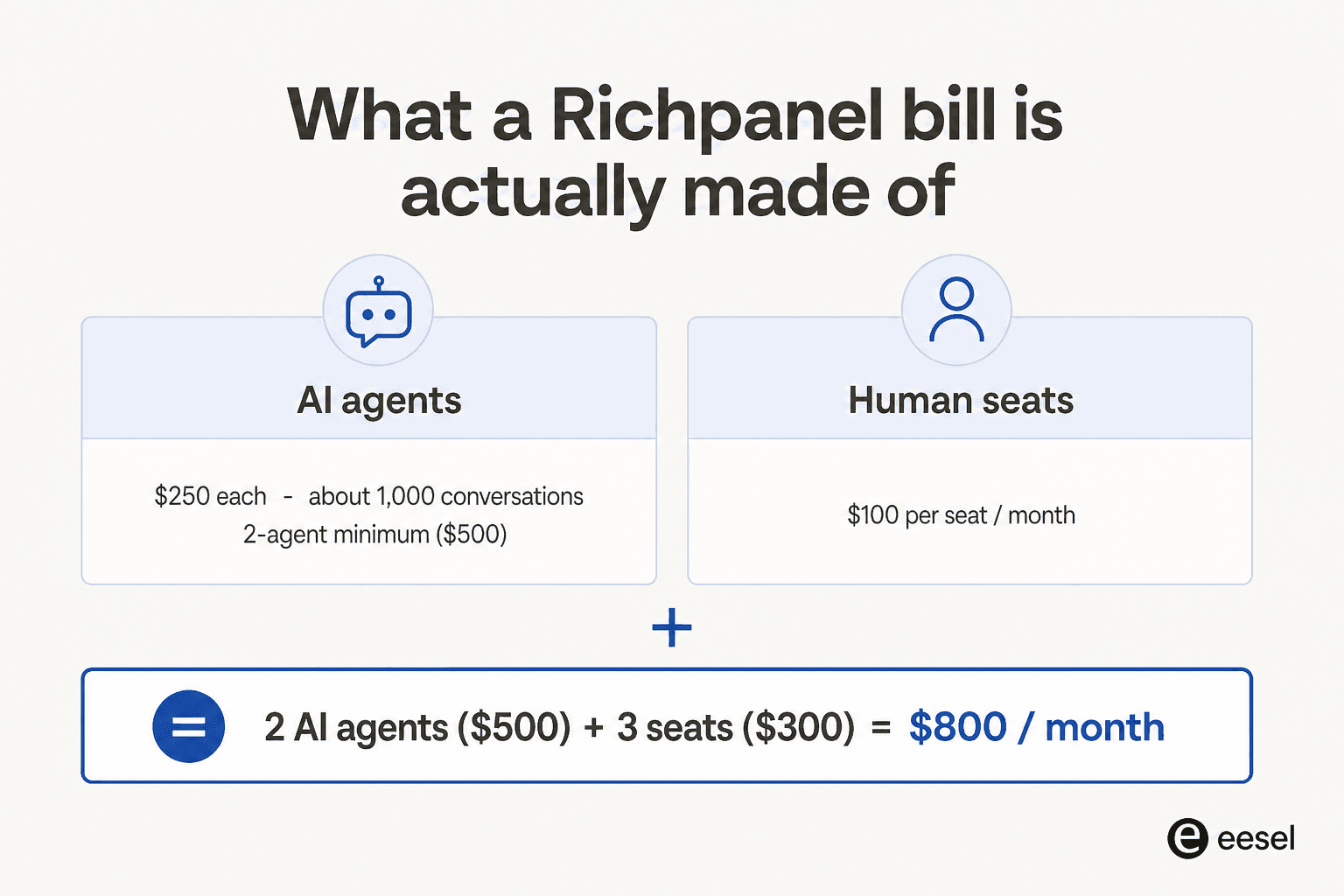
Source: Richpanel's pricing page. The sample bill the page shows is 2 AI agents ($500) plus 3 human seats ($300) = $800/month. Capacity scales in roughly 1,000-conversation steps: 3 agents covers about 3,000 conversations, 5 agents about 5,000, and anything past 10 agents (~10,000 conversations) tips you into "talk to sales."
The thing the price grid hides is that a Richpanel bill really only has two moving parts. You buy AI capacity in $250 blocks of about 1,000 conversations (minimum two), and you pay $100 for each human who needs a login. That is it, no per-channel fees, no add-on modules.
The per-conversation meter is the part to watch
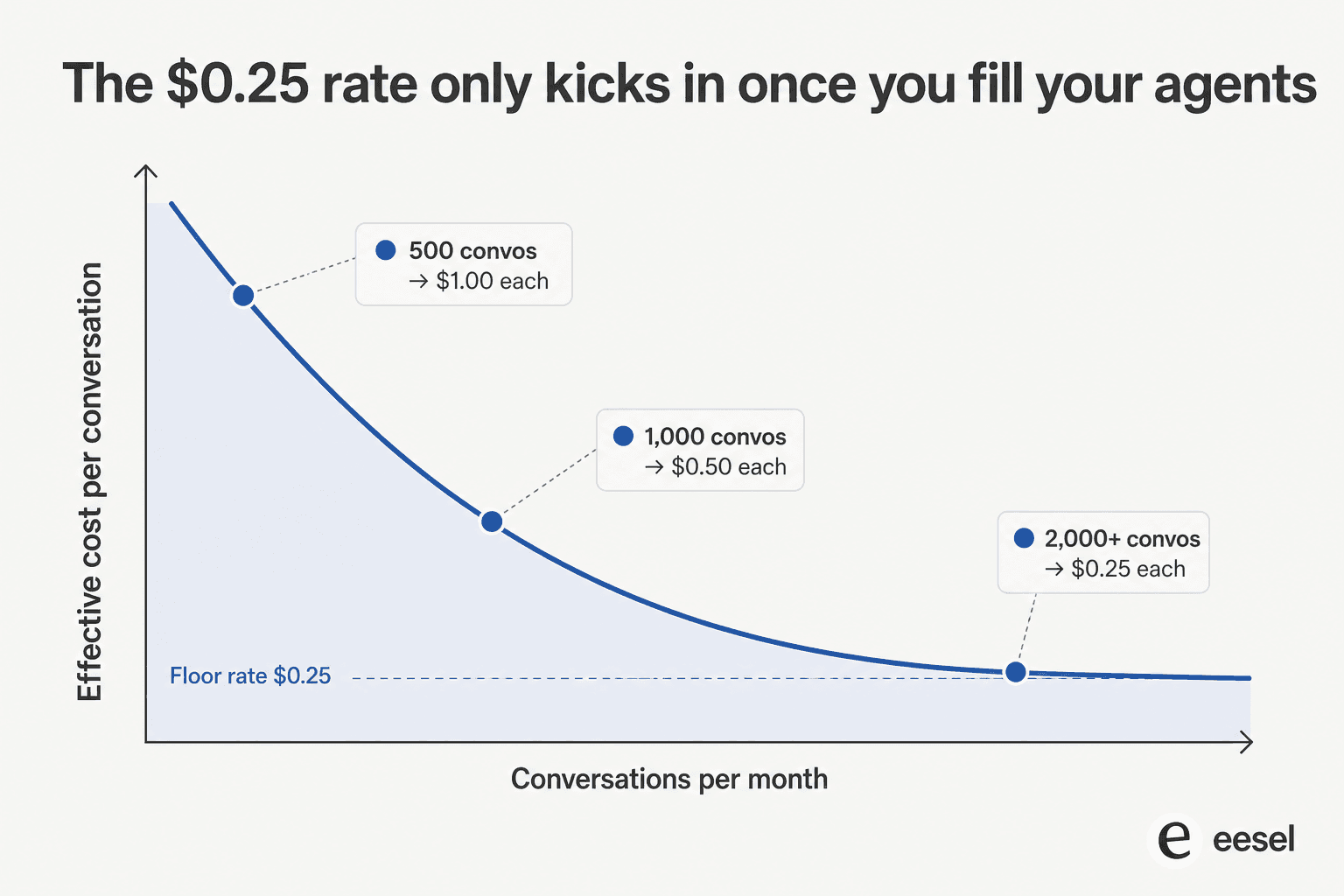
Here is where I slow buyers down. The "$0.25 per conversation" headline is true, but it is a floor rate, not your effective rate. Because the plan starts at a fixed $500 for two agents, a store doing 500 conversations a month is still paying $500, which works out to $1.00 per conversation, four times the advertised number. You only actually pay $0.25 once you are doing around 2,000 conversations and the agents you bought are full.
The second thing about a per-conversation meter: it is volume-based, so the bill moves with your ticket count. That is fine in a quiet March. It is less fine when Black Friday quadruples your conversation volume and your support bill quadruples with it, in the exact month your margins are already under pressure. When I model these plans for teams, the seasonal spike is almost always the line item that surprises them. Richpanel's own marketing leans hard on handling peak season, so it is worth remembering that the tool that brags about absorbing Black Friday volume is also metering you for it.
This is the one place a flat or no-minimum model reads differently. eesel AI, for example, runs on usage-based pricing with no per-seat fees and no platform floor, so a 500-conversation month costs what 500 conversations cost. Different philosophy, and worth a side-by-side before you sign.
A calculator for your own numbers
Rather than make you do the arithmetic, plug your real volume in. This runs the published Richpanel formula: AI capacity in $250/1,000-conversation blocks (two-agent minimum), plus $100 per human seat.
Slide the volume down toward a few hundred conversations and watch the effective rate balloon. That gap between the advertised $0.25 and what a small store actually pays is the single most important thing to understand about Richpanel pricing.
What every plan includes
Credit where it is due: Richpanel does not play the usual enterprise-software game of locking the good stuff behind higher tiers. The pricing page states it bluntly, "No tiered safety. No locked integrations. No 'contact sales for security.'" Both the self-serve plan and enterprise get the same AI safety layers, the same native integrations, and the same compliance posture.
What is in the box on every plan:
- Brand-voice training and 24/7 availability
- One inbox across email, chat, social, SMS, and WhatsApp
- Multi-brand management from a single dashboard
- A QA AI that reviews every reply before it sends
- Human escalation when the AI is unsure
- Subscription "save" flows before a cancellation goes through
- Native Shopify, Recharge, Loop, AfterShip, and TikTok Shop integrations
- SOC 2 Type II, HIPAA, GDPR, and CCPA compliance
That last bullet is worth pausing on. A lot of vendors gate HIPAA or SSO behind an enterprise call, so a regulated brand on a starter plan finds out at the worst possible moment that the certification they need is a sales conversation away. Richpanel includes SOC 2 and the rest on the entry plan, which is a genuinely buyer-friendly choice.
Where the money goes: the AI team
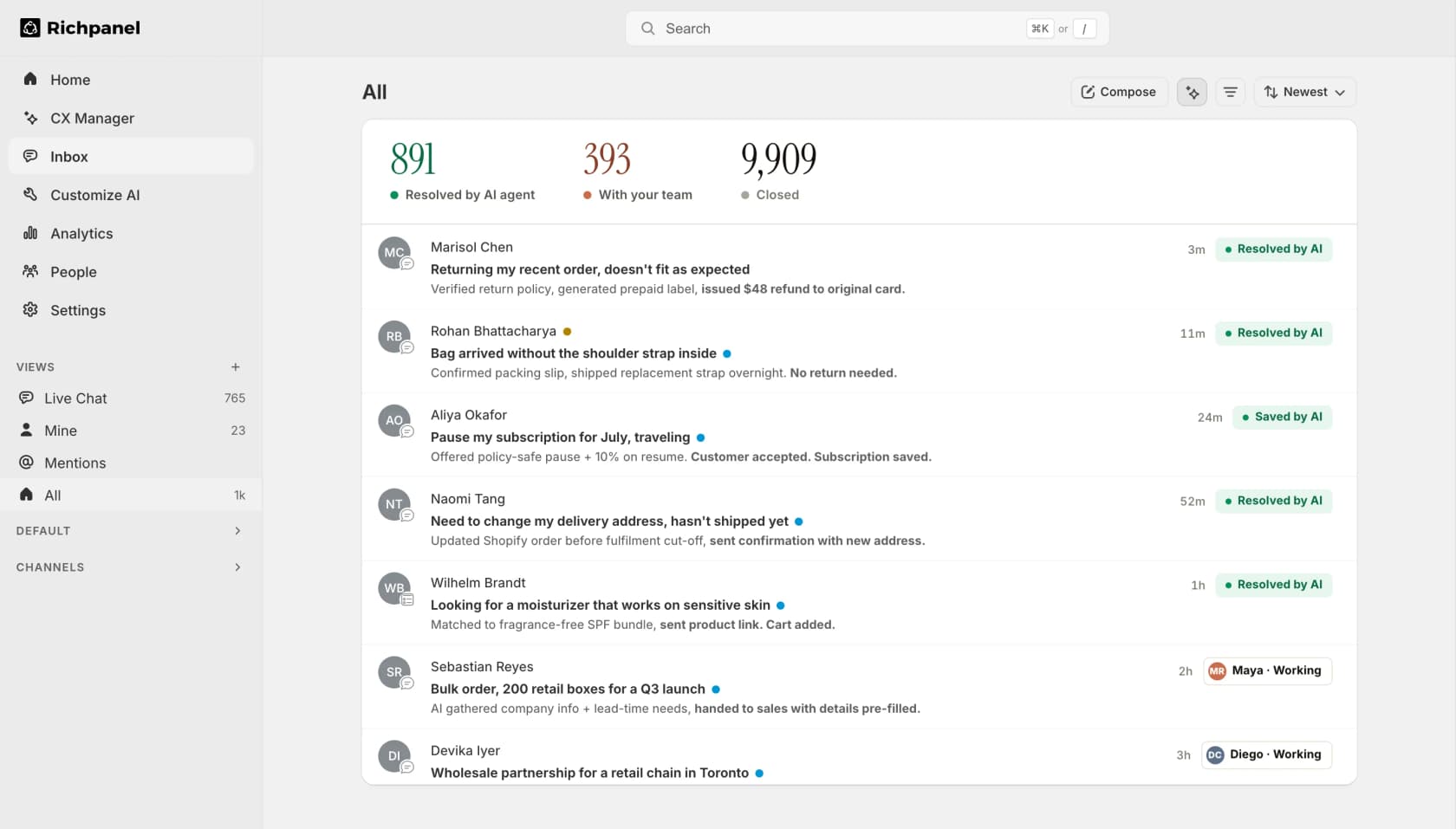
The reason Richpanel can fold AI into the platform fee is that the AI is the product. Instead of one chatbot, you get four roles, framed as employees you hire rather than software you configure. As of mid-2026 the company says it serves 2,000+ brands and clears 4,328 resolutions an hour across its network.
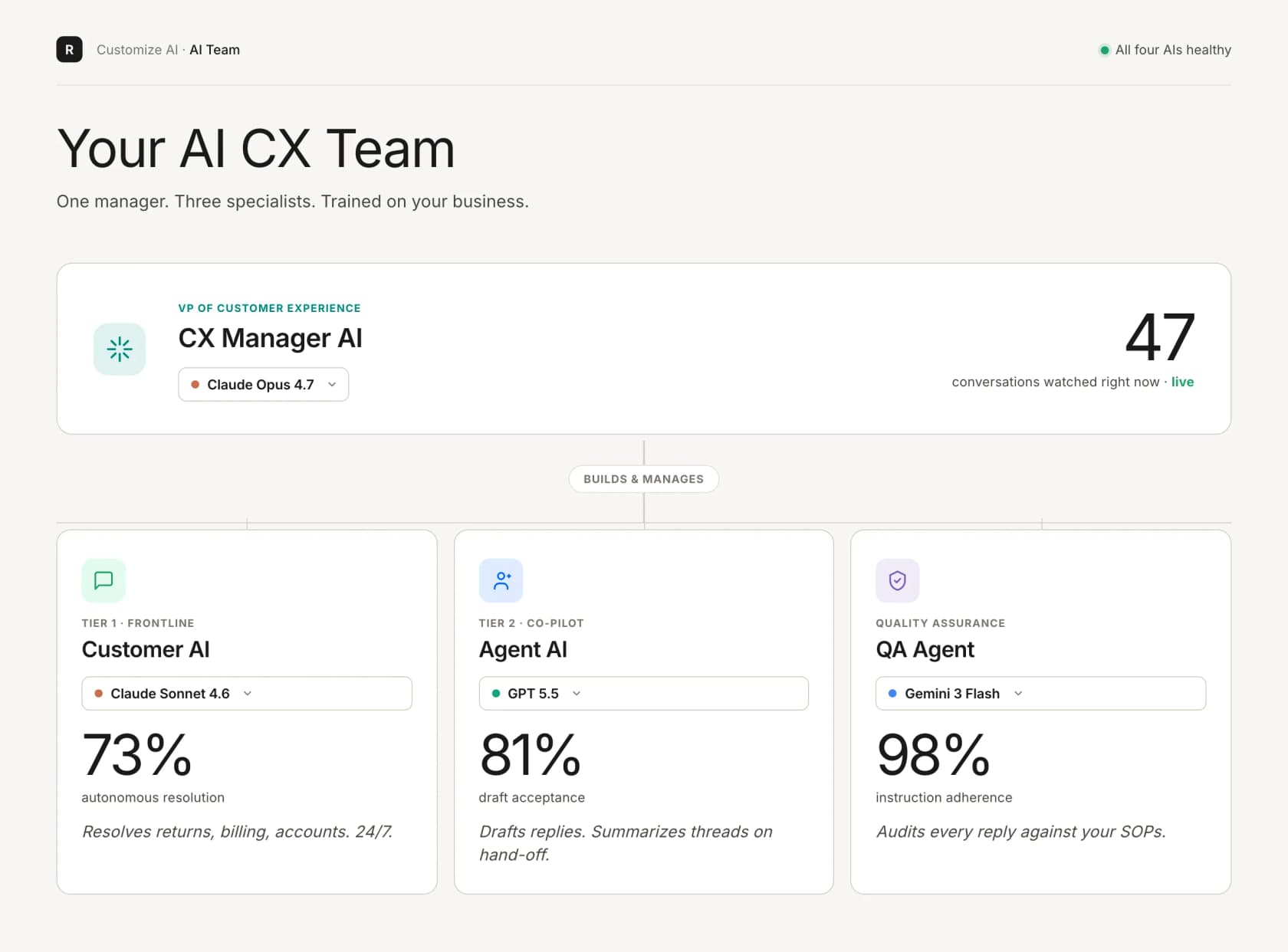
- Frontline AI resolves the bread-and-butter ecommerce tickets end to end: order tracking, returns, refunds, subscription cancellations, product recommendations. Richpanel claims 70 to 80% autonomous resolution at maturity.
- Copilot AI rides alongside human agents, researching context and drafting replies, with a claimed 5x throughput boost. If you have used a helpdesk copilot before, this is the familiar half of the product.
- QA AI reviews 100% of conversations and feeds misses back into policy. This is Richpanel's answer to the hallucination worry, and it is a sensible one.
- CX Manager AI builds the playbooks, assigns work, and monitors the other three.
It is a genuinely well-thought-out structure, and the per-role model accuracy (one screenshot shows different models powering each role) signals a team that thinks about this seriously. Whether you get 50% or 80% autonomous resolution depends entirely on how clean your help docs and policies are, which is true of every AI support tool, Richpanel included. If you are still comparing the field, our best AI helpdesk roundup and our list of the cheapest AI helpdesk apps are good next reads.
The 30-day guarantee is the real pricing story
If you only remember one thing about how Richpanel sells, make it this: the company guarantees 50% autonomous resolution within 30 days or a full refund, with "no hoops" and no proration. In a category where most "AI agents" quietly underperform their demo, putting the refund on the table is a strong signal of confidence, and it neutralizes most of the risk of the $500 commitment.
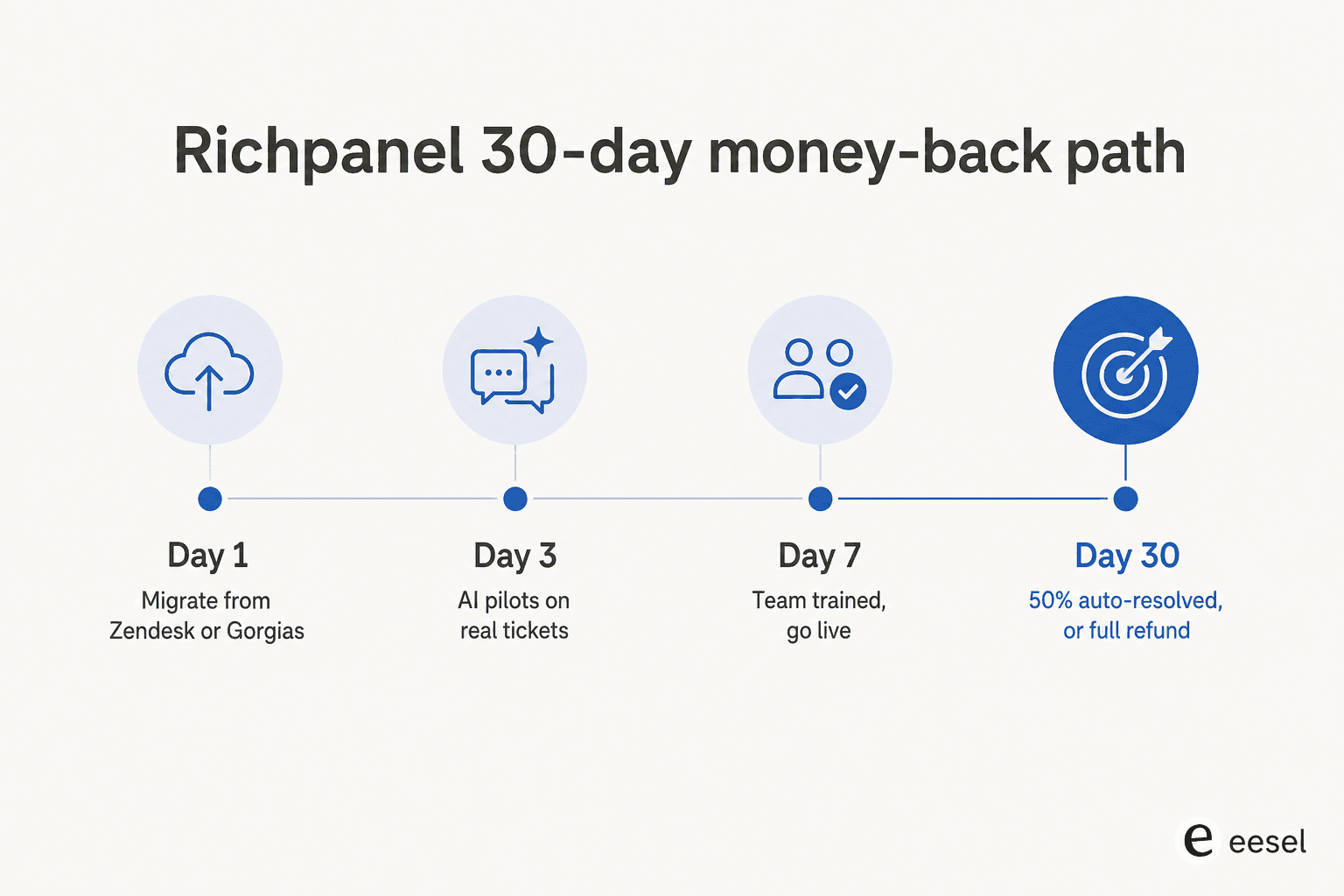
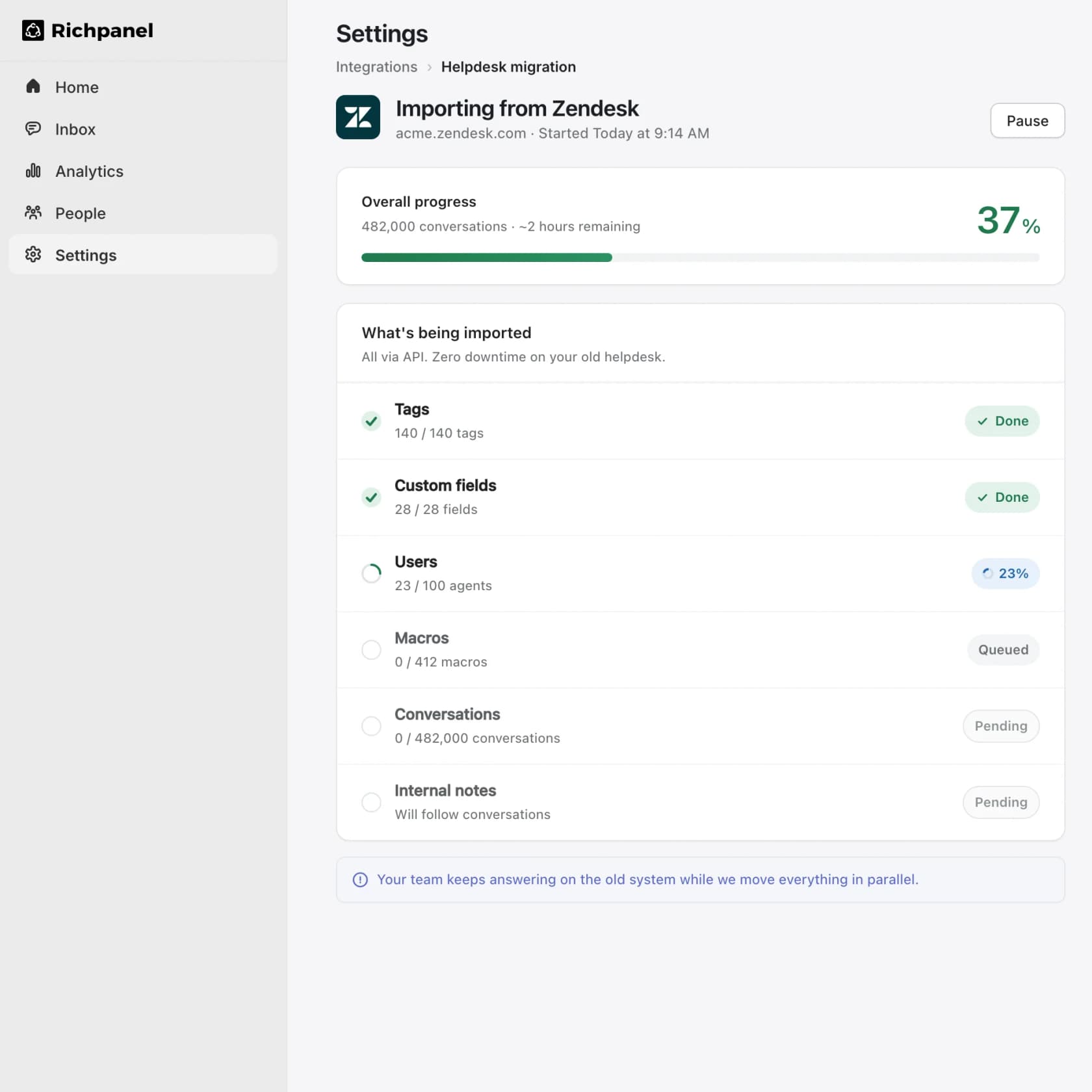
The guarantee is backed by an onboarding flow that is faster than most. Richpanel migrates from Zendesk or Gorgias at a claimed 30 to 50 brands a month, moving tickets, macros, tags, custom fields, routing rules, and internal notes over the API while your team keeps answering on the old system.
To its credit, Richpanel also publishes a four-layer approach to keeping the AI honest: 1,000+ simulations on your SOPs before it talks to a customer, the QA AI reviewing every reply, deterministic tool execution for refunds and cancellations (rather than letting the model freestyle a money movement), and human escalation when confidence drops. That "simulate before you ship" instinct is exactly right. It is the same reason we simulate every rollout against historical tickets at eesel, because a confident-sounding bot giving wrong answers is the failure mode that actually loses you customers.
The customer proof
Richpanel's pricing page does the smart thing and ties cost to outcomes with named brands. These are vendor-supplied figures, so read them as the company's best cases rather than typical results, but they are specific and attributable.
| Brand | Headline result |
|---|---|
| The Ridge | 70% lower cost per ticket, ~$500K annual savings, CSAT 88% → 96% |
| Jones Road Beauty | 18 → 10 agents (revenue up), ticket-to-order rate 25% → 11%, zero BFCM backlog |
| Pela | 50% lower SaaS cost, Trustpilot 2.2 → 4.4 |
| Karta Ventures | 72% drop in ticket volume across 3 brands |
The Jones Road Beauty number is the one I find most honest about what AI support actually does. The team went from 18 agents to 10 while revenue grew, which Richpanel frames not as headcount-slashing but as reallocating your best people off repetitive tickets. That is the right framing, and it matches what I hear from the teams I work with: the win is rarely "fire everyone," it is "stop making your senior people answer 'where is my order' fifty times a day."
Who Richpanel pricing actually fits
After running the numbers across a lot of stores, here is where I land.
It fits if you are a mid-sized Shopify or ecommerce brand doing somewhere north of 2,000 conversations a month, you want the helpdesk and the AI from one vendor, and you like the idea of a hard guarantee de-risking the switch. At that volume the $0.25 rate is real, the bundled compliance is a genuine saving, and the migration tooling makes leaving Gorgias or Zendesk relatively painless. It also stacks up well against other Shopify AI apps on raw resolution.
Think twice if you are a small store under ~2,000 conversations a month (the $500 floor means you overpay per conversation), if your volume is highly seasonal (the per-conversation meter spikes with you), or if you already love your current helpdesk and only want to add an AI support layer rather than replace the whole platform. Richpanel is an all-or-nothing move: you are buying the inbox, not bolting AI onto the one you have.
That last group is where a layer-on-top tool tends to win. If your team is happy on Zendesk, Freshdesk, Gorgias, Help Scout, or Kustomer, you can keep all of it and add AI without a platform migration or a $500 floor.
Try eesel for AI support without the platform floor
If the part of Richpanel that appeals to you is "AI resolves the repetitive ecommerce tickets" but the part that gives you pause is "replace your whole helpdesk and commit to a $500 minimum," that is exactly the gap eesel AI is built for. It sits on top of the helpdesk you already run, Shopify, Zendesk, Gorgias, Freshdesk, and connects in minutes rather than weeks.
The pricing is the other half of the pitch: usage-based with no per-seat fees and no platform minimum, so a quiet month costs less than a busy one instead of starting at $500 regardless. And before anything goes live, you can simulate the AI against your own historical tickets to see the real resolution rate, the same "prove it before you ship it" instinct behind Richpanel's own guarantee.
It is free to try, and you can have it answering on your existing Shopify support queue before lunch.
Frequently asked questions


AI support for your Shopify store
Go live on your existing helpdesk in minutes, no platform floor, no per-seat fees.
Share this article