Semrush vs SEO.ai: Which is right for your content strategy?


Last edited January 26, 2026
SEO isn't what it used to be. Not that long ago, it was all about grinding out manual keyword research, painstakingly analyzing competitors, and spending hours upon hours writing. Today, things look a little different. We have massive analytics platforms like Semrush that give us a near-complete view of the digital landscape, and automated tools like SEO.ai that promise to put content creation on autopilot.
So, which way do you go? Do you equip yourself with the deep, data-rich toolkit of Semrush, or do you go for the hands-off, automated content engine of SEO.ai?
They're both powerful, but they solve very different problems. This post will break down the two approaches to help you figure out which one actually fits your goals, your team, and your budget. We'll even look at a third option: tools built specifically to turn a single keyword into a complete, publish-ready article, bridging the gap between deep analytics and simple text generation. One of those tools, the eesel AI blog writer, is what we use ourselves, but more on that in a bit.
What is Semrush?
Think of Semrush as the Swiss Army knife of digital marketing. It’s a huge, all-in-one platform trusted by 35% of Fortune 500 companies for a reason: it gives you a complete 360-degree view of your online world. It’s not just one tool; it’s a whole suite covering SEO, Content, Advertising, and Social Media.
SEMRush is what I pay for in my agency (10 person team) because it's better for content. As an SEO, I preferred Ahrefs, but their content tools just weren't as good. I've test 20 others and they all sucked in comparison. I don't agree with the takes that other work. Yeah, I guess they might if you stack them with 15 other tools, but SEMrush is the best 'all-in-one'.

At its heart, Semrush is built for deep analysis. You can dive into keyword research, track your rankings, spy on your competitors’ ad strategies, audit your site for technical problems, and manage your social media presence, all from one dashboard.
More recently, they’ve added AI-focused features like the AI Visibility Toolkit. This isn't for writing content, but for tracking how your brand gets mentioned in AI-generated answers from platforms like ChatGPT and Google's AI Overviews. It’s all about understanding your reputation in this new AI-driven search world.
Semrush is made for people who want to be in the driver's seat: SEO pros, marketing agencies, and in-house teams who need solid data to build and run complex strategies.
What is SEO.ai?
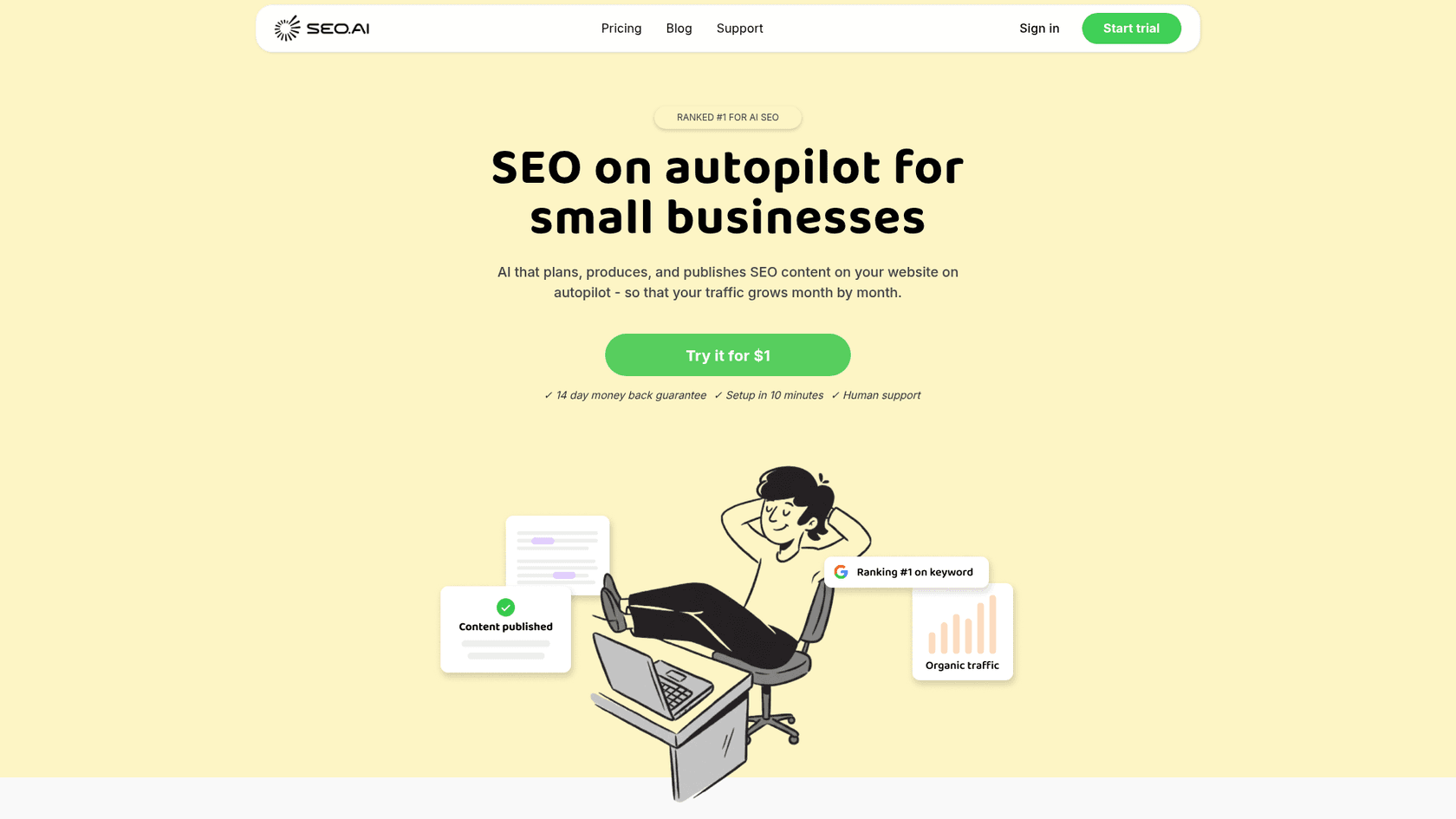
If Semrush is a Swiss Army knife, SEO.ai is more like a specialized power tool designed for one job: putting your SEO content on autopilot. It’s built for simplicity and automation, which makes it a popular choice for small businesses that don't have a dedicated SEO team.
Its entire workflow is meant to be hands-off. You connect your website, and it starts analyzing your existing content to find gaps and identify relevant keyword clusters. From there, it writes complete articles for you, optimized with E-E-A-T (Experience, Expertise, Authoritativeness, and Trustworthiness) principles in mind. It even adds internal links and can be set up to automatically publish the finished articles right to your WordPress or Shopify site.
The core promise is pretty attractive: grow your organic traffic without having to become an SEO expert or spend all your time writing. It’s aimed right at small business owners, solopreneurs, and content managers who need a consistent way to get content published.
Feature comparison: Semrush vs SEO.ai
While both tools want to get you more search traffic, they take completely different routes to get there. Semrush gives you a massive toolbox for manual analysis and guided optimization. SEO.ai, on the other hand, focuses on automating the whole content creation process from start to finish. Let's break down the key differences.
Keyword and topic research
Semrush: Semrush excels in this area. Its Keyword Magic Tool pulls from a database of over 27 billion keywords. You can get incredibly specific, digging into search volume, keyword difficulty, search intent, and what your competitors are ranking for. It’s a powerful, hands-on tool for building a data-driven strategy from scratch.
SEO.ai: Its approach is automated and specific to your site. Instead of giving you a giant database to explore, it crawls your website to spot missing content. It then finds relevant keyword clusters and basically builds a content plan for you. It’s less about open-ended research and more about getting a guided strategy based on your site's content gaps.
Verdict: Semrush is well-suited for users who need deep, strategic, hands-on research. If you'd rather have a tool suggest what to write about, SEO.ai's automated approach is more direct.
Content creation and optimization
Semrush: Semrush doesn't write for you. Instead, it helps you write better with its SEO Writing Assistant (SWA). Think of it as a very smart editor that lives inside your Google Docs or WordPress. As you write, it gives you real-time scores and suggestions on readability, SEO, tone of voice, and originality, all based on what's already ranking at the top of Google. It guides the process but expects a human to do the actual writing.
SEO.ai: This is the platform's core function. It generates complete articles from scratch. It doesn't just spit out text; it handles formatting, adds internal links, and can even generate images. The goal is to remove the manual writing process from your to-do list entirely. You give it a topic, and it delivers a finished product.
Verdict: This is the biggest difference between the two. Semrush assists human writers in creating more optimized content, while SEO.ai is designed to automate the writing process. The appropriate choice depends on whether you want to assist your writers or automate their work.
AI SEO and visibility tracking
Semrush: With its AI Visibility Toolkit, Semrush is focused on the measurement side of AI search. It’s an analytics tool that tracks when and how your brand gets mentioned in large language models like ChatGPT. It helps you understand your share of voice and brand sentiment in this new landscape, so you can see if your efforts are paying off.
SEO.ai: Its focus on AI is purely creative. The platform is designed to produce content that is "loved by humans, Google and ChatGPT," but it doesn't offer any tools to track or measure your visibility in AI answers. There are no reports on brand mentions or sentiment analysis. This is a major functional difference—it creates the content but doesn't help you measure its impact in the AI world.
Verdict: Semrush focuses on measuring and managing a brand’s reputation in AI search. SEO.ai focuses on creating content intended to appear in AI search.
Pricing and plans compared
The price tag for each tool reflects its core philosophy. Semrush's pricing is for a comprehensive suite of analytical tools, while SEO.ai's is for a specialized, automated service. Here’s a look at their entry-level plans.
| Feature | Semrush (Semrush One Starter Plan) | SEO.ai (Single Site Plan) |
|---|---|---|
| Starting Price | $199 per month ($165.17/mo paid annually) | $149 per month |
| Primary Focus | All-in-one SEO, content, and AI visibility suite | Automated AI content generation and publishing |
| AI Visibility Tracking | Included in plan | Not available (focus is on creation, not tracking) |
| Content Creation | SEO Writing Assistant (guides and scores human writers) | Fully automated article generation |
| Best For | SEO professionals, agencies, and marketing teams | Small business owners and solopreneurs |
Semrush justifies its higher price with a massive array of tools for deep-dive strategy and analysis. You're paying for data and control. SEO.ai's price reflects a service designed to save you a ton of time on content production. You're paying for automation and convenience.
Semrush vs SEO.ai: Which one should you choose?
This decision really comes down to what you need to get done.
Choose Semrush if: You're an SEO professional, run a marketing agency, or work in a business that needs deep data to drive your strategy. If your day-to-day involves competitor analysis, technical site audits, backlink building, and managing multi-channel campaigns, Semrush is your command center. You have the team and the expertise to turn its powerful insights into action.
Choose SEO.ai if: You're a small business owner, blogger, or affiliate marketer whose main goal is just to get consistently optimized content published without a steep learning curve. If content speed and automation are more important to you than granular technical analysis, SEO.ai is built to take that work off your plate.
An alternative for automated, publish-ready content: eesel AI
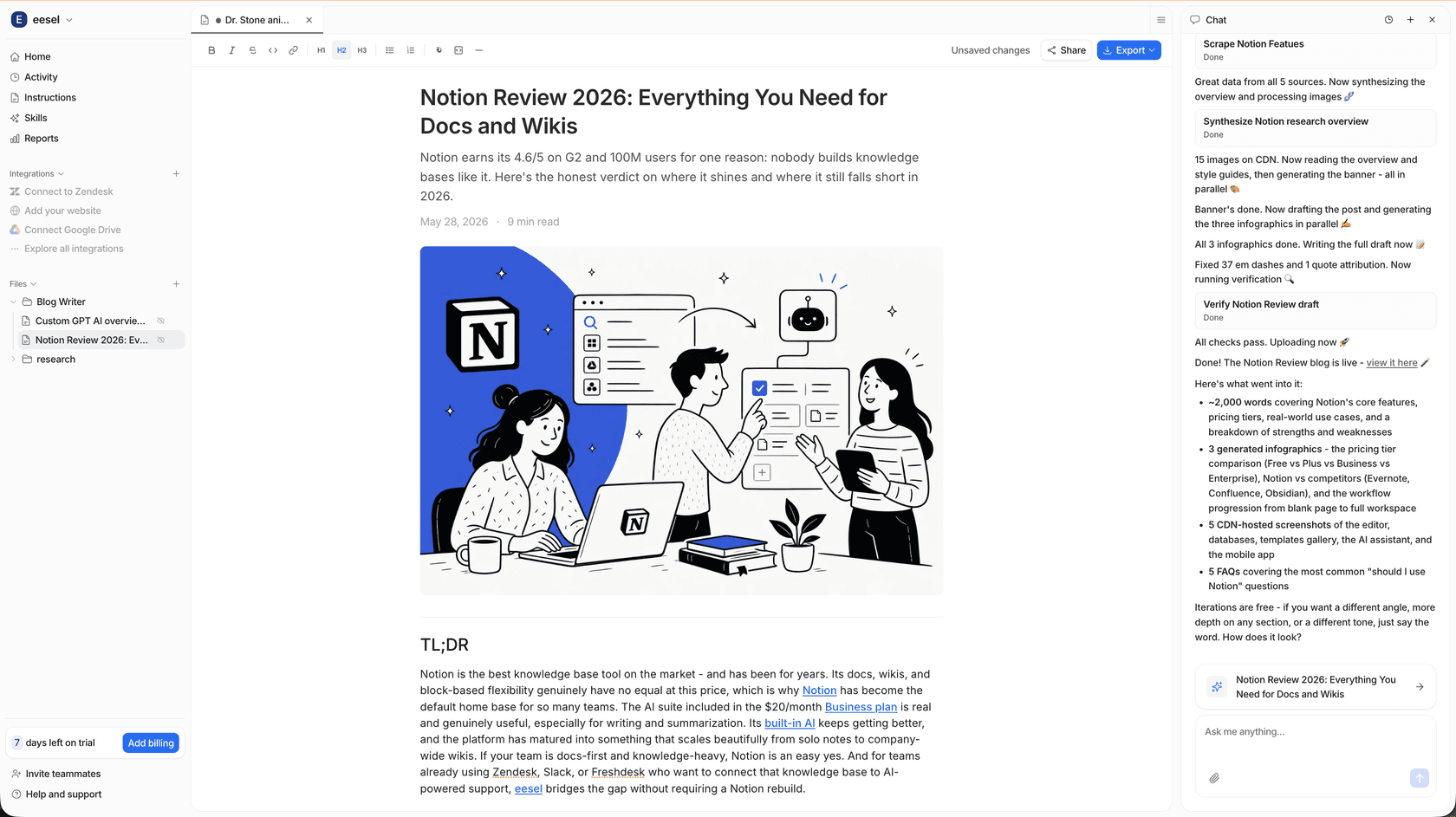
That’s where a focused tool like the eesel AI blog writer comes in. It’s designed to bridge the gap between analysis and simple text generation by creating a complete, media-rich article from a single keyword. It’s not just a text generator; it's a full content creation engine.
Here’s what makes it different:
- Automatic asset generation: It doesn’t just write words. It creates relevant images, infographics, charts, and tables to break up the text and make the content more engaging and easier to read.
- Rich media and social proof: It automatically finds and embeds relevant YouTube videos and pulls real quotes from Reddit discussions. This adds a layer of authenticity and human perspective that most AI-generated content completely misses.
- Optimized for AI answer engines (AEO): The content is structured not just for traditional Google search but also to be easily understood and cited by AI platforms like ChatGPT and Google AI Overviews.
It’s the same tool we used to grow our own site's impressions from 700 to 750,000 per day in three months by publishing over 1,000 optimized blogs.
It's free to try, so you can generate a full blog post and see the quality for yourself.
To see how Semrush's AI and content tools work in practice, especially for tracking visibility in the new AI-driven search landscape, check out this deep dive into the Semrush One platform.
Final thoughts
At the end of the day, the choice between Semrush and SEO.ai is a choice between two different philosophies. Semrush is for the strategist who wants deep, expert-level control and analysis. SEO.ai is for the busy entrepreneur who needs a hands-off, automated way to get a content plan done.
The best tool is the one that solves your most pressing problem. Your decision should come down to your goals, your team's skills, and your budget.
But if your main challenge isn't just analyzing keywords or generating text, but producing high-quality, engaging, and complete blog posts at scale, then a specialized tool might be the answer. A platform like the eesel AI blog writer offers a powerful and efficient solution built specifically for that job.
Frequently Asked Questions

Share this article

Article by
Stevia Putri
Stevia Putri is a marketing generalist at eesel AI, where she helps turn powerful AI tools into stories that resonate. She’s driven by curiosity, clarity, and the human side of technology.