
The 6 best SERP analysis tools for 2026

Last edited February 2, 2026
Targeting keywords is just one piece of the puzzle in today's digital world. To actually land a top spot on Google, you need to understand the entire search engine results page (SERP). That means knowing who is ranking, why they're ranking, and what it’ll take to do better than them. Trying to analyze SERPs manually for every single keyword is a huge time sink and you’ll likely miss important details, like a competitor's domain authority or the appearance of AI Overviews.
You should check out tools like SEMrush or Ahrefs. They can track your website's ranking for specific keywords across different countries automatically. It saves a lot of time compared to doing it manually.

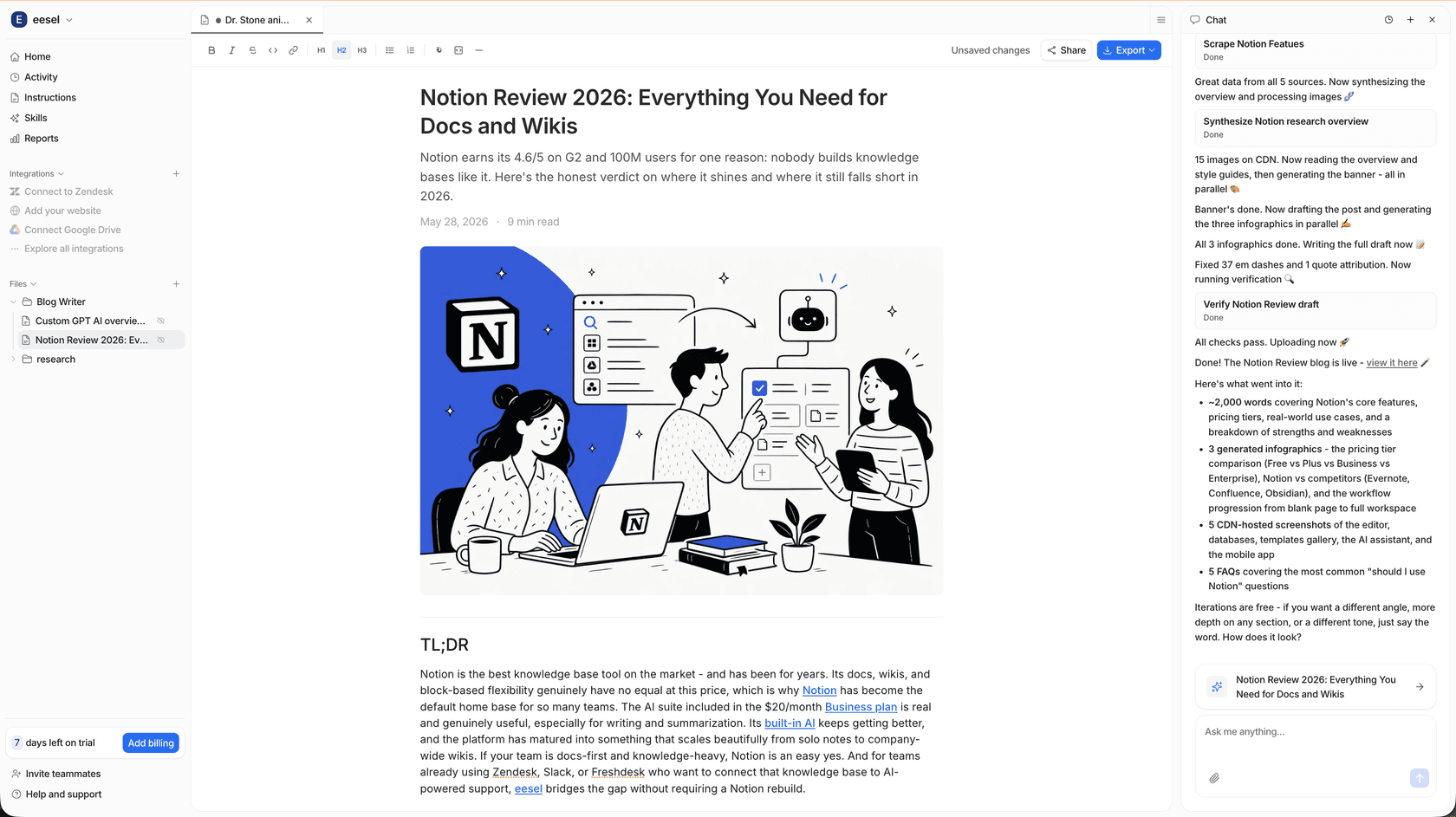
What are SERP analysis tools?
A SERP, or Search Engine Results Page, is simply what Google shows you after you type something in. SERP analysis is the process of looking at the top-ranking results for a keyword to figure out what Google’s algorithm considers relevant and trustworthy. It's less about your own site and more about understanding the competitive environment you're stepping into.
Our criteria for selecting the best SERP analysis tools
To give you a clear and useful list, we picked these tools based on a few key criteria. This ensures that every tool recommended here offers genuine value and can help you build a better SEO strategy.
- Accuracy and Freshness: The online world moves fast, so your data needs to be current. We focused on tools that provide up-to-date or near-real-time SERP data, so your decisions are based on what's happening now, not last month.
- Depth of Metrics: A simple rank tracker doesn't cut it anymore. The best tools dig deeper, offering information on competitor backlinks, domain authority, estimated traffic, and on-page content factors. This gives you a full picture of what it takes to rank.
- User Experience: Powerful data is pointless if you can't make sense of it. We looked for tools with clean interfaces that present complex information in an easy-to-understand and actionable way.
- Value for Money: Whether it's a free tool or a paid subscription, it needs to be worth it. We assessed each tool to make sure its features justify its price, offering real benefits for your business.
A comparison of the top SERP analysis tools
This table gives you a quick overview of the tools we’ll cover, helping you compare them at a glance.
| Tool | Best For | Key Feature | Starting Price |
|---|---|---|---|
| eesel AI SERP Checker | Quick, free analysis and content integration | Seamless connection to an AI blog writer | Free |
| Semrush | All-in-one SEO and AI visibility tracking | AI Visibility Toolkit for tracking brand mentions in AI Overviews | $199/mo |
| Ahrefs | In-depth backlink and authority analysis | Industry-leading backlink database and Domain Rating (DR) metric | $29/mo |
| Mangools SERPChecker | Local SEO and user-friendly interface | Local SERP simulation for over 65,000 locations | $29.90/mo |
| Moz Pro | Authority metrics and SERP feature insights | Proprietary Domain Authority (DA) and Brand Authority scores | $49/mo |
| LowFruits | Finding low-competition keywords | Identifying "weak spots" (low-DA sites) in the SERPs | $29.90/mo |
The 6 best SERP analysis tools to try this year
Here’s a detailed look at the top SERP analysis tools, each with its own strengths, features, and ideal use cases.
1. eesel AI SERP Checker
The eesel AI SERP Checker is a free tool built for quick, practical insights into the top 100 results for any keyword. Its key feature is its integration with the rest of the eesel AI platform. After you analyze the SERP, you can use the eesel AI blog writer to generate a complete, SEO-optimized article designed to outperform the competitors you just researched. This workflow connects analysis and execution, which is useful for content creators.
- Pros: It's completely free, has a simple and clean interface for quick checks, and provides a direct path from competitor analysis to content creation.
- Cons: As a focused, free tool, it doesn't have the extensive historical data, deep backlink profiles, or advanced filtering you'd find in premium platforms like Semrush or Ahrefs.
- Pricing:
- Free to use.
2. Semrush
Semrush is a full-scale digital marketing platform with very powerful SERP analysis features. It does much more than just track ranks. Its specialized toolkits, like the AI Visibility Toolkit, let you see how your brand is mentioned in Google's AI Overviews, which is a big deal in today's search environment. With a database of over 26.4 billion keywords, Semrush offers deep data on everything from organic traffic estimates to keyword difficulty scores, making it a solid choice for marketing teams that need a complete view of the search landscape.
- Pros: It has an incredibly deep feature set, including the ability to track AI visibility in ChatGPT and monitor SERP volatility. Its reporting tools are strong, customizable, and great for agencies or in-house teams.
- Cons: The sheer number of features can be a bit much for beginners. Its starting price is also higher than many other tools on this list, so it's a real investment.
- Pricing:
- Semrush One Starter: Starts at $199 per month ($165.17/mo if billed annually).
- Higher tiers (Pro+ and Advanced) are available with more features and usage limits.
3. Ahrefs
Ahrefs is well-known for its top-tier backlink index, which contains over 43 trillion live backlinks. This massive dataset powers its SERP analysis tools, providing important metrics like Domain Rating (DR) and URL Rating (UR) for every ranking result. A great feature is its SERP position history chart, which shows how rankings for a keyword have changed over time. This gives you a good sense of a SERP's stability and helps you see if the top spots are held by long-time authorities or are always in flux.
- Pros: The backlink data is second to none, giving you an accurate idea of the off-page SEO effort needed to rank. The user interface is clean, and the tool shows estimated organic traffic for each ranking page, which helps you prioritize high-value keywords.
- Cons: While there's a free SERP checker, its functionality is limited. The full suite is a significant investment, and its new credit-based system for certain reports can be a bit confusing to manage.
- Pricing:
- Starter: Starts at $29 per month with limited credits.
- Lite: Starts at $129 per month for more intensive use.
4. Mangools SERPChecker
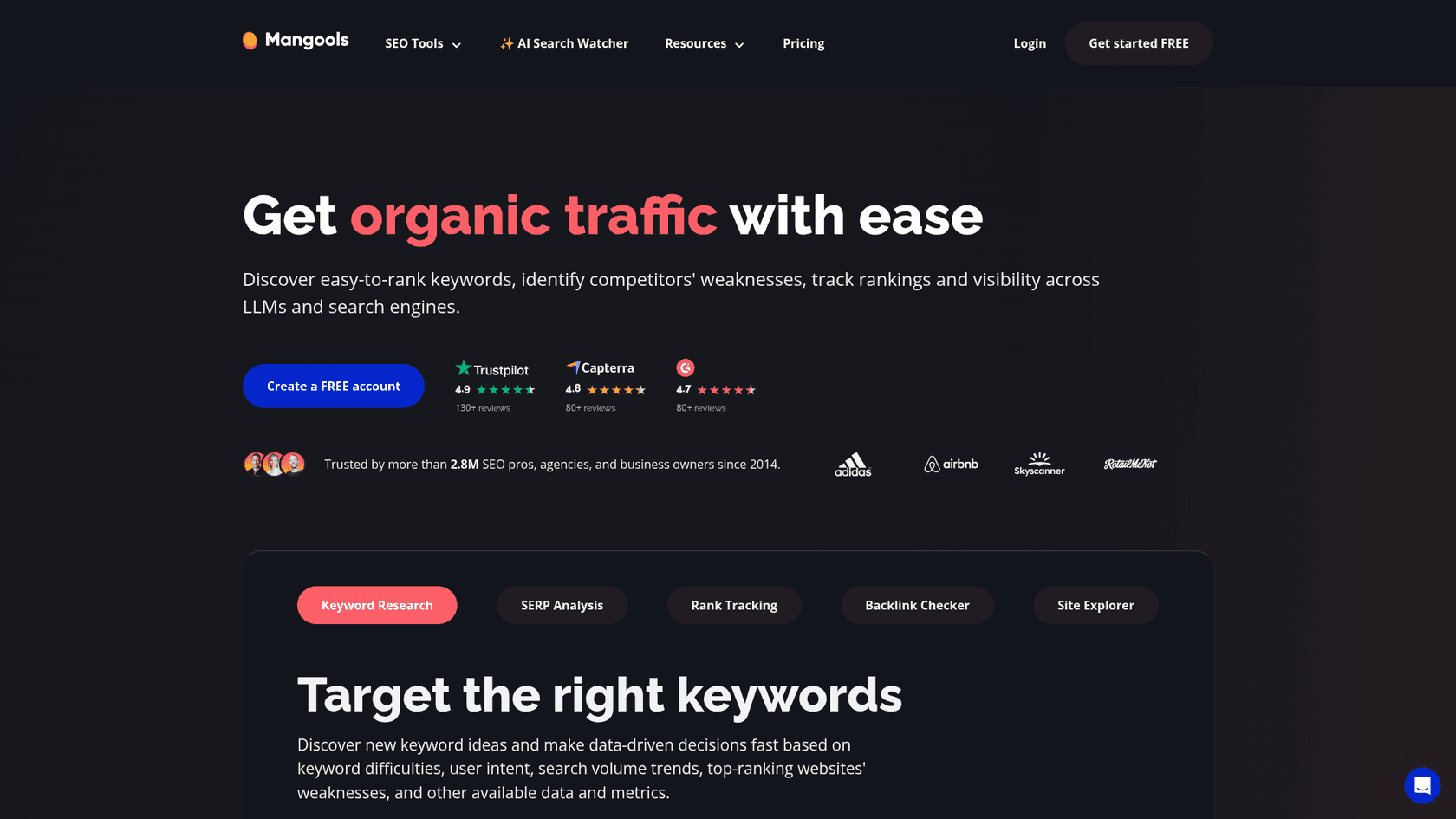
Mangools SERPChecker is made for users who want powerful data without a steep learning curve. It's particularly good at local SEO, letting you check SERPs from over 65,000 locations, including specific cities and districts. This is a huge help for local businesses. The tool pulls metrics from trusted sources like Moz and Majestic to give a complete view of competitor authority and calculates a unique "Performance Index" to score your site's overall SEO health.
- Pros: Very user-friendly with a clean, visual layout of complex data. It offers great value for its price, and its focus on local SERP analysis is a big plus for businesses serving specific geographic areas.
- Cons: It's more of a specialized toolkit than an all-in-one platform. It doesn't have some of the advanced features like in-depth site auditing or content marketing modules that you find in larger suites like Semrush.
- Pricing:
- Basic: $29.90 per month.
- Premium: $44.90 per month.
- Agency: $89.90 per month.
5. Moz Pro
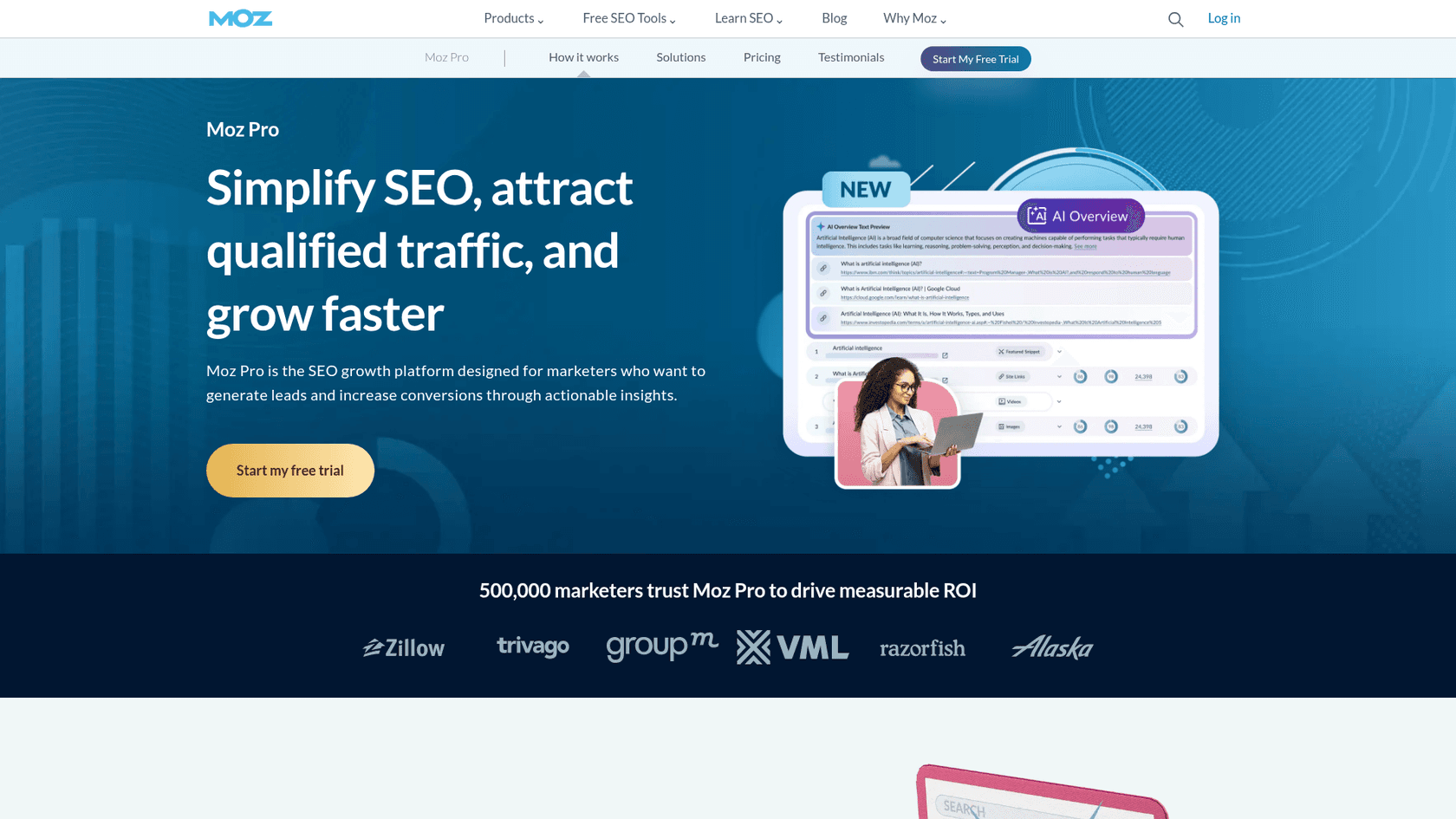
Moz Pro is one of the original SEO tools and remains a trusted name. It’s known for creating its own metrics like Domain Authority (DA) and Page Authority (PA), which are now industry standards for quickly judging a website's strength. More recently, it introduced Brand Authority, a score that measures a brand's true reach and recognition. Its Keyword Explorer tool provides a clear SERP analysis that shows which SERP features (like image packs or "People Also Ask" boxes) are present, and it calculates a "Priority Score" to help you decide which keywords to target first.
- Pros: Moz's authority metrics are widely trusted for quick competitive checks. The platform also offers excellent educational resources through Moz Academy and has a strong, helpful community.
- Cons: Some users feel that Moz's backlink database isn't as large as Ahrefs'. The tool's interface can also feel a bit slow compared to some of its more modern competitors.
- Pricing:
- Starter: Starts at $49 per month.
- Higher tiers (Standard, Medium, and Large) are available.
6. LowFruits
LowFruits has a unique and very practical take on SERP analysis. Instead of focusing on super competitive keywords, its whole purpose is to find "weak spots" in the search results. The tool is designed to help newer or smaller websites find low-competition keywords they can actually rank for. It analyzes the SERPs and automatically highlights results from low-authority domains, like forums or user-generated content sites, flagging these as potential quick wins.
- Pros: Great for finding actionable long-tail keywords and easy ranking opportunities that bigger tools might overlook. The "weak spots" feature is very intuitive, and the platform is affordable and easy for beginners to use.
- Cons: LowFruits is a niche tool. It's not built for analyzing highly competitive keywords or for deep technical SEO audits. Its focus is squarely on finding the path of least resistance.
- Pricing:
- Subscriptions: The Standard plan starts at $29.90 per month.
- Pay-as-you-go credits: Start at $25 for 2,000 credits.
For a more hands-on explanation of how to conduct a SERP analysis and use the data to your advantage, check out the video below. It offers practical tips on how to break down the search results page to uncover ranking opportunities and refine your content strategy.
How to choose the right SERP analysis tools for your needs
With so many solid options, the right choice really comes down to your specific needs, budget, and workflow. Here’s a quick guide to help you decide.
- For quick analysis and content creation: If your main goal is to quickly check the competition for a keyword and then immediately start writing, the free eesel AI SERP Checker is a direct solution. It cuts out the steps between getting an insight and acting on it.
- For solopreneurs and small businesses: If budget is a major factor and you need practical insights without a complicated tool, options like the Ahrefs Starter plan, Mangools, and LowFruits are great places to start. They give you the core data you need without a hefty price tag.
- For marketing teams and agencies: For those managing complex campaigns, a comprehensive suite like Semrush, Ahrefs (Standard plan or higher), or Moz Pro is worth the investment. These platforms provide the deep data, historical tracking, and robust reporting needed for working at scale.
Ultimately, the best tool is the one that fits your process. Think about what you need to do after you've done the analysis. If your goal is to publish content regularly, a workflow that connects insights directly to creation, like the one offered by the eesel AI toolkit, can save you a lot of time and effort.
From analysis to action
Understanding the SERP is a core part of any good SEO strategy in 2026. The tools we've looked at provide the insights you need to compete, whether you're a local business targeting your neighborhood or a global company aiming for the top spot on competitive keywords.
Choosing the right one depends on your budget, goals, and how you work. The most important thing, however, is to move from just gathering data to acting on it. Information alone won't improve your rankings.
Start by analyzing your target keywords with a free tool like the eesel AI SERP Checker. Once you have a clear picture of the competition and the type of content that’s ranking, you can use the eesel AI blog writer to generate a high-quality, SEO-optimized blog post that’s ready to go.
Frequently Asked Questions

Share this article

Article by
Stevia Putri
Stevia Putri is a marketing generalist at eesel AI, where she helps turn powerful AI tools into stories that resonate. She’s driven by curiosity, clarity, and the human side of technology.


