Serval AI pricing in 2026: How the pilot model works


Last edited May 2, 2026
Disclosure: This article is published by eesel AI. eesel is a competitor to Serval. We've described Serval using its own published materials, with sources linked throughout. For Serval's official pricing information, go directly to serval.com/pricing.
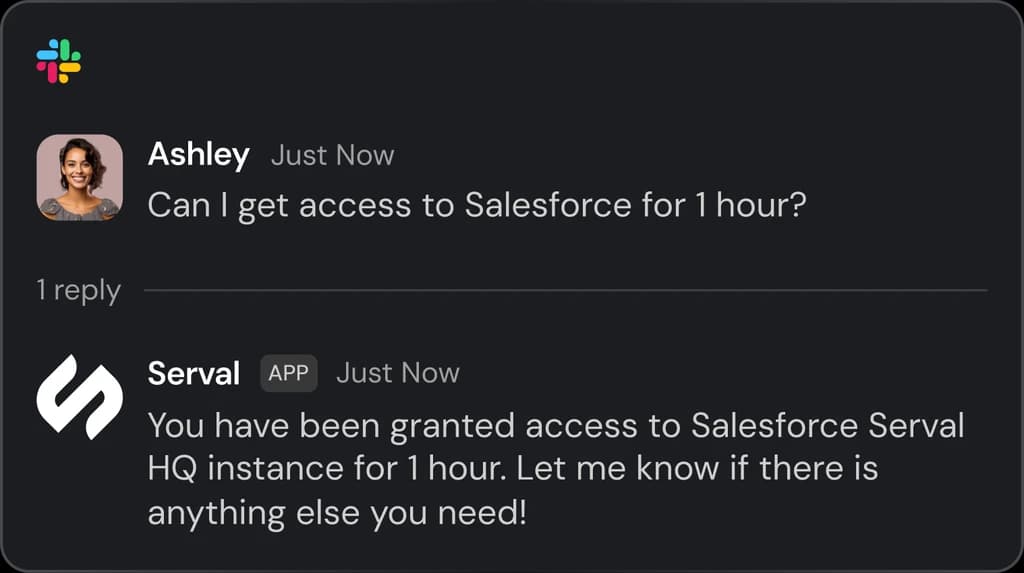
Serval is an AI-native ITSM platform that handles help desk requests, access management, and workflow automation in a single product. If you're evaluating it, one of the first practical questions is what it costs.
The short answer: Serval doesn't publish per-seat or per-ticket pricing. The longer answer is that the pricing page describes a specific engagement model that's worth understanding before you book a call. This article walks through what that model actually is, sourced from Serval's own materials, and what to weigh when comparing it to platforms with public per-interaction pricing.
What Serval's pricing page actually says
Serval's pricing page doesn't list dollar amounts. Instead, it describes a pilot-based engagement built around a guaranteed outcome: customers work with a dedicated deployment engineer through four phases, and Serval guarantees that at least 50% of incoming IT tickets will be automated by the end of the pilot.
The four phases, as listed by Serval:
- Meet. Meet your dedicated deployment engineering team, connect your core integrations, and introduce foundational automations.
- Build. Identify your highest-value automation opportunities and build workflows tailored to your environment.
- Deploy. Trial Serval with end users and iterate on automations based on real usage.
- Optimize. Explore cross-company use cases, audit, and refine your configuration.
Per Serval, the pilot is "rapid onboarding with measurable automation outcomes", with the deployment engineer providing hands-on technical support throughout.
The 50% automation guarantee is the part of this model that's most worth understanding. It's not a generic "we'll work hard for you" promise; it's a measurable commitment that at least half your incoming IT tickets will be resolved by the AI by the end of the pilot. That gives you a binary success/failure check at the end, and gives Serval skin in the game on actually delivering value during the engagement. For a category where many AI vendors promise the moon and hand you a sandbox, this is a real piece of risk-sharing.
What this guarantee depends on (reasonable inferences from the pilot structure, not Serval's own claims):
- The pilot needs enough ticket volume and variety to measure against. A team with 20 tickets a month probably can't measure 50% in a meaningful way.
- The integrations need to cover the systems where the work actually happens (your help desk, identity provider, the SaaS apps that show up in tickets). Without those, the AI can read questions but can't take actions.
- Knowledge sources need to be accessible. If most answers live in tribal knowledge or scattered Slack threads, the AI has less to work with.
What's included
The pricing page lists the product capabilities included in the engagement:
- ITSM: AI-native ticket resolution, a unified workspace for AI-handled and escalated issues, view and sort and filter tickets, bi-directional sync with third-party ticketing systems, Copilot for escalated tickets, advanced analytics.
- Access management: Customizable policies, just-in-time provisioning with automated deprovisioning, multi-approver workflows, manual and SCIM provisioning, custom provisioning workflows.
- Help desk: Conversational AI-native chat, knowledge base Q&A, complex request automation.
- Workflows: Natural language workflow building, code-editable workflows, real-time progress visualization, deterministic multi-step workflows.
- Integrations: 30+ native integrations and full API access.
How to think about the model
Serval's pilot model is a deliberate commercial choice and it has real tradeoffs.
On the upside: you get a real engineer working through your environment, an explicit success criterion (50% automation), and a structured process. For a complex IT environment, that hand-holding can be valuable. The 50% guarantee is a meaningful commitment and a way to share risk between vendor and customer.
On the downside: you can't sign up self-serve, and you can't read a price off a webpage. If your evaluation process prefers to compare tools by spinning up trials and comparing public price tiers, the pilot model adds a layer of sales conversation upfront. Whether that's a friction or a feature depends on your team and your buying style.
We're not going to speculate about specific dollar figures, contract length, or whether there are setup fees. Serval doesn't publish that information, and the pricing page is the source of truth. If those details matter for your decision, ask Serval directly.
How public task-based pricing compares
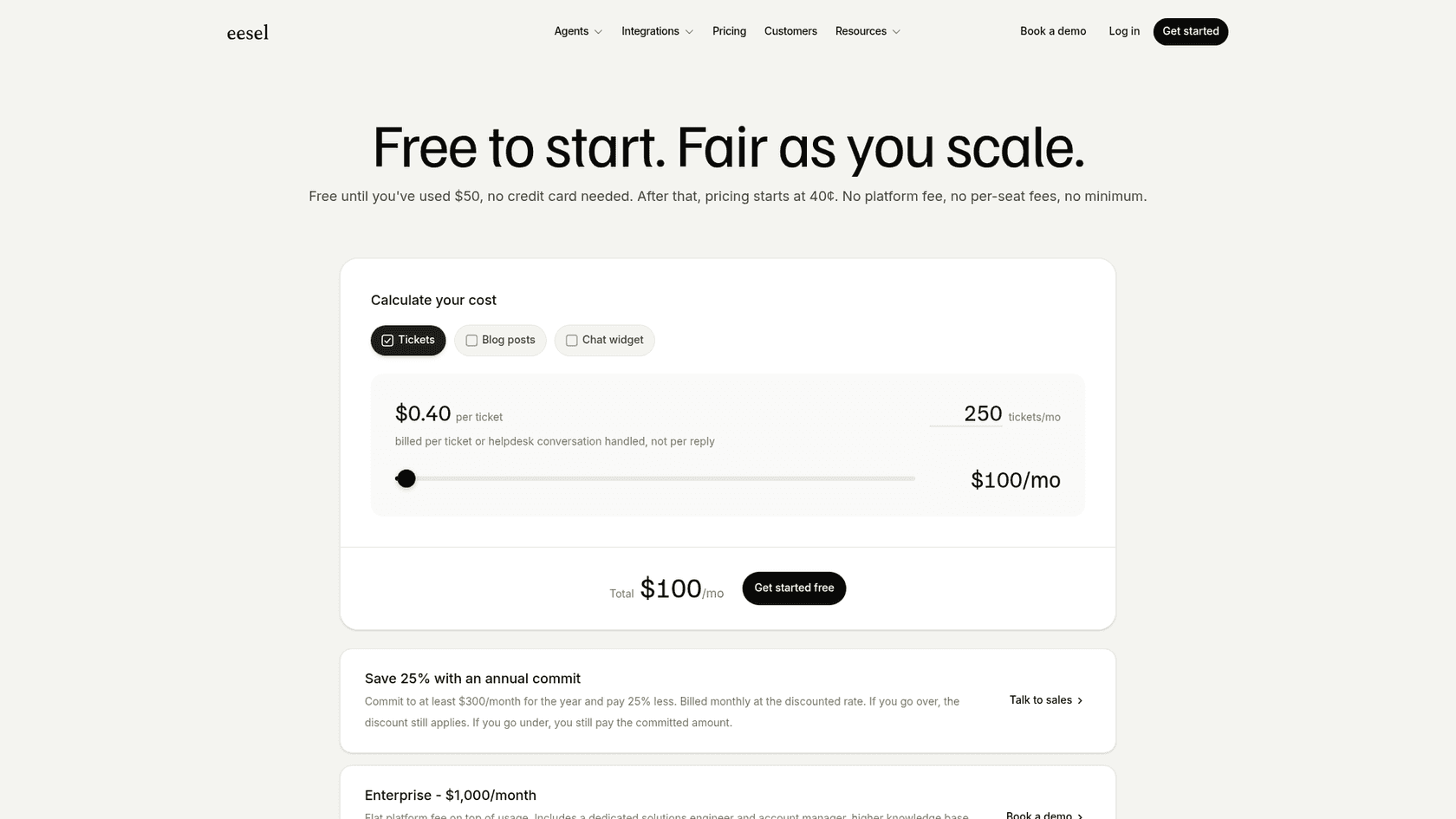
eesel AI takes a different approach. Pricing is public, billing is task-based (you pay only for completed work), and you can sign up without a sales call.
| Task type | Examples | Price |
|---|---|---|
| Light | Internal lookups, dashboard questions, knowledge searches | Free |
| Regular | Resolved or drafted support tickets, chat sessions | $0.40 per task |
| Heavy | Blog post generation, complex research | $4.00 per task |
You start with $50 in free credits, no credit card required. Annual plans save 25% (minimum $300/mo). Enterprise is a flat $1,000/mo and includes SSO, HIPAA option, a dedicated solutions engineer, and unlimited agents. A default $250/mo cap with alerts at 50%, 75%, and 100% means no overage surprises. Full breakdown on eesel.ai/pricing.
Example monthly costs on eesel AI
If you're trying to model what eesel would cost at different ticket volumes, here are concrete numbers:
| Tickets resolved or drafted per month | Monthly cost | Annual cost (no discount) | Annual cost (25% annual discount) |
|---|---|---|---|
| 100 | $40 | $480 | $360 |
| 500 | $200 | $2,400 | $1,800 |
| 1,000 | $400 | $4,800 | $3,600 |
| 2,500 | $1,000 | $12,000 | $9,000 |
| 5,000 | $2,000 | $24,000 | $18,000 |
These numbers assume every ticket counts as a regular task ($0.40). In practice, many internal lookups (e.g. "where's the expense policy?") count as light tasks and are free, so the real cost typically runs lower than the table suggests.
Serval's pilot pricing isn't published, so we can't give you a like-for-like comparison. The right move if you're seriously evaluating both is to ask Serval for a quote at your specific ticket volume and compare against the table above.
A side-by-side. Serval details below come from Serval's pricing page; eesel details from eesel.ai/pricing.
| Aspect | Serval | eesel AI |
|---|---|---|
| Public pricing | Not published; pilot-based engagement | Yes, public task-based pricing |
| Sign-up | Pilot engagement; contact sales | Self-serve sign-up |
| Pricing model | Pilot-based with guaranteed automation outcome | Pay per completed task; light tasks free |
| Free credit / trial | Not described on the pricing page | $50 in free credits, no card required |
| Deployment support | Dedicated deployment engineer | Self-serve setup; dedicated solutions engineer on Enterprise |
Which model fits depends on what you're optimising for. If you want a guided rollout with a measurable outcome and you're comfortable with a sales engagement, Serval's model is built for that. If you want predictable, transparent pricing you can stand up yourself, public per-interaction pricing fits better.
Things to clarify with Serval before signing
If you're going down the Serval path, the following are reasonable questions to bring to a sales conversation. We're not implying Serval handles any of these in a particular way, just listing what tends to matter in enterprise software contracts so you can ask:
- Pricing structure. Per-seat, per-ticket, platform fee, all of the above? How does cost scale as your team or your ticket volume grows?
- Contract length. What's the minimum commitment? What's the renewal structure? Is there a path to month-to-month after the initial term?
- Pilot success / failure. What happens after the pilot if the 50% automation outcome is met? What happens if it isn't? Is there a money-back or extended-pilot clause?
- Deployment engineer engagement. Is the engineer part of the contract through the pilot only, or ongoing? What does that resource cost, and how is it billed?
- Integration scope. Which integrations are in scope at signing? What does adding a new integration later cost or require?
- Data export and termination. If you decide to leave, what data do you get back, and in what format? How long do you have to migrate?
- Workflow ownership. Per Serval's docs workflows can live in Git. Is your repo, with all the workflow code, contractually yours? What happens to it on termination?
- Compliance. SOC 2, ISO 27001, HIPAA, FedRAMP. What certifications does Serval hold, and which are in scope under your contract?
These are the kinds of details that aren't on a public pricing page anywhere in enterprise software, and they're the right questions for the sales call rather than a blog post.
Cost beyond the line item
A few costs that don't show up on either Serval's or eesel's pricing pages but matter in the total cost of ownership:
- Internal time during evaluation. A guided pilot with a deployment engineer is faster than a lonely self-serve trial in some ways and slower in others. The pilot has structure but also takes scheduled meetings, integration work, and testing. Self-serve evaluation is more flexible but requires you to figure things out yourself.
- Implementation work that's not the AI. Whichever tool you pick, you'll need to clean up your knowledge sources, decide which workflows you actually want, and probably retire some old half-broken automations. This work is the same shape regardless of vendor.
- Maintenance. Workflows drift. Integrations break when an upstream API changes. Knowledge gets stale. Whoever owns automation in your org will spend ongoing time keeping things running, more than vendor demos suggest.
- Switching costs. If you pick wrong, what does it take to switch? Public-pricing self-serve tools are easier to walk away from. Pilot-based platforms with multi-month contracts are harder.
None of these are reasons to not adopt AI; they're just the realistic backdrop to whichever vendor you pick.
Wrapping up
Serval's pricing model is intentional and matches its product positioning: a guided, outcome-based engagement for teams that want a unified AI-native ITSM with a deployment engineer alongside them. The pricing page is the source of truth for the model.
If you'd rather evaluate without a sales call, public task-based pricing is the alternative shape. eesel AI is set up that way: public pricing, self-serve sign-up, and a simulation mode you can run on your past tickets to see expected impact before you decide.
Start a free trial of eesel AI if that fits how you buy.
Frequently asked questions

Share this article

Article by
Amogh Sarda
CEO of eesel AI. Amogh Sarda is obsessed with making the ultimate AI for customer service teams. He lives in Sydney, Australia and has previously worked at Atlassian and Intercom. Outside of work he’s usually surfing or on stage doing improv.