Skild AI review (2025): A look at the general-purpose robot brain


Last edited November 6, 2025
You've probably seen the headlines about Skild AI. It's hard to miss, with a massive $300 million Series A funding round and a goal to create a single "brain" for every robot on Earth. The videos of robots walking, working, and doing parkour are definitely cool.
But let's cut through the hype. What is Skild AI really doing? And, more to the point, what does it mean for a business trying to solve problems today?
This Skild AI review will break down the tech, its potential uses, and the real-world hurdles of physical AI. We’ll also look at a different path for businesses that need automation now, not a decade from now.
What is Skild AI?
First things first, let's clear up some confusion. If you search for Skild AI, you might get a little turned around.
The company we're talking about is a robotics and AI startup founded in 2023. Their whole mission is to build one AI foundation model that can run any robot doing any physical task. They've dubbed it "Physical AI", an "omni-bodied brain" meant to take AI out of our screens and into the real world. They're trying to solve something called Moravec's paradox, which is a fancy way of saying that things humans find easy (like walking up stairs) are ridiculously hard for robots.
And just so we're clear, this Skild AI has nothing to do with Skild.com, which is a totally different company that runs "innovation challenges." Same name, different game.
The core technology behind Skild AI
With a $1.5 billion valuation, Skild AI is clearly doing something interesting. Let's peek under the hood at how their universal robot brain is supposed to work.
One brain for any robot body
Skild's big idea is to stop reinventing the wheel. Instead of creating custom software for a four-legged robot and a totally different program for a humanoid one, they’re building one brain that works for all of them.
The AI learns general principles of movement and interaction that it can apply to different "bodies." This means deploying a new robot could become way faster and easier, since you wouldn't have to code its intelligence from the ground up every single time.
How they teach the AI
So how do you teach a robot brain about the real world without spending millions of hours on physical trial and error?
Skild gets around this problem by using a mix of computer simulations and a huge library of human videos from the internet. This lets the AI learn the basics of physics, balance, and how objects move before it ever powers on a physical robot. Think of it like learning to drive in a simulator before getting into a real car. That simulated knowledge is then polished up with smaller, more specific real-world practice.
What the robots can actually do
This training approach has led to some pretty impressive demos. The robots aren't just following a script; they're showing a genuine understanding of their environment.
-
Walking and balancing: Their bots can walk through messy rooms, climb stairs, and stay upright even when pushed or on slippery ground.
-
Using hands: The AI can control hands and arms to grab, move, and handle objects, which could be useful for packing or assembly line work.
-
Adapting to new things: This is the most interesting part. The robots have shown they can figure out how to do tasks they weren't specifically trained for. It's a sign of real problem-solving, not just programming.
Skild AI use cases and applications
With these skills, Skild AI is aiming for industries that are struggling with safety, efficiency, and major labor shortages.
Manufacturing and logistics
The first and most obvious place for these robots is in factories and warehouses. Imagine robots that can pack boxes, sort products, or haul materials around a plant on their own. With experts predicting 2.1 million empty manufacturing jobs by 2030, this isn't just about being more efficient, it's about finding a way to get the work done.
Security and inspection
Another area is using robots to patrol big facilities, construction sites, or places too dangerous for people. These machines can do routine check-ups and collect data 24/7, which frees up human workers for more important tasks and keeps them out of harm's way.
Dangerous jobs in construction
Construction sites are chaotic, unpredictable, and often hazardous. Skild AI wants to put robots in these environments to take over repetitive or risky jobs, making the whole site safer and more productive.
The practical challenges of physical AI
The vision for Skild AI is amazing. But if you’re a business looking for solutions now, you need to be realistic about the hurdles that come with hardware-based AI.
The robots themselves cost a fortune
Here’s the thing: the AI brain is just software. To do anything, it needs a body. And those bodies, the actual robots, are incredibly expensive.
We’re talking a massive upfront investment in hardware, not to mention ongoing costs for maintenance, repairs, and the time they'll inevitably spend out of commission. A smart brain is useless if its body is broken. For most companies, that price tag alone makes physical AI a non-starter.
You can't just "try it out"
You won't find a "Pricing" tab on the Skild AI website, and that tells you a lot. This isn't a tool you can sign up for and test drive. Getting started means going through a long, complicated enterprise sales process with custom contracts and a team of consultants to get it all running.
There's no free trial or self-serve option, which makes it nearly impossible to figure out the real cost or even see if it’s a good fit for your business without a huge commitment.
Getting your money's worth takes years
Putting a physical robot on your factory floor isn't like installing new software. It's a complete overhaul of your operations. You need new safety rules, changes to your building's layout, and people with specialized skills to manage the hardware. The return on an investment this big is measured in years, not months, and the whole project is loaded with risk.
Automating the digital world: A practical alternative
So, while Skild AI works on automating the physical world, most businesses are drowning in a different kind of repetitive work, the digital kind. Think about all the time wasted on answering the same customer questions, sorting through support tickets, and digging through documents.
This is a problem that can be solved right now with a software-based approach to AI.
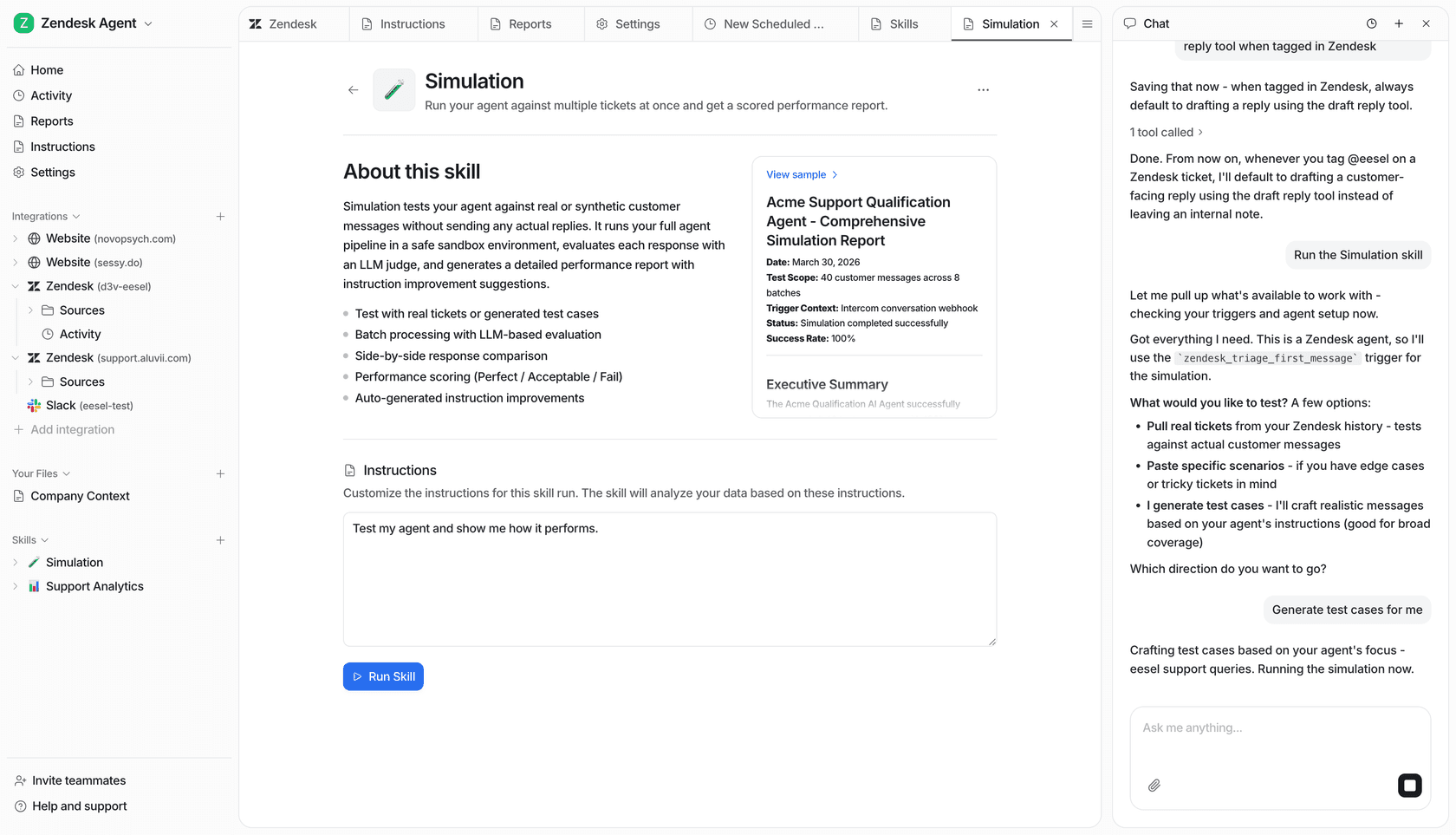
Instead of needing a robot, AI platforms like eesel AI connect directly to the tools you already use, like Zendesk, Slack, and Confluence. It doesn't automate an assembly line; it automates your customer support by answering tickets and finding information for your team instantly.
The difference is night and day. With eesel AI, you can be up and running in minutes, not months, because it’s completely self-serve. There's no hardware to buy, just simple integrations with your current software. Best of all, you can test it out risk-free in a simulation mode to see exactly how it will perform on your real customer tickets before it ever goes live.
Let's put them side-by-side:
| Feature | Skild AI (Physical AI) | eesel AI (Digital AI) |
|---|---|---|
| Primary Use Case | Automating physical tasks (e.g., assembly, inspection) | Automating digital workflows (e.g., customer support tickets) |
| Setup Time | Months to years, requires hardware integration | Minutes, fully self-serve software setup |
| Cost Model | Opaque, high capex enterprise contracts | Transparent, predictable monthly/annual plans |
| Accessibility | Limited to large enterprises with robotics teams | Accessible to any business, from startups to enterprise |
| ROI Timeline | Long-term (Years) | Short-term (Weeks to Months) |
The future of Skild AI vs. today's business needs
Don't get us wrong, what Skild AI is doing is incredible. It’s a fascinating glimpse into the future of general-purpose robots, and they have the cash and the brainpower to make a real run at it.
But for the vast majority of businesses, that future is still a long way off. The challenges of cost, complexity, and the sheer hassle of hardware make physical AI impractical for solving today's problems.
Automate your support with an AI you can control
While we wait for the robot revolution, you can solve your digital grunt work today. A software-first approach gives you results right away by cutting down on support tickets and freeing up your team.
See how eesel AI can plug into your helpdesk and start working in minutes. You can try it for free or book a demo to see it in action.
Frequently asked questions

Share this article

Article by
Stevia Putri
Stevia Putri is a marketing generalist at eesel AI, where she helps turn powerful AI tools into stories that resonate. She’s driven by curiosity, clarity, and the human side of technology.