What is machine learning in simple words? A practical guide

Last edited September 25, 2025
Table of Contents
- Defining what is machine learning in simple words (and how is it different from AI?)
- How it works: a 5-step process for what is machine learning in simple words
- The main types explained: part of what is machine learning in simple words
- Putting it to work: what is machine learning in simple words for customer service
- What is machine learning in simple words and why it's ready for you
Is your support team answering the same questions over and over? Do you feel like you're sitting on a mountain of customer feedback but have no idea what to do with it? It’s a common problem, and it often feels like you’d need a team of data scientists to even begin to fix it.
But the solution might be closer than you think. Machine learning (ML) isn't just a buzzword for tech giants anymore. It's a real tool that can solve these exact problems, and you don’t need a fancy degree to understand how it works. This guide will break down "what is machine learning in simple words?" and show you how your business, especially your support team, can actually start using it.
Defining what is machine learning in simple words (and how is it different from AI?)
At its heart, machine learning is about teaching computers to find patterns in data so they can make decisions or predictions on their own. The key is that they learn without you having to write code for every single possibility.
Think about teaching a toddler to spot a cat. You wouldn't give them a list of rules like "a cat has pointy ears, whiskers, four legs, and a tail." You'd just show them lots of pictures of different cats. A fluffy one, a sleek one, a grumpy-looking one. Eventually, their brain just gets the pattern of "cat." Machine learning is basically the same idea: you feed a computer a ton of examples, and it figures out the patterns for itself.
Now, where does artificial intelligence (AI) fit into all this? It can get a bit confusing, but the relationship is pretty simple.
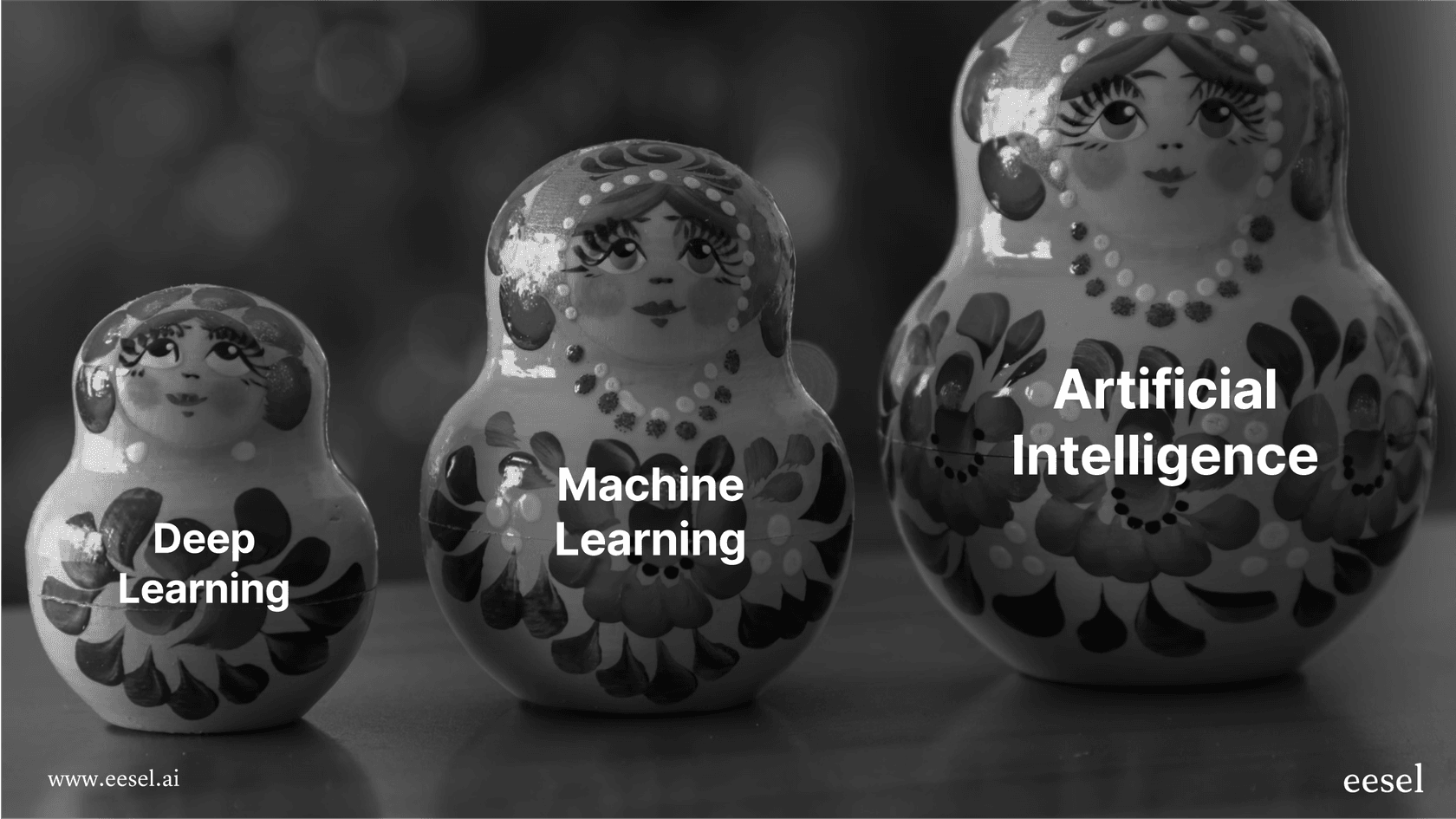
- Artificial Intelligence (AI): This is the big, umbrella term for creating machines that can think or act in a way we consider "smart." It's the whole universe of intelligent technology.
- Machine Learning (ML): This is a type of AI, and it’s the most common way we create smart systems today. Instead of programming a computer with a rigid set of rules, you let it learn from data. ML is the engine that runs most of the AI you interact with every day.
- Deep Learning: This is a more advanced subset of machine learning that uses complex structures called "neural networks," which are loosely modeled after the human brain. Deep learning is great for really complex stuff like image recognition or understanding speech, but it needs a staggering amount of data to work.
A good way to visualize it is with a set of nesting dolls. AI is the biggest doll. You open it up, and inside you find machine learning. Open that one, and you’ll find deep learning.
How it works: a 5-step process for what is machine learning in simple words
While the math behind it can get intense, the general process for making machine learning do something useful is pretty logical. Let's walk through it by imagining we're building an AI agent to help with customer support.
- Data Collection: First, you need data. A whole lot of it. For a support agent, you’d gather thousands of past customer support tickets, all of your help center articles, and any internal playbooks your team uses. This is the textbook the machine is going to study.
- Data Preparation: Raw data is almost always messy. This step is about cleaning it up so the machine can make sense of it. You’d get rid of duplicate tickets, fix typos, and organize everything into a consistent format. It’s like tidying up a library before letting someone in to read the books.
- Model Training: This is where the learning actually happens. You feed all that clean data into a machine learning algorithm. The algorithm churns through the examples and starts connecting the dots. For our support agent, it learns which words and phrases in a customer's question tend to lead to a specific answer from the knowledge base. It's discovering the hidden patterns between problems and solutions.
- Evaluation: Just because the model has studied old data doesn't mean it's ready for the real world. Now, you test it with a separate set of tickets it has never seen before. This is to check its accuracy and make sure it didn't just "memorize" the answers. The goal is to see if it can correctly handle brand-new questions.
- Deployment & Monitoring: Once the model proves it's reliable, you put it to work in a live environment, like your helpdesk, where it can start helping real customers. The job isn't over, though. You have to keep an eye on its performance, see where it's struggling, and periodically update it to make it even smarter.
The main types explained: part of what is machine learning in simple words
Not all machine learning works the same way. Depending on the problem you have and the data you’re working with, you’ll likely use one of three main approaches.
Supervised learning: learning with an answer key
This is the most common type of machine learning you’ll see in business. The algorithm learns from data that has already been "labeled" with the correct answers.
- Example: You train a model using thousands of old support tickets, each one manually tagged with a category like "Billing Issue," "Password Reset," or "Product Defect." After seeing enough labeled examples, the model learns to automatically categorize new, incoming tickets all by itself.
This is pretty much how tools like eesel AI get so smart. By analyzing your resolved conversations from helpdesks like Zendesk or Freshdesk, it understands the kinds of problems your customers have and the solutions that actually work for them. That's how it can give accurate answers that a generic model could only dream of.
Unsupervised learning: finding patterns on its own
In this case, the algorithm gets a big pile of data with no labels. Its job is to dive in and find its own patterns, structures, or groups without any human nudging.
- Example: A retail company could use unsupervised learning to sift through customer purchase histories. The algorithm might find its own groupings, creating customer segments like "frequent bargain hunters," "high-value weekend shoppers," or "one-time gift buyers," all without being told what to look for.
Reinforcement learning: learning from trial and error
This type of learning is all about an "agent" taking actions in an environment to achieve a goal. It gets rewards for good moves and penalties for bad ones, and over time, it learns the best strategy to maximize its reward.
- Example: This is famously how AI is trained to play chess. The agent makes a move (an action) and gets a positive reward if it improves its position or a negative penalty if it makes things worse. After playing millions of games against itself, it learns the best strategies to win.
| Type | How it learns | Common Use Case | Example |
|---|---|---|---|
| Supervised Learning | From labeled data (with answers) | Classification & Prediction | Spam email filtering, AI support agents |
| Unsupervised Learning | Finds patterns in unlabeled data | Clustering & Segmentation | Customer segmentation, anomaly detection |
| Reinforcement Learning | Trial and error (rewards/penalties) | Real-time decision making | Game playing, robotics |
Putting it to work: what is machine learning in simple words for customer service
Understanding the concepts is one thing, but actually using machine learning for your business is another. For a long time, building a custom ML model for something like customer support was a huge project.
The old way was a headache:
- You needed massive, perfectly clean datasets and a team of expensive data scientists.
- The whole process could take months, if not years, just to get a working prototype.
- The solutions that came out of it were often generic and couldn't grasp a company's unique voice or specific customer problems.
- Worst of all, you often had to throw out your existing tools and force your team to learn a whole new system.
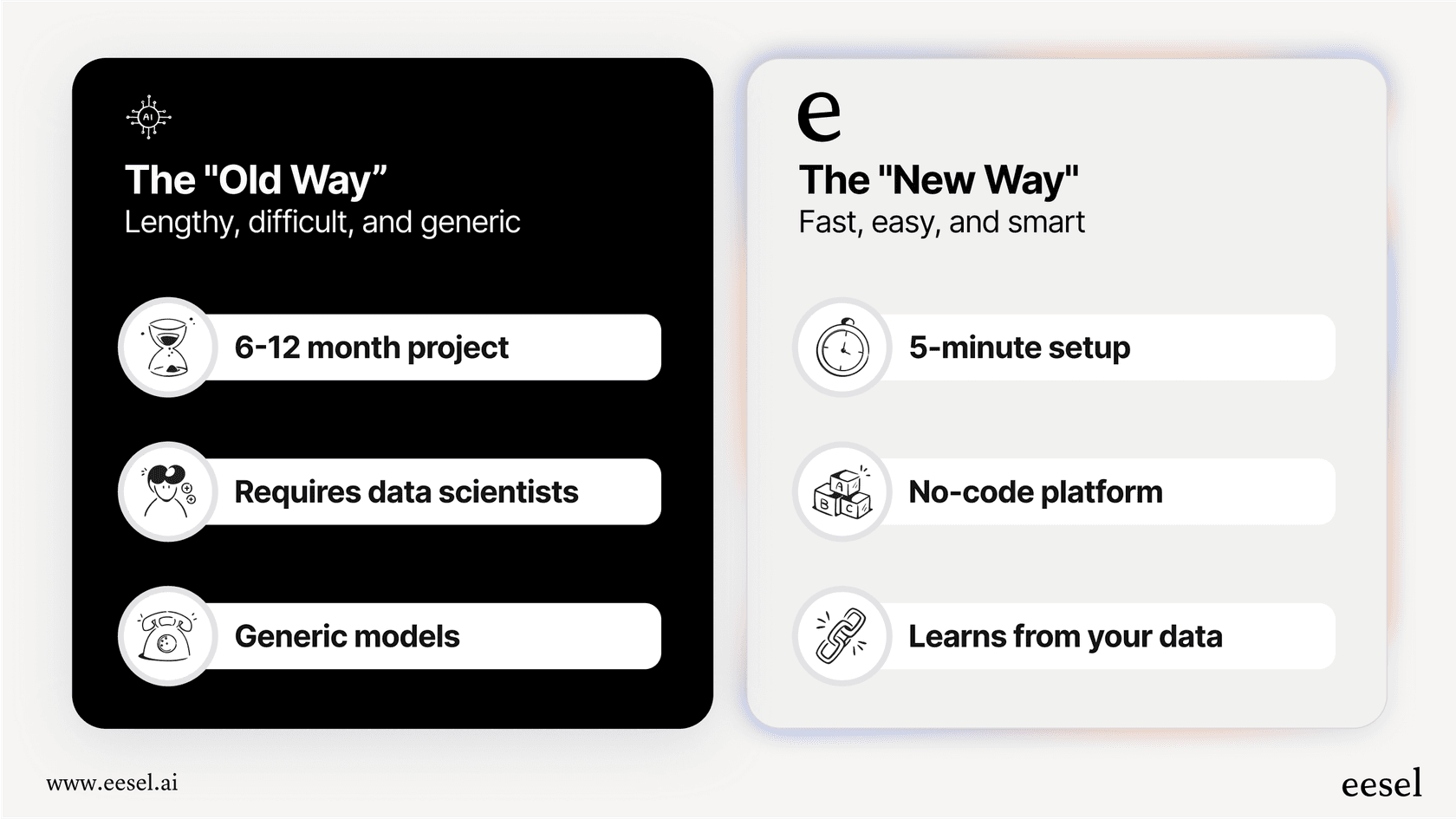
Luckily, things have changed. Modern tools have made powerful, custom machine learning something anyone can use. For example, a tool like eesel AI was built to sidestep all those old problems.
Get up and running in minutes
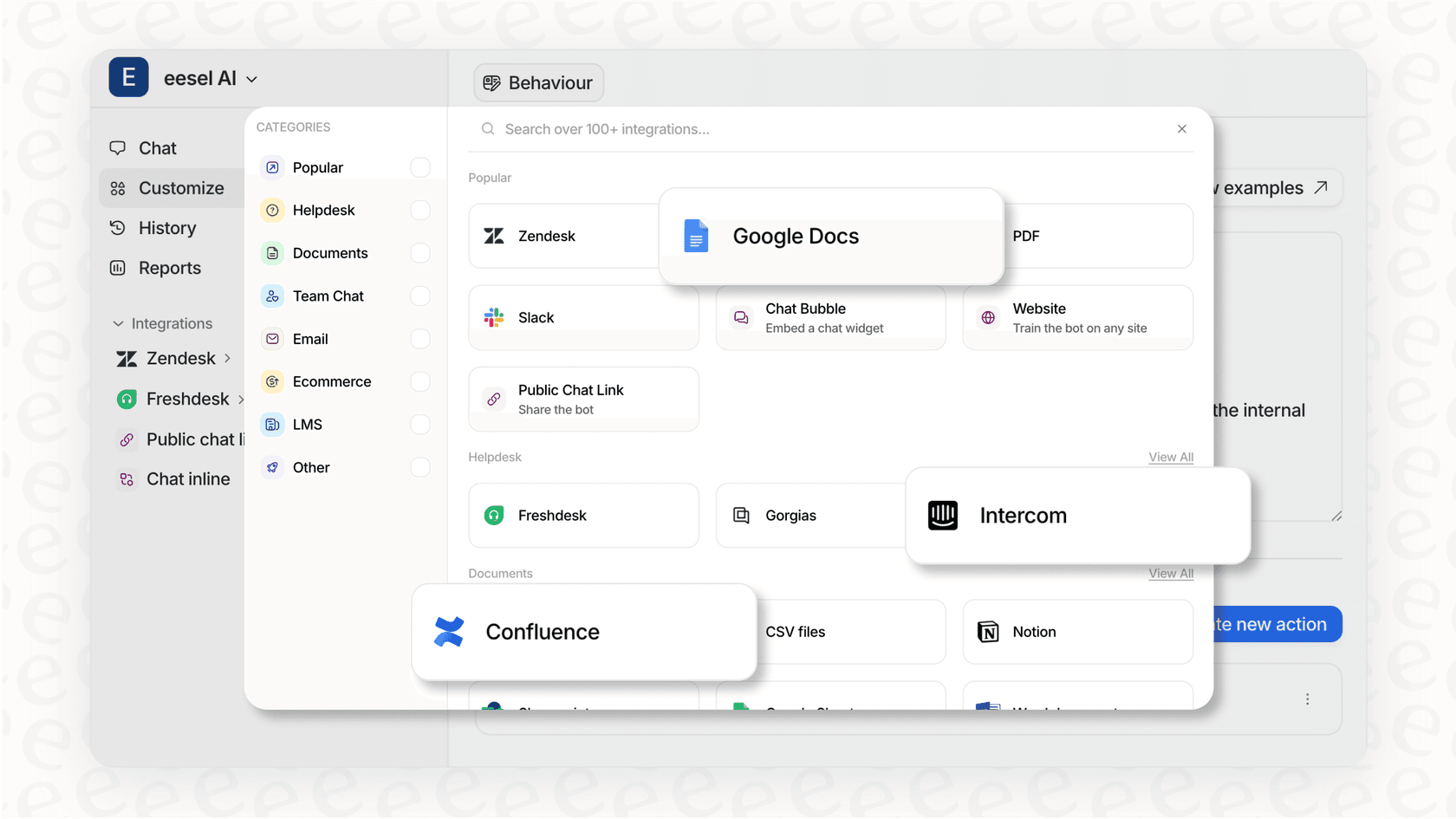
You don't need to book demos, sit through long sales calls, or wait for a developer to have time for you. With eesel AI, you can build and launch a fully functional AI agent on your own. It has one-click integrations for helpdesks like Zendesk, Freshdesk, and Intercom, so you can have an AI assistant working inside the tools you already use in just a few minutes.
Get answers based on your actual knowledge
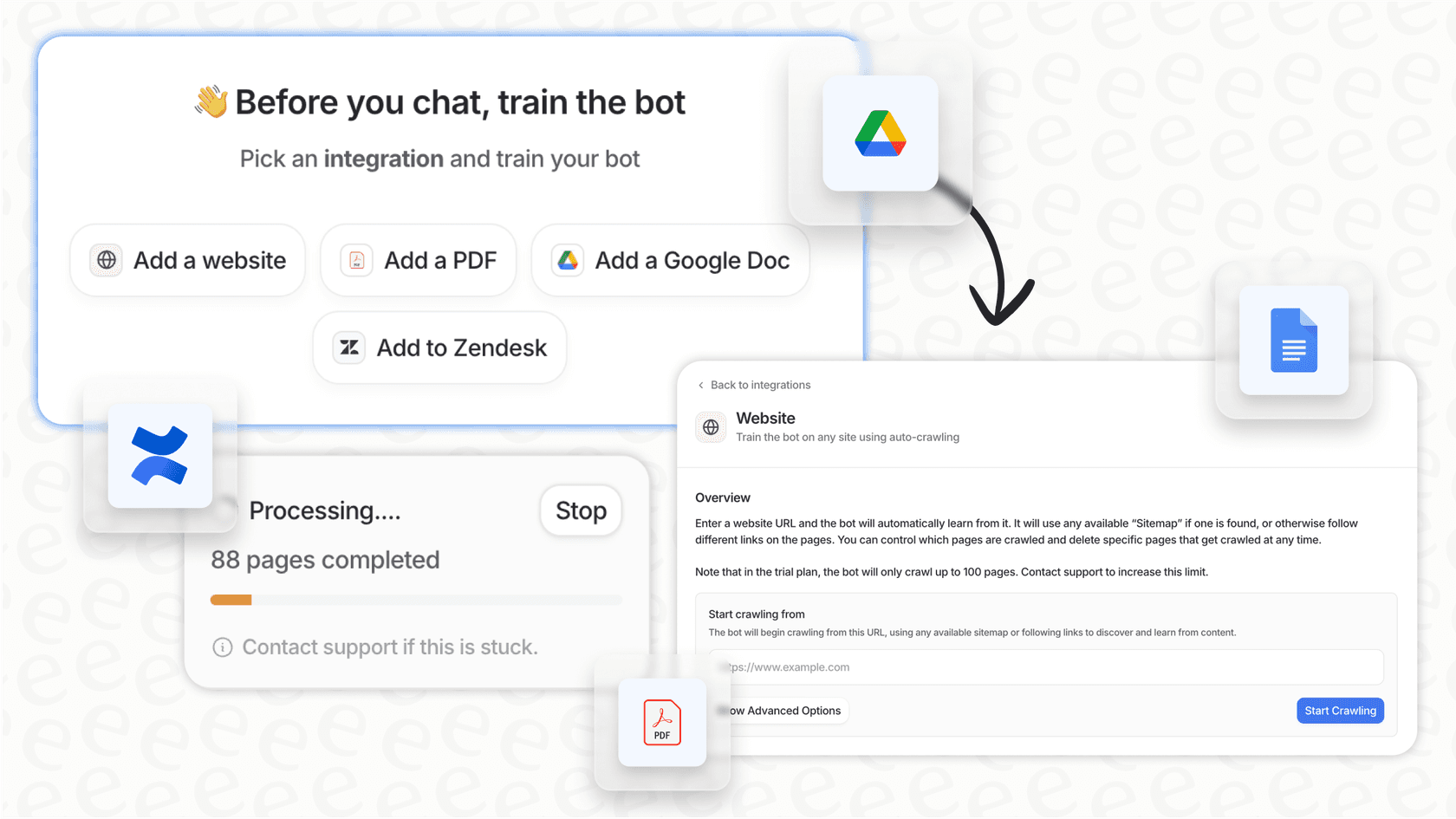
The biggest reason generic chatbots fail is that they don't know your business. They spit out vague, unhelpful answers because they haven’t learned from your specific company knowledge.
eesel AI works differently. It instantly learns from your most valuable resource: your past customer conversations. It also connects to all the other places your knowledge is stored, whether that’s in Confluence, Google Docs, or Notion. This means the AI gives answers that are not only correct but also match your brand’s tone and voice.
Test it out before anyone else sees it
The thought of letting a buggy AI loose on your customers is terrifying. What if it gives the wrong answer and makes someone angry?
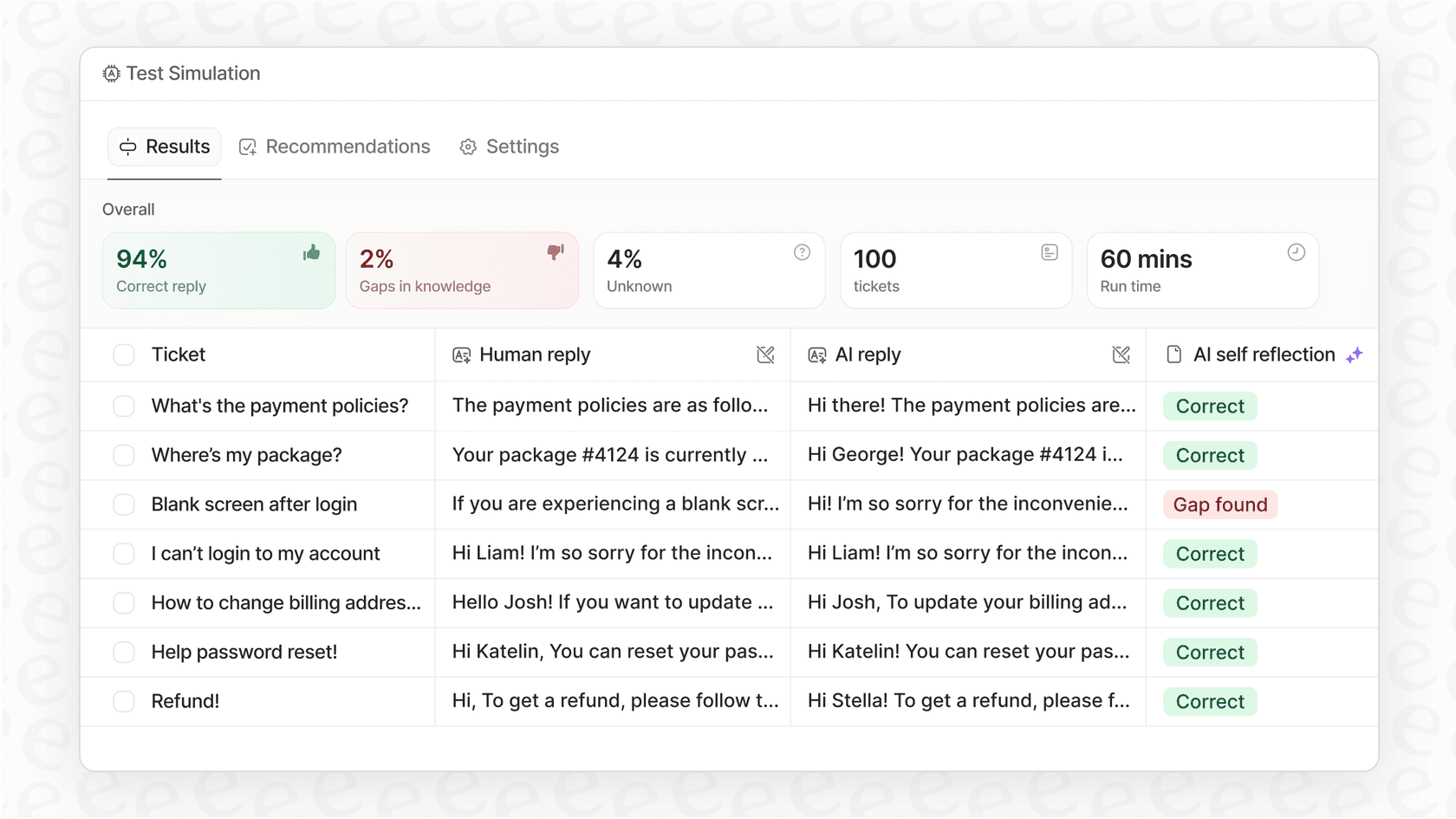
That’s why eesel AI's simulation mode is so helpful. Before your AI agent talks to a single live customer, you can test it on thousands of your past tickets in a safe environment. You can see exactly how it would have responded, get a clear estimate of how much work it will automate, and tweak its behavior until you're completely confident. It’s a risk-free way to see the impact before you flip the switch.
What is machine learning in simple words and why it's ready for you
So, what is machine learning in simple words? It’s a technology that lets computers learn from experience, much like we do. It’s what’s powering a smarter and more efficient way to get work done.
For years, that power felt locked away, hidden behind high costs and technical walls. But that’s just not the case anymore. With tools like eesel AI, any business can now use a powerful, custom-trained AI support agent to handle repetitive work, free up their team, and give customers a better experience.
Ready to see what it can do for your support team? Sign up for a free trial of eesel AI and build your first AI agent in under 5 minutes.
Frequently asked questions

Share this article

Article by
Kenneth Pangan
Writer and marketer for over ten years, Kenneth Pangan splits his time between history, politics, and art with plenty of interruptions from his dogs demanding attention.