
Want to remove ads? Log in to see fewer ads, and become a Premium Member to remove all ads.
Origin and history of liberty
liberty(n.)
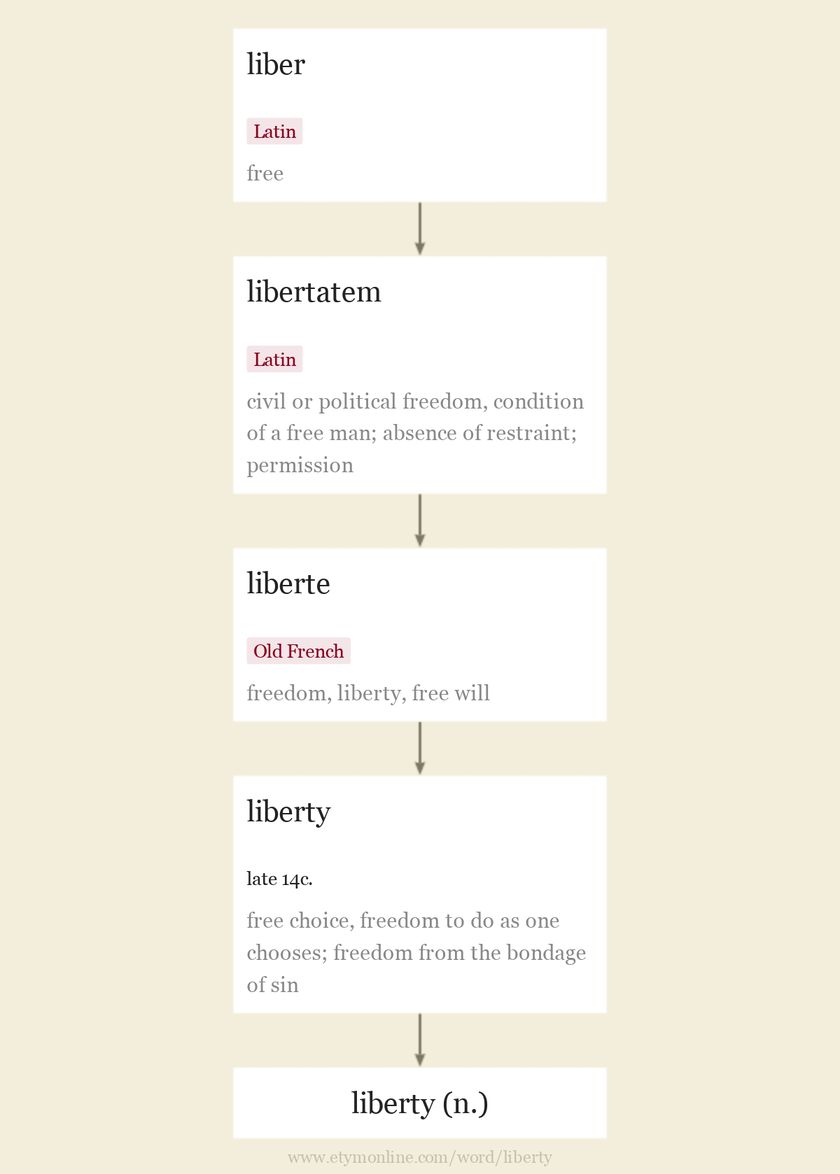
late 14c., "free choice, freedom to do as one chooses," also "freedom from the bondage of sin," from Old French liberte "freedom, liberty, free will" (14c., Modern French liberté), from Latin libertatem (nominative libertas) "civil or political freedom, condition of a free man; absence of restraint; permission," from liber "free" (see liberal (adj.)). At first of persons; of communities, "state of being free from arbitrary, despotic, or autocratic rule or control" is by late 15c.
The French notion of liberty is political equality; the English notion is personal independence. [William R. Greg, "France in January 1852" in "Miscellaneous Essays"]
Nautical sense of "leave of absence" is from 1758. The meaning "unrestrained action, conduct, or expression" (1550s) led to take liberties "go beyond the bounds of propriety" (1620s). The sense of "privileges by grant" (14c.) led to the sense of "a person's private land" (mid-15c.), within which certain special privileges may be exercised, which yielded in 18c. in both England and America a sense of "a district within a county but having its own justice of the peace," and also "a district adjacent to a city and in some degree under its municipal jurisdiction" (as in Northern Liberties of Philadelphia). Also compare Old French libertés "local rights, laws, taxes."
Liberty-cap is from 1803; the American Revolutionary liberty-pole, "tall flagstaff set up in honor of liberty and often surmounted by a liberty-cap" is from 1775. Liberty-cabbage was a World War I U.S. jingoistic euphemism for sauerkraut.
Entries linking to liberty
mid-14c., "generous," also "nobly born, noble, free;" from late 14c. as "selfless, magnanimous, admirable;" from early 15c. in a bad sense, "extravagant, unrestrained," from Old French liberal "befitting free people; noble, generous; willing, zealous" (12c.), and directly from Latin liberalis "noble, gracious, munificent, generous," literally "of freedom, pertaining to or befitting a free person," from liber "free, unrestricted, unimpeded; unbridled, unchecked, licentious."
This is conjectured to be from PIE *leudh-ero-, which probably originally meant "belonging to the people," though the precise semantic development is obscure; but compare frank (adj.). This was a suffixed form of the base *leudh- (2) "people" (source also of Old Church Slavonic ljudu, Lithuanian liaudis, Old English leod, German Leute "nation, people;" Old High German liut "person, people").
Who hath indeed, most like a liberal villain,
Confess'd the vile encounters they have had
A thousand times in secret.
["Much Ado," IV.1.93]
Liberal was used 16c.-17c. as a term of reproach with the meaning "free from restraint in speech or action." The Enlightenment revived it in a positive sense "free from prejudice, tolerant, not bigoted or narrow," which emerged 1776-88. In 19c. often theological rather than political, opposed to orthodox, used of Unitarians, Universalists, etc. For educational use, see liberal arts.
Purely in reference to political opinion, "tending in favor of freedom and democracy," it dates from c. 1801, from French libéral. In English the label at first was applied by opponents (often in the French form and with suggestions of foreign lawlessness) to the party more favorable to individual political freedoms. But also (especially in U.S. politics) tending to mean "favorable to government action to effect social change," which seems at times to draw more from the religious sense of "free from prejudice in favor of traditional opinions and established institutions" (and thus open to new ideas and plans of reform), which emerged by 1823.
This is the attitude of mind which has come to be known as liberal. It implies vigorous convictions, tolerance for the opinions of others, and a persistent desire for sound progress. It is a method of approach which has played a notable and constructive part in our history, and which merits a thorough trial today in the attack on our absorbingly interesting American task. [Guy Emerson, "The New Frontier," 1920]
"a favorite German dish consisting of cabbage cut fine, pressed, salted, and fermented until sour," 1630s, from German Sauerkraut, literally "sour cabbage," from sauer "sour" (from Proto-Germanic *sura-; see sour (adj.)) + Kraut "vegetable, cabbage," from Old High German krut, from Proto-Germanic *kruthan.
They pickle it [cabbage] up in all high Germany, with salt and barberies, and so keepe it all the yeere, being commonly the first dish you have served in at table, which they call their sawerkrant. [James Hart, "Klinike, or the diet of the diseased," 1633]
In U.S. slang, figurative use for "a German" dates from 1858 (compare kraut). "The effort to substitute liberty-cabbage for sauerkraut, made by professional patriots in 1918, was a complete failure." [Mencken]. French choucroute (19c.) is the German word, but via Alsatian German surkrut but with folk etymology alteration in French based on chou "cabbage" + croûte "crust" (n.).
Want to remove ads? Log in to see fewer ads, and become a Premium Member to remove all ads.
More to explore
Share liberty
Want to remove ads? Log in to see fewer ads, and become a Premium Member to remove all ads.
Want to remove ads? Log in to see fewer ads, and become a Premium Member to remove all ads.
Want to remove ads? Log in to see fewer ads, and become a Premium Member to remove all ads.