








10 CloudHealth Competitors to Watch in 2026
What Is VMware Tanzu CloudHealth?
VMware Tanzu CloudHealth is a cloud management platform that helps organizations optimize, monitor, and govern their cloud environments across multiple cloud providers. For organizations managing multi-cloud infrastructures, CloudHealth provides visibility into cloud costs, resource utilization, security, and compliance.
The platform consolidates data from public cloud providers like AWS, Microsoft Azure, and Google Cloud Platform, offering a central interface to manage cloud resources. By providing insights and analytics into cloud spending, CloudHealth enables companies to identify savings opportunities, enforce governance policies, and track cloud usage across teams.
Editor’s note: Updated CloudHealth limitations and information for CloudHealth competitors to reflect features and capabilities in 2026.
This is part of a series of articles about
Key Features of VMware CloudHealth
CloudHealth offers a range of features to help organizations manage and optimize their cloud environments. Here’s an overview of CloudHealth’s key capabilities:
- Cost management and optimization: CloudHealth provides tools to monitor and manage cloud spending, offering insights into cost allocation and identifying opportunities for savings.
- Multi-cloud support: The platform supports various cloud service providers, including AWS, Azure, and Google Cloud Platform, allowing centralized management of multi-cloud environments.
- Governance and automation: CloudHealth enables the implementation of policies for cost allocation, chargeback, and accountability among departments and teams, enhancing governance and operational efficiency.
- Reporting and analytics: Users can generate customizable reports and dashboards to gain insights into cloud usage, performance, and costs.
- Security and compliance: The platform includes features to monitor security risks and ensure compliance with industry standards.
- Resource management: CloudHealth assists in managing resource inventories, rightsizing, and eliminating idle resources to optimize performance and reduce costs.
- Integration capabilities: The platform integrates with various third-party tools and services, enhancing its functionality and allowing incorporation into existing workflows.
Why Consider Alternatives to CloudHealth?
Organizations may encounter some limitations in CloudHealth that prompt them to explore alternative solutions. These limitations were reported by users on the :
- Limited pricing transparency: Pricing details are not clearly available, making it difficult for organizations to estimate costs before engaging with the vendor
- Relatively few user reviews: A small number of user reviews on G2 can make it harder to assess real-world performance and reliability across different use cases
- Dependence on vendor engagement: Some users may need to rely on vendor interaction or demos to fully understand capabilities, rather than accessing comprehensive self-service information
- Learning curve for evaluation: Understanding the full feature set and comparing it with alternatives may require additional effort due to limited publicly available detail
Cloud Cost Management / FinOps Platforms
1. Finout

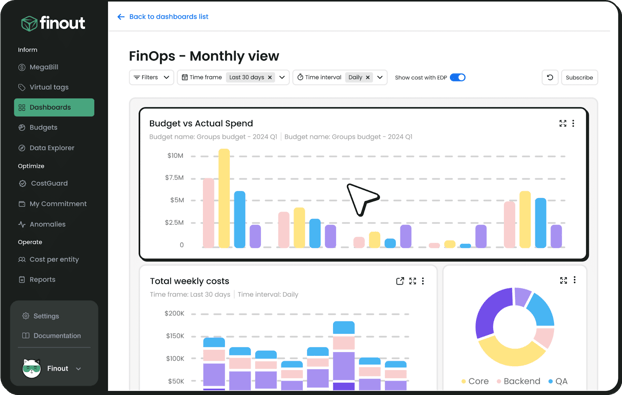
Finout has emerged as a formidable competitor to CloudHealth in the realm of cloud cost management, offering a robust suite of tools tailored to the complex needs of enterprises. Unlike CloudHealth, which has been a longstanding player under VMware’s umbrella, Finout distinguishes itself with its patented Instant Virtual Tagging solution. This innovative feature allows businesses to allocate 100% of their cloud spend instantly, even for untagged resources, across multiple cloud providers and services. By eliminating the dependency on manual tagging, Finout provides a seamless and accurate cost allocation process, enabling enterprises to gain granular visibility into their spending patterns. This capability is particularly valuable for large organizations managing sprawling multi-cloud environments, where traditional tagging methods often fall short due to inconsistencies or oversight.
In addition to its tagging prowess, Finout excels with robust financial planning and forecasting tools, advanced anomaly detection alerts, and intuitive dashboarding, making it a feature-rich parity for enterprise use cases. Its financial planning capabilities leverage historical data to deliver precise forecasts, empowering FinOps teams to set budgets, track commitments, and optimize long-term spending strategies—all within a single platform. The advanced alerts system proactively monitors for cost anomalies, notifying users in real-time via integrations like Slack or email, ensuring swift action to mitigate unexpected spikes. Coupled with customizable dashboards, Finout provides enterprises with actionable insights tailored to diverse stakeholders, from finance to engineering, fostering a collaborative approach to cloud cost governance. This comprehensive feature set positions Finout as a strong alternative to CloudHealth, particularly for businesses seeking scalability, precision, and operational efficiency in their FinOps practices.
Source:
2. Anodot

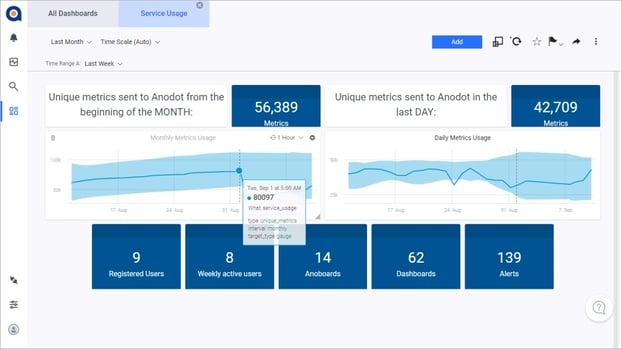
Anodot focuses on AI-driven monitoring and anomaly detection across large-scale data environments. It analyzes high volumes of business and operational data in real time, helping teams detect cost anomalies, performance issues, and revenue-impacting incidents early. The platform emphasizes automated detection and root cause analysis, reducing the need for manual investigation.
Key features:
- Real-time anomaly detection: Continuously analyzes data streams to identify unusual patterns and incidents as they occur
- Automated root cause analysis: Correlates data across systems to help identify the source of anomalies
- Autonomous monitoring: Uses machine learning to monitor metrics without requiring manual rule configuration
- Broad data integration: Connects with multiple data sources across the stack for unified monitoring
Source:
3. CloudCheckr

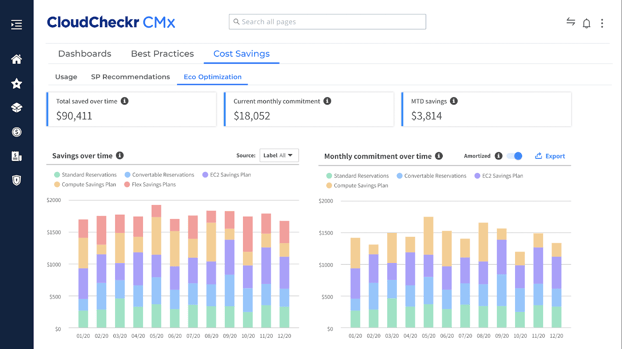
CloudCheckr provides cloud cost management along with governance, security, and operational visibility. It is intended for enterprises and managed service providers that need detailed insights into usage, billing, and optimization opportunities across cloud environments.
Key features:
- Cost and usage visibility: Provides insights into current and historical cloud spend and resource consumption
- Automated cost optimization: Identifies waste and recommends actions such as rightsizing and commitment-based discounts
- Governance and compliance checks: Includes controls to enforce policies and maintain compliance across cloud environments
- Custom reporting and billing: Supports tailored reports and billing views for internal teams or customers
- FinOps collaboration tools: Enables teams to share insights and manage cloud financial operations together
Source:
4. Apptio Cloudability

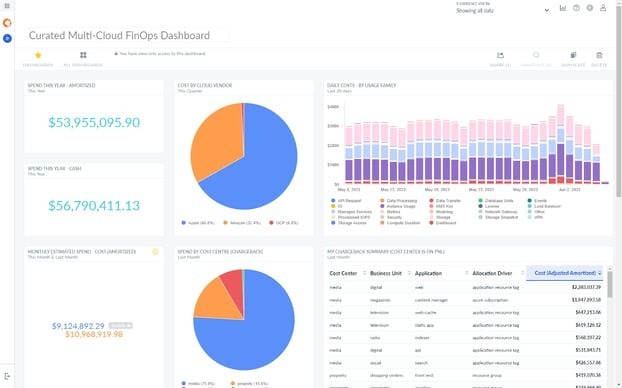
Apptio Cloudability is a FinOps platform focused on helping organizations understand, allocate, and optimize cloud spend across multi-cloud environments. It supports collaboration between finance, engineering, and operations teams by providing shared visibility and financial insights.
Key features:
- Multi-cloud cost visibility: Tracks usage and cost across cloud providers, containers, and applications
- Anomaly detection and waste reduction: Identifies unusual spend patterns and highlights inefficiencies
- Commitment management automation: Helps optimize reserved instances and savings plans
- Unit economics analysis: Connects cloud costs to business metrics such as customer or product profitability
- Budgeting and forecasting: Uses historical data to plan and predict future cloud spend
Source:
Learn more in our detailed guide to
5. Yotascale

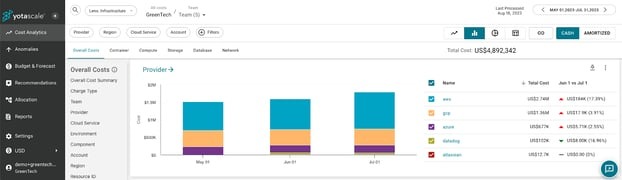
Yotascale is designed to provide granular visibility and cost control for large-scale cloud environments. It enables teams to track, allocate, and optimize cloud spend with real-time insights and detailed attribution across teams, services, and infrastructure components.
Key features:
- Granular cost visibility: Allows users to drill down from high-level spend to team, project, or engineer-level insights
- Cost allocation and tagging: Identifies untagged resources and applies consistent labeling across environments
- Real-time anomaly alerts: Detects cost spikes and notifies responsible teams for quick action
- Optimization recommendations: Provides workload-based rightsizing and efficiency insights
- Budgeting and forecasting: Supports predictive budgeting and planning using historical usage data
Source:
Cloud Management, Observability and Optimization
6. IBM Turbonomic

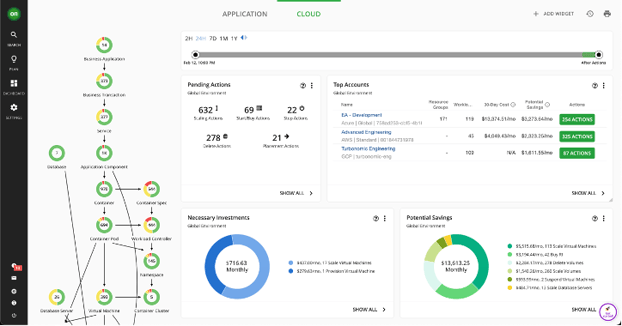
IBM Turbonomic focuses on application resource management and performance optimization across hybrid and multi-cloud environments. It uses automation to continuously adjust resource allocation based on real-time demand, balancing cost efficiency with performance requirements.
Key features:
- Full-stack visibility: Analyzes applications, containers, VMs, and infrastructure to map dependencies and usage
- Automated resource optimization: Continuously adjusts compute, storage, and network resources in real time
- Kubernetes optimization: Right-sizes containers and pods to reduce overprovisioning and cluster costs
- Capacity planning and forecasting: Uses historical and live data to predict resource needs
- Policy-driven automation: Enforces governance rules while optimizing performance and cost
Source:
7. CloudBolt

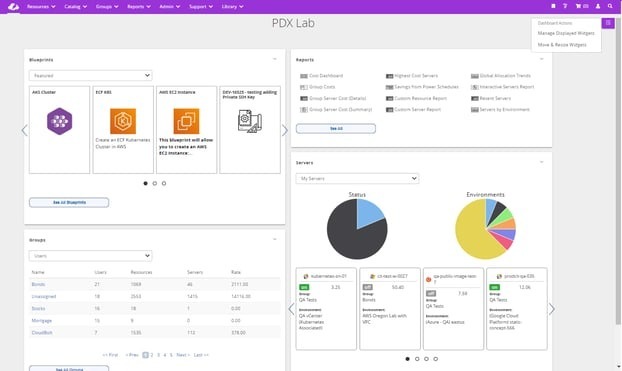
CloudBolt is a cloud management platform that combines provisioning, cost control, and optimization across hybrid and multi-cloud environments. It focuses on automation and self-service capabilities to reduce manual operations and improve efficiency.
Key features:
- Hybrid cloud management: Provides a unified interface to manage public cloud, private cloud, and Kubernetes environments
- Provisioning and self-service: Automates infrastructure delivery with policy-based controls
- Cost allocation and chargeback: Tracks and assigns cloud costs across teams and business units
- Kubernetes cost optimization: Supports rightsizing and cost visibility for containerized workloads
- Workflow automation: Reduces manual tasks through automated cloud operations
Source:
8. Datadog
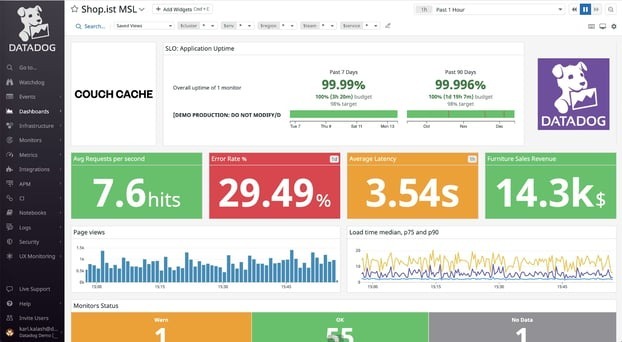
Datadog combines observability with cloud cost management, allowing teams to correlate performance metrics with cost data. This integration helps engineering and FinOps teams make informed optimization decisions within the same platform.
Key features:
- Unified observability platform: Monitors infrastructure, applications, and logs across environments
- Integrated cost visibility: Connects cost data with performance metrics for better context
- Extensive integrations: Supports a range of cloud services, tools, and APIs
- Real-time monitoring and alerts: Detects issues and anomalies across systems
- Collaboration features: Enables teams to share insights through dashboards and reporting tools
Source:
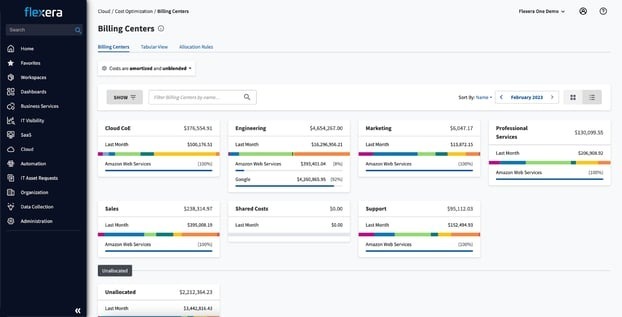
9. Flexera One

Flexera One provides a unified platform for managing IT assets, cloud costs, and SaaS usage. It combines FinOps with IT asset management to give organizations a broader view of technology spend and risk.
Key features:
- Unified IT visibility: Tracks hardware, software, SaaS, and cloud resources in one platform
- Cost optimization insights: Identifies inefficiencies and opportunities to reduce spend
- Business mapping of costs: Links technology usage to business units, services, and cost centers
- Compliance and risk management: Monitors licensing, vulnerabilities, and regulatory requirements
- Hybrid environment support: Covers cloud, on-premises, and SaaS environments
Source:
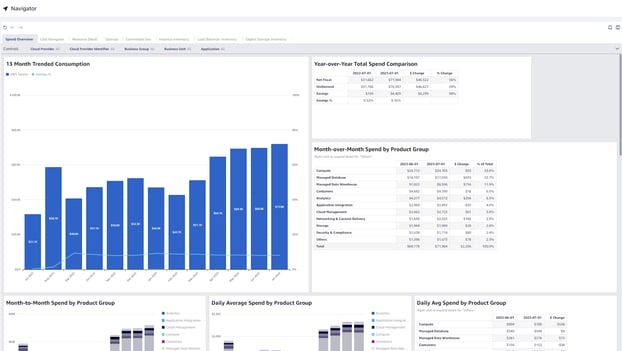
10. Vega Cloud

Vega Cloud is a FinOps platform focused on cost optimization, billing accuracy, and financial governance in multi-cloud environments. It combines automation with financial oversight to help organizations manage cloud spend more effectively.
Key features:
- Billing error detection: Identifies and corrects inaccuracies in cloud billing data
- Centralized cost management: Provides a single interface to manage and analyze multi-cloud spend
- Cost optimization tools: Helps reduce waste and improve efficiency across cloud resources
- Financial governance support: Includes tools for managing contracts, discounts, and provider agreements
- Multi-cloud visibility: Aggregates spend data across different cloud providers for unified analysis
Source:
Conclusion
Cloud management platforms are essential for organizations striving to optimize their multi-cloud environments, ensuring cost efficiency, operational effectiveness, and compliance. With a range of solutions available, organizations must evaluate their priorities—such as cost visibility, automation, Kubernetes support, or integration capabilities—to select the tool that best aligns with their goals.
Related content:
- Read our guide on
- Read our guide on
cloud & AI spend
FAQs

Stay ahead of FinOps trends
Get our monthly product newsletter delivered straight to your inbox.
.svg)

One platform.
Every team. Complete control.
Built for the complexity, speed, and ownership demands of modern cloud and AI environments