This website uses cookies to enhance your browsing experience and ensure the functionality of our site. For more detailed information about the types of cookies we use and how we protect your privacy, please visit our Privacy Information page.
×
Cookie Settings
This website uses different types of cookies to enhance your experience. Please select your preferences below:
Common name (e.g. trout)
Genus + Species (e.g. Gadus morhua)
Holostei (gars and bowfins) >
Amiiformes (Bowfins) >
Amiidae (Bowfins)
Etymology: Amia: Greek, amia = a kind of shark (Ref. 45335); calva: calva (Latin) = smooth or 'the bald scalp of the head', probably referring to the smooth appearance of the head of live specimens (Ref. 46234).
More on author: Linnaeus.
Environment: milieu / climate zone / depth range / distribution range
Ecology
Freshwater; demersal; potamodromous (Ref. 126106). Subtropical; 15°C - 20°C (Ref. 2060); 47°N - 25°N, 97°W - 70°W (Ref. 86798)
North America: from the Pearl River in Louisiana and Mississippi, USA to the Florida Peninsula, and the rivers draining to the Atlantic Ocean in Georgia, South Carolina, North Carolina and Virginia, USA (Ref. 132277). Introduced sparingly elsewhere, including on Atlantic Slope north to Massachusetts, USA Ref. 86798).
Length at first maturity / Size / Weight / Age
Maturity: Lm 53.0, range 38 - 68 cm
Max length : 109 cm TL male/unsexed; (Ref. 86798); common length : 53.4 cm TL male/unsexed; (Ref. 12193); max. published weight: 9.8 kg (Ref. 4699); max. reported age: 30 years (Ref. 72462)
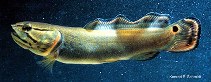
Dorsal spines (total): 0; Dorsal soft rays (total): 42 - 53; Anal spines: 0; Anal soft rays: 9 - 12; Vertebrae: 80 - 90. Branchiostegal rays: 10-12. Body is long and robust. Head is conic, mouth large, with maxillary extending well past eye; jaws wit strong, conical teeth; anterior nostrils at base of short barbels. Dorsal fin origin at 1/3 of total length; anal fin origin at midpoint of dorsal base; pelvic fins inserted at midpoint of body.
Pigmentation: Dark olive above combines with lighter color on sides to form reticulated pattern; venter cream or greenish; head yellow to brown with darker horizontal bars; lower fins vivid green; caudal light olive with irregular darker vertical bars. Adult males with prominent yellow to orange bordered black spot at upper caudal base, less intense or absent in females.
Body shape (shape guide): elongated.
Facultative air-breathing (Ref. 126274); Adults inhabit swamps, sloughs, lakes, and pools and backwaters of lowland streams (Ref. 86798). They are usually found near vegetation (Ref. 86798). They are air-breathers that can withstand high temperatures, which enable them to survive in stagnant areas; even known to aestivate; lethal temperature is 35.2°C (Ref. 46234). They are voracious and opportunist feeders, subsisting on fishes including other sport fishes, frogs, crayfish, insects, and shrimps. It uses scent as much as sight and captures food by means of gulping water. Small juveniles eat microcrustaceans and insects (Ref. 93252). Males are always smaller than females which live longer. Apparently somewhat migratory during spawning season (Ref. 4639). Eggs are adhesive, attached to decaying vegetation and upright weeds (Ref. 4639). Larvae are found in nest, remaining attached to roots or lying on bottom until adhesive organ is absorbed, thereafter in tight "swarm" guarded by male parent outside nest (Ref. 4639). A 'living fossil' and lone survivor species of Family Amiidae.
Males build and guard nest and young, usually nesting in colonies, and clearing out vegetation for the nest (Refs. 205, 34296, 34297, 3672). Most active at twilight and dawn (Ref. 34297); spawn at night (Ref. 34296). Eggs hatch in 9 days; newly hatched young measuring 8 mm (Ref. 34297). Larvae are guarded by the male parent until they are able to swim freely (Ref. 205).
Page, L.M. and B.M. Burr, 2011. A field guide to freshwater fishes of North America north of Mexico. Boston : Houghton Mifflin Harcourt, 663p. (Ref. 86798)
IUCN Red List Status (Ref. 130435: Version 2025-2 (Global))
Threat to humans
Harmless
Human uses
Fisheries: of no interest; gamefish: yes; aquarium: public aquariums
More information
Trophic ecology
Food items (preys) Diet composition Food consumption Food rations Predators
Anatomy
Gill area Brain Otolith
Physiology
Body composition Nutrients Oxygen consumption Swimming type Swimming speed Visual pigments Fish sound Diseases & Parasites Toxicity (LC50s)
Genetics
Genome Genetics Heterozygosity Heritability Genetic Diversity
Human related
Aquaculture systems
Aquaculture profiles
Strains
Ciguatera cases
Stamps, coins, misc.
Tools
Special reports
Download XML
Internet sources
Estimates based on models
Phylogenetic diversity index (Ref.
82804): PD
50 = 1.2520 [Uniqueness, from 0.5 = low to 2.0 = high].
Bayesian length-weight: a=0.00437 (0.00165 - 0.01157), b=3.11 (2.88 - 3.34), in cm total length, based on LWR estimates for this (Sub)family-body shape (Ref.
93245).
Trophic level (Ref.
69278): 3.8 ±0.67 se; based on food items.
Resilience (Ref.
120179): Low, minimum population doubling time 4.5 - 14 years (K=0.14; tm=3-5; tmax=13; Fec=23,600).
Fishing Vulnerability (Ref.
59153): Moderate to high vulnerability (50 of 100).
Accessed through:
2600
FishBase mirror site : localhost
Page last modified by :
mrius-barile - 20 July 2016
Total processing time for the page : 3.4793 seconds