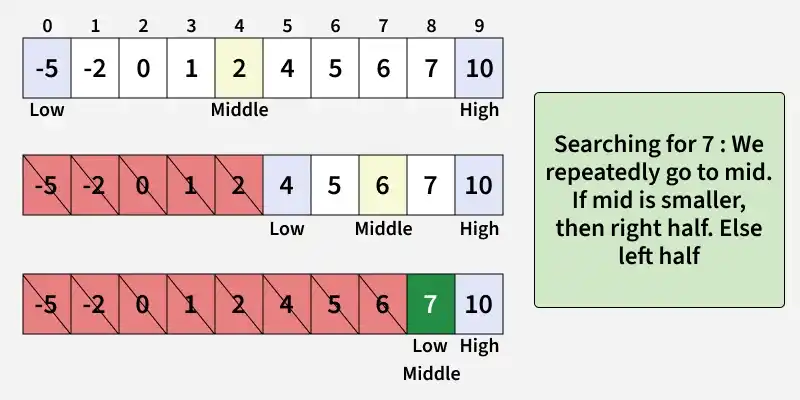
Binary Search is a searching algorithm that operates on a sorted or monotonic search space, repeatedly dividing it into halves to find a target value or optimal answer in logarithmic time O(log N).
Conditions to apply Binary Search Algorithm in a Data Structure
The data structure must be sorted.
Access to any element of the data structure should take constant time.
Binary Search Algorithm
Divide the search space into two halves by finding the middle index "mid".
Compare the middle of the search space with the key.
If the key is found at middle, the process is terminated.
If the key is not found at middle, choose which half will be used as the next search space. -> If the key is smaller than the middle, then the left side is used for next search. -> If the key is larger than the middle, then the right side is used for next search.
This process is continued until the key is found or the total search space is exhausted.
How does Binary Search Algorithm work?
To understand the working of binary search, consider the following illustration:
Consider an array arr[] = {2, 5, 8, 12, 16, 23, 38, 56, 72, 91}, and the target = 23.
How to Implement Binary Search?
It can be implemented in the following two ways
Iterative Binary Search Algorithm
Recursive Binary Search Algorithm
Iterative Algorithm: O(log n) Time and O(1) Space
Here we use a while loop to continue the process of comparing the key and splitting the search space in two halves.
Recursive Algorithm: O(log n) Time and O(Log n) Space
Create a recursive function and compare the mid of the search space with the key. And based on the result either return the index where the key is found or call the recursive function for the next search space.
Output
Element is present at index 3
Complexity Analysis
Time Complexity: -> Best Case: O(1) -> Average Case: O(log N) -> Worst Case: O(log N)
Auxiliary Space: O(1), If the recursive call stack is considered then the auxiliary space will be O(log N).