|
VOOZH | about |
|
VOOZH | about |
The intersection of IoT (Internet of Things) and Cloud Computing has transformed the way we interact with the world around us. Both technologies have enabled us to gather huge amounts of data from multiple devices and then store, analyze, and respond to this data in real-time. From homes to factories, IoT makes it possible for common things to talk to each other and exchange data via the internet, while Cloud Computing offers the platforms and services that enable the data to be processed and stored optimally.
In this article, we will discuss the significance of IoT and Cloud Computing and how they are closely interrelated. We will dive into the basic concepts of IoT, its advantages, and how it is used across different industries like agriculture, healthcare, and smart cities. We will also analyze the contribution of Cloud Computing in the IoT system, its essential characteristics, and how it enhances scalability, cost-efficiency, and accessibility.
Table of Content
Internet of Things (IoT) is an ecosystem of connected physical objects that are accessible through the Internet (formal definition). So, in simple terms IOT means anything that can be connected to internet and can be controlled / monitored using Internet from our smart devices or PCs.
The “things” specified here can be anything from small tracking chips to actual smart cars on road, all these can be categorized as IOT. All things that are connected to internet are assigned with IP to it so that it can be monitored uniquely using internet. The embedded systems and technology are the objects that help in realization of successful IOT.
Everything can be connected to internet and can be controlled from internet. Systems can be automated so that sensors upload data continuously to cloud and various algorithms (like Machine Learning Techniques) can be applied to this data so that we can analyse the data properly and produce efficient outputs. And based on results, the clouds can perform pre-defined actions in response to sensor data.
Security can be enhanced from our smart devices as we can keep an eye at our homes, work places etc. Automated rapid responses like in industries when certain parameters get disturbed automatically actions are triggered to counter the effect. (License plate recognition used in Traffic systems). Monitor places where surveillance is difficult.
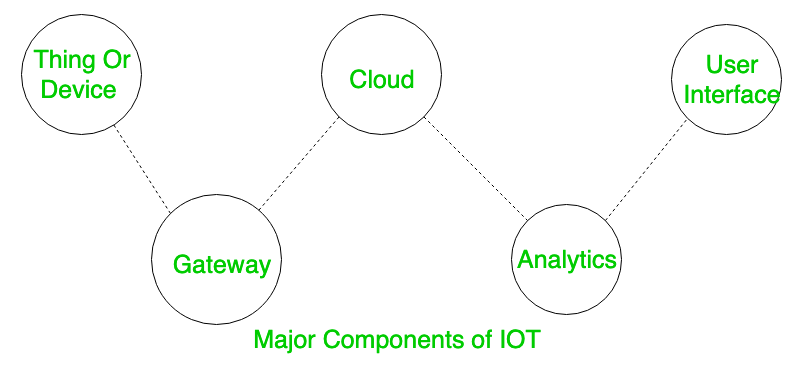
These are explained as following below.
These are fitted with sensors and actuators. Sensors collect data from the environment and give to gateway where as actuators performs the action (as directed after processing of data).
The sensors give data to Gateway and here some kind of pre-processing of data is even done. It also acts as a level of security for the network and for the transmitted data.
The data after being collected is uploaded to cloud. Cloud in simple terms is basically a set of servers connected to internet 24*7.
The data after being received in the cloud processing is done . Various algorithms are applied here for proper analysis of data (techniques like Machine Learning etc are even applied).
User end application where user can monitor or control the data.
The answer is simply no because we can do the processing even locally instead of uploading the data into the cloud. These techniques are called as “Fog Computing ” or “Edge Computing”. But then, why we associate cloud computing with IOT, the reason is also simple because cloud computing gives us scalability and low cost of operations.
If we stop using the Cloud resources then this would slow down the growth of the IOT career .
So, benefits of using the clouds are :-
In simple terms, it is defined as storing and accessing of data and computing services over the internet rather than managing the files in a local storage. Cloud computing makes it possible to save these files(data) over internet. It’s like having a high performance computer some where in internet and we are only using the computing resources of that virtual high performance computer.
Essential characteristics of Cloud Computing:
Cloud can be used as :-
These are explained below:
So, we discussed about importance of IOT and Cloud Computing. But what are the challenges in IOT ?
The combination of IoT and Cloud Computing has unlocked numerous possibilities for innovation across various industries. IoT enables devices to be connected to the internet and valuable data to be gathered, while Cloud Computing provides the infrastructure to store, analyze, and act on that data effectively. But as the IoT ecosystem expands, it will be important to tackle issues like security, privacy, and regulation in order to continue the success and growth of these technologies. By combining the capabilities of both IoT and Cloud Computing, businesses can build smarter systems, enhance efficiency, and accelerate technological progress.