Eisenhower Matrix | Task Prioritization Method to Increase Productivity
Last Updated : 28 Mar, 2026
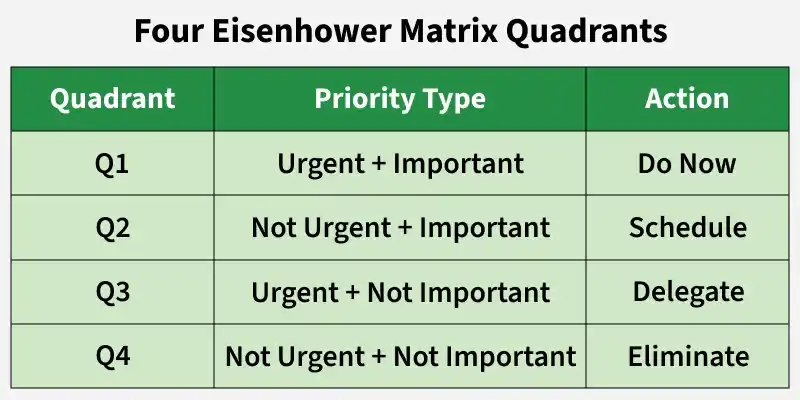
The Eisenhower Matrix (also called the Eisenhower Box or Eisenhower Decision Matrix) is a powerful prioritization framework used for time management and productivity. It helps professionals systematically decide what deserves immediate attention, what to schedule, what to delegate, and what to eliminate.
The method works by categorizing tasks based on two key factors:
Importance: How much the task contributes to goals and outcomes
Urgency: How quickly the task requires attention
By organizing work using these criteria, individuals and teams can focus on high-value activities and avoid reactive, low-impact work.
These tasks require immediate action and directly impact critical goals.
Characteristics
Tight deadlines
High consequences if delayed
Crisis or time-sensitive work
Examples
Production outage
Client escalation
Critical project deadline
Medical emergency
Action: Do these tasks immediately.
Quadrant 2: Not Urgent & Important
These tasks drive long-term success but do not need immediate attention.
Characteristics
Strategic planning
Skill development
Relationship building
Preventive activities
Examples
Project planning
Process improvements
Training and certifications
Product roadmap development
Action: Schedule and protect time for these tasks.
Note: This quadrant creates the most long-term value.
Quadrant 3: Urgent & Not Important
Tasks that require quick action but do not require your expertise.
Characteristics
Interruptions
Routine approvals
Administrative coordination
Low-value urgent requests
Examples
Routine emails
Status updates
Scheduling meetings
Non-critical paperwork
Action: Delegate wherever possible.
Quadrant 4: Not Urgent & Not Important
Low-value tasks that consume time without meaningful returns.
Characteristics
Distractions
Passive activities
Time-wasters
Examples
Excessive social media browsing
Random web surfing
Unnecessary meetings
Action: Eliminate or minimize.
Practical Use Cases
1. Product Owner
Product Owners balance product vision with delivery timelines. The matrix helps prioritize:
Sprint-critical deliverables (Q1)
Roadmap planning (Q2)
Routine coordination (Q3)
Low-impact requests (Q4)
2. Project Manager
Project Managers constantly manage competing priorities. The matrix enables them to:
Focus on milestone-critical tasks
Allocate time to risk planning and stakeholder engagement
Delegate administrative workload
Avoid low-value distractions
3. Product Director / Functional Leaders
Senior leaders benefit by:
Spending time on strategy and governance (Q2)
Delegating operational coordination (Q3)
Avoiding reactive work patterns
Best Practices for Using the Eisenhower Matrix
1. Limit Tasks per Quadrant:
Avoid overloading.
Ideal range: 5–8 tasks per quadrant.
2. Use Color Coding: Assign consistent colors to improve visual clarity:
Red: Urgent & Important
Blue: Important & Scheduled
Yellow: Delegated
Grey: Eliminated
3. Separate Personal & Professional Matrices: Maintain distinct boards to avoid cognitive overload.
4. Review Daily or Weekly: Priorities change. Regular reviews keep the matrix relevant.
When to Use the Eisenhower Matrix
This framework is especially effective for:
Workload prioritization
Sprint and milestone planning
Leadership time management
Personal productivity systems
High-pressure project environments
Key Benefits of the Eisenhower Matrix
Clear decision-making on priorities: Separates what truly matters from what only feels urgent, enabling faster and more confident task prioritization.
Improved productivity and focus: Directs attention toward high-impact work instead of constant firefighting, resulting in meaningful progress each day.
Reduced stress and reactive work: Minimizes last-minute rushes and crisis-driven workflows by encouraging proactive planning and structured execution.
Better delegation and time utilization: Identifies tasks that can be assigned to others, freeing up time for strategic responsibilities and specialized work.
Stronger alignment with strategic goals: Ensures daily activities contribute to long-term objectives rather than being consumed by low-value tasks.