Google Software Engineer Interview Process & Preparation Guide
Last Updated : 26 Mar, 2026
Google is one of the most attractive employers in the world, known for innovation, challenging problems, and top-tier compensation. Landing a Software Engineer (SWE) role at Google requires more than just coding knowledge, it demands strong problem-solving skills, clear thinking, and the ability to tackle unfamiliar problems.
What Google Looks for in a Software Engineer
Google hires engineers who can solve new and complex problems, not just those they’ve seen before.
Core Evaluation Areas
Problem-solving & DSA proficiency
Code quality (clean, readable, efficient)
Analytical thinking
Communication skills
Googlyness: curiosity, collaboration, ethics, and passion for technology
Software Engineer Levels at Google
Level
Role/Title
Typical Experience (Years)
Interview Focus
L3
Software Engineer II (Entry-level / New Grad)
Fresh graduates / 0–2 years (often 0–1 for new grads; up to ~2–3 with internships or limited experience)
Primarily DSA (Data Structures & Algorithms) + coding problems; little to no system design
L4
Software Engineer III (Mid-level)
~2–5 years (sometimes awarded to strong new grads/PhDs; BS + ~4–6 years / MS/PhD equivalents lower)
Heavy DSA/coding + introductory/light system design (component-level or feature design)
L5
Senior Software Engineer
~5–10 years (often 6–9; the "terminal" senior level where many stabilize)
Significant industry experience (L6: ~8–15+ years)
Advanced system design (large-scale, ambiguous, cross-team impact) + leadership, strategy, and high ambiguity handling
Getting Noticed by Google
Google receives over two million resumes each year but hires only around 4,000 candidates, making it highly competitive to get an interview call. To improve your chances, you need a strong profile and smart visibility.
How to Increase Your Chances of Getting an Interview
1. Build a strong one-page resume
Keep your resume short, precise, and relevant. Recruiters typically spend 10–15 seconds scanning a CV.
List only skills you are confident in
Avoid exaggeration, interviewers can easily detect it
Mention projects with their complexity, scale, and impact
2. Leverage referrals and professional networks
Referrals significantly improve visibility. Connect with Googlers through LinkedIn, alumni networks, and professional communities.
3. Participate in Google coding competitions
Google’s official coding competitions Code Jam, Kick Start, and Hash Code were discontinued in 2023. However, competitive programming is still a powerful way to sharpen interview skills.
Practice using archived Google Code Jam and Kick Start problems
Actively participate in reputable alternatives such as:
Codeforces
AtCoder
ICPC-style contests
LeetCode weekly and biweekly contests
These platforms build speed, problem-solving depth, and algorithmic thinking all crucial for Google interviews
4. Maintain updated online profiles
Keep your LinkedIn, GitHub, and coding platform profiles current. Hiring managers often review these to assess technical skills and activity.
4. Network at conferences and events
Attend tech conferences and meetups. Google engineers frequently speak at these events and are generally approachable, making networking easier.
Telephonic Interview
Once your resume is shortlisted, Google schedules technical phone interviews (usually two rounds). These interviews differ from onsite rounds and focus primarily on Data Structures and Algorithms (DSA).
Interview Format
Duration: ~45 minutes per interview
Platform: Shared editor (commonly Google Docs)
Questions: 1–2 DSA problems
Expectation: Write working code for at least one problem
Onsite Interview
After clearing the phone interviews, Google conducts 4–6 onsite interview rounds, including a lunch round (which is informal and not an evaluation round). Each interview lasts 45–60 minutes and is primarily whiteboard-based, with a strong emphasis on coding and problem-solving.
The difficulty and focus of questions depend on the level you are applying for. Interviews typically include technical coding rounds followed by a system design round (based on experience).
1. Technical Coding & General Analysis Rounds
These rounds evaluate your ability to solve real-world problems using Data Structures and Algorithms (DSA). Interviewers expect optimized solutions, clean code, and a clear explanation of your approach.
What Is Tested:
Problem-solving and algorithmic thinking
Choice and usage of appropriate data structures
Code quality, correctness, and optimization
Time and space complexity analysis
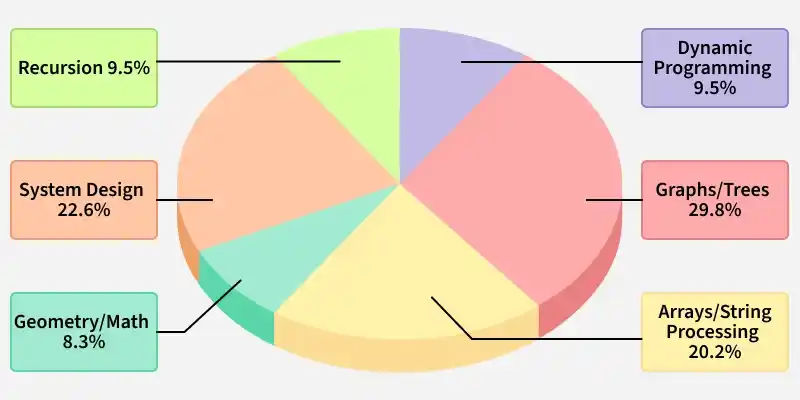
Key Topics to Prepare
Sorting Algorithms: Know at least one O(n log n) algorithm (preferably merge sort and quicksort). Avoid basic sorts like bubble sort.
Trees: Binary trees, N-ary trees, tries, and at least one balanced tree (AVL, Red-Black, or Splay tree). Traversals: BFS, DFS, inorder, preorder, postorder.
Graphs Graph representation and basic traversal algorithms. Advanced algorithms (e.g., Dijkstra) are optional unless time permits.
NP-Complete Problems: Be familiar with classic problems like Knapsack and Traveling Salesman, and learn to recognize them in disguised forms.
Discrete Mathematics: Basics of combinatorics, probability, and n-choose-k problems.
Operating Systems: Threads, processes, concurrency, deadlocks, livelocks, and synchronization concepts.
Practicing from Cracking the Coding Interview (CTCI), GeeksforGeeks, LeetCode, CareerCup, and Google’s official preparation resources is highly recommended.
System design interviews are open-ended discussions, mostly for experienced candidates. You may be asked to design scalable systems such as Gmail, YouTube, or Uber.
Expectations by Level
L4 and below: Object-oriented design and high-level system concepts
L5 and above:
Define system requirements
Design high-level architecture
Deep-dive into components
Identify bottlenecks and scalability challenges
Google places a strong emphasis on scalability, so expect ambiguous real-world problems that test how you structure, analyze, and scale large systems.
Tips:
Think out loud throughout the interview: Always explain your thought process and approach. Interviewers need to understand how you think, not just the final answer.
Practice writing code on a whiteboard or paper: This improves clarity, structure, and confidence, especially since most onsite interviews are whiteboard-based.
Never say “I can’t solve this”: Even if the problem is unfamiliar, keep exploring different approaches. Interviewers often provide hints, giving up is a major red flag.
Ask clarifying questions before coding: Confirm assumptions, constraints, and edge cases before starting. This shows structured thinking and avoids incorrect solutions.
Write actual code, not pseudo-code: In a 45-minute interview, you’re expected to write working code. Pseudo-code wastes time and may reduce your score.