|
VOOZH | about |
|
VOOZH | about |
As Andrew Ng rightly quoted, “AI is the new electricity,” and the latest domain that AI is exploring is healthcare. With the power to perform thousands of complex operations in a second, AI can process vast repositories of medical data into useful insights. AI is rapidly being incorporated into different areas of medical research, and there have already been some breakthroughs that threaten to transform the future of medicine. Here are some healthcare applications where AI is being applied currently:
Table of Content
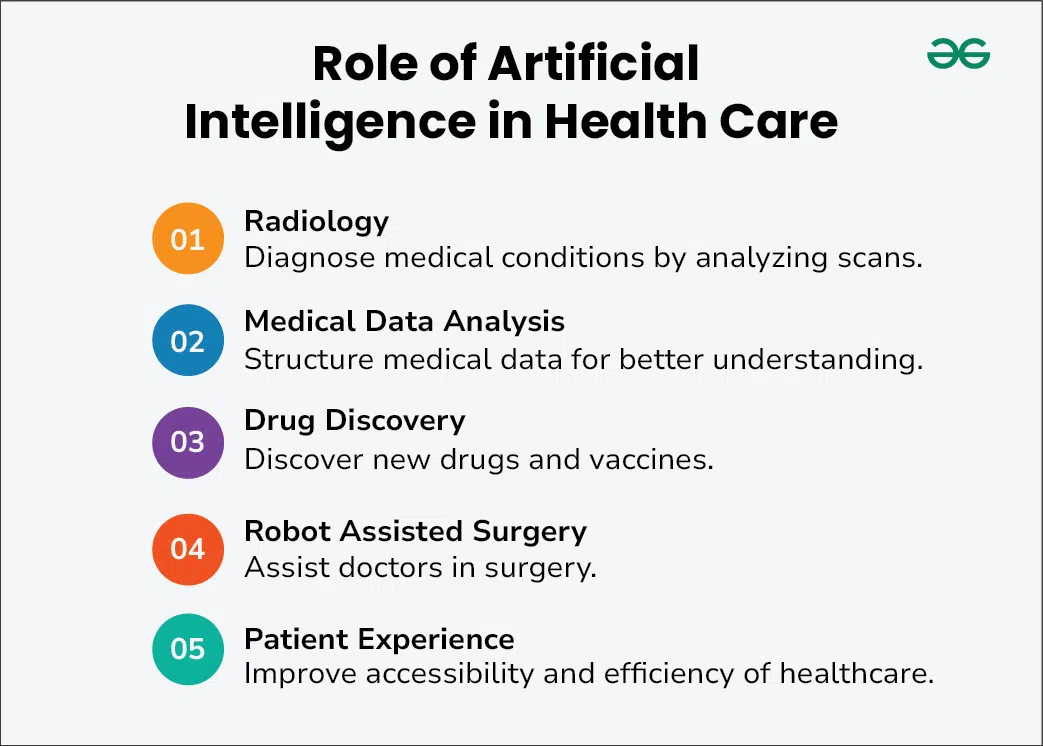
AI is being used to analyze X- ray, CT and MRI scans, to diagnose medical conditions in patients. The computer vision techniques allow programs to detect abnormalities in radiology images, and have reached up to 100% accuracy on test datasets, for several diseases. Not only does AI provide an accurate diagnosis, but also is very time efficient as compared to conservative diagnostic techniques. In the recent COVID-19 outbreak, AI has proved to be a great asset in zero-contact diagnosis, especially for contagious diseases. The success of AI in the field of medical diagnosis, gives hope for a future with minimized errors and speedy diagnosis, which will take healthcare years ahead of its time.
Implementation of AI in Radiology
Consider working in TV, where they receive thousands of videos, pictures, and articles every day. In comes AI to try and learn from these massive datasets of scans – each one accurately marked with a documented diagnosis. These images get labelled and constitute the datasets used, where the AI algorithms are trained to identify the correlations that define certain diseases.
Impact of AI in Radiology
It is now no longer the exclusive preserve of the radiologist. AI operates as a helpful and effective second opinion when it comes to detecting the problematic regions or lesions that otherwise might be overlooked. This means that patients are diagnosed before their condition deteriorates, and more importantly, diagnosis is done when the chances of curing the disease are higher, for instance, when diagnosing cancers. Timely intervention is the key here and AI equips the doctors to act in early stages that may well translate into better prognosis for patients.
With deep learning and cutting edge tools, AI is structuring medical data, to provide doctors and medical researchers with better understanding of the enormous medical data cache. From processing and analysis clinical trials, to find the effects of vaccines, drugs and more, to tracing the origins of strains of viruses, AI is helping scientists track and further medical research, by eliminating redundant methods of data analysis and manual filtering of data.
Implementation of AI in Medical Data Analysis
The sector creates vast amounts of intricate information – electronic medical records, test results, and numerous studies on conditions and treatments. This data holds a lot of value, as it contains the answer to numerous questions important to healthcare organizations; however, the data volume is astounding, and humans cannot analyze such an amount of data efficiently. That is where AI plays a part here. Sophisticated algorithms and AI apps step into the limelight to increasingly rigorously categorize and process this information. These utilize complex computational methods to quickly find features that would require a human subject-matter expert to discern.
Impact of AI in Medical Data Analysis
AI has discovered groundbreaking links, incredible findings. Such observations may create an enhanced understanding of a disease development and can enable preventive measures to be taken. Moreover, it helps doctors to make decisions, prescribing individual treatment scenarios depending on data indicating each patient’s conditions. In addition, through large datasets, AI becomes capable for predicting potential target for new drugs thus speeding up the process of identifying diseases cure.
Integrating AI with bio-tech platforms is one of the most interesting applications of AI in healthcare today. Several pharmaceutical companies like Pfizer are applying machine learning, in search of immuno-oncology drugs. By finding patterns in medical data, and studying the outcomes of existing drugs on patients, they are trying to discover new combinations of drug ingredients for developing novel drugs. With some very advanced projects like ChemGAN currently available online, researchers and AI engineers are trying unprecedented techniques for discovering new drugs and vaccines to combat chronic and several other illnesses.
Implementation of AI in Drug Discovery
Typically, the process of discovery has been long and costly with numerous compounds lying in a database or even in file drawers for years. How Automation Interventions speed up, the efficiency of the complex processes. It is capable of processing large set of other genetic data sets as well as protein structures in search of potential pockets where drugs may engage with and alter pathogenesis. The forward-looking capabilities of this analysis are impressive: Instead of just finding targets, AI can also estimate how drug candidates might behave in the human body, including possible appendix benefits and adversities.
Impact of AI in Drug Discovery
Combining the AI advancements with drug discovery increases evident drug candidates and improves clinical studies. This will also result in earlier production of new drugs and effective treatment for different diseases, which will help to save people’s lives and provide them with a better quality of life. Moreover, because AI accelerates the processes of new drugs discovery and development, it lessens the costs related to launching pharmaceuticals.
By using AI for creating robots to assist doctors in surgery, the latest discoveries are trying to uncover the secret to minimally invasive surgeries. The robots combine live camera feed with mechanical tools to perform a new kind of surgery that allows surgeons to operate with magnified views, better control and precision of the tools, and thus minimizing the surgery-related complications.
Implementation of AI in Robot-Assisted Surgery
Picture having robotic assistant to replace a surgeon’s limbs, moving in perfect tandem with its operator. This is the power which has been recently invested into surgeons through utilizing surgical robots enhanced by artificial intelligence. There are these special ones that have been designed with artificial intelligent movements and can sense what a surgeon is doing and enable the surgeon to have extra control especially when undertaking delicate operations. Another area, which is closely related to computer-based planning, is pre-operative planning. The benefits are even higher in medical applications: it can produce detailed 3D models of a human body, which enable surgeons to plan the operation in detail and avoid dangerous mistakes.
Impact of AI in Robot-Assisted Surgery
Applying AI and robots, the relationship between these smart devices and patients is transformative. These robots help in surgery that require smaller cuts thus short healing periods and less comfort when in pains. Surgeons benefit as well. According to the new advances in technology, it also gives them better control and enhanced visualization during operations to reduce mistakes.
From optimizing ambulance routes to waiting times using real time data, AI is working towards making healthcare more accessible and efficient for the general public. Conversational AI is making huge progress in developing chatbots to assist patients, monitor their progress and giving health-specific alerts. Some of these projects can conduct entire appointments from the patients’ homes and then guide the patient towards treatment or specialized appointments, by reviewing the symptoms and analyzing the data provided by the patient.
Implementation of AI in Patient Experience
Just think about it, a population of citizens that has at their finger tips a long arm that responds to their basic health check up at any one time, any one day. This is the reality with AI-driven chatbots and virtual assistants, and it is high time that marketers adapted their thinking and strategies to this new reality. Some of them are trained on large repositories of medical information, can answer simple questions about patients’ health, assign appointments, or remind about the administration of prescribed medication.
Impact of AI in Patient Experience
However, utilization of AI influences is not confined to Medical practitioners as we are about to see. Advancements in artificial intelligence would enhance the access to healthcare for patients, especially in regions where the number of healthcare practitioners is scarce. It can help in providing a primary level of care so that doctors and nurses alike can shower their attention on complicated patients thus leading to a better quality of care.
Must Read
AI is revolutionizing the field of healthcare combining large scale data analytics and intelligent deep learning frameworks. But with great computational power, comes great responsibility. An important guideline while integrating AI with healthcare is to not lose sight of the real science- medicine, behind the layers of our neural networks. While creating complex models, and processing the data, engineers should collaborate with medical practitioners, to ensure that they are going along the right path.