|
VOOZH | about |
|
VOOZH | about |
5G (Fifth Generation) wireless technology is the latest mobile network standard offering ultra-fast speeds, low latency, and massive connectivity. It delivers speeds up to 10–12 Gbps (about 100× faster than 4G) with latency as low as 1 ms, enabling real-time applications like autonomous driving, remote surgery, and VR.
5G achieves these capabilities through:
Together, these technologies improve efficiency, enhance coverage, and enable innovations across IoT, smart cities, and industrial automation.
5G uses a cellular network architecture with cells served by gNodeBs. Devices connect via radio waves to the core network and internet. Utilizing 5G New Radio (NR), massive MIMO and edge computing, it delivers ultra-fast speeds, low latency and massive connectivity, operating in standalone (SA) or non-standalone (NSA) modes.
The RAN connects your device, like a smartphone, to the 5G network through base stations called gNodeBs. It uses massive MIMO (Multiple Input Multiple Output) antennas, which can send and receive many data streams at the same time. This increases network capacity, improves signal quality and allows more devices to connect simultaneously.
The 5G Core (5GC) is the brain of the network. It is cloud-based and virtualized, meaning it can be managed efficiently and updated easily. It handles authentication, routing of data and network slicing, allowing the creation of virtual networks for different purposes, such as gaming, IoT devices or autonomous vehicles.
Multi-access Edge Computing (MEC) brings computing power closer to the user instead of sending data far away to centralized servers. This reduces latency, making real-time applications like autonomous driving, gaming or remote surgery faster and more responsive.
5G uses Orthogonal Frequency-Division Multiplexing (OFDM) to pack and transmit data efficiently over the network. This allows faster data transfer, better spectrum usage and reliable communication even in crowded networks.
5G operates on multiple frequency ranges:
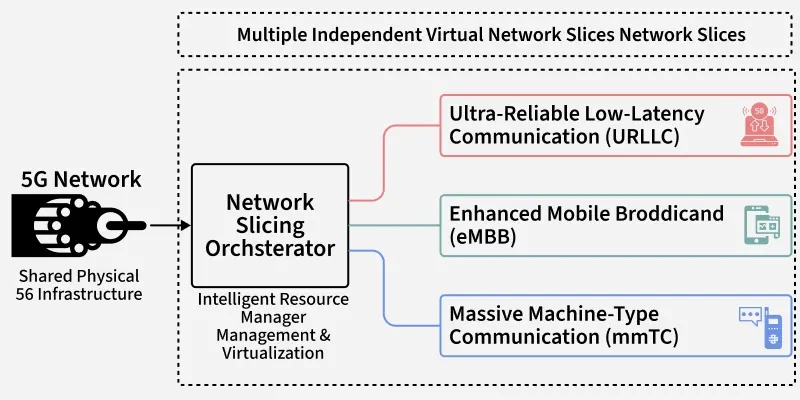
Network slicing in 5G allows a single network to be divided into multiple "slices," each designed for a specific use case. For example, one slice can deliver high-speed mobile internet, another ultra-reliable links for critical tasks like remote surgery or autonomous cars and another can support massive IoT connectivity. These independent slices ensure smooth performance, making 5G more powerful and flexible than previous networks.
For Example: Imagine a smart city with diverse needs, such as autonomous vehicles, public safety and energy management. Network slicing allows the city to create separate virtual networks for each application, guaranteeing the required quality of service.
5G deployment has expanded rapidly since its early trials by AT&T and Verizon, with over 300 networks now live worldwide. Companies like Qualcomm, Huawei and Intel continue to drive innovation, but 5G’s shorter range at higher frequencies requires far more base stations, making rollout costly and time-consuming. While adoption is growing, global seamless coverage will still take years.
| 4G Technology | 5G Technology |
|---|---|
| It stands for Fourth Generation technology | It stands for Fifth Generation technology |
| Maximum upload rate of 4G technology is 500 Mbps | Maximum upload rate of 5G technology is 1.25 Gbps |
| Maximum download rate of 4G technology is 1 Gbps | Maximum download rate of 5G technology is 2.5 Gbps. |
| Latency of 4G technology is about 50 ms | Latency of 5G technology is about 1 ms |
| 4G offers CDMA | 5G offers OFDM, BDMA |
| 4G can't differentiate between fixed and mobile devices | 5G has the capability to differentiate between fixed and mobile devices. It uses cognitive radio techniques to identify each device and offer the most appropriate delivery channel. |
| 4G has the advantages of high speed handoffs, global mobility | 5G has the advantages of extremely high speeds, low latency |
| 4G can be used for high speed applications, mobile TV, wearable devices | 5G can be used for high resolution video streaming, remote control of vehicles, robots and medical procedures |