|
VOOZH | about |
|
VOOZH | about |
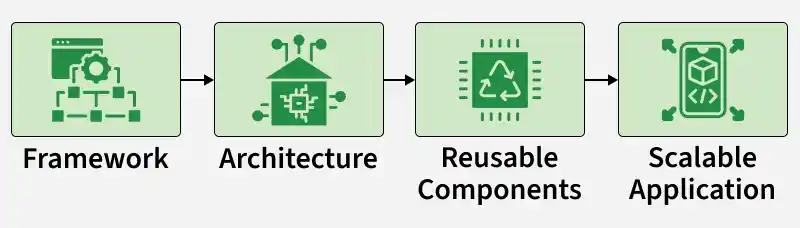
A framework is a structured foundation that simplifies development by providing predefined architecture and reusable components, making applications easier to build, maintain, and scale.
Before starting development, you must choose the right programming language and framework based on your project requirements, scalability needs, and features.
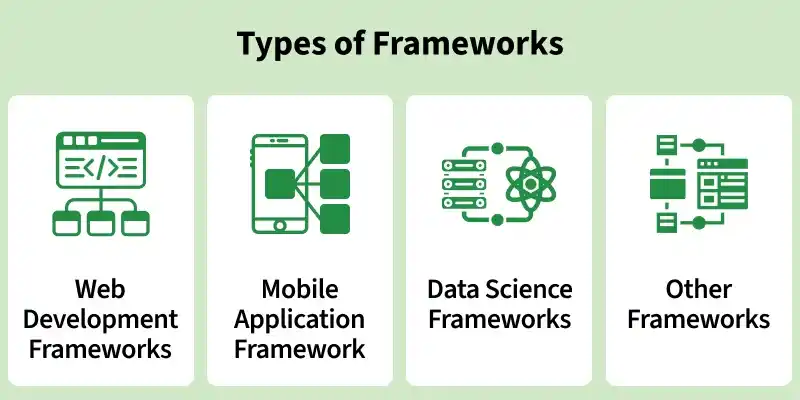
Web development focuses on building and maintaining websites and web applications, including static, dynamic, and single-page applications. Web development frameworks provide essential tools, services, and APIs, and are mainly categorized into Front-end and Back-end frameworks.
Frontend web development frameworks are used to create the user interface of the website that is seen and used by the users. They develop the client side of the application. Some of the popular front-end web development frameworks are Angular and Vue.js.
Angular
Angular is an open-source TypeScript-based web framework developed by Google for building dynamic, scalable web applications and Progressive Web Apps (PWAs).
VueJS
Vue.js is an open-source JavaScript frontend framework used for building interactive and dynamic user interfaces using HTML, CSS, and JavaScript.
Bootstrap
Bootstrap is an open-source CSS framework used for developing responsive and mobile-first websites using HTML, CSS, and JavaScript.
Backend web development frameworks operate on the server side and handle tasks such as processing requests, managing databases, and interacting with APIs. Popular examples include Ruby on Rails, Django, and PHP frameworks.
Ruby on Rails
Ruby on Rails is an open-source Ruby-based web framework that follows the MVC architecture to build secure, scalable, and maintainable web applications.
Django
Django is an open-source Python-based web framework designed for rapid development of secure, scalable, and maintainable web applications.
Spring Boot
Spring Boot is an open-source Java-based framework used to build production-ready, standalone, and scalable web applications.
Mobile application frameworks are used to build apps for Android and iOS, supporting native, hybrid, and cross-platform development. Popular frameworks include Flutter, React Native, and Ionic.
Flutter
Flutter is an open-source UI framework developed by Google for building cross-platform applications using the Dart programming language.
React Native
React Native is an open-source JavaScript framework developed by Meta for building cross-platform mobile and desktop applications using a single codebase.
Data Science is a field that collects data from various sources and then analyses them by applying various algorithms and statistics. Majorly, data scientists work with Python language hence many Python frameworks are used in data science:
PyTorch
PyTorch is an open-source Python-based deep learning framework built on the Torch library for developing machine learning models.
Apache Spark
Apache Spark is an open-source big data processing framework used for large-scale data analytics and real-time data processing.
Specialized frameworks target specific domains like gaming, machine learning, desktop, and API development.
Libraries provide specific reusable functionality, while frameworks offer a complete structured environment for building applications.
Library | Framework |
|---|---|
A collection of reusable functions or components for a specific task. | A complete development structure with tools, libraries, and predefined architecture. |
Focuses on a particular functionality. | Covers the overall application development process. |
Developer controls when and how to call it. | Controls the application flow and calls the developer’s code. |
May be used independently or within a framework. | Often includes multiple libraries and tools. |