|
VOOZH | about |
|
VOOZH | about |
Decision-making is a fundamental aspect of our daily lives, influencing everything from the everyday choices of what to eat for breakfast to the complex deliberations that shape our careers and personal relationships. Whether it's an individual pondering a personal decision or an organization strategizing its next move, making a decision is universal and vital.
In this article, we will discuss what decision-making is, what are the 7 steps of a decision-making process, and more.
👁 Decision making: Meaning, Nature, Role and Relationship between Planning and Decision-makingTable of Content
Decision-making is an integral part of everyday life and a crucial component of management in organizations. It involves selecting the best action from various options by considering resources, outcomes, and personal preferences. This process includes identifying a situation, gathering and analyzing information, evaluating the pros and cons, and choosing a path forward. Decisions, whether made through rational analysis or instinct, significantly affect all involved parties.
Effective decision-making, which entails evaluating all possible outcomes and choosing the most beneficial one, is essential for personal, professional, and organizational success. Conversely, poor decisions can lead to losses and tarnish reputations. Thus, developing a structured approach to decision-making is vital for achieving favorable outcomes.
“Decision-making is the selection based on some criteria from two or more possible alternatives.“ - George R. Terry
“A decision is an act of choice, wherein an executive form a conclusion about what must be done in a given situation. A decision represents a course of behaviour chosen from several possible alternatives.“ - D.E. Mc. Farland
The initial step in decision-making is identifying the precise issue that needs resolution or the query that demands an answer. It's essential to accurately define the decision at hand. Incorrectly identifying the problem or choosing an overly broad issue can derail your decision-making efforts from the get-go. For goals associated with the decision, ensure they are quantifiable and bound by time.
Once the decision has been indetified, the next phase involves collecting relevant information to that decision. This includes an internal review to understand past successes and failures within your organization that relate to your decision. Additionally, acquiring information from external sources, such as academic research, market analysis, or possibly feedback from consulting services, is crucial. However, be wary of information overload, as it can overwhelm and complicate the decision-making process.
Armed with the relevant data, it's now time to outline potential solutions to your problem. Typically, there are several avenues to consider for achieving a goal. For instance, if the aim is to boost social media engagement, alternatives could range from investing in paid social ads, tweaking your organic social media tactics, or employing a blend of both strategies.
Having pinpointed several potential solutions, the next step involves assessing the merits and demerits of these alternatives. Review past instances of success within similar contexts, and analyze your organization’s past achievements and setbacks. Evaluate the risks associated with each option against the potential benefits.
This stage is where the actual decision is made. Ideally, by this point, you've clearly identified the decision to be made, gathered all necessary information, and considered various possible directions. Now, you're equipped to make an informed choice.
With the decision made, it's time to act. Formulate a plan to bring your decision to fruition. Create a detailed project plan based on your decision, assigning specific tasks to members of your team to execute the plan effectively.
After a set period, which was determined in the first step, revisit your decision to evaluate its effectiveness. Did it address the problem? Did it achieve the intended goal? If the answer is yes, document the successful strategies for future reference. If not, take this as a learning opportunity to refine your decision-making process for future endeavors.
The nature of decision-making can be characterized by several key factors, including:
Thus, decision-making is generally a complex and dynamic process that requires taking decisions that give the best-desired outcomes and involves analyzing possibilities, taking risks into account, acquiring information, and working with others.
Making decisions plays a key part in the life of an individual and any organization. The accomplishment of personal and organizational objectives, enhanced performance, risk minimization, and success maintenance all depend on effective decision-making. Here are some key roles of decision-making:
Therefore, the general purpose of decision-making is to give people and organizations direction and advice so they may succeed by making decisions that are in line with their priorities.
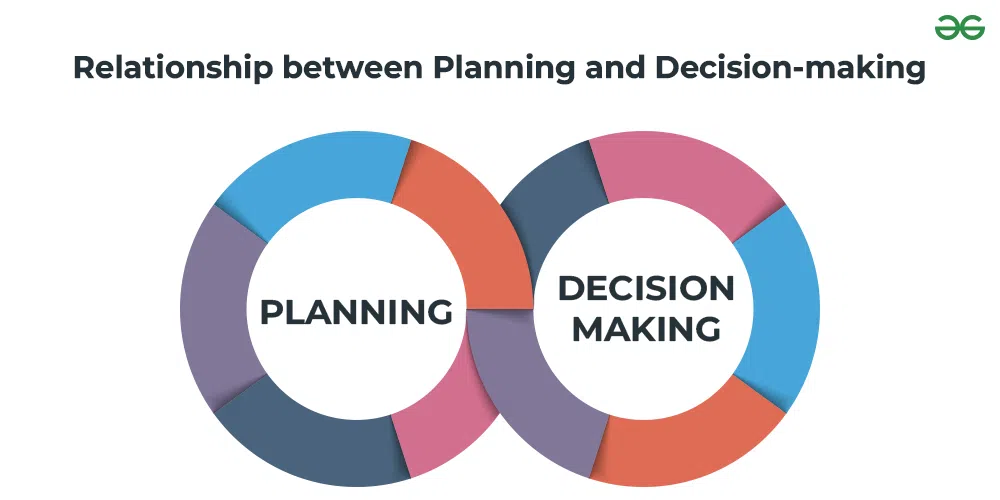
Making decisions and planning are closely interrelated activities. Making decisions is frequently seen as the most important step in the planning process. This is because planning enables establishing objectives, choosing practicable courses of action, and evaluating potential outcomes, all of which are essential processes for making effective decisions.
👁 Relationship between Planning and Decision-makingFollowing are some ways in which planning and decision-making are related:
Overall, planning and decision-making are repetitive processes that demand constant review and modification. To make sure that objectives are met, and resources are used efficiently, planning and decision-making must adapt according to the changing conditions and information.
In conclusion, the art of decision making is a critical skill that influences every facet of our lives, from personal choices to professional strategies. Mastering decision making involves understanding the balance between intuition and analysis, recognizing the impact of biases, and applying a structured approach to navigate through options.
Thus, cultivating strong decision-making skills is indispensable for anyone looking to navigate the challenges of the modern world with confidence and understanding.