|
VOOZH | about |
|
VOOZH | about |
Operations Management is a vital component of any business, encompassing the practices, techniques, and tools that organizations use to produce and deliver goods and services efficiently and effectively. Whether in manufacturing or service industries, operations management plays a crucial role in building a competitive edge and driving long-term success.
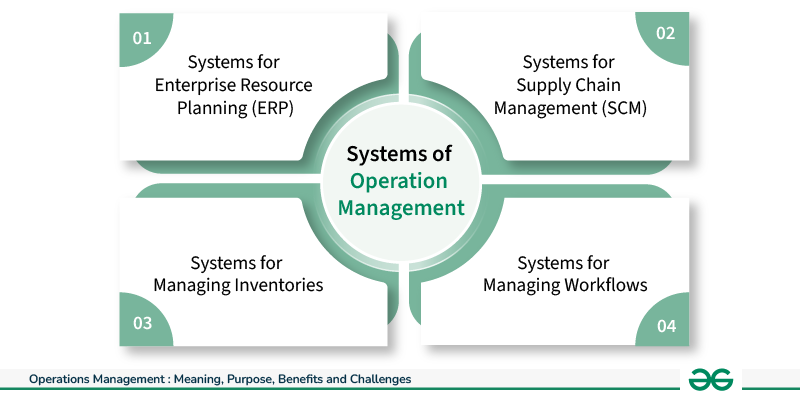
👁 Systems of Operation Management
The creation, supervision, and control of the systems and procedures that businesses utilize to generate commodities and provide services are the main objectives of the management field known as Operations Management. To guarantee the effective and efficient production of goods or the provision of services, it involves the planning, organizing, and optimization of resources, processes, and activities. In several sectors, including manufacturing, healthcare, retail, transportation, and services, operations management is essential leading to enhanced customer happiness, cost savings, and efficiency.
Operations form the backbone of any company, focussing its approach to managing the supply chain and logistics intricacies. The financial health of a business is deeply tied to its ability to maintain lean and effective operational strategies. Inadequate operational practices pose a significant risk to a company's longevity, highlighting the necessity for process optimization.
Employing proficient staff, ensuring operations are ethical and safe, and choosing strategic locations are important for maintaining operational excellence. This not only enhances efficiency but also supports the organization's commitment to ethical practices and safety standards, crucial for sustainable growth and customer trust.
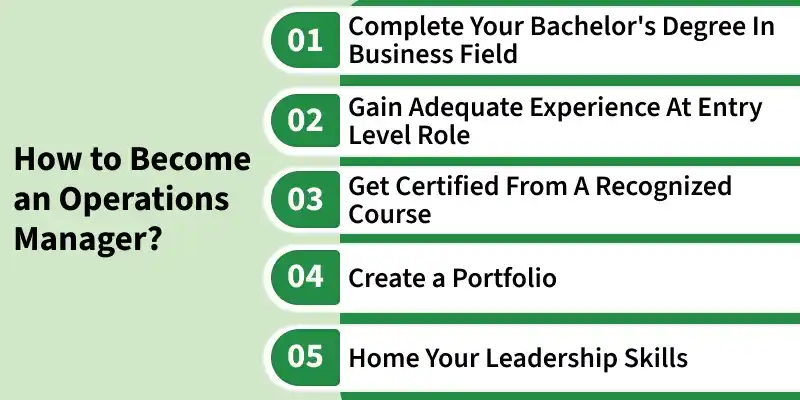
1. Complete Your Bachelor's Degree in a Business Field: Earn a bachelor's degree in business, management, or a related field to build a strong foundation in business operations and management principles.
2. Gain Adequate Experience at an Entry-Level Role: Work in entry-level positions to gain practical experience and understand how daily business operations are managed.
3. Get Certified from a Recognized Course: Obtain professional certifications to enhance your knowledge, skills, and credibility in operations management.
4. Create a Portfolio: Develop a portfolio showcasing your projects, achievements, and operational improvements to demonstrate your capabilities.
5. Hone Your Leadership Skills: Strengthen your communication, decision-making, and team management abilities to effectively lead people and processes.
The skills required from an Operations Manager are:
Here are some of the Career Paths in Operations Management:
1. Globalization and Complex Supply Networks: The complexity and interconnectivity of supply chains have increased with the globalization of business. Coordination, communication, and cultural variations become obstacles when managing suppliers, logistics, and production processes across borders and time zones.
2. Demand Variability and Forecasting: Demand can be difficult to predict accurately, and changes in consumer demand might result in overstock or stockouts. To adapt to shifting demand patterns, operations managers need to create flexible production procedures and efficient forecasting models.
3. Skill Shortages and Talent Management: One of the ongoing challenges in operations management is finding, developing, and keeping competent employees. Technology's constant evolution combined with greater rivalry for talent may result in a lack of skilled workers, which will reduce operational efficiency.
4. Assurance and Control of Quality: It is difficult to consistently provide high-quality goods or services. Vigilant monitoring and ongoing improvement initiatives are necessary due to variations in supplier quality, production process variability, and adherence to quality standards.
Here are some of the Benefits of Operations Management:
Improved Productivity: Increasing productivity through process and workflow optimization is the main goal of operations management. Organizations can create more with the same or fewer resources by removing bottlenecks and inefficiencies.
Improved Quality: Higher-quality goods and services are the outcome of strict quality control procedures carried out by operations management. Increased customer satisfaction, improved brand reputation, and lower warranty or rework costs are the results of this.
Faster Time-to-Market: Product development and delivery can happen more quickly when operations management is done well. Reducing the time it takes to launch goods or services into the market is made possible by efficient project management, streamlined procedures, and improved supply chain operations.
Idealized Supply Levels: Effective inventory control guarantees that companies keep the right amount of goods on hand, saving holding expenses and averting instances where there is an excess of inventory. Better cash flow and increased profitability follow from this.
Some Examples of Operations Management are:
Planning and Optimizing Processes: Manufacturing processes are designed and optimized by operations managers. This involves selecting the right equipment, designing the assembly line layout for maximum efficiency, and setting up quality control checkpoints throughout the production process.
Planning for Capacity: Operations managers determine how much demand there is for automobiles and then schedule production to meet that demand, figuring out the ideal quantity to make in a certain amount of time, taking seasonal fluctuations and market demand into account.
Management of Workforce: Workforce planning is the responsibility of operations managers, who make sure that there is an adequate supply of trained labour at every stage of the manufacturing process. This includes planning, educational initiatives, and upholding a secure workplace.